
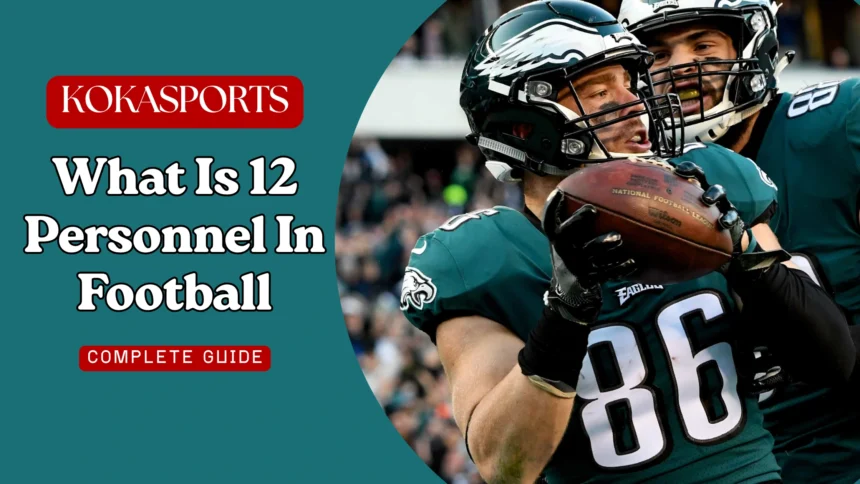
12 personnel football is an offensive grouping with 1 running back, 2 tight ends and 2 wide receivers, one of the most flexible packages an offense can use.
Have you ever watched a game and heard announcers talk about “12 personnel” or “11 personnel” without really knowing what they mean? You’re not alone. Personnel groupings work like a secret decoder ring for the strategy behind every play. The numbers aren’t random: they tell you what the offense is trying to do and how the defense should respond.
Along with the quarterback and five offensive linemen, 12 personnel puts two tight ends on the field instead of a third receiver. That simple swap creates a world of possibilities and makes the offense much harder for defenses to prepare for.
By the end of this guide, you’ll fully understand 12 personnel in football and how it compares to other popular personnel groupings like 11 personnel, 21 personnel, 10 personnel, 13 personnel, and 22 personnel. More importantly, you’ll see why coaches choose different personnel groups and how 12 personnel impacts the game at every level, from college football to the NFL.
What Is 12 Personnel in Football?
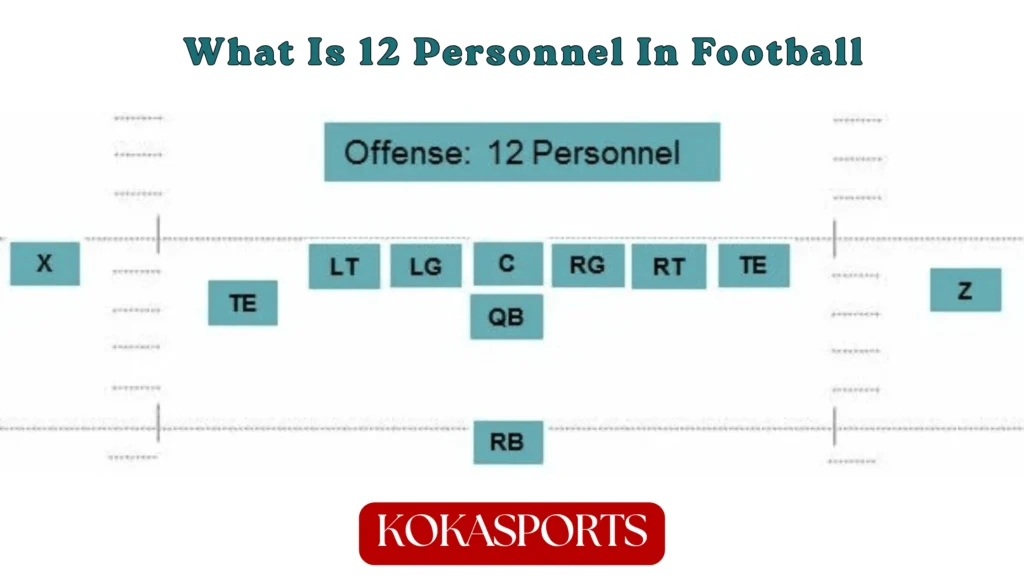
12 personnel is an offensive personnel grouping that puts 1 running back and 2 tight ends on the field, along with 2 receivers. The numbering system is straightforward once you understand the pattern: the first digit represents the number of running backs, and the second digit shows how many tight ends are on the field. So “12” tells us there’s one running back and two tight ends in the game.
This personnel group matters tremendously because it forces both the offense and defense to make critical decisions before the ball is even snapped. When defenses see tight ends on the field, they have to prepare for multiple possibilities – will this be a heavy run game attack, a play-action pass, or something completely different?
The beauty of 12 personnel football lies in its versatility. Unlike some formations that clearly telegraph run or pass, this personnel package keeps defensive coordinators guessing. Teams like the Buffalo Bills and Detroit Lions have used this grouping to create mismatches that put tremendous pressure on opposing defenses to make the right call.
Read Also: What is 10 Personnel in Football? (Complete Guide for 2025 NFL Season)
Personnel Groupings in Football
Before diving deeper into 12 personnel, it’s essential to understand how offensive personnel groupings work in modern football. Think of personnel groups as the foundation that everything else builds upon. The offense starts by choosing how many running backs and tight ends to put on the field, and this decision ripples through every aspect of the play.
Personnel groupings in football serve multiple purposes. First, they help coaches create specific matchups they want to exploit. Second, they allow the offense to disguise their intentions – keeping the defense unsure whether a run or pass is coming. Third, they determine how many blockers versus receivers will be available for any given play.
The standard offensive formation always includes the quarterback and five offensive linemen, so the remaining five positions can be filled with different combinations of running backs, tight ends, and receivers. This is where the strategy gets interesting, because each combination creates different strengths and weaknesses that both sides must account for.
Modern NFL offenses typically rotate between several different personnel groups during a game, with 11 personnel (1 running back, 1 tight end, 3 receivers) being the most common in today’s pass-heavy league. However, smart offensive schemes mix in other groupings like 12 personnel to keep defenses off balance and create favorable matchups.
How 12 Personnel Football Works
When an offense decides to use 12 personnel, they’re putting a very specific set of players on the field that creates unique opportunities and challenges. Let’s break down exactly what this looks like and why it matters.
The 12 personnel package consists of:
- 1 running back positioned in the backfield
- 2 tight ends who can line up in various positions
- 2 receivers (usually wide receivers)
- 1 quarterback
- 5 offensive linemen on the line of scrimmage
What makes this grouping special is the flexibility of those two tight ends. Unlike a fullback or additional running back, tight ends can serve as both blockers and pass-catching threats. This dual capability is what makes 12 personnel so challenging for defenses to prepare for.
The positioning of these players can vary significantly. One tight end might line up next to the offensive line in a traditional blocking position, while the other could split out wide like a receiver. Or both tight ends could stack on one side of the formation to create a powerful run game attack. The possibilities are nearly endless, which is exactly what makes this personnel group so valuable.
Why Offenses Use 12 Personnel
The primary reason teams choose 12 personnel is versatility. This grouping gives offensive coordinators the ability to run and pass effectively from the same formation, making it nearly impossible for the defense to predict what’s coming next.
From a running perspective, having 2 tight ends on the field provides excellent blocking support. Teams can create powerful gap schemes, outside zone plays, or even pull one of the tight ends to lead block on sweep plays. The threat of running the football becomes very real when there are extra blockers available.
But here’s where 12 personnel gets really interesting – it’s equally effective in the pass game. Play-action passes work exceptionally well because the defense has to respect the run fake when they see multiple tight ends on the field. Additionally, tight ends can create mismatches against linebackers in coverage or find soft spots in zone schemes.
Teams like the New England Patriots under coaches who understood how to maximize tight end talent have shown just how devastating this personnel group can be. When you have athletic tight ends who can both block and catch, 12 personnel becomes a nightmare for defensive coaches to game plan against.
Strengths and Weaknesses of 12 Personnel
Like any offensive formation, 12 personnel comes with both advantages and limitations that coaches must carefully consider.
Strengths:
- Flexibility to run or pass from the same look
- Multiple tight end sets provide excellent blocking for running the football
- Play-action opportunities are enhanced
- Creates linebacker coverage mismatches
- Can disguise intentions until after the snap
- Provides safety outlets for the quarterback in the passing game
Weaknesses:
- Limits receivers on the field compared to spread formations
- Requires talented tight ends who can both block and catch
- May struggle against teams that can cover tight ends effectively
- Less explosive passing potential than 11 personnel or 10 personnel
- Can become predictable if overused
The key for offensive coordinators is finding the right balance. Modern 12 personnel works best when teams have tight ends who are genuine dual threats: players who can stretch the field vertically on one snap and seal the edge as a blocker on the next.
12 Personnel Formations
The same five skill players can line up in very different ways. Where the two tight ends stand decides whether the formation looks like a power run set or a spread passing set.
- Ace (two tight ends inline): one tight end attached on each side of the line, with two wide receivers outside. Balanced and hard to predict.
- Inline and move tight end: one tight end attached as a blocker, while the second acts as a “move” tight end or H-back who can shift, motion or split out.
- Deuce: the second tight end lines up as an H-back just off the line behind the weak-side tackle, adding a lead blocker without telegraphing the run.
- Two tight ends to one side: both tight ends on the same side to overload the edge and create a strong run lane.
- Spread 2×2: one tight end flexed into the slot or out wide, so the formation looks like 11 personnel while keeping a bigger blocker on the field.
Eight Gaps and Four Vertical Threats
The run game arithmetic here is genuinely compelling. With two tight ends extending the line of scrimmage on either side, an offense operating out of 12 personnel presents eight total gaps the defense must account for. That’s a serious assignment problem for any front. Football gaps, the spaces between and outside offensive linemen, multiply when tight ends attach to the formation, and a defense trying to plug all eight while respecting the passing game is being asked to do two contradictory things simultaneously.
On top of that, the offense still has four players who can run vertical routes: two tight ends and two wide receivers.
Some coaching analysts have argued that 12 personnel might be the single hardest grouping to defend in football, pointing to exactly that combination: eight immediate gaps and four vertical threats. That’s a coaching opinion, not a statistical law, but it captures something real about the structural pressure this grouping creates. Defenses often respond with Cover 3 and an extra safety walked down near the line of scrimmage, trying to add a run-force body without fully surrendering coverage depth. The problem is that move gives the offense a predictable alignment to read, especially against even defensive fronts where gap assignments become schematically transparent.
How Defenses Respond to 12 Personnel
When defensive coaches see 12 personnel on the field, they face a challenging decision about how to align their players. The defense must account for both run game and pass game possibilities, which often means making compromises that the offense can exploit.
The most common personnel response is for defenses to bring in an extra linebacker or safety to match the additional tight end. This might mean going from a base defense with four defensive backs to a formation with five or six defenders closer to the line of scrimmage.
However, this creates its own set of problems. If the defense brings in too many run stoppers, they become vulnerable to pass-catching tight end routes over the middle. If they stay in a lighter personnel group to defend the pass, the offense can attack with power running schemes that the defense isn’t equipped to handle.
Smart defensive coordinators try to counter 12 personnel by using versatile players who can handle multiple responsibilities. A safety who can come down and play like a linebacker against the run, then cover tight ends in the passing game, becomes incredibly valuable in these situations.
Pre-snap motion makes the problem harder. When a tight end shifts from one side to the other, or motions out into the slot, the defense has to declare its strength and rotate its safeties before the snap. That tells the quarterback what coverage is coming and whether to keep the run or check to a pass.
Comparing 12 Personnel to Other Personnel Groupings in Football
To truly understand the value of 12 personnel, it’s helpful to compare it with other offensive personnel groupings that teams commonly use.
11 Personnel (1 RB, 1 TE, 3 WR) is the most popular in today’s NFL. This grouping prioritizes the passing game by putting three wide receivers on the field, making it the foundation of most spread offense concepts. While it’s more explosive than 12 personnel in the passing game, it offers less flexibility and fewer blocking options for running plays.
21 Personnel (2 RB, 1 TE, 2 WR) represents a more traditional, run-heavy approach. Having 2 running backs on the field clearly signals ground game intentions, though play-action passes can still be effective. This is heavier personnel than 12 personnel but offers less versatility.
10 Personnel (1 RB, 0 TE, 4 WR) is pure spread offense. Four receivers on the field creates maximum passing options but provides minimal help for the run game. This formation is almost the opposite philosophy of 12 personnel.
13 Personnel (1 RB, 3 TE, 1 WR) goes even heavier than 12 personnel with three tight ends on the field. This is primarily used in short-yardage and goal-line situations where running the ball is the clear priority.
22 Personnel (2 RB, 2 TE, 1 WR) represents the heaviest common personnel grouping, often used for power running situations or when teams need to run the ball in obvious running downs.
For a full list of every grouping, from 10 to 23 personnel, see our guide to football personnel groupings explained.
How 12 Personnel Fits into Offensive Schemes
The brilliance of 12 personnel lies in how it fits into comprehensive offensive schemes. Coaches like Ben Johnson, who built the Detroit Lions’ offense before becoming head coach of the Chicago Bears, have shown how this personnel group can be the foundation of a balanced attack that keeps defenses guessing.
In play-action schemes, 12 personnel is particularly effective because the extra tight end sells the run fake while also providing protection for the quarterback. The defense has to respect the threat of running when they see multiple blockers, which often leaves tight ends or receivers in favorable matchups downfield.
For teams that want to establish run the ball as their identity, 12 personnel provides the blocking power needed to control the line of scrimmage while still maintaining enough receiving threats to prevent the defense from stacking the box completely.
The second most common way teams use this grouping is in red zone situations, where the shorter field makes the tight end routes more effective and the extra blocking helps in power running situations near the goal line.
Counter 12 Personnel – Defensive Adjustments
Stopping 12 personnel requires defensive coordinators to make smart personnel as well as schematic adjustments. The most effective approaches typically involve using versatile defenders who can handle multiple responsibilities.
Many NFL teams will bring in a safety or hybrid linebacker who can play close to the line of scrimmage against run plays but also cover tight ends in man coverage. This type of player allows the defense to match the offense‘s flexibility without making major compromises.
Another common approach is to use defensive backs who are comfortable playing closer to the box. Teams might keep their regular secondary on the field but ask a safety to rotate down and play more like a linebacker when they see 12 personnel.
The key for any defensive approach is maintaining discipline and not overreacting to what the offense shows pre-snap. 12 personnel works best when it can force the defense into making quick decisions that create mismatches.
The Future of 12 Personnel in Football
The evolution of 12 personnel continues as the tight end position becomes more athletic and versatile. Modern tight ends who can run like receivers but block like offensive linemen make this personnel group more dangerous than ever before.
NFL offenses are increasingly looking for ways to create mismatches and unpredictability, and 12 personnel fits perfectly into this trend. Teams that can find and develop dual-threat tight ends gain a significant advantage in their ability to use 12 personnel effectively.
The Patriots dynasty showed how dominant this grouping could be when executed properly, and teams like the Detroit Lions are continuing to innovate within this framework. As offensive football continues to evolve, expect to see more creative ways to utilize multiple personnel groupings, with 12 personnel remaining a crucial part of the equation.
Looking ahead, the teams that can best combine 12 personnel with the more common 11 personnel will have significant advantages in their ability to keep defenses off balance and create favorable matchups throughout the game.
Conclusion
12 personnel in football is essential for appreciating the strategic elements of the game. This formation provides the perfect balance between run game power and pass game flexibility.
The key differences between 12 personnel and other groupings like 11 personnel and 21 personnel come down to versatility. While 12 personnel might not have the pure passing explosiveness of spread formations or the run-heavy power of 22 personnel, its flexibility makes it invaluable.
Football 101 teaches us that the best offenses create uncertainty for the defense. 12 personnel does exactly that, and recognizing 12 personnel might be the key to predicting what happens next and why coaches make the decisions they do.
FAQs
What is 12 personnel football?
12 personnel football is an offensive grouping with 1 running back, 2 tight ends and 2 wide receivers. It is one of the most balanced packages in football because it can run or pass equally well.
Is 12 personnel a run or pass formation?
Both. The two tight ends give extra blocking for the run, but they can also run routes, so defenses cannot easily tell what is coming. That makes 12 personnel especially good for play-action passes.
What formations can you run from 12 personnel?
Common 12 personnel formations include Ace (a tight end on each side), Deuce (one tight end inline and one as an H-back), two tight ends to one side, and spread 2×2 looks with a tight end flexed into the slot.
What does 12 personnel mean in football?
12 personnelmeans 1 running back and 2 tight ends on the field, along with 2 receivers and 5 offensive linemen.
How many receivers are in 12 personnel?
There are 2 receivers in 12 personnel.
What is the difference between 11 personnel and 12 personnel?
11 personnel uses 1 tight end and 3 wide receivers, which spreads the field for passing. 12 personnel swaps one receiver for a second tight end, making it more balanced, with extra blocking for the run while still keeping four players who can catch passes.
Why is it called 12 personnel in football?
The first number (1) represents running backs, the second number (2) represents tight ends. So “12” = 1 running back + 2 tight ends.