
If you have watched college football or an NFL broadcast and heard a coach shout “line up in a 4i,” you may have wondered what that number and that little letter actually mean. This complete guide to 4i technique football breaks it down in plain language, with every detail checked against trusted coaching sources.
Where does the player stand? What is his job? And why has this one alignment become one of the most talked about tools in modern defense? If you want to watch these fronts live this week, you can find the full schedule on our live NFL on TV page.
What Is a 4i Technique in Football?
A 4i technique is a defensive line alignment where the player lines up on the inside shoulder of the offensive tackle. The number 4 points to the tackle, and the small “i” stands for “inside,” meaning the defender shades toward the ball rather than away from it.
Think of the tackle as having three spots a defender can take: the inside shoulder (4i), head up (4), and the outside shoulder (5). The 4i is the tightest of the three, which is exactly why it causes offenses so much trouble.
The Defensive Line Numbering System (Where the 4i Fits)
Defensive techniques are numbered alignments that tell a player where to stand relative to a blocker. The count starts head up over the center and works outward in both directions. Even numbers sit head up on a blocker, odd numbers sit on an outside shoulder, and an even number with an “i” sits on an inside shoulder.
Here is the quick version:
- 0: head up on the center
- 1: outside shoulder of the center
- 2i: inside shoulder of the guard
- 2: head up on the guard
- 3: outside shoulder of the guard
- 4i: inside shoulder of the tackle
- 4: head up on the tackle
- 5: outside shoulder of the tackle
- 7: inside shoulder of the tight end (the famous exception)
- 9: outside of the tight end
One honest note that thinner articles skip: this system is not universal. The numbering is usually credited to Bear Bryant, who standardized it so that alignment and job could be called with a single number, but coaches still use small variations from team to team. The 7 technique is the best known oddity, since many staffs refuse to call a head up tight end alignment a 6. You can read our full breakdown of that spot in the 7 technique guide.
Gaps: How the 4i Relates to the B Gap
Gaps are the spaces between offensive linemen, and defenses label them with letters. The A gap sits between the center and guard, the B gap between the guard and tackle, the C gap off the tackle, and the D gap outside the tight end.
In most run fits the 4i is responsible for the B gap. Because he is already pressed to the inside shoulder of the tackle, he is sitting right on top of that space before the ball is even snapped. That head start is a big part of why the alignment works.
The Tite Front: The Home of the Double 4i
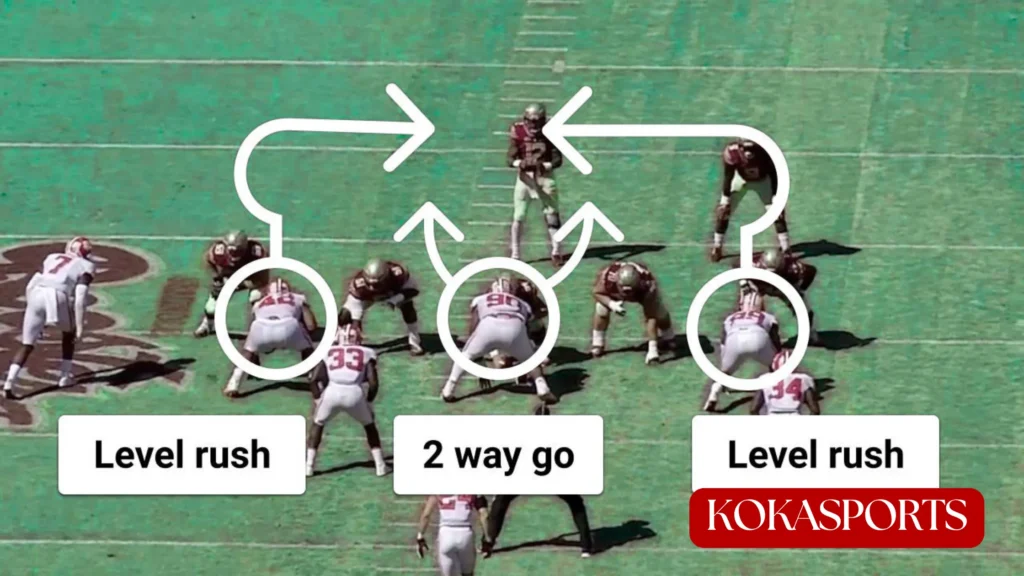
The 4i became famous because of the Tite front, also called the 4-0-4 or Mint front. It uses three down linemen: a nose tackle head up in a 0 technique and two defensive ends in 4i techniques on either side of him.
The idea is simple. With two 4i players and a nose clogging the middle, the defense caps the interior gaps using the fewest bodies possible. That forces runs to bounce outside, where faster linebackers and safeties are waiting. It also keeps blockers off the inside linebackers so they can run free to the ball.
Why Coaches Use It
The Tite front is widely credited to Dave Aranda, who leaned on it as a coordinator before it spread to nearly every level of the game. Its biggest strength is flexibility. A defense can show the same three down look and still rush three, four, or five, which keeps quarterbacks guessing. For a wider look at how fronts are chosen, see our guide to youth football defensive formations.
4i vs 3 Technique: Why the Inside Shade Troubles Offenses
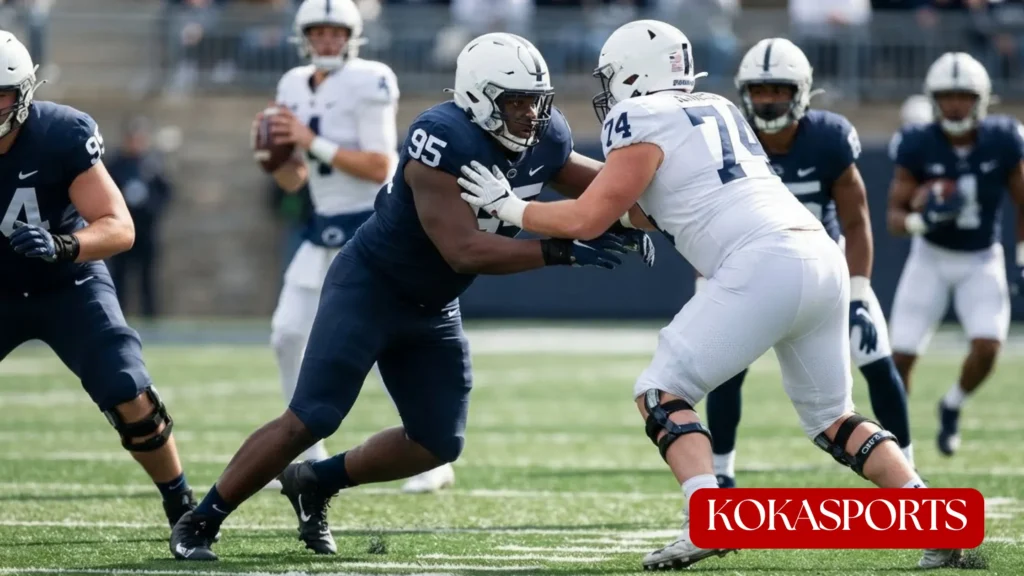
Here is the heart of it. A 3 technique sits on the outside shoulder of the guard, which gives the guard a clean angle to base block him. A 4i flips that math. By sitting on the inside shoulder of the tackle, the defender puts the tackle on an island and takes away easy down blocks and double team angles.
When a play goes away from the 4i, he is already closer to the cutback lane than an outside shade would be, and his hands are into the tackle’s chest fighting any attempt to wash him down the line. That squeezes the life out of cutbacks and lets linebackers scrape fast and hit the hole clean.
How to Play the 4i Technique
Run Fits
Against the run, the 4i strikes the inside hip and chest plate of the tackle and holds his ground in the B gap. His read is the near hip of the next inside lineman, and he fights pressure rather than running around blocks. Length, size, and strength matter here, since he grapples with tackles every snap. Clean hand work is built in practice, and our defensive tackle drills cover the exact techniques that help.
Pass Rushing From a 4i
Rushing the passer from a 4i is hard because the blocker already has outside leverage. Pure speed will not win, so players lean on counter moves. One common approach is to threaten the inside gap, then club back outside toward the quarterback. Another is to attack the outside gap first to widen the blocker, then work back across his face. The goal is always a balanced rush that keeps the quarterback trapped inside the pocket.
Strengths and Weaknesses of the 4i
The strengths are clear. The 4i clogs interior gaps, keeps linebackers clean, and wrecks inside zone and gap schemes that want to hit between the tackles.
The weaknesses are just as real. Generating a pass rush with so few linemen is hard, the front can be stressed by outside zone and mobile quarterbacks, and offenses can answer by adding a tight end to create an extra gap. That is why tight end heavy looks matter so much, and you can see how offenses build them in our guide to 12 personnel football.
How the 4i Compares to Other Techniques
The 4i is one piece of a larger alignment family. The 1 technique anchors the interior as a nose, the 7 technique owns the C gap off the tight end, and the 9 technique is the wide pass rush spot off the edge. Learning how each one shades a blocker makes every broadcast and every coaches film clip much easier to read.
Frequently Asked Questions About 4i Technique Football
What is a 4i technique in football?
A 4i technique is a defensive lineman who lines up on the inside shoulder of the offensive tackle. The 4 refers to the tackle and the “i” means inside, so the player shades toward the ball.
What does the “i” mean in 4i?
The “i” stands for inside. It tells the defender to align on the inside shoulder of the blocker rather than head up or on the outside shoulder.
What gap does a 4i play?
In most run fits the 4i is responsible for the B gap, the space between the guard and the tackle. He is pressed to that gap before the snap, which gives him a head start.
What is the difference between a 4i and a 3 technique?
A 3 technique sits on the outside shoulder of the guard, while a 4i sits on the inside shoulder of the tackle. The 4i puts the tackle on an island and takes away the easy down block and double team angles that a 3 technique allows.
What front uses the 4i technique?
The Tite front, also called the 4-0-4 or Mint front, is built around two 4i ends and a nose tackle in a 0 technique. It clogs the interior and forces runs to bounce outside.
Is a 4i a defensive end or a defensive tackle?
It can be either, depending on the scheme. In the three down Tite front the two 4i players are usually listed as defensive ends, even though they align inside like interior linemen.
Who made the 4i and the Tite front popular?
The Tite front is widely credited to Dave Aranda, who leaned on it as a defensive coordinator before it spread across college football and into the NFL.
Conclusion
The 4i technique looks like a tiny detail, just a half step on the inside shoulder of the tackle, but that half step changes the whole math of a defense. It puts tackles on islands, keeps linebackers free, and pushes modern spread offenses outside into the waiting arms of the defense. Once you can spot a 4i and picture the Tite front around it, you will see why coaches at every level keep coming back to it.
For deeper technical breakdowns, two trusted outside resources are Pro Football Focus on defensive line techniques and USA Football on the Tite front.