

If you are coaching youth football this season, here is some good news: a solid defense will win you more games than any trick play ever will. At the younger ages, most teams run the ball nearly every down, and the team that lines up right, stays in its gaps, and tackles well usually comes out on top.
It all starts with the youth football defensive formations you choose, and there is no single magic defense that fits every team. The right one depends on the kids you have, how old they are, and the offenses you face each week, so let us make sense of the numbers and find the one that fits your group.
What Is a Defensive Formation in Youth Football?
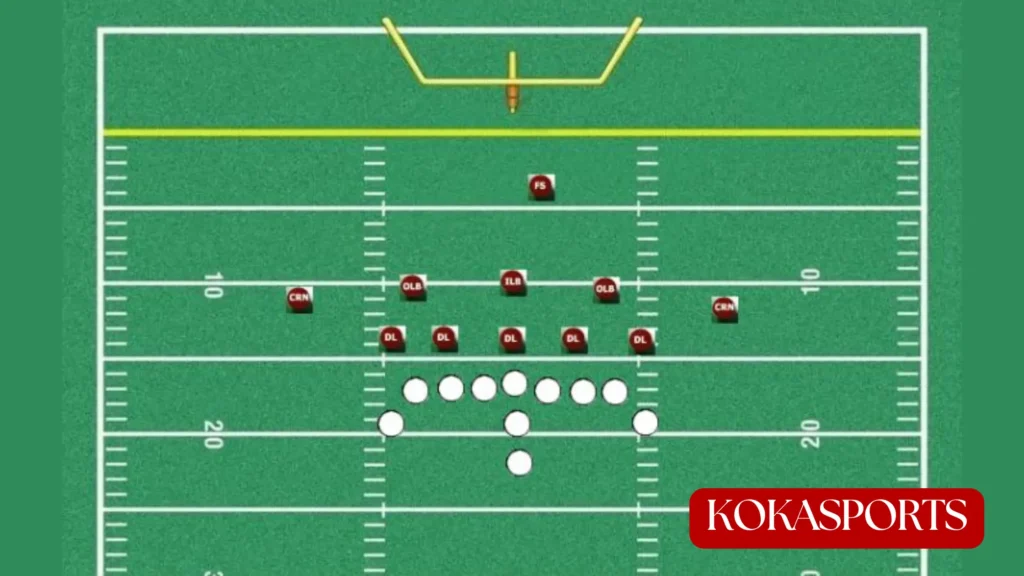
A defensive formation is just how your eleven defenders line up before the snap. It decides who attacks the line, who reads the play and flows to the ball, and who drops back to cover the pass. That is it. Do not overthink it.
The names come straight from the numbers. The first number is how many defensive linemen are on the line. The second number is how many linebackers sit behind them. When you see a third number, that is your defensive backs. So a 6-2 is six linemen and two linebackers, and a 4-2-5 is four linemen, two linebackers, and five defensive backs. If you want to see how fronts and coverages fit together across the whole game, our complete guide to football formations lays out the full picture.
Here is the simple rule to carry with you: more players up front means more muscle against the run, and more players in the back means more speed and coverage against the pass.
How to Choose the Right Formation for Your Team
Before you pick a scheme off the internet, take an honest look at the kids in front of you. The best youth defense is the one your players can actually run, not the fanciest one on the whiteboard. And remember, player safety always comes first. Teach good tackling and proper alignment before you add a single wrinkle.
Start with your roster. Got a few bigger, stronger kids who love to get after it? A run-stuffing front like the 6-2 or 5-3 turns them loose. Smaller but quicker group? Give that speed room to run with more linebackers and defensive backs.
Think about their age and skill. The younger your players, the simpler you keep it. Fronts where each kid has one clear gap to defend are so much easier to coach than schemes full of reads and movement.
Look at your schedule. If most of the teams you face just line up and pound it at you, load the box and dare them to throw. If a couple of teams like to spread you out or air it out, keep a lighter, faster look in your back pocket for those weeks.
The Best Youth Football Defensive Formations
Here are the formations that hold up with young players, what each one does well, and the kind of team it fits best.
6-2 Defense
Six linemen, two linebackers, three defensive backs. The 6-2 is the old reliable of the youngest levels. It packs the line of scrimmage so tightly that a young offensive line simply cannot open holes. If the teams you face run it almost every down and rarely throw, this front will frustrate them all game long.
Best for: the youngest age groups and run-heavy leagues. Just know its soft spots are the pass and the edge, so you may grow out of it as kids get older.
5-3 Defense
Five linemen, three linebackers, three defensive backs. The 5-3 is a favorite for a reason. It gives you power and pursuit in one package. Five up front hold the run, and three linebackers fly sideline to sideline to clean up whatever sneaks through.
Best for: coaches who want a tough, flexible run defense that can still chase. It is a dependable go-to through the middle youth ages.
4-4 Defense
Four linemen, four linebackers, three defensive backs. Run as a 4-4 stack with the linebackers tucked behind the line, this one puts eight in the box with a little more team speed than the heavier fronts. It is stingy against the run and a blast to blitz from, since any of those four linebackers can come flying.
Best for: teams blessed with linebackers who can run and tackle in space.
5-2 Defense
Five linemen, two linebackers, four defensive backs. The 5-2 is the sturdy, no-fuss middle ground. The nose sits over the center, the gap assignments are easy to teach, and that extra defensive back gives you a bit more pass help than a 6-2 or 5-3.
Best for: coaches who want a run-first front with clean, simple responsibilities every kid can remember.
4-2-5 Defense
Four linemen, two linebackers, five defensive backs. This is your answer when an offense spreads you out and starts throwing. Five defensive backs give you the speed and coverage to handle it, while four linemen still get after the quarterback. For how your front turns that into pressure, our step-by-step pass rush moves guide breaks it down.
Best for: older, more athletic teams that see passing or spread offenses.
3-3 Stack Defense
Three linemen, three linebackers, five defensive backs, with the linebackers stacked right behind the line. The stack hides where your pressure is coming from and lets athletic kids attack any gap. It is a fun, multiple look, but it does ask a little more of your players.
Best for: experienced, athletic teams that can handle a few more moving parts.
Man vs Zone Coverage at the Youth Level
Your front handles the run, but your coverage decides what happens when the ball goes up. There are two basic ways to go, and with young players you want to keep it simple.
In man coverage, each defender picks up one receiver and sticks with him. It is aggressive and easy to explain, though it can fall apart if a kid loses his man. In zone coverage, each defender guards a patch of the field instead of a person, which helps young players keep the play in front of them and cuts down on big plays. For most youth teams, a simple zone is the smart base, with a little man sprinkled in as the kids mature.
Coaching Tips That Make Any Defense Work
The formation is only the starting point. What really turns a diagram into a defense is how you teach it. Keep it simple so your players can cut it loose and play fast instead of standing around thinking. Drill tackling and pursuit at every practice, because eleven kids running to the ball will beat a fancy scheme every time. Give each defender one clear job on every play. And build your install into a routine you repeat.
If you need a framework to fit it all into, grab a football practice plan template and build your defensive period around it. It also pays to know the offensive line positions your defense is lining up against, since those are the kids your front has to beat. And if you want another voice on building a defense from scratch at this level, Hudl’s guide to building a youth defense is worth a read.
Most of all, keep it fun and keep them safe. That is why you are out there.
Frequently Asked Questions
What is the best defensive formation for youth football?
For the youngest, run-heavy levels, the 6-2 is tough to beat. As your team gets older and starts facing the pass, the 5-3 and 4-4 give you the best balance.
What do the numbers in a defensive formation mean?
The first number is your defensive linemen, the second is your linebackers, and a third number, when there is one, is your defensive backs. A 5-3 is five linemen and three linebackers.
What is the easiest defense to teach young players?
The 6-2 and 5-2 are the simplest, since they load the line and hand each kid one clear gap to defend.
How do you defend the pass in youth football?
Go with a lighter front like the 4-2-5 that puts more defensive backs on the field, and play a simple zone so your young defenders keep the ball in front of them.
Should youth teams play man or zone coverage?
Start most youth teams in a simple zone, because it limits big plays, and add in man coverage as the kids develop.
Conclusion
The best youth football defensive formation is the one that fits your kids and is simple enough for them to play fast. Match your front to your roster and your schedule, keep every job clear, and drill tackling and pursuit until it is second nature. Do that, and whatever formation you pick will give your team a defense to be proud of, and give you a whole lot more Saturdays worth smiling about.