
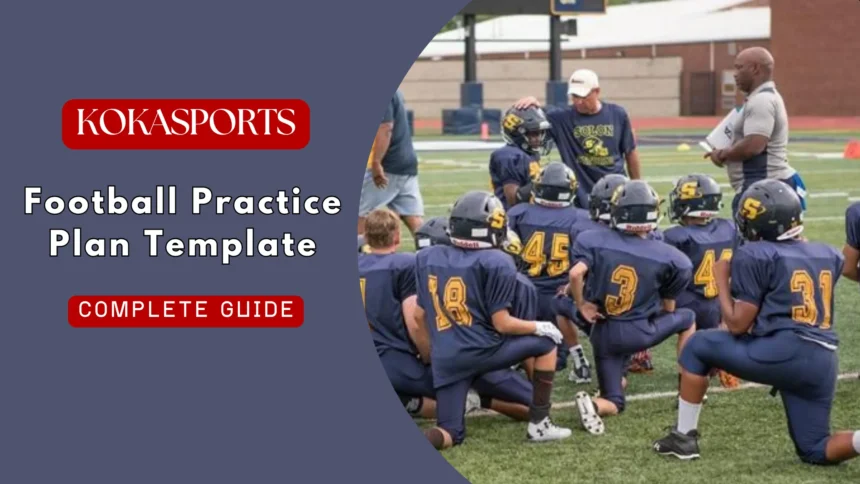
You have anywhere from 20 to 80 players, several position groups, three separate units that all need field time, and a staff where each coach runs a different station. Without a written schedule, half your roster stands around while the other half works. A football practice plan template fixes that. It splits your session into timed blocks for warm-up, individual technique, position groups, team offense, team defense, special teams, and conditioning, so every coach and every player knows exactly where to be and when to move.
This page gives you ready-to-run schedules for 60-minute, 90-minute, and 2-hour sessions, age-group guidelines drawn from official USA Football standards, a position-by-position drill reference, and the safety rules that actually matter in the United States, including contact limits and heat acclimatization. Everything here that touches player safety is sourced from governing bodies, not opinion, so you can build your season on it with confidence.
What a Football Practice Plan Template Is
A football practice plan template is a simple document that breaks a single session into numbered, timed segments. Each row lists the segment, the clock window, the number of minutes, and the drills or focus for that block. You fill it in before you step on the field, hand copies to your assistants, and post one on the sideline board.
The value is not the paper. It is the discipline the paper forces. When every minute is assigned, you stop losing two or three minutes between drills while someone decides what comes next. You cover all three phases of the game instead of running out of time before special teams. And you give your assistants a plan they can run without waiting on you.
A good template has four parts: a header for the date, team, and focus; a column for timed segments; a column for the drills in each segment; and space for notes. That is it. The rest of this guide shows you how to fill those blocks for your level.
How to Structure a Football Practice
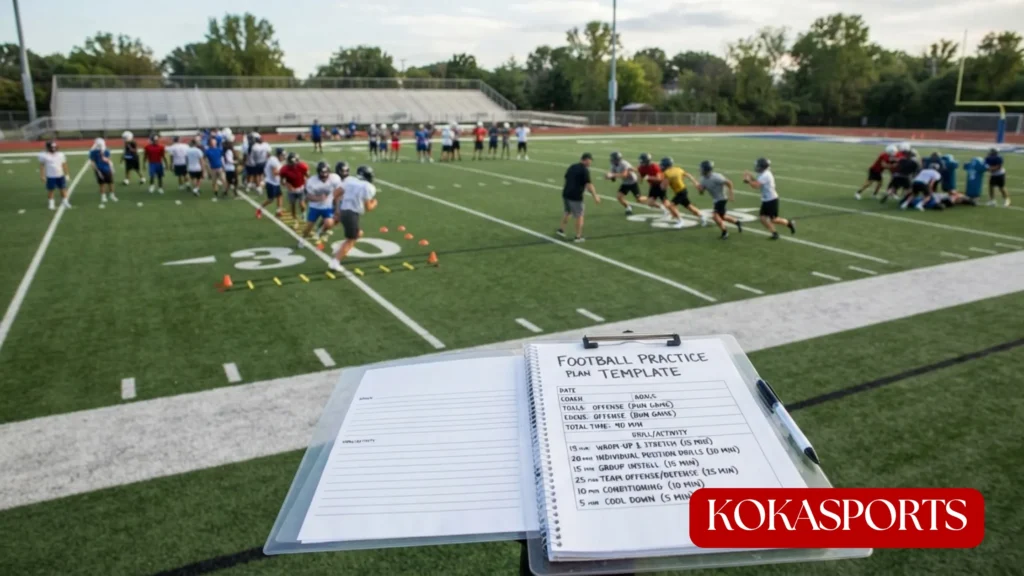
Football is different from most sports because you coach three distinct units and many position groups at once. The way you keep all of them busy is by running practice in periods. There are three types, and nearly every good plan moves through them in order.
Individual Period (Indy)
Indy time is when players work with their position coach on the fundamentals of their role. Linemen drill stance and hand placement, quarterbacks and receivers work footwork and releases, defensive backs backpedal and break. These are short, focused blocks, usually five to twelve minutes, and they are the foundation everything else is built on. Keep groups small so every player gets reps instead of standing in line.
Group Period
Group periods bring two or three positions together to work on the parts of the game where they rely on each other. Quarterbacks, running backs, receivers, and tight ends run routes on air. The offensive line works pass protection against the defensive line. This is where the timing and communication built in indy time start to connect.
Team Period
Team periods put all eleven players on each side together. This is the closest you get to a real game without playing one. You run your offense against a scout defense, your defense against a scout offense, and your first units against each other in situations like third and long, red zone, and goal line. Team periods teach players to adjust on the fly, which is the hardest thing to coach and the easiest to skip.
A simple way to remember the flow: teach it in indy, connect it in group, and test it in team.
Blank Football Practice Plan Template
Use this structure as your starting point for any level. Set your own clock times based on how long your session runs, then type your drills into each row.
| # | Segment | Time | Min | Drills / Notes |
|---|---|---|---|---|
| 1 | Dynamic Warm-Up | |||
| 2 | Individual Technique (Indy) | |||
| 3 | Position Groups | |||
| 4 | Team Offense | |||
| 5 | Team Defense | |||
| 6 | Special Teams | |||
| 7 | Team Period / Situations | |||
| 8 | Conditioning and Cool-Down |
Header fields to fill in at the top: Date, Team, Head Coach, and Focus for the Day. That last one matters. Picking one clear focus, such as short-yardage offense or tackling fundamentals, keeps the whole staff pulling in the same direction.
60-Minute Football Practice Plan
Most templates online jump straight to 90 minutes, but the youngest age groups and many early-season or midweek sessions run an hour or less. Here is a full 60-minute plan that still touches every phase of the game.
| # | Segment | Time | Min | Focus |
|---|---|---|---|---|
| 1 | Dynamic Warm-Up | 0:00 – 0:08 | 8 | Jog, high knees, hip openers, lateral shuffle |
| 2 | Individual Technique | 0:08 – 0:20 | 12 | Stance and start, ball security, footwork by position |
| 3 | Group Work | 0:20 – 0:32 | 12 | Blocking fits, QB to WR timing, run fits |
| 4 | Team Offense | 0:32 – 0:42 | 10 | Install or review 3 to 4 core plays |
| 5 | Team Defense | 0:42 – 0:50 | 8 | Alignment and run fits vs. scout look |
| 6 | Team Period | 0:50 – 0:57 | 7 | Live or thud team reps, coach on corrections |
| 7 | Conditioning and Cool-Down | 0:57 – 1:00 | 3 | Short sprints, stretch, recap the focus |
Keep transitions tight. In a 60-minute window, two minutes lost between every block is almost a full segment gone. Script your plays the night before so there is no thinking on the field.
90-Minute Football Practice Plan
Ninety minutes is the standard for most youth tackle programs and many middle school teams. This plan covers all three phases while keeping each block short enough to hold attention.
| # | Segment | Time | Min | Focus |
|---|---|---|---|---|
| 1 | Dynamic Warm-Up | 0:00 – 0:10 | 10 | Jog, dynamic stretch, agility, sprint bursts |
| 2 | Individual Technique | 0:10 – 0:22 | 12 | Stance, hand placement, footwork, ball security |
| 3 | Position Groups | 0:22 – 0:35 | 13 | Line combos, QB to WR routes, LB reads, DB break |
| 4 | Team Offense | 0:35 – 0:48 | 13 | Install or review run and pass plays vs. scout |
| 5 | Team Defense | 0:48 – 1:00 | 12 | Alignment checks, run fits, coverage rotations |
| 6 | Special Teams | 1:00 – 1:08 | 8 | Kickoff, punt, or PAT and field goal (rotate weekly) |
| 7 | Team Period | 1:08 – 1:22 | 14 | Live or thud reps, stop for corrections, restart |
| 8 | Conditioning and Cool-Down | 1:22 – 1:30 | 8 | Position sprints, static stretch, recap |
To get the most from 90 minutes, split your position groups so linemen and skill players work at the same time with different coaches. Two groups and two coaches means double the reps. Rotate your special teams focus by day of the week so you cover kickoff, punt, and field goal across the week instead of cramming all three into one session.
2-Hour Football Practice Plan
Two hours is the standard for most high school programs. The extra half hour over the 90-minute plan goes toward a film or walk-through segment, longer team periods, and a dedicated situational block.
| # | Segment | Time | Min | Focus |
|---|---|---|---|---|
| 1 | Walk-Through / Film | 0:00 – 0:10 | 10 | Corrections from last game, no pads, alignment only |
| 2 | Dynamic Warm-Up | 0:10 – 0:20 | 10 | Jog, dynamic stretch, agility ladder |
| 3 | Individual Technique | 0:20 – 0:35 | 15 | Position coaches run technique drills |
| 4 | Position Groups / Combos | 0:35 – 0:50 | 15 | Line vs. line, QB and RB mesh, WR vs. DB |
| 5 | Team Offense | 0:50 – 1:08 | 18 | Game-plan install, down and distance, red zone |
| 6 | Team Defense | 1:08 – 1:24 | 16 | Base, nickel, blitz looks vs. scout offense |
| 7 | Special Teams | 1:24 – 1:34 | 10 | Return, protection, and kick units (rotate focus) |
| 8 | Team Period / Situations | 1:34 – 1:52 | 18 | Two-minute drill, short yardage, backed up |
| 9 | Conditioning | 1:52 – 1:58 | 6 | Gassers or tempo conditioning |
| 10 | Cool-Down and Review | 1:58 – 2:00 | 2 | Stretch, review focus, preview tomorrow |
Assign one coach or assistant to be the clock manager. Their only job is to sound the horn when each period ends. Without that, individual blocks run long and the team period gets cut short. Front-load your technical work while players are fresh, and save conditioning for the end.
Youth Football Practice Plan by Age Group
A seven-year-old in flag and a high school junior in full pads need completely different sessions. The practice lengths below come from the USA Football American Development Model, which sets official frequency and duration standards by age. The skill focus and coaching notes are general best practice.
| Age Group | Practices / Week | Length | Skill Focus | Key Principle |
|---|---|---|---|---|
| Under 6 | 1 to 2 days | 45 to 60 min | Movement, catching, flag pulling | Games first, one skill per station |
| Under 8 | 2 days | 60 to 75 min | Stance, handoff, blocking form | Teach one skill at a time, rotate often |
| Under 10 | 2 days | 60 to 90 min | Blocking, tackling form, basic routes | Keep the playbook small |
| Under 12 | 2 to 3 days | 75 to 90 min | Pass protection, coverage, QB reads | Add simple decisions |
| Under 14 | 3 days | 75 to 90 min | Combo blocks, zone coverage, situations | Practice specific game situations |
These numbers are maximums for a reason. One of the most common coaching errors is running practice too long, which leads to lost focus. The goal is not to fill the time. It is to use the least amount of time in the most efficient way.
Youth Football Practice (Ages 6 to 10)
At the youngest levels, practice is about movement and fundamentals, not scheme. Teach blocking and tackling form in short, controlled reps before any live contact. Keep each station under about six minutes. If a drill needs more than one sentence to explain, it is too complicated for this age. Safe, correct tackling technique is the priority, and our guide to youth tackling drills walks through the progression step by step.
Middle School Football Practice (Ages 11 to 14)
Players at this level can handle a real playbook and position-specific responsibilities. The shift is from teaching movements to teaching decisions: when to pull as a guard, where to fit as a linebacker, which route to sit on as a safety. Practice can run the full 90 minutes if you move quickly between periods. Add a special teams block at least twice a week, because most youth leagues underinvest there and that is where close games turn.
High School Football Practice (Ages 15 to 18)
High school practice splits roughly into thirds: individual technique, team scheme installation, and competitive periods. Film review before or after practice adds another layer. At this level every rep should look like a game rep, and tempo matters more than volume. Twenty high-quality team reps beat forty where players are walking through assignments. For context on how organized programs structure offseason and preseason work, see our breakdown of NFL OTAs, minicamp, and training camp.
Levels of Contact: The Official System
Before you assign any contact in your plan, you need to speak the same language as every certified coach in the country. USA Football defines five Levels of Contact, and these were adopted into high school football practice guidelines by the National Federation of State High School Associations (NFHS) in 2014. Label every drill and every team period in your template with one of these levels.
- Air (Level 0): Players run the drill unopposed, with no contact at all.
- Bags (Level 1): The drill is run against a bag or another soft-contact surface.
- Control (Level 2): The drill is run at assigned speed with a predetermined winner chosen by the coach. Contact stays above the waist and players stay on their feet.
- Thud (Level 3): The drill is run at competitive speed through the moment of contact, with no predetermined winner. Contact stays above the waist, players stay on their feet, and a quick whistle ends it.
- Live Action (Level 4): The drill is run in game-like conditions. This is the only level where players are taken to the ground.
The distinction coaches most often get wrong is Control versus Thud. The difference is the winner: in Control the coach decides who wins the rep beforehand, while in Thud there is no predetermined winner. Learn it correctly and teach it to your staff, because the full definitions come straight from USA Football’s safety guidelines.
Full-Contact Time Limits
This is the rule that has real teeth. USA Football defines full contact as any drill run at Thud or Live Action, and its National Practice Guidelines for Youth Tackle Football set a 30-minute limit on full contact within a single session, with the session itself not to exceed 90 minutes. These guidelines were the first youth football practice standards to earn the endorsement of the NFL.
What this means for your plan: the first three levels, Air, Bags, and Control, are considered controlled contact and carry no time limit. Only Thud and Live Action count against your 30-minute full-contact budget. Plan your week so you are not burning live reps on individual drills when a Control-level rep would teach the same thing more safely.
Heat Acclimatization and the First Days of Practice
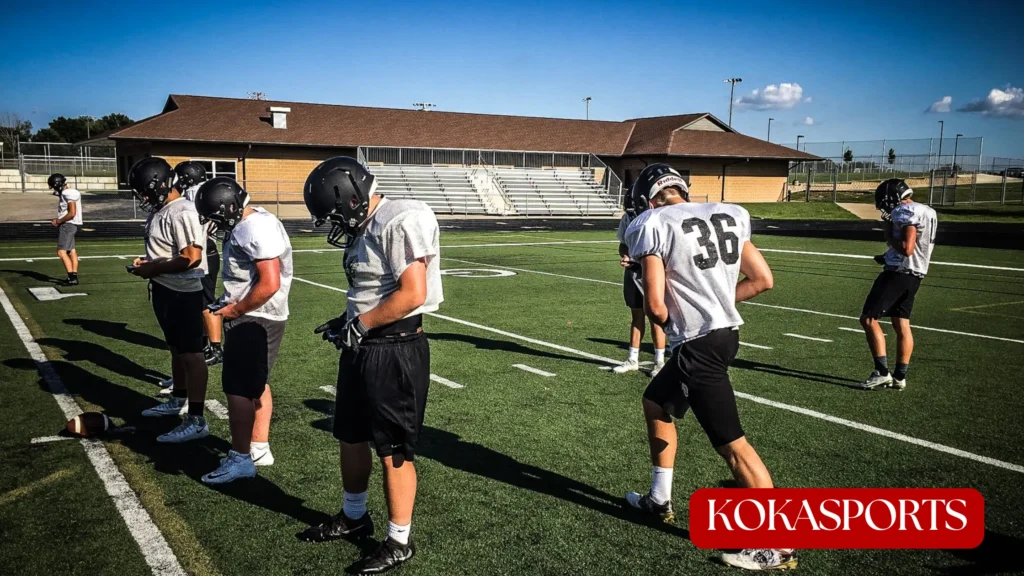
Most practice plan guides skip this entirely, and it is the single most important safety topic in American football. Among all sports, football has the highest incidence of exertional heat stroke, and the majority of heat-related deaths happen during the first few days of practice. If you coach in August anywhere in the United States, this section applies to you.
The NFHS position statement on heat acclimatization sets a national framework for the first five days of formal practice:
- Days 1 through 5 make up the heat-acclimatization period.
- Athletes may not take part in more than one practice per day during this window.
- Total practice time should not exceed three hours in any single day.
- A one-hour maximum walk-through is permitted, but it must be separated from practice by a three-hour recovery period.
- On days 1 and 2, helmets are the only protective equipment allowed.
The exact limits differ by state, so the numbers above are the baseline, not the final word. For example, Oklahoma limits preseason sessions to 2.5 hours with at least one hour between practices, Colorado caps a single practice at 2 hours and total daily practice at 3 hours, and Wisconsin allows only one practice per day at a maximum of 2.5 hours from the third week onward. Always check your own state athletic association for the rules that govern your team.
Hydration and Heat-Index Monitoring
Build water into your plan rather than treating it as an interruption. Keep bottles or stations near the field so players drink during transitions instead of stopping everything for a separate break. Every coaching staff should have a heat-index app and check conditions at every session, and be willing to shorten or move a practice when the index climbs into the danger zone. The science here is straightforward, and the NFHS heat guidance is the authority to follow. Conditioning in heat is also where explosive, well-fueled athletes separate themselves, a point we dig into in the science of explosive power.
Eight Principles Behind a Good Practice Plan
The USA Football development model leans on Coach John Wooden’s eight principles of practice design. They are a useful checklist to run your own plan against before you print it.
- Teach fundamentals before creativity.
- Use variety to keep players engaged.
- Teach new material at the start of practice, when minds are fresh.
- Make transitions between activities quick.
- Increase complexity from one practice to the next.
- Use conditioning to support learning, not just to punish.
- End on a positive note.
- Avoid altering the plan in the middle of practice.
That last one is worth sitting with. The time to fix your plan is tonight, after you review the session, not on the field while 40 kids wait.
Football Practice Drills by Position
Your plan tells you when to work each phase. Your drills tell you what to run. Choose three or four exercises per session from different skill areas and rotate them across the week so players develop every area without repeating the same drill two days running.
- Offensive line: fit and drive, pull and kick-out, pass-set punch. Keep pad level low and hands inside.
- Defensive line: get-off, swim and rip, block recognition. Pass-rush technique is a skill you can build in detail, as our guide to pass rush moves lays out.
- Quarterbacks and receivers: three-step drop rhythm, pocket movement, route timing. The flag football route tree is a clean reference for teaching route shapes at any level.
- Running backs: ball security through a gauntlet, directional steps, pass protection.
- Linebackers and defensive backs: read and react, pursuit angles, backpedal and break.
- Tackling for everyone: shoulder tackling with the head to the leverage side, then wrap, squeeze, and finish. Never initiate with the head.
If you want to know exactly which drills fit which role, start with our complete guide to football positions, which maps the job of every spot on the field.
Weekly In-Season Practice Schedule
A single session plan is only part of the picture. During the season, you also want a consistent weekly rhythm so players know what each day demands. Here is a common high school template for a team that plays Friday night.
| Day | Focus |
|---|---|
| Sunday | Coaches only. Film review and game planning, build the week’s schedule |
| Monday | Film session, then full practice with a fundamentals emphasis |
| Tuesday | Physical, competitive practice. Install the offensive and defensive game plan |
| Wednesday | Full practice, mix of indy, group, and team work. Keep refining the plan |
| Thursday | Walk-through in shorts and helmets. Mental prep, keep it light |
| Friday | Game day |
| Saturday | Self-scout film session, review the tape, assess the week |
Adjust the balance for your level. Younger teams need more fundamentals and less game plan. The point is that each day has a clear job, so you are not teaching new installs the day before a game or hitting hard the day after one.
Five Tips for Running an Efficient Practice
- Over-plan. Script more than you think you can cover. If players move fast, you have more ready. If they struggle, you drop the extras.
- Script your team period. Write down every play and the look you want the scout team to give. This removes the dead time where a coordinator decides what to call next.
- Delegate to position coaches. Let each assistant own and prepare their own segments. You keep the big picture; they keep the reps high.
- Keep periods short. Three or four drills in a tight ten-minute block beats one drill dragged out to thirty minutes with players drifting.
- End with competition, not just conditioning. Make your last full team block a live situation, such as a two-minute drill or a goal-line stand. Players remember how practice ends.
Paper vs. Digital Practice Plans
A printed template works perfectly for one team with a small staff and a simple playbook. You hand-write notes on the field and file them after.
Digital planning starts to earn its place when you coordinate several position coaches who each need to see the same plan, when you want to track which plays you installed and which still need reps, or when you need to connect practice plans to player evaluations and game film across a full season. Neither is better in the abstract. Match the tool to the size of your program.
Frequently Asked Questions
How do you structure a football practice?
Run it in periods. Start with a warm-up, move to individual (indy) work with position coaches, then group periods that combine positions, then full team periods for scout and situational reps, fit special teams in, and finish with conditioning and a cool-down. Keep each block short and timed.
How long should a football practice be?
It depends on level. Under official USA Football standards, youth sessions run from 45 to 60 minutes at the youngest ages up to 90 minutes by middle school. High school practices commonly run two hours. Longer is not better: focus drops when sessions run too long.
How much full contact is allowed in a youth practice?
USA Football’s guidelines limit full contact, meaning drills at Thud or Live Action, to 30 minutes within a single session that does not exceed 90 minutes. Air, Bags, and Control carry no time limit because they are controlled contact.
What are the levels of contact in football?
There are five, defined by USA Football and used in NFHS guidelines: Air (no contact), Bags (against a bag), Control (above the waist with a coach-chosen winner), Thud (competitive speed, no predetermined winner, stay on feet), and Live Action (game-like, the only level where players go to the ground).
What should a coach do to prepare for practice?
Meet with your staff to set the week’s goals, build a timed plan with a single clear focus, script your team periods, assign a contact level to every drill, and check the heat index. Then hand copies to every assistant before you reach the field.
Conclusion
A football practice plan template is the cheapest coaching upgrade you can make. It turns a chaotic hour into a sequence of purposeful blocks, keeps every player moving, and makes sure the fundamentals and safety rules that protect your team never get squeezed out by the clock. Start with the blank template above, pick the session length that fits your level, label your contact, and build from there. The teams that plan the best practices are usually the ones still playing in November.
Safety standards on this page are drawn from USA Football and the NFHS. Always confirm the current rules with your own state athletic association before the season, as contact and heat limits vary by state.