
If you coach or play flag football, the flag football route tree is the first thing you need to learn. It gives every route a number, so a coach can call a whole play in a few words and every receiver knows exactly where to run. Learn the tree, and play calling, practice and game day all get simpler.
In this guide, you will find the official NFL FLAG route tree, a short diagram for every route, why flag routes are shorter than tackle routes, and simple 5v5 and 7v7 play examples you can use this week.
What Is a Flag Football Route Tree?
A route is the path a receiver runs to get open for a pass. A route tree is a diagram that puts the most common routes together and gives each one a number. Picture a receiver standing at the bottom of a tree. Every branch is a different direction he can go.
Instead of telling a player “run seven yards, then cut toward the corner,” the coach just says “4.”
Why Coaches Use a Route Tree
- Faster play calling. A call like “Trips Right 041” tells three receivers their routes in one breath.
- Easy audibles. The QB can change one number at the line instead of burning a timeout.
- No-huddle offense. Route numbers fit on playbook wristbands, so players line up quickly.
The Official NFL FLAG Route Tree (0 to 9)
NFL FLAG, the NFL’s official flag football program, publishes its own route tree numbered 0 to 9. Because it comes straight from the NFL’s own program, it is the one we recommend learning first.
| # | Route | Quick Description |
|---|---|---|
| 0 | Hitch | 7 yards, then turn back toward the QB |
| 1 | Slant | A couple of yards, then cut at about 45 degrees |
| 2 | Out | 5 yards, then a 90-degree cut to the sideline |
| 3 | Post | 7 yards, then 45 degrees to the middle |
| 4 | Corner | 7 yards, then 45 degrees to the sideline |
| 5 | Fly | Straight and fast |
| 6 | Option | Starts like a slant, then cuts toward the sideline |
| 7 | Stop and Go | 7 yards, stop, then sprint deep |
| 8 | Post Corner | Fake the post, then break to the corner |
| 9 | Chair | 4 yards, cut out, then turn upfield |
You can see NFL FLAG’s original diagrams on its official flag football plays and formations page.
Every Route Explained (with Short Diagrams)
0: Hitch Route
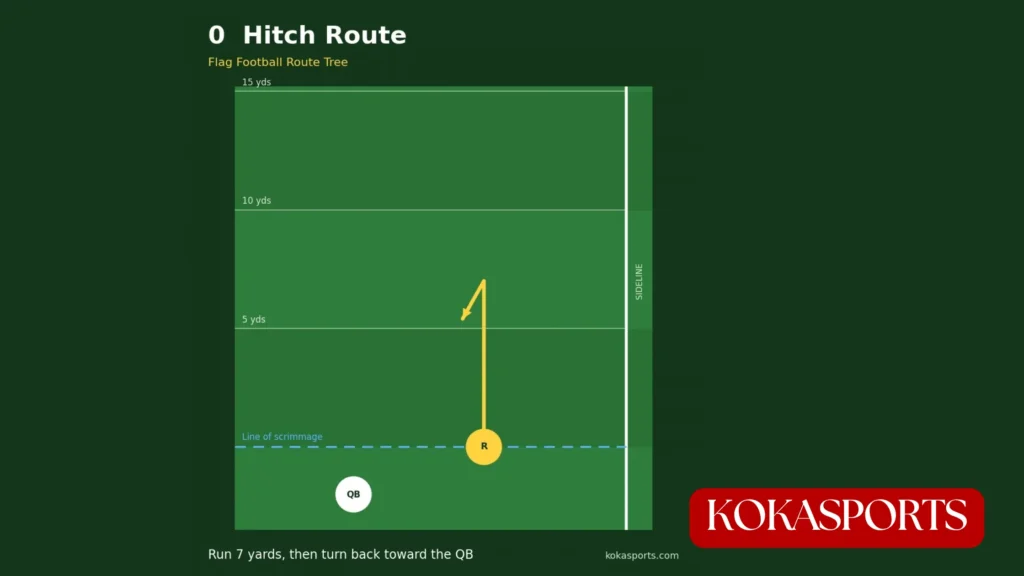
Run straight for 7 yards, then quickly turn back toward the QB for a couple of yards. The hitch is a safe, quick throw and a great first route for beginners.
1: Slant Route
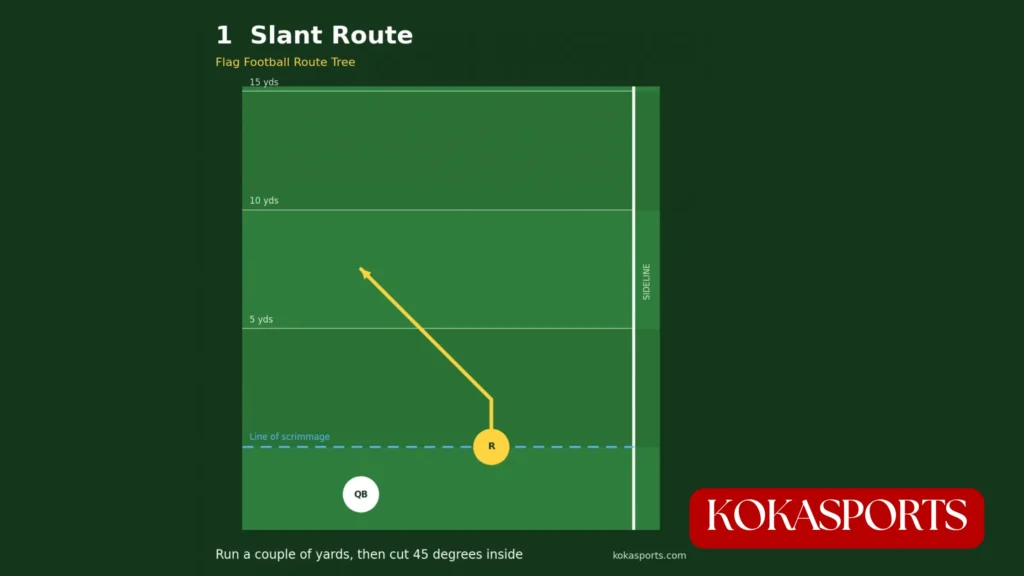
Run forward a couple of yards, then cut at about 45 degrees toward the middle of the field. The slant gets the ball out fast, which is perfect against rushers.
2: Out Route
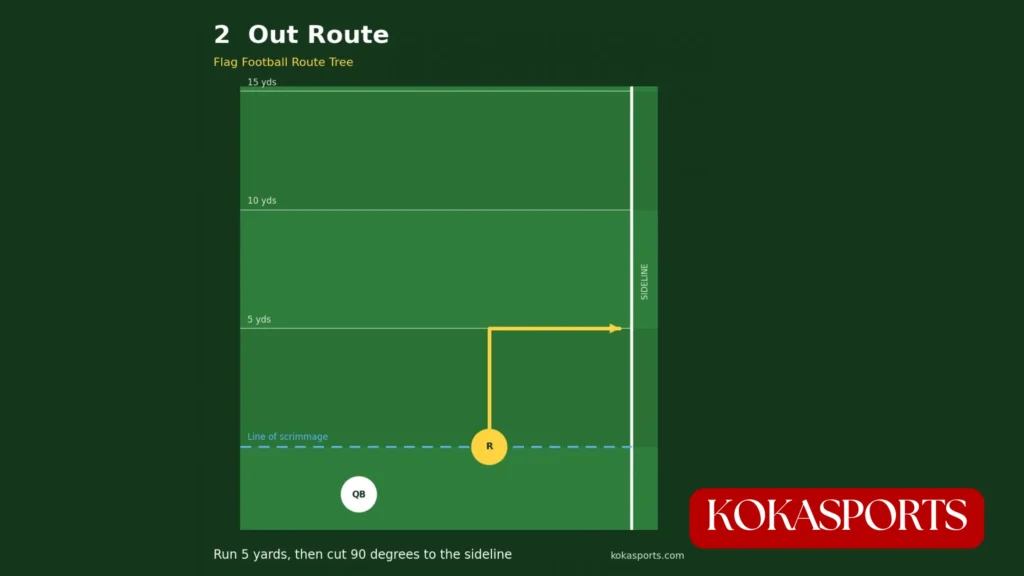
Run 5 yards, then cut at a sharp 90-degree angle toward the sideline. Line up far enough from the sideline so you can catch the ball and stay in bounds.
3: Post Route
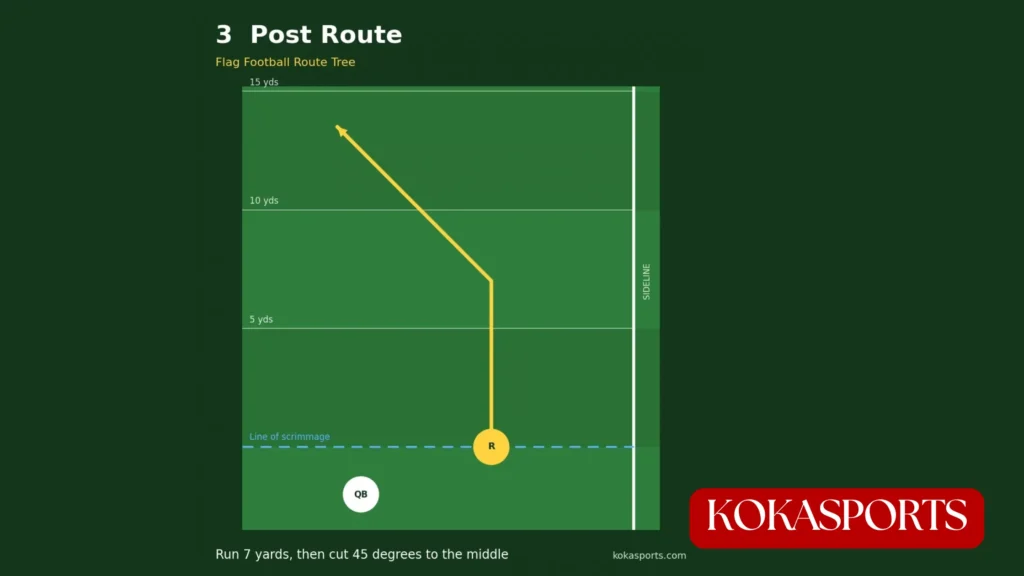
Run 7 yards, then cut at a 45-degree angle toward the center of the field. Think of aiming at the goal post, which is where the name comes from.
4: Corner Route
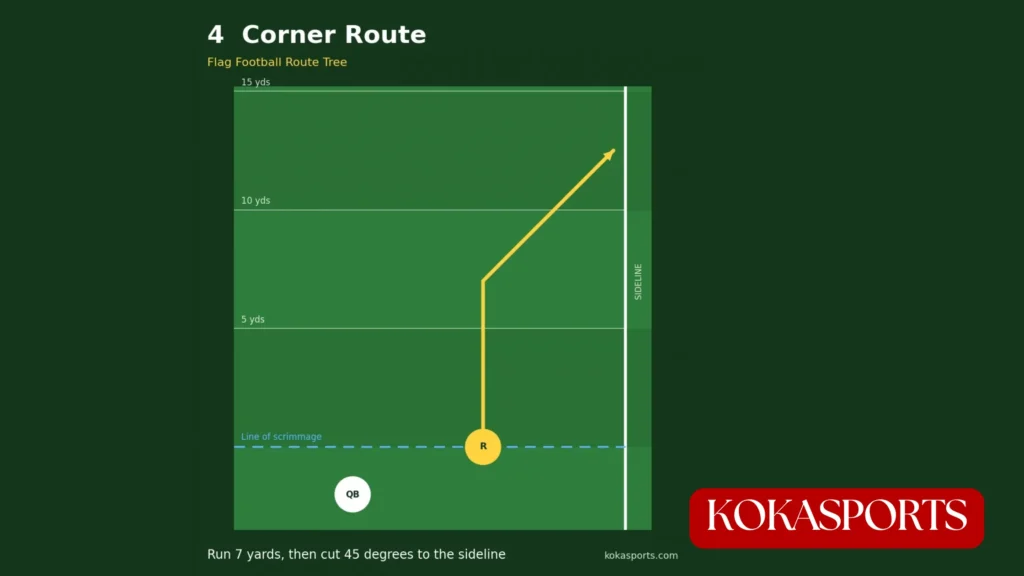
Run 7 yards, then cut at a 45-degree angle toward the sideline. The corner is the mirror image of the post. For a cleaner cut, NFL FLAG coaches teach you to plant the opposite foot before you pivot.
5: Fly Route
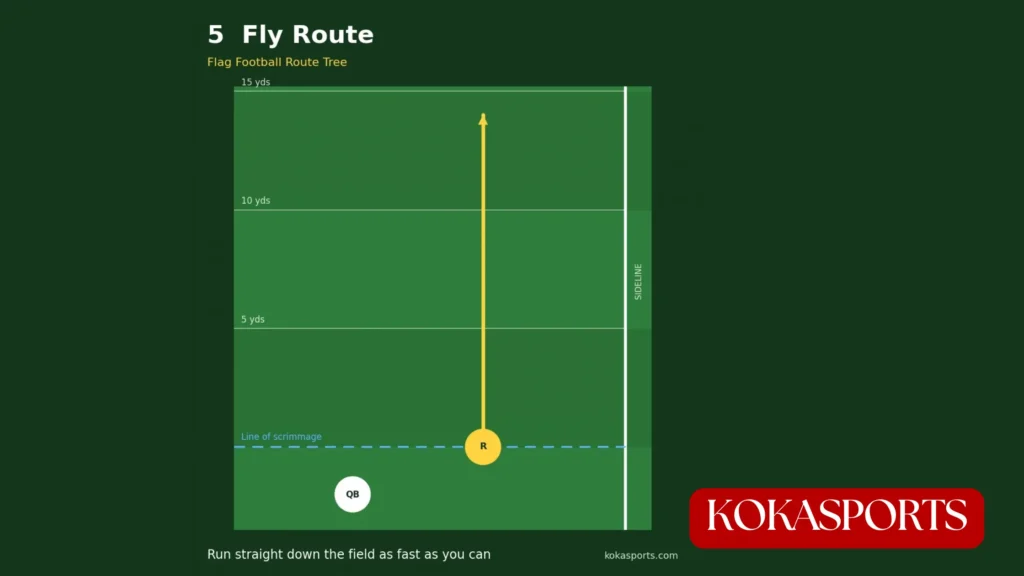
Run straight down the field as fast as you can. The fly is the deep shot, and it also pulls defenders away from shorter routes underneath.
6: Option Route
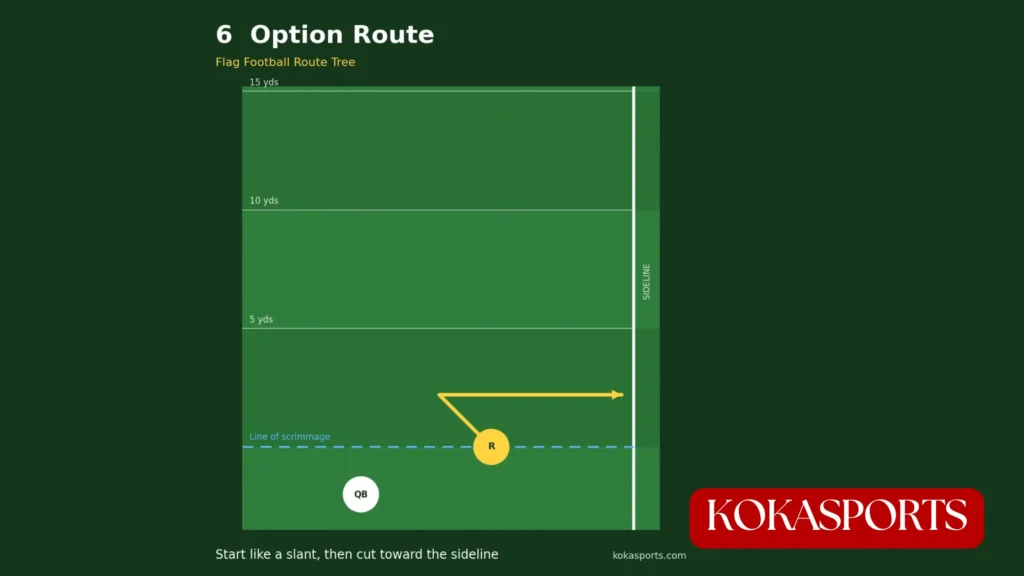
Start like a slant toward the middle, then cut directly toward the sideline. The change of direction freezes a defender who jumped the slant.
7: Stop and Go Route
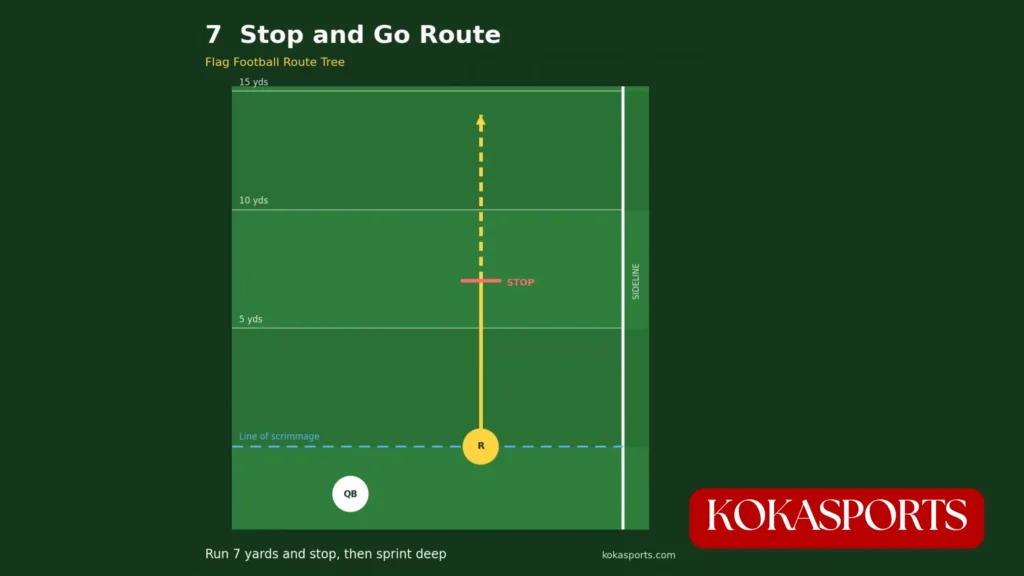
Run about 7 yards and stop as if you are running a hitch. When the defender steps up, take off toward the end zone.
8: Post Corner Route
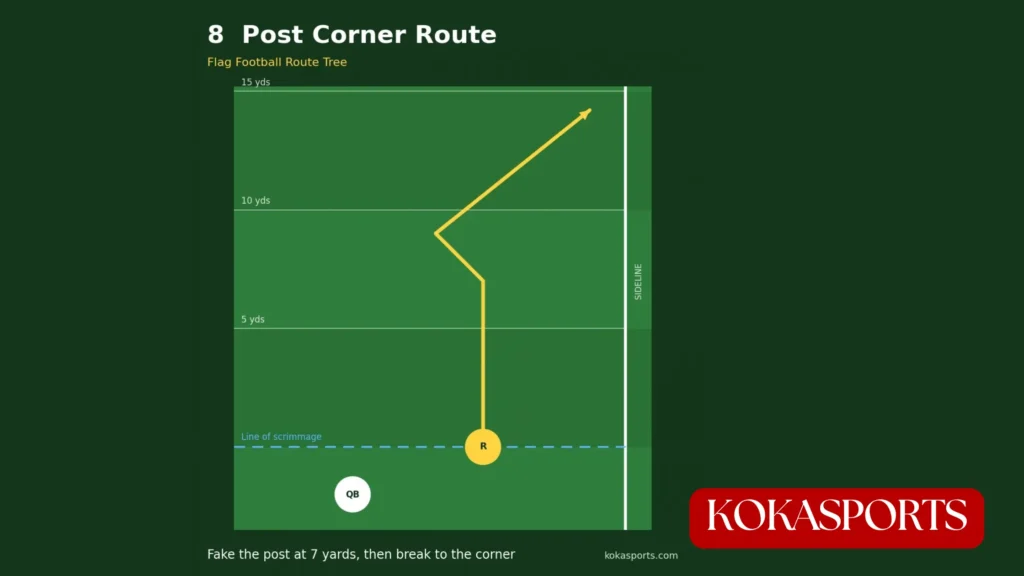
Run 7 yards and cut toward the middle like a post. Once the defender bites, break back out toward the corner. This double move works best against tight man coverage.
9: Chair Route
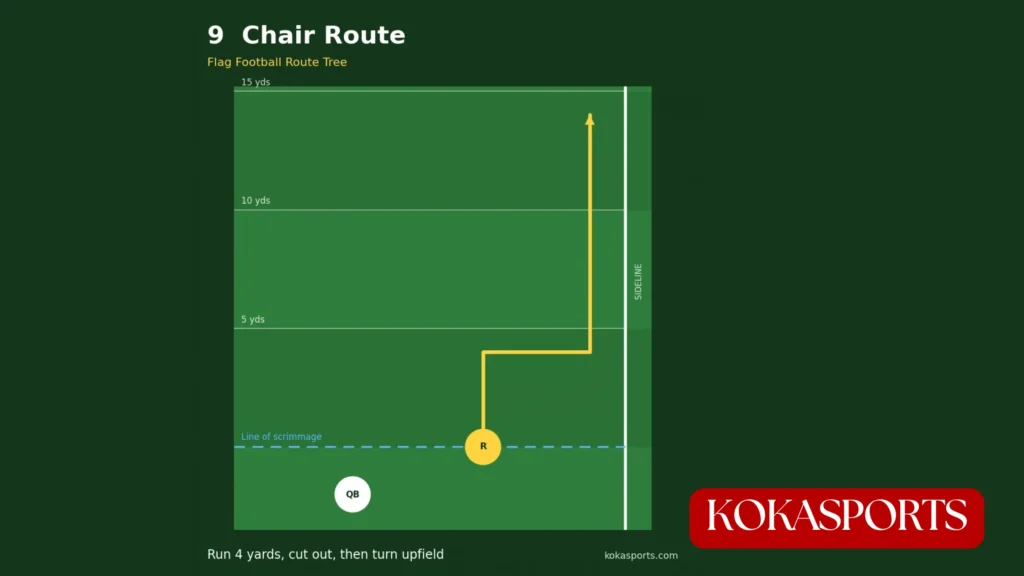
Run about 4 yards, cut parallel toward the sideline, then turn straight up the field toward the end zone. The chair starts like an out and finishes like a fly.
Extra Routes Worth Knowing
NFL FLAG’s official receiver drills also cover the comeback, fade, wheel, whip, dig, square in and slant-go. Add these once your players master the 10 routes above.
Why Flag Football Routes Are Shorter Than Tackle Routes
If you have seen a tackle football route tree, you may notice that flag routes break much earlier. That is on purpose. The official NFL FLAG rules shape every route:
- Smaller field. An NFL FLAG field is 30 yards wide and 70 yards long, including two 10-yard end zones.
- The 7-second pass clock. The QB has 7 seconds from the snap to throw, so routes must develop quickly.
- No QB runs. The quarterback cannot run across the line of scrimmage, so the passing game carries the offense.
- No-run zones. Within 5 yards of each goal line and midfield, every play must be a pass, so short routes become key.
- Limited rush. Up to two rushers can come from the 7-yard rush line, which gives receivers a little time to work.
That is why most flag routes break at 5 to 7 yards, while tackle routes often break at 10 to 15.
Other Route Tree Numbering Systems
Not every league uses NFL FLAG’s numbers. Some coaches use a tackle-style tree, where the corner is a 7, the post an 8 and the go a 9. Others build a simple six-route tree for young players, such as 1 slant, 2 out, 3 in, 4 corner, 5 post and 6 go.
None of these are wrong. What matters is that your whole team uses the same numbers.
Best Routes for Beginners
If you coach young players, do not teach all 10 routes on day one. Start with three or four “classics”:
- Hitch (0): Short, simple and easy to complete.
- Slant (1): Quick and great against rushers.
- Out (2): Teaches a sharp 90-degree cut.
- Fly (5): Every kid loves to go deep.
Give plays fun, memorable names, and add the other routes once these feel automatic.
Who Runs Which Route?
In flag football, almost every offensive player can catch a pass. NFL FLAG’s official glossary notes that the center snaps the ball and can then run a route as a receiver. Wide receivers run the full tree, while the running back can take a handoff or slip out on a short route.
For a full breakdown of every role, read our guide to flag football positions 7v7.
Simple 5v5 Play Examples
NFL FLAG plays are 5 on 5, so every play needs to get receivers open fast. Here are three easy plays built from the official route tree. (Route numbers follow the NFL FLAG tree above.)
Play 1: Corner Post (Two Receivers Right)
Line up two receivers to the right of the QB and one a few yards behind him. On the snap, the outside receiver runs a 7-yard corner (4) and the inside receiver runs a 7-yard post (3). Their paths cross, which confuses defenders and often leaves one receiver open deep. NFL FLAG features this same corner and post idea in its official play examples.
Play 2: Hitch Corner (Smash)
The outside receiver runs a hitch (0) and the slot receiver runs a corner (4) over the top. The QB watches the defender on that side. If he sits on the hitch, throw the corner. If he drops deep, throw the hitch. It is one of the easiest reads in football.
Play 3: No-Run Zone Quick Game
Inside the no-run zone, you must pass. Have the center run a hitch (0), the left receiver a slant (1) and the right receiver an out (2). All three break fast, so the QB has a quick, safe throw.
Simple 7v7 Play Examples
In NFL FLAG’s 7v7 format, teams add a lineman who protects the QB without contact, and usually use four receivers split between the slot and outside. USA Football’s 7v7 rulebook mirrors its 5v5 rules with adjustments for the two extra players, and all contact is still banned.
Play 1: Flood Right
Put three receivers on the right side. The outside receiver runs a fly (5) to clear the deep defender, the middle receiver runs a corner (4), and the inside receiver runs a short out (2). Three routes at three depths stretch one side of the field.
Play 2: Slant Wheel
Two receivers on one side. The outside receiver runs a slant (1), and the slot runs a wheel up the sideline. If the defender follows the slant, the wheel opens up deep.
5v5 vs 7v7: How Routes Change
| 5v5 (NFL FLAG) | 7v7 | |
|---|---|---|
| Players on offense | 5 | 7 |
| Typical receivers | 3 plus the center | 4 |
| Extra protection | None | One non-contact lineman |
| Best routes | Quick: hitch, slant, out | More room for deeper combinations |
| Spacing | Wide splits to create room | Tighter splits with more receivers |
The routes are the same in both formats. The difference is spacing and timing, since more receivers share the field in 7v7.
Flag Football at the 2028 Olympics
Flag football is heading to the biggest stage of all. At the LA28 Olympic Games, each team will have five players on the field from a roster of 12, with six men’s and six women’s teams. Games use a 70-yard field with two 10-yard end zones and two 20-minute halves.
Olympic teams get four downs to reach midfield and four more to score, while NFL FLAG youth teams get three downs to score after crossing midfield. The routes, though, are exactly the same.
Common Route Mistakes to Avoid
- Rounding the cut. Plant your foot and snap the cut, or the defender catches up.
- Wrong depth. If the play calls for 7 yards, run 7. The QB is throwing to a spot.
- Running out of room. Leave space from the sideline for out, corner and chair routes.
- Bunching up. Keep your spacing so one defender cannot cover two receivers.
FAQs
What is a route tree in flag football?
A route tree is a numbered diagram of the most common pass routes. Each number stands for one route, so coaches can call plays quickly and receivers know exactly where to run.
What are the routes in the NFL FLAG route tree?
The NFL FLAG route tree runs from 0 to 9: hitch, slant, out, post, corner, fly, option, stop and go, post corner and chair.
Is the flag football route tree the same as tackle football?
The routes are similar, but the numbers and depths are different. NFL FLAG routes usually break at 5 to 7 yards because of the smaller field and the 7-second pass clock.
What is the best route in flag football?
There is no single best route, but the slant and hitch are the most reliable for beginners because they are short, quick and easy to complete.
Can the center run a route in flag football?
Yes. In NFL FLAG, the center snaps the ball to the quarterback and can then run a route as an eligible receiver.
Conclusion
The flag football route tree turns a confusing passing game into a simple numbers system. Start with the classics, keep your depths consistent, and add new routes as your team grows. For the full official rules, see USA Football’s flag football rulebooks.