
If you have ever watched a receiver sprint up the field, snap his route toward the sideline and catch a pass near the pylon, you have seen the corner route in action. In corner route football terms, this is one of the most valuable deep throws in the game. It is not the most common route on the field, but when it hits, it usually means a big gain or a touchdown.
What Is a Corner Route in Football?
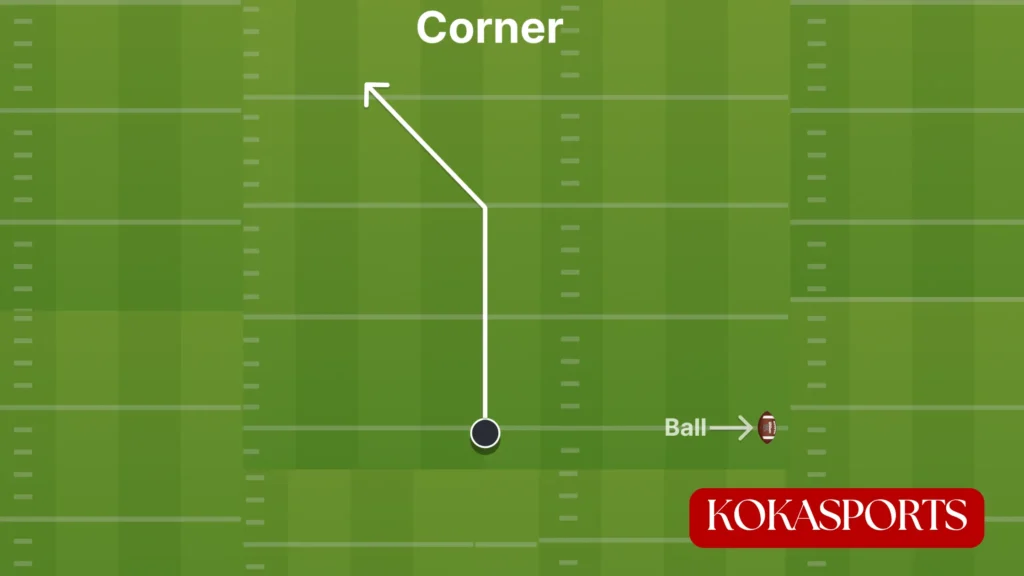
The corner route is a deep, outside-breaking pass route. The receiver runs straight up the field (this part is called the stem), then breaks at roughly a 45-degree angle toward the sideline, aiming for the back corner of the field or the corner of the end zone.
Think of it as the mirror image of the post route. Both start with the same vertical push. The post breaks inside toward the goal posts, while the corner breaks outside toward the sideline. That shared start makes both routes hard to defend, because the defender cannot tell which way the receiver is going until the break.
The corner route attacks the open space behind a cornerback and outside a safety. Because the ball is thrown toward the sideline and away from the middle of the field, it is also a safer deep throw than routes that break into traffic.
Corner Route vs Flag Route: Same Route, Two Names
You will often hear the corner route called the flag route. They are the same route. The old name comes from the corner flags that marked the edges of the end zone, which receivers were taught to aim at. Most coaches say “corner” today, but “flag” still shows up in older playbooks and many youth programs.
The Corner Route in the Route Tree
In the most common version of the football route tree, the corner route is the 7 route. The deep routes sit at the top of the tree:
| Number | Route | Direction of Break |
|---|---|---|
| 7 | Corner | Deep, outside at about 45 degrees |
| 8 | Post | Deep, inside at about 45 degrees |
| 9 | Go | Straight vertical, no break |
Routes that break outside usually get odd numbers, and routes that break inside usually get even numbers. The corner (7) breaks outside and the post (8) breaks inside, so the pattern holds.
For a full breakdown of all nine routes, from the flat to the go, check out our complete guide to the football route tree.
Why the Route Number Can Change
Here is something many guides skip: the numbering is not universal. Every coach, team and league can build its own tree. NFL FLAG, the NFL’s official flag football program, uses a tree where the corner is labeled a 4. Many college and NFL offenses skip numbers entirely and use their own terms. If your coach calls the corner something other than a “7,” nobody is wrong. The route itself is what matters.
How Deep Is a Corner Route?
There is no single correct depth. It depends on the level of play, the size of the field, the quarterback’s arm strength and the play design:
| Level | Typical Break Depth | Why |
|---|---|---|
| Flag football (NFL FLAG) | About 5 to 10 yards | Smaller field, shorter throws |
| Youth tackle | About 6 to 10 yards | Less arm strength |
| High school | About 10 to 12 yards | Standard playbook depth |
| College and NFL | About 10 to 15 yards | Faster defenders, stronger arms |
In the classic Smash concept, many coaches break the corner at around 12 yards. Because the receiver keeps running after the break, the ball is often caught more than 20 yards downfield. That is why the corner is a true deep route even when the break happens at intermediate depth.
Key coaching point: Consistency matters more than the exact number. If the receiver breaks at 8 yards on one rep and 14 on the next, the quarterback can never throw on time. Pick a depth that fits your level and rep it until it is automatic.
How to Run a Corner Route Step by Step
A great corner route is more than “run up, then run to the corner.” Every phase has a job.
1. Win the Release
Get off the line of scrimmage cleanly and avoid the jam against press coverage. If you are lined up outside the numbers, take an inside release first. This creates room between you and the sideline for the break. Hug the sideline and you will run out of field before the ball arrives.
2. Sell the Vertical Stem
Run hard and straight at the defender as if you are running a go route or a post. The goal is to make the defensive back open his hips or commit to the deep middle. If he believes you are going deep or inside, he cannot react in time when you break outside.
3. Plant and Break at 45 Degrees
At your break point, sink your hips and cut at about 45 degrees toward the sideline. NFL FLAG teaches a simple technique: plant the foot opposite the direction you want to go before you pivot. Breaking right? Plant your left foot. This gives you a clean, tight break instead of a rounded one the defender can recover from.
4. Stay High and Find Green Grass
After the break, do not flatten out. Keep the route “high,” gaining depth as you move outside. A flat route lets the cornerback cover both you and any short route underneath. Many coaches give receivers a landmark, such as the pylon, to stay on the right path.
5. Turn Your Head and Track the Ball
You are running away from the quarterback, so get your head around quickly after the break. The pass usually comes over your outside shoulder, away from the defender. Be ready to extend and catch it with your hands.
Where the Corner Route Is Run From

The corner route can be run from almost any alignment, but it is most common from the slot. Slot receivers and tight ends start inside, which leaves plenty of field between them and the sideline for the route to develop.
Outside receivers can run it too, but they need that inside release or a tighter split to create space. In the red zone, tight ends and running backs often run corners from bunch or condensed formations, where defenders struggle to sort out who covers whom.
What Coverages Does the Corner Route Beat?
Cover 2
This is where the corner route shines. In Cover 2, two safeties split the deep field in half and the cornerbacks usually play short, protecting the flats. That leaves a pocket along the sideline between the top of the cornerback’s zone and the bottom of the safety’s zone. A corner route from the slot lands right in that hole. Paired with a flat route underneath, it is one of the best Cover 2 beaters in the NFL.
Cover 1 (Man Coverage)
In Cover 1, one safety plays deep middle and everyone else plays man coverage. The corner route breaks away from that middle safety, so if the receiver wins his matchup, no help is coming over the top. That makes it a go-to red zone call against Cover 1.
Cover 3 and Cover 4
These are tougher. In Cover 3, the cornerbacks drop into the deep outside thirds, exactly where the corner route is headed. In Cover 4, safeties read the slot receiver and can sit on the route. Offenses usually need a different concept or a double move against these looks.
Key coaching point: Two high safeties before the snap do not automatically mean the corner route is open. Quarterbacks still need to confirm the coverage after the snap.
The Smash Concept: The Corner Route’s Best Friend
The corner route is most dangerous when paired with a short route underneath. The most famous pairing is the Smash concept:
- The outside receiver runs a short hitch (or sometimes an out) at around 5 to 6 yards.
- The inside receiver runs a corner route over the top.
This puts one defender, usually the cornerback, in a high-low bind. He cannot cover both routes at once, so the quarterback reads only him:
- If the cornerback drops deep to take away the corner, throw the hitch.
- If the cornerback comes up to jump the hitch, throw the corner over his head.
This simple read is why Smash is taught everywhere, from youth leagues to the NFL. Other combinations built on the same idea include the flat and corner, where a flat route stresses the same defender, and Scissors, where a post and a corner cross to confuse the safeties.
Corner Route vs Post Route
| Corner Route | Post Route | |
|---|---|---|
| Route number | 7 (in most trees) | 8 (in most trees) |
| Break direction | Outside, toward the sideline | Inside, toward the goal posts |
| Attacks | Space outside the safety | Deep middle of the field |
| Best against | Cover 2, Cover 1 in the red zone | Looks that leave the deep middle open |
| Throw | Toward the sideline, away from traffic | Into the middle, where safeties live |
The Post-Corner Route: Deadly Double Move
The post-corner combines both routes. The receiver runs what looks like a normal post route, breaking inside toward the goal posts. Then, after one to three steps, he breaks back outside on a corner.
The goal is to get the defender to bite on the post. Once his momentum carries him inside, the receiver breaks the other way. It works especially well against man coverage and in the red zone.
Important: The post-corner and the corner are not the same route. On a standard corner, the receiver sells vertical and breaks straight to the corner. Only the post-corner adds the fake inside break first.
The Corner Route in the Red Zone
Inside the 20-yard line, the field shrinks and the end zone becomes the back wall. The corner route turns from a long deep shot into a shorter throw to the back pylon. Because it works away from the middle safety, it is a favorite goal line call against man coverage.
The Corner Route in Flag Football
The corner route is a staple in flag football too, just on a smaller scale. In the official NFL FLAG route tree, the receiver runs straight for about seven yards, then breaks at a 45-degree angle toward the edge of the field.
NFL FLAG also highlights a smart situational use: since the route finishes near the sideline, it is ideal when you need a receiver to catch the ball and step out of bounds to stop the clock late in a close game. For more technique straight from the source, see NFL FLAG’s official guide to wide receiver drills.
NFL Stats: How Valuable Is the Corner Route?
The NFL’s Next Gen Stats team built a Route Recognition model that uses player-tracking data to classify every route on every pass play. Their analysis of the 2018 and 2019 seasons showed these results for the corner route:
| Stat | Corner Route | What It Means |
|---|---|---|
| Share of wideout routes | 4.5% (9th of 10) | One of the least-run routes |
| Target rate | 14.6% | Targeted on about 1 in 7 runs |
| Air yards per target | 21.0 (3rd) | A true deep throw |
| EPA per target | +0.43 (2nd) | One of the most valuable routes |
| Catch rate | 45% | Harder to complete |
| Separation when targeted | 2.3 yards | More than a go route (1.8 yards) |
The big takeaway: the corner route is run rarely, but it is the second most valuable route in the NFL per target, behind only the post. Expected points added (EPA) measures how much a play improves a team’s scoring chances. The corner beats the go route by a wide margin, likely because routes with a break create more separation than a straight sprint. You can read the full breakdown in the NFL’s official Next Gen Stats Route Recognition report.
Common Corner Route Mistakes to Avoid
- Breaking too flat. Cutting too sharply toward the sideline lets the cornerback cover both the corner and the short route. Keep it high.
- Lazy stems. Without a real vertical threat, the defender sits on the break.
- Running out of room. Outside receivers who hug the sideline have nowhere to go. Use an inside release.
- Rounding the break. A soft, curved cut gives the defender time to recover.
- Throwing it late. A late throw gives the safety time to drift over. The ball should come out on time, toward the sideline and away from the defender.
FAQs About Corner Route Football
What is a corner route in football?
A corner route is a deep pass route where the receiver runs straight up the field, then breaks at about a 45-degree angle toward the sideline, aiming for the corner of the field or end zone.
What number is the corner route?
In the most common route tree, the corner route is the 7 route. Numbering is not universal, though. NFL FLAG, for example, labels the corner as a 4.
Is a flag route the same as a corner route?
Yes. The flag route is an older name for the corner route, taken from the corner flags that marked the end zone.
How deep should a corner route be?
Flag football corners often break at around 5 to 10 yards, while high school, college and NFL corners usually break between 10 and 15 yards.
What coverage does the corner route beat?
It is best against Cover 2, where it attacks the pocket between the cornerback and safety. It is also a strong red zone call against Cover 1.
What is the difference between a corner route and a post-corner route?
A corner route breaks straight to the sideline after the stem. A post-corner first fakes a post toward the middle, then breaks back outside to the corner.
Conclusion
The corner route is not the most common route in football, but it is one of the most dangerous. It punishes Cover 2, wins in the red zone and pairs perfectly with Smash. Master the release, sell the stem, break clean at 45 degrees and stay high, and you will see why corner route football knowledge separates good receivers and play-callers from great ones.