
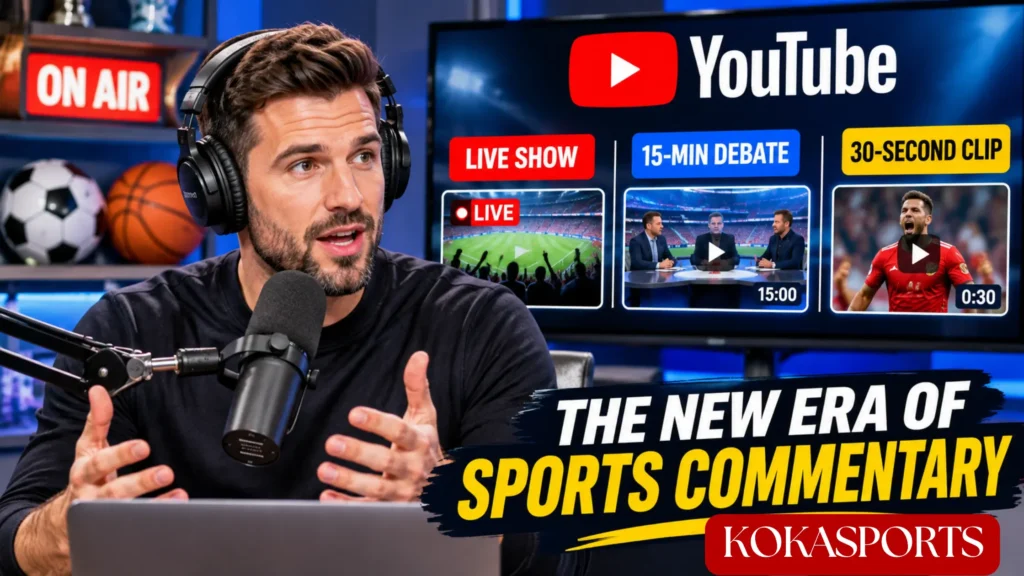
A commentator used to need a station’s schedule before an audience could hear them. Today, sports commentary can be distributed as a live show, a fifteen-minute debate and a thirty-second clip, each reaching viewers at a different hour. The shift is no longer limited to aspiring presenters: established television networks now buy into personalities and formats that proved their value on YouTube.
The careers of Pat McAfee and Gary Neville show two different paths. One took an independent sports talk format into ESPN’s schedule. The other built a football discussion brand large enough to attract investment and a streaming distribution deal. The common asset is not the studio. It is a repeat audience that recognizes the presenter’s voice.
McAfee turned his YouTube identity into a network product
ESPN announced a multi-year arrangement with Pat McAfee in May 2023. The company’s official release said his weekday show would appear on ESPN, the ESPN app, ESPN+ and YouTube. A digital-first personality entered a major broadcaster without abandoning the online viewing habit that helped build his audience.
The numbers explain the appeal. ESPN reported 242 million total views across platforms during the first four weeks after the September 2023 launch, with clips accounting for 213 million cumulative views. Those figures are cross-platform consumption, not 242 million unique people. They nevertheless show why a short excerpt can carry an interview far beyond the live broadcast window.
The Overlap became a business before it became a schedule
Gary Neville launched The Overlap in 2021, creating space for long-form interviews and frank discussion with former players. In January 2026, radio and entertainment group Global announced a majority investment in the business. The Association of Online Publishers’ account quoted more than 38 million monthly YouTube views and 2.2 billion views across platforms during 2025.
Another distribution step followed in August 2026: The Guardian reported a Disney+ arrangement covering episodes of Stick to Football and a new Wayne Rooney-led program. Neville’s role had expanded from pundit to media founder. Production teams, intellectual property, guest access and deal-making now sit beside the on-camera performance.
The clip is no longer a disposable by-product
A presenter with ten carefully reported videos can demonstrate research, interviewing, judgment and sports analysis in public. The record is there to be watched.A long sports discussion yields a full episode, a debate and a short video.
In a review of Melbet apk download latest version, presenters could demonstrate Android navigation across pre-match, live and casino sections. Comparing layouts gives viewers useful information immediately. Each clip must also remain accurate when separated from its original conversation.
Clips give commentators feedback about what fans want explained next. A debate over the best betting site in BD can examine pre-match and in-play odds as lineups change. The useful story is the reason behind a price movement, not the price alone. Verified team news gives a short clip more substance than a bold prediction.
Revenue comes with conditions that a microphone cannot solve
YouTube offers advertising revenue, memberships and fan funding to channels that qualify. Its monetization rules identify memberships, Super Chat and Super Thanks, each subject to eligibility and policy requirements. Sponsorship, podcast distribution and live events add possible income streams, but none guarantees financial independence.
YouTube announced in August 2026 that, from February 1, 2027, new applicants need 1,000 subscribers plus 8,000 annual watch hours or 20 million Shorts views in 90 days for ad and Premium revenue sharing. Existing program participants were excluded from that particular threshold change. Anyone assessing a new commentary channel should check current eligibility, not a years-old “how to monetize” tutorial.
Broadcast footage remains the expensive boundary
Commentary does not confer the right to rebroadcast a match. Rights holders license live pictures, highlights, graphics and audio separately, while YouTube’s automated copyright systems can restrict or claim uploads that use protected material. A reaction show is therefore a different product from a live play-by-play feed containing official video.
For new commentators, the defensible starting format is original reporting: independently sourced statistics, self-created visualizations, interviews conducted with permission and analysis that can stand without protected match clips. Presenter credibility matters when a dramatic prediction fails. Publishing the evidence behind an opinion gives viewers a reason to return after the headline changes.
What a commentator now needs to master
A good sports voice must still recognize a tactical change before the audience does. On YouTube, that skill sits alongside three practical jobs:
- Package a long discussion into accurate titles, clips and searchable descriptions.
- Keep a consistent publishing cadence without sacrificing verification.
- Understand platform policy, sponsorship terms and the limits of footage rights.
The industry’s new hiring signal is a library of work, not merely a polished audition. A presenter with ten carefully reported videos can demonstrate research, interviewing, judgment and audience response in public. The record is there to be watched.
FAQs
How has YouTube changed sports commentary careers?
YouTube allows commentators to build an audience independently through live shows, interviews, podcasts, debates and short clips. A strong online following can also attract opportunities from major broadcasters, streaming platforms and media companies.
Can sports commentators make money on YouTube?
Yes. Eligible creators can earn through advertising, YouTube Premium revenue, memberships, Super Chat, Super Thanks and other commercial opportunities. Sponsorships, events and podcast deals can provide additional income.
Do sports commentators need broadcasting experience to succeed on YouTube?
Not necessarily. A strong understanding of the sport, clear communication, reliable research and consistent publishing can help a new commentator build an audience. A public library of quality videos can also demonstrate skills to broadcasters and media companies.
Conclusion
Sports commentary is no longer controlled entirely by television schedules. YouTube has given presenters a way to build their own audiences, test formats and turn individual shows into larger media brands.
The examples of Pat McAfee and Gary Neville show how a recognizable voice and loyal audience can create opportunities beyond traditional broadcasting. For new commentators, the biggest advantage is the ability to start building that audience before a major network ever comes calling.