

Looking for a clear 200 yards visual to picture exactly how far this distance really is? Here is the quick answer: 200 yards equals 600 feet, or about 182.88 meters, which is roughly 0.114 miles. But numbers alone are hard to see in your head. That is why this guide turns 200 yards into a real, visual distance you can actually picture, using football fields, buildings, running tracks, and everyday objects. By the end, you will be able to look across a field or down a street and know instantly what 200 yards looks like. Let’s make this distance easy to see.
200 Yards Visual: How Far Is 200 Yards?
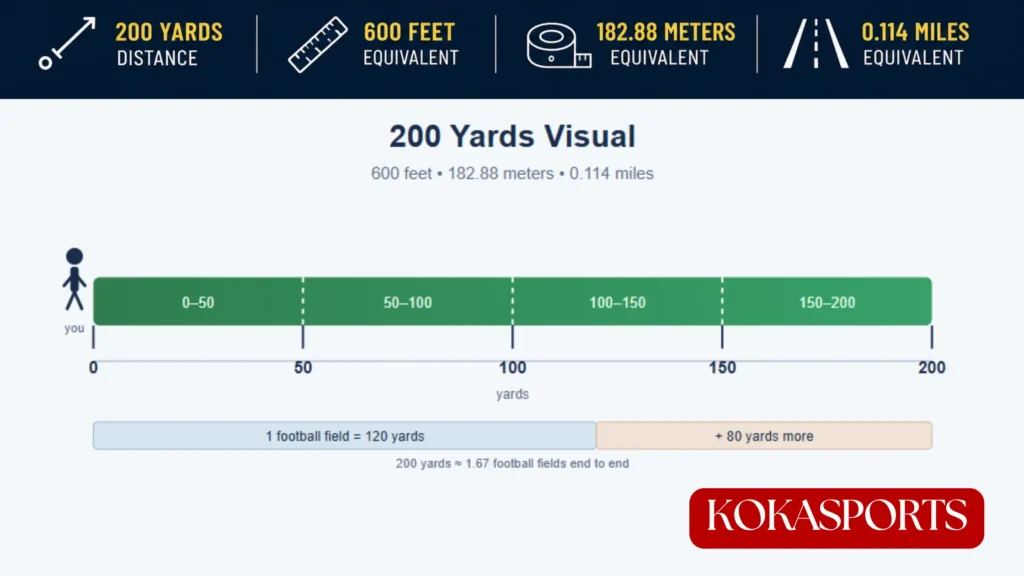
Let’s start with the basics. 200 yards is a measurement of length equal to 600 feet or 182.88 meters. In miles, it is just over one-tenth, about 0.114 miles. That is a solid, open stretch of ground, longer than most people picture when they first hear the number.
Here is the problem, though: 200 yards is genuinely hard to visualize on its own. Our brains are not built to judge raw distances in the air. Ask someone to point to a spot 200 yards away, and most people guess wrong. Why? Because without a reference point, the number is just abstract. Is it the length of a street? A field? A few buildings? That is exactly why comparisons matter so much. The trick to seeing 200 yards is to line it up against things you already know, like a football field or a running track. Once you do that, the distance clicks into place. Let’s build that picture step by step.
200 Yards in Feet, Meters, and Miles
Here is a simple conversion table to anchor the distance in every common unit.
| Measurement | Equivalent |
|---|---|
| Yards | 200 |
| Feet | 600 |
| Meters | 182.88 |
| Miles | 0.114 |
| Inches | 7,200 |
What Does 200 Yards Look Like?
So picture yourself standing at one end of a long, open stretch. Two hundred yards away, a person would look quite small, roughly the size of your thumbnail held at arm’s length. You could still see them clearly, but details like their face would be fuzzy. That is the everyday feel of 200 yards.
Interestingly, the same distance can look very different depending on where you stand. On a straight, narrow path, like a long sidewalk or hallway, 200 yards feels stretched out and far, because everything funnels toward a single vanishing point. Out on a wide-open field, though, that same 200 yards can look shorter, since there is nothing to give your eyes a sense of scale. This is the power of perspective. Distance is not just about measurement; it is about what surrounds it. A flat, empty field hides distance, while a lined path reveals it.
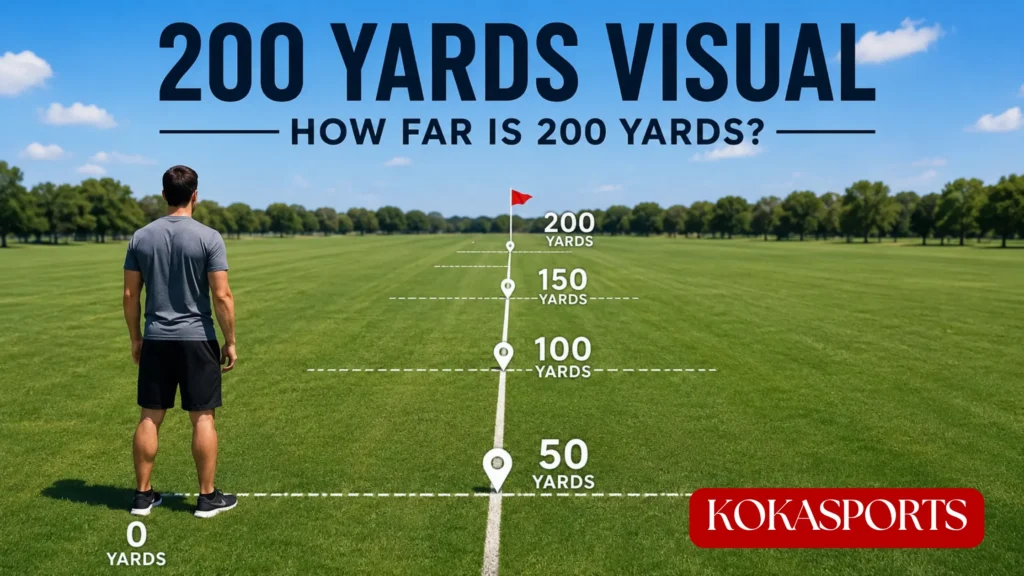
To truly see it, imagine markers placed every 50 yards: a starting point at 0, then flags at 50, 100, 150, and finally 200 yards. Each 50-yard chunk is about half a football field’s playing area. Stack four of those together, and you have your full 200 yards.
(Suggested feature image: a horizontal 200 yards visual showing the distance from 0 to 200 yards, with markers at 50, 100, 150, and 200, and a person at one end for scale.)
200 Yards Compared to a Football Field
For most people, a football field is the easiest way to picture 200 yards, and it works beautifully. An American football field is 120 yards long in total, which includes the 100-yard playing field plus two 10-yard end zones, as confirmed by the NFL. You can read the full breakdown in this guide on how long a football field is.
So how does 200 yards stack up? It is 80 yards longer than an entire football field, end zones included. Picture standing at the very back of one end zone, looking all the way to the back of the other. That whole length is 120 yards. Now add another 80 yards beyond it, and you have reached 200 yards. In other words, 200 yards is a full football field plus two-thirds of another one.
How Many Football Fields Is 200 Yards?
Let’s put a number on it. Since one football field is 120 yards, we simply divide: 200 ÷ 120 equals about 1.67. So 200 yards is roughly 1.67 football fields laid end to end. If you have ever watched a game and imagined running from one end zone, all the way to the other, and then most of the way back again, that is your 200-yard visual. Not so abstract now, is it?
200 Yards Compared to a Soccer Field
A soccer field, or pitch, is another handy comparison, though it comes with a catch. Unlike football fields, soccer pitches are not one fixed size. Their length can range widely, roughly from 100 to 130 yards, depending on the stadium, league, and level of play. As the general standards for a football pitch show, sizes vary quite a bit, which is why you cannot treat one soccer field as a universal ruler.
Is 200 Yards Longer Than a Soccer Field?
Yes, in almost every case. Since most soccer pitches top out around 130 yards, 200 yards is comfortably longer than a single field, by 70 yards or more. Even the largest pitches fall well short of 200 yards. So if you picture a full soccer field and then tack on another 70 to 100 yards, you land at 200. Just remember that because pitch sizes vary, this is a general comparison, not an exact one.
200 Yards Compared to a Running Track
Track and field gives us another clean reference. A standard outdoor running track measures 400 meters for one full lap around the inside lane. Since 200 yards equals 182.88 meters, the math is easy: 200 yards is just under half of one lap around a standard track. Run from the start line to a little before the halfway mark, and you have covered your 200 yards.
200 Yards vs 200 Meters
Here is a mix-up worth clearing up, because people confuse these two constantly. They are not the same distance. 200 yards equals 182.88 meters, while 200 meters equals about 218.72 yards. That means 200 meters is the longer of the two, by roughly 18 yards. So if you run a 200-meter sprint on a track, you are actually running a bit farther than 200 yards. Small difference on paper, but it matters in a race.
How Long Does It Take to Walk 200 Yards?
Wondering how 200 yards feels on foot? Not far at all, honestly. At a normal walking pace, most people cover 200 yards in about two minutes.
Average Walking Time for 200 Yards
Your exact time depends on your speed. A slow, relaxed stroll might take around three to three-and-a-half minutes. A normal, steady walk lands close to two minutes. A brisk, fast walk can cover it in about a minute and a half. Of course, terrain and fitness change things. Walking 200 yards uphill or across sand takes longer than strolling down a flat sidewalk. But as a rule of thumb, 200 yards is a short, easy walk, about the length of a quick trip across a large parking lot.
How Long Does It Take to Run 200 Yards?
Running flips the feeling entirely. Two hundred yards is a common short-distance running measurement, and it goes by fast. A recreational runner jogging at a comfortable pace might cover it in roughly 40 to 60 seconds. A trained, competitive sprinter can blaze through 200 yards in around 20 seconds or even less.
Times vary a lot, though, based on age, ability, fitness, and conditions like wind or track surface. And once again, do not confuse 200 yards with the standard 200-meter sprint you see in the Olympics. The 200-meter race is a touch longer, so sprint times for the two are not identical. Still, for most people, 200 yards is a quick, punchy run, over almost before it begins.
200 Yards Compared to Everyday Objects and Places
Sports fields are great, but let’s bring 200 yards into daily life with things you see all the time.
200 Yards Compared to a City Block
City blocks are a natural yardstick, but they vary a lot from city to city. In many places, a typical block runs somewhere near 100 yards, which would make 200 yards roughly two city blocks. In other cities, blocks are longer or shorter, so treat this as a handy estimate rather than a precise rule. Walk to the end of your block, then the next one, and you are in the ballpark of 200 yards.
200 Yards Compared to a House
Here is one that really drives the size home. A typical house is maybe 15 to 20 yards wide across the front. That means you could line up around ten or more average homes side by side and still barely stretch to 200 yards. Picture an entire row of houses down one side of a street. That long line of homes gives you a strong sense of just how far 200 yards reaches.
200 Yards Compared to a Basketball Court
Basketball courts offer a precise comparison. An NBA court is 94 feet long. Since 200 yards equals 600 feet, we divide 600 by 94 and get about 6.4. So 200 yards is roughly six and a half basketball courts placed end to end. Imagine laying six full NBA courts in a row, then adding half of a seventh. That is your 200-yard visual, court by court.
100 Yards vs 200 Yards: What’s the Difference?
It helps to compare 200 yards with its little sibling, 100 yards. The table below lays them side by side.
| Distance | Feet | Meters | Miles |
|---|---|---|---|
| 100 yards | 300 | 91.44 | 0.057 |
| 200 yards | 600 | 182.88 | 0.114 |
The relationship is simple: 200 yards is exactly twice 100 yards. But here is the interesting part. Doubling a distance changes how it looks more than you might expect. One hundred yards is a single football playing field, an easy, familiar span. Two hundred yards suddenly feels like a real journey, stretching well past a full field. When you double the ground, you do not just add length, you change the whole feel of the distance.
200 Yards vs 200 Meters
Since this trips up so many people, it deserves its own quick look. 200 yards equals 182.88 meters. 200 meters equals about 218.72 yards. The difference between them is roughly 17 meters, or about 18 yards. So 200 meters is clearly the longer distance. If you picture 200 yards and then add nearly another 20 yards on the end, you reach 200 meters. They sound the same, but they are not, so it is always worth double-checking which unit you mean.
How to Measure 200 Yards Yourself
Want to mark out 200 yards in the real world? Here are the most reliable ways. A measuring wheel is the classic tool, since you just roll it along the ground until it reads 200 yards. A GPS running app on your phone can track the distance as you walk it. A marked sports field, like a football field, gives you a built-in ruler to count from. An online map measurement tool lets you draw the distance on a satellite image from your computer. And for shorter reference points, a measuring tape works if you repeat it in sections. One warning: pacing it out by counting your steps is only a rough estimate, because everyone’s stride length is different.
Quick 200-Yard Conversion Chart
Here is a compact reference you can bookmark.
| Unit | 200 Yards |
|---|---|
| Feet | 600 |
| Inches | 7,200 |
| Meters | 182.88 |
| Kilometers | 0.18288 |
| Miles | 0.1136 |
FAQs About 200 Yards
How far is 200 yards?
200 yards is 600 feet, or about 182.88 meters. In miles, that comes to roughly 0.114 miles, a little over one-tenth of a mile.
Is 200 yards a long distance?
It depends on the activity. For walking or running, 200 yards is short and quick. For throwing, measuring land, or judging distance by eye, it can feel surprisingly far.
How many football fields is 200 yards?
About 1.67 full football fields, including both end zones, since one field is 120 yards long. That is one complete field plus roughly two-thirds of another.
How many feet are in 200 yards?
There are 600 feet in 200 yards, because each yard contains 3 feet, and 200 times 3 equals 600.
How many meters are in 200 yards?
200 yards equals 182.88 meters, since one yard is exactly 0.9144 meters.
Is 200 yards the same as 200 meters?
No. 200 meters is longer. 200 meters equals about 218.72 yards, roughly 18 yards more than 200 yards.
How long does it take to walk 200 yards?
At a normal pace, about two minutes. A slow stroll may take up to three-and-a-half minutes, while a brisk walk can cover it in around a minute and a half.
Conclusion
So here is the simplest way to lock in your 200 yards visual: 200 yards equals 600 feet, or 182.88 meters, which is about 1.67 football fields laid end to end. Whether you picture a football field plus another two-thirds, six and a half basketball courts, or a long row of houses down a street, the goal is the same, to turn an abstract number into a distance you can actually see. Next time someone says “200 yards,” you will not have to guess. You will know exactly how far that is, and you will be able to picture it in a heartbeat.