


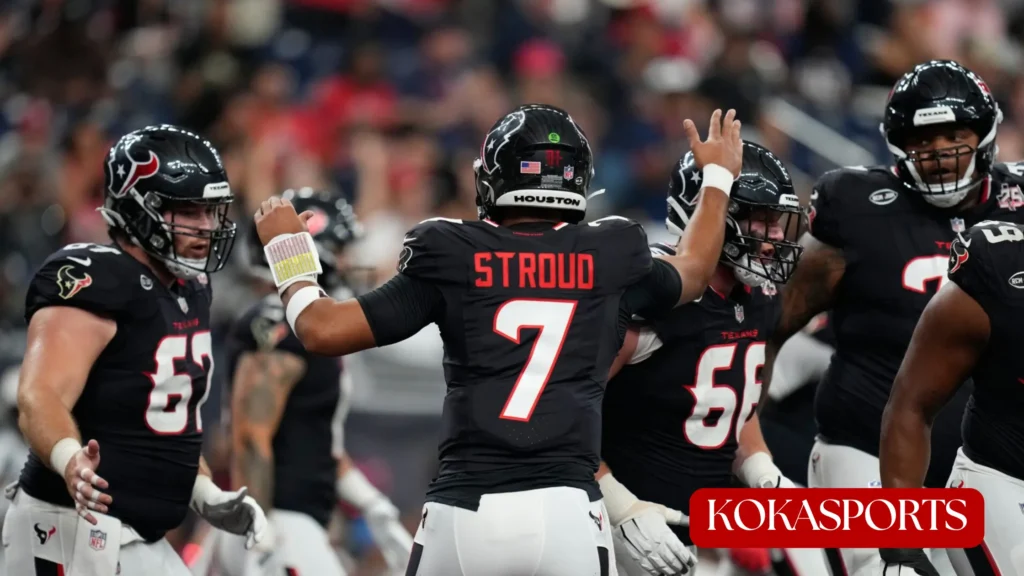
Houston Texans fans might have felt they were overdue for some good news. During Week 5, the Texans delivered. After a less-than-inspiring string of four defeats, the team beat the Tennessee Titans 26–3. Central to that result was C.J. Stroud who provided a clinical performance that was reinforced by inspired defensive contributions.
The victory left Houston at 1-4 through five games, compared with Jacksonville’s 4-1 record over the same stretch. That opening established the ground the Texans needed to recover in the AFC South. The Texans’ narrow 19–17 loss to Indianapolis also showed how costly divisional defeats can be. For Houston to recover, several improvements need to last longer than a single Sunday.
Give C.J. Stroud More Help From the Entire Offense
Stroud threw for 261 yards against Tennessee, spreading the ball around and generally keeping the offense moving. Houston looked more composed than it had during parts of its winless opening stretch, but that level of execution can’t remain an occasional treat.
Protection comes first. A quarterback can read a defense correctly and still have no chance if pressure arrives before his receivers finish their routes. Better communication across the offensive line, particularly against disguised blitzes, would give Stroud more opportunities to attack downfield without gambling on every throw.
The Texans have also added an intriguing receiving option. Marvin Harrison Jr. arrived from Arizona in an October trade, reuniting with Stroud after their time together at Ohio State, where the pair became one of the most productive connections in college football. His previous connection with Stroud provides background to the move, while his production in Houston will depend on his role, preparation and execution against NFL defenses.
Houston shouldn’t build its offense around spectacular completions alone. Short throws on schedule, receivers creating space underneath and fewer wasted early downs can make the difficult plays less necessary. The goal is an attack that functions even when opponents take away its preferred matchup.
Make the Running Game a Genuine Threat
Houston needs more productive rushing rather than simply more carries. Coordinated blocking and usable running lanes help the offense avoid repeated second-and-long situations. A four- or five-yard gain preserves more options, while short gains and losses give defenses greater reason to anticipate a pass and pressure Stroud.
For readers following Houston Texans odds, rushing efficiency provides context alongside the passing game. The aim is an offense that sustains drives through different types of plays, reducing its dependence on Stroud to recover lost yardage or repeatedly convert difficult third downs.
Turn the Tennessee Defensive Performance Into a Habit
Houston’s defense was the standout unit against Tennessee. The Titans managed only three points, and Will Anderson Jr. recorded three sacks as the Texans disrupted passing plays and forced mistakes.
That intensity offers a useful standard. Edge pressure can change a quarterback’s first read, but it works best when the coverage behind it holds together. A free runner coming through the line means little if a receiver is left completely uncovered.
Ryans has taken back defensive play-calling responsibilities following the team’s difficult start. Stronger communication should reduce the blown assignments that turn an ordinary gain into a long touchdown, particularly when offenses use motion or hurry to stress the secondary.
There’s also a difference between dominating a struggling opponent and containing a dangerous divisional rival. Jacksonville, for instance, won’t necessarily give Houston the same chances Tennessee did. The Texans need pressure that travels from week to week, paired with disciplined tackling when opponents find a way into the open field.
Stop Letting Tight Games Slip Away
Houston knows how painful a narrow loss feels. The Texans fell 19–17 at Indianapolis in Week 3 and lost 34–30 to Dallas the following week. Those two games were decided by a combined six points, yet neither added anything to the standings.
Close games rarely come down to one isolated mistake. A penalty that turns third-and-short into third-and-long, a missed tackle near the sideline or a red-zone trip ending without a touchdown can matter as much as the final possession.
Better situational execution isn’t about playing timidly. Houston must recognize when aggression is justified and when taking a modest gain, protecting the ball or forcing an opponent to use a timeout is the smarter move.
Those moments can be planned for and they do say that practice makes perfect. However, players still have to make decisions on the fly in environments where crowd noise can be overwhelming. Those teams that remain composed will have an advantage over their opponents, especially when the game is in its dying minutes.
Treat AFC South Games Like Opportunities to Change the Race
The division gives Houston a direct route to recover ground, but it also punishes missed opportunities. Losing to Indianapolis in September hurt twice: the Texans missed a win, and a rival collected one.
Jacksonville’s strong opening provides a divisional benchmark for Houston. Performances against the Jaguars help assess whether the Texans can sustain defensive pressure against different opposition while keeping Stroud out of obvious passing situations.
The 26–3 win over Tennessee established that Houston can still impose itself on a divisional opponent. The challenge is repeating that level of control when the game stays close and the other sideline starts making adjustments.
Divisional rematches provide opportunities to affect both teams’ records directly. Beating Indianapolis or Jacksonville adds a Houston win and a rival’s loss, making those results especially relevant to the standings. Those opportunities also make consistent execution important beyond the initial Tennessee victory.
Build Consistency Beyond One Convincing Win
The success that Houston had against Tennessee proved how well the offense and defense were working when combined. The overall picture will depend on how well the protection, rushing efficiency, and situation execution contribute to that success against various teams. This also includes player availability and the demands of the match.
A recovery requires more than repeating the final score from one successful afternoon. Sustaining drives, limiting defensive breakdowns and managing close games provide concrete areas to assess. Consistency across those situations would offer stronger evidence of Houston’s competitiveness within the AFC South.
FAQs
What do the Houston Texans need to improve?
The Houston Texans need to improve their consistency on offense, protect the football, strengthen their run game, and maintain the strong defensive performances that can keep them competitive in AFC South games.
Can the Houston Texans still compete in the AFC South?
Yes. A 1-4 start makes the challenge difficult, but the season is not over. Winning divisional games and building on the Week 5 victory could help the Houston Texans close the gap with teams such as Jacksonville and Indianapolis.
What is the biggest area the Houston Texans need to fix?
Consistency is one of the biggest concerns. The Texans need their offense and defense to perform at a reliable level each week rather than depending on one strong performance to turn the season around.
Conclusion
The Houston Texans showed against Tennessee that they can respond after a difficult start. However, one win will not solve the problems that caused their early struggles. Better offensive consistency, stronger execution, and continued defensive effort will be important going forward. If Houston can turn those improvements into a weekly standard, the Texans can give themselves a better chance of competing in the AFC South. To keep up with every Texans game and the rest of the weekend’s action, see our full guide to sports on TV today.