
Every snap in football starts with sound. The quarterback barks a rhythm, the line waits for the word, and the ball moves. A hard count flips that rhythm into a weapon. Run it right and the offense steals five free yards, or a free shot downfield, before the defense even realizes it jumped too soon.
So what is a hard count in football, and why do the smartest quarterbacks lean on it all game long? Here is the complete breakdown, checked line by line against the official NFL rulebook.
What Is a Hard Count in Football?
A hard count is an audible snap count that uses an irregular, accented cadence to bait the defense into jumping early. The quarterback runs his normal rhythm, then punches an extra loud word or syllable right where the snap would usually come. If a defensive lineman bites and crosses the line, the offense wins the down before it even starts.
The whole trick lives in the voice. The quarterback is not snapping the ball. He is selling the snap. The defense has been timing his cadence all game, so he uses that timing against them.
Hard Count vs Snap Count vs Cadence
These three terms get mixed up constantly, so get them straight once and for all.
- Cadence is everything the quarterback says before the snap: the color calls, the motion words, the audibles, and the snap signal.
- Snap count is only the part that tells the center when to snap the ball. It is one piece of the cadence, not the whole thing.
- Hard count is a cadence used on purpose to look like the snap is coming when it is not.
In short, every hard count is a cadence, but not every cadence is a hard count.
How a Hard Count Works
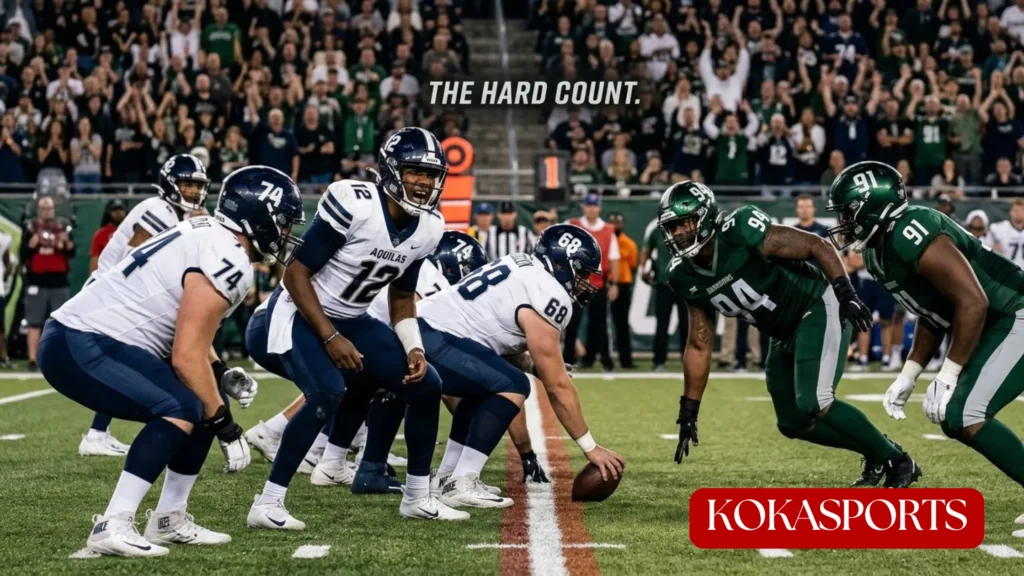
The setup is simple. The quarterback establishes a normal rhythm early in the game so the defense learns his timing. Then, on a key down, he adds a hard, loud call where the snap normally lands. Think of a steady “set, hut one, hut two” that suddenly gets an aggressive extra beat.
A pass rusher who is keyed on the sound guesses, explodes off the line, and lands in the neutral zone before the ball has moved. The flag flies, and the offense collects the reward.
This is where disciplined defensive linemen earn their money. The rule in the trenches never changes: watch the ball, not the voice. If you want to understand the players most often targeted by a hard count, our guide to pass rush moves for defensive ends and EDGE rushers and our breakdown of the 5 technique in football show exactly who is lined up in the firing line.
Why Offenses Use the Hard Count
The obvious payoff is the penalty, but the hard count does more than draw a flag. Even when the defense holds, the threat of a hard count keeps pass rushers a beat slower off the snap, because nobody wants to be the guy who jumps. That hesitation gives the offensive line an edge and buys the quarterback time.
Used often enough, it forces the defense to play honest, react instead of attack, and lose a half step of aggression all game. That is a quiet win on every single down.
What Is a Free Play?
The free play is the biggest prize a hard count can unlock. If the defense jumps offside but the ball is still snapped, the officials let the down play out because there is a penalty in the offense’s pocket no matter what happens.
Now the quarterback has nothing to lose. He can take a deep shot into the end zone knowing that if it falls incomplete or gets intercepted, the offense simply declines nothing and accepts the five-yard offside penalty instead. If the big play connects, they keep the gain. Heads they win, tails they break even.
The Penalties a Hard Count Can Draw
A hard count is designed to force one of three pre-snap defensive fouls. All three cost the defense five yards, and the definitions below come straight from the NFL’s official video rulebook.
- Offside: A defender is offside when any part of his body is in or beyond the neutral zone when the ball is snapped. Penalty: loss of five yards.
- Neutral zone infraction: Called when a defender moves beyond the neutral zone before the snap with a clear path to the quarterback, or when he jumps in and causes an offensive player to react. The whistle blows immediately and the penalty is five yards.
- Encroachment: Called when a defender crosses the line and makes contact with an offensive player or the ball before the snap. It is a dead-ball foul worth five yards.
One important note for your notes: a five-yard defensive penalty only produces an automatic first down when those five yards actually reach the line to gain. It is not automatic on every play.
When a Hard Count Becomes Illegal
Here is the part most explainers miss. The hard count is legal with the voice, but there is a hard limit on movement. The NFL rulebook is clear that any obvious attempt by the quarterback, or another player in position to take the snap, to draw the defense offside is a false start. Any quick, abrupt movement that simulates the snap is also a false start, and the whistle blows right away.
So the quarterback can shout, stretch his cadence, and add all the hard calls he wants. The moment he or his linemen flinch to fake the snap, the five-yard penalty flips the other way onto the offense. There is also another built-in risk: a quarterback’s own offensive line can get fooled by the hard count and jump, giving up a false start of their own.
When Quarterbacks Use the Hard Count

Timing matters. Quarterbacks love the hard count right before the end of the first or third quarter and just before the two-minute warning, because the clock stoppage protects them from a delay-of-game penalty if the play clock runs down. For a refresher on how the game clock is structured, see our guide to how many quarters are in football.
Crowd noise is the other big factor. A loud home crowd can drown out a visiting quarterback and strip the hard count right out of his toolbox, which is one more reason home-field advantage is real.
Famous Hard Count Examples
No conversation about the hard count is complete without Aaron Rodgers, widely regarded as the best in the league at it and often called the king of the hard count. His ability to draw free plays turned routine third downs into touchdowns for years.
The tactic also landed in the spotlight during the January 2025 NFC Championship Game, when the Philadelphia Eagles paired a hard count with their Tush Push quarterback sneak. The Washington Commanders kept jumping offside trying to time the snap, and the officiating crew eventually warned that they could award the Eagles a score if the repeated fouls continued. It was a live lesson in how dangerous a well-run hard count can be at the goal line.
Frequently Asked Questions
Is a hard count legal in football?
Yes. A hard count is completely legal as long as it stays in the quarterback’s voice. He can shout, stretch his cadence, and add hard calls freely. It only becomes illegal if he or his linemen make a quick movement that fakes the snap, which is a false start on the offense.
What is the difference between a hard count and a snap count?
The snap count is simply the signal that tells the center when to snap the ball. A hard count is a cadence run on purpose to look like that snap is coming when it is not, so the defense jumps early.
What penalty does a hard count cause?
It is designed to draw one of three pre-snap defensive fouls: offside, a neutral zone infraction, or encroachment. Each one costs the defense five yards.
What is a free play on a hard count?
If the defense jumps offside but the ball is still snapped, the offense gets a free play. They can take a risky deep shot knowing any bad result can be wiped out by the five-yard penalty, or they keep the gain if the play works.
Who is the best at the hard count in the NFL?
Aaron Rodgers is widely regarded as the best, often called the king of the hard count for how consistently he draws defenders offside and turns it into free plays.
Conclusion
A hard count is one of football’s purest mind games. No fancy formation, no trick play, just a quarterback using his voice and the defense’s own timing against them. It can steal five yards, unlock a free play, or simply slow a pass rush down for sixty minutes.
For defenders, the counter is discipline. For offenses, it is a free weapon that never leaves the playbook. Either way, understanding what a hard count is turns a confusing pre-snap flag into one of the most satisfying plays to watch.
Want to keep sharpening your football IQ? Dig into our NFL catch rule explained guide and our complete football positions breakdown next.