
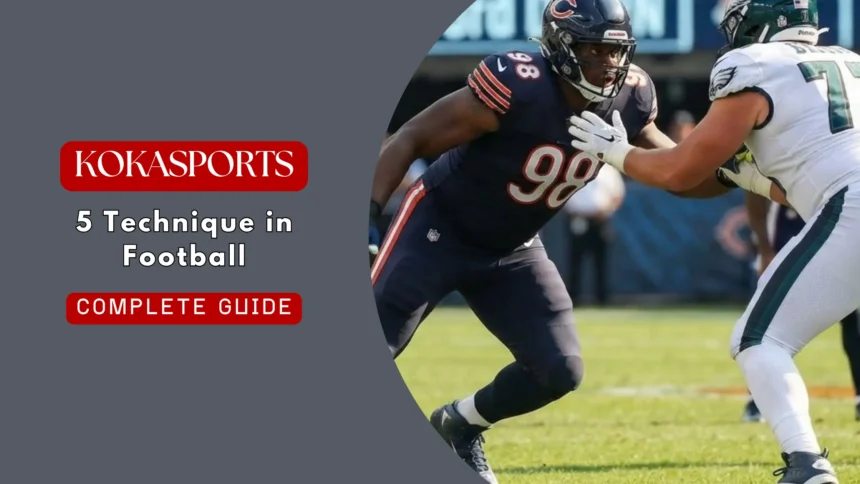
If you have watched a draft broadcast or listened to a defensive coach break down film, you have probably heard a player described as a “5 technique.” It sounds like jargon, and in a way it is, but the idea behind it is simple. In 5 technique football, the number does not describe a skill or a pass-rush move. It describes exactly where a defensive lineman lines up before the snap. Get that one idea straight and the rest of the defensive line vocabulary starts to fall into place.
This guide breaks down what a 5 technique in football is, how the numbering system works, where the 5 technique fits into modern defenses, and why the label is so often misunderstood, even by people who use it every week.
What Is a 5 Technique in Football?
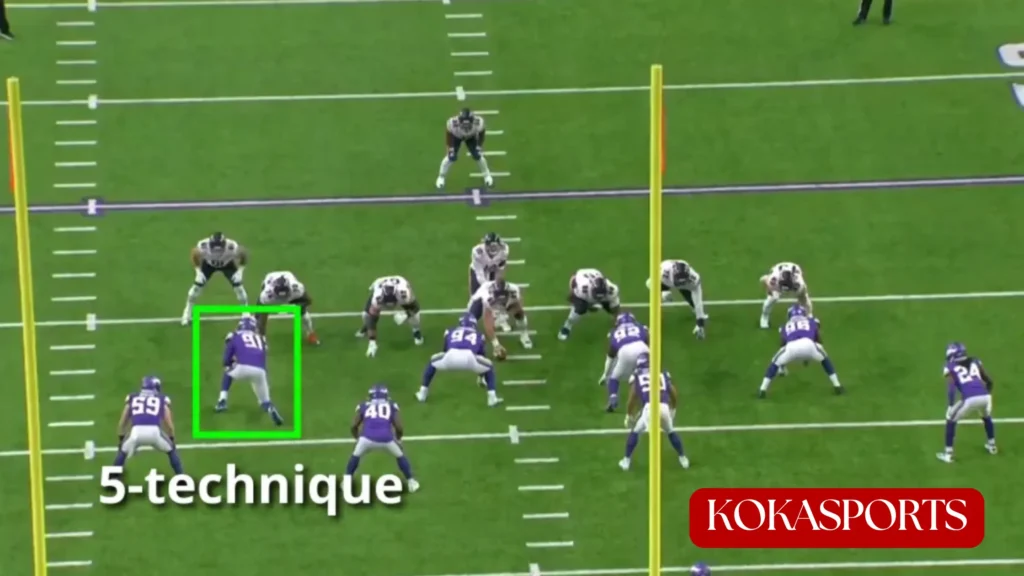
A 5 technique in football is a defensive lineman who lines up on the outside shoulder, or outside eye, of the offensive tackle. That is the whole definition. When a defender’s helmet is aimed at the outside half of the offensive tackle at the snap, he is playing a 5 technique.
The term comes from the defensive line technique numbering system, a coaching shorthand that assigns a number to every alignment across the offensive front. Because the 5 technique sits right on the edge of the interior line, it is one of the most important and most talked about spots on the field, especially for teams that build their defense around a 3-4 front.
The Defensive Line Technique Numbering System (0 to 9)
The numbers run from the center outward, so the closer a defender is to the middle of the formation, the lower his number. The 5 technique is just one number in the broader defensive line numbering system, which spans 0 through 9.
Here is how the standard alignments break down:
| Technique | Alignment |
|---|---|
| 0 | Head up on the center |
| 1 | Outside shoulder of the center |
| 2i | Inside shoulder of the guard |
| 2 | Head up on the guard |
| 3 | Outside shoulder of the guard |
| 4i | Inside shoulder of the tackle |
| 4 | Head up on the tackle |
| 5 | Outside shoulder of the tackle |
| 6 | Head up on the tight end |
| 7 | Inside shoulder of the tight end |
| 9 | Outside shoulder of the tight end |
There is a simple logic underneath the chart. Even numbers place a defender head up on a blocker. Odd numbers place him on the outside shoulder. An “i” attached to a number means he is on the inside shoulder instead. So a 5, being an odd number, is an outside alignment, and it is measured off the tackle. Clear definitions of each alignment and gap are also laid out in reference form by Wikipedia’s guide to football gaps.
Gaps and the 5 Technique
To understand why alignment matters, you have to understand gaps. Gaps are the spaces between offensive linemen, and the defense has to account for every one of them to stop the run. They are labeled with letters, working outward from the center. The A gap is between the center and guard, the B gap is between the guard and tackle, the C gap is between the tackle and tight end, and the D gap is outside the tight end.
A 5 technique lines up on the outside shoulder of the tackle, which puts him right on the edge of the B gap and the C gap. Where his responsibility actually falls depends on the scheme, which is where the 3-4 defense comes in.
The 5 Technique in a 3-4 Defense
The 5 technique is most closely tied to the 3-4 defense. In a traditional 3-4 front, the defensive line is made up of a nose tackle over the center and two defensive ends, and those ends line up at 5 technique on either side.
What makes the classic 3-4 end different from a 4-3 end is responsibility. In a true two-gap 3-4, the 5 technique is asked to control the offensive tackle and hold both gaps on either side of him, the B gap and the C gap. Rather than shooting upfield to get to the quarterback, he takes on the blocker, reads the play, and keeps blockers off the linebackers behind him. That is a demanding job, and it is why 3-4 defensive ends tend to be some of the longest and strongest players on the field, often listed around 285 to 315 pounds.
3 Technique vs 5 Technique

These two positions get compared constantly, and the difference comes down to where they line up and what they are asked to do.
A 3 technique lines up on the outside shoulder of the guard. He is usually a one-gap penetrator whose job is to fire into the B gap and disrupt the backfield. You find the 3 technique most often as an interior rusher in a 4-3 defense.
A 5 technique lines up on the outside shoulder of the tackle. He plays farther out, is more often a two-gap player, and is typically the defensive end in a 3-4. In short, the 3 technique attacks and penetrates, while the 5 technique controls and anchors. Both are valuable, but they are built for different jobs.
The 4, 4i, and 5 Technique Mix-Up
Here is where even experienced fans get tripped up. In everyday conversation, people call the 3-4 defensive end a 5 technique as if he lines up there on every snap. In reality, that label has become a catch-all.
The player most people picture as a “pure 5 technique,” the long, strong end who dominates the run over the tackle, often lines up head up on the tackle at a 4 technique or on the inside shoulder at a 4i technique, depending on the front and how the nose tackle is shaded. Analysis from Pro Football Focus, which charts the exact alignment of every defender, has shown that snaps at a true 5 technique are actually less common than many assume, with the 4 and 4i showing up far more often. So when you hear “5 technique,” think of it as a role and an archetype as much as a precise spot on the line.
What Makes a Great 5 Technique
Because the 5 technique often has to hold up against blockers rather than simply run past them, the traits that matter are a little different from those of a pure speed rusher.
- Length and size. Long arms let a defender lock out an offensive tackle, control him, and still shed the block to make a play.
- Power and anchor. A good 5 technique cannot get moved off the line, so lower-body strength and leverage are essential.
- Hand technique. Winning the hand fight is how he controls a blocker and stays clean enough to cover two gaps.
- Discipline. Two-gap responsibility rewards patience and gap integrity over gambling upfield.
A player who can also rush the passer from that spot is especially valuable, which is why the most versatile ends slide inside on passing downs and line up as a 3 technique in nickel packages.
Where the Numbering System Came From
The numbering system is not an official rule handed down by a league. It grew out of coaching. The alignment numbers are generally credited to Bum Phillips, who worked out the system as a Texas high school coach, and to Paul “Bear” Bryant, who adopted it, standardized it, and popularized it in his 1960 book on building a championship team. As the NFL itself has noted, Phillips gave Bryant the idea for defensive front numbering such as the one technique, three technique, and five technique. You can read more about that history through NFL.com.
That origin also explains why you will occasionally see small differences from one staff to another. As long as a coaching staff agrees on its own definitions, the system does its job, which is getting eleven defenders lined up correctly with as few words as possible.
Frequently Asked Questions About the 5 Technique in Football
What is a 5 technique in football?
A 5 technique is a defensive lineman who lines up on the outside shoulder, or outside eye, of the offensive tackle. The number refers only to his alignment before the snap, not to a specific skill or pass-rush move.
Is a 5 technique the same as a defensive end?
Not always, but the two overlap. In a 3-4 defense, the defensive ends usually play the 5 technique, so the terms are often used interchangeably. In a 4-3 defense, ends line up wider and are not typically called 5 techniques.
What is the difference between a 3 technique and a 5 technique?
A 3 technique lines up on the outside shoulder of the guard and is usually a one-gap penetrator, most common as an interior rusher in a 4-3. A 5 technique lines up on the outside shoulder of the tackle, plays farther out, and is more often a two-gap anchor in a 3-4.
Why is a 5 technique often confused with a 4 or 4i technique?
Because “5 technique” has become a catch-all for the 3-4 defensive end. That same player often lines up head up on the tackle at a 4 technique or on the inside shoulder at a 4i technique, depending on the front and how the nose tackle is shaded, so his true alignment changes from snap to snap.
Conclusion
In 5 technique football, one number tells you almost everything about a player’s job. He is the defender on the outside shoulder of the offensive tackle, usually the anchor of a 3-4 front, built to control blockers, hold the edge, and keep his linebackers clean. Learn the numbering logic behind it, remember that even fans and analysts use “5 technique” as a loose label for the 3-4 end, and the next time you hear the term on a broadcast you will know exactly what it means and why it matters.