
13 personnel formations are some of the most flexible looks in football, which is exactly why they have become so popular in the modern game. The grouping puts three tight ends on the field, and those three big bodies can line up in a dozen different ways, from a bruising goal-line wall to a spread-out passing look created with a single motion. This guide breaks down the alignments you can run from 13 personnel, the one rule that shapes every legal formation, and how offenses use these sets to put defenses in a bind.
What Is 13 Personnel?
13 personnel is an offensive grouping with 1 running back, 3 tight ends, and 1 wide receiver. The first digit is the running backs and the second is the tight ends, and the lone receiver is whatever is left of the five skill spots. It is a heavy package, traditionally tied to power running, though modern offenses now use it to throw as well. If you want the full background on the grouping itself, see our full guide to 13 personnel. This article focuses on the formations you can build from it.
The Rule That Shapes Every 13 Personnel Formation
Before the formations make sense, you need one rule, because it decides how three tight ends can legally line up. An offense must have seven players on the line of scrimmage, and only the two players on the very ends of that line are eligible to catch a forward pass. Everyone else on the line is ineligible. You can read the rule in this eligible receiver reference.
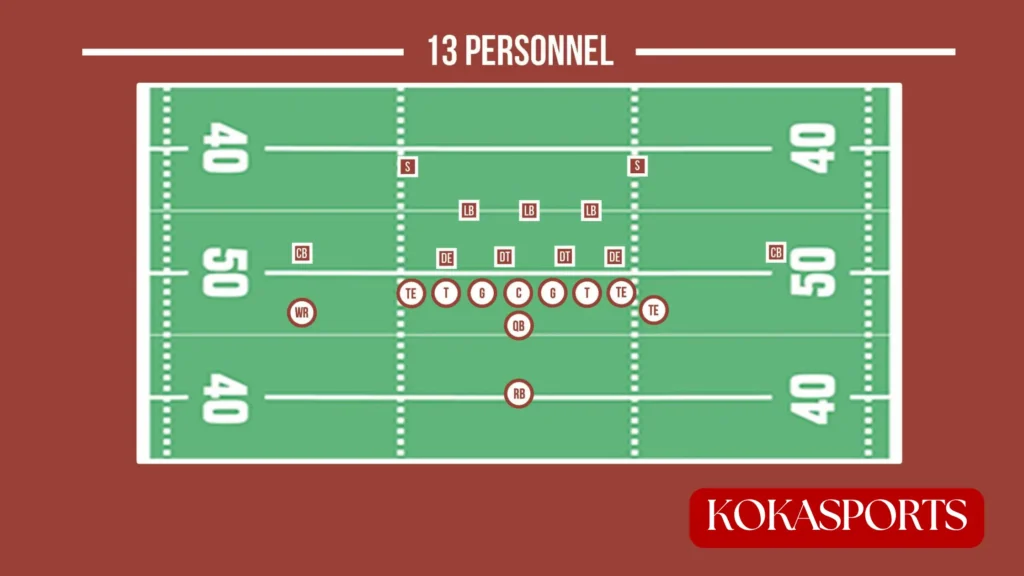
Here is why that matters in 13 personnel. You have three tight ends and one receiver, which is four eligible pass catchers on top of the running back. But if you line a tight end up on the line and place another player outside him on that same line, the inside tight end is now “covered” and can no longer catch a pass. So offenses running three tight ends usually keep one or two of them off the line, a step or so into the backfield, so all of them stay eligible. That single rule is the reason the alignments below look the way they do.
Tight End Alignments in 13 Personnel
The three tight ends do not all line up the same way. Coaches spread them into different roles to keep them eligible and to stress the defense.
Inline Tight End
An inline, or attached, tight end lines up right next to the offensive tackle on the line of scrimmage. When he is the last man on his end of the line, he is an eligible receiver and a strong run blocker. This is the classic tight end look and the anchor of most heavy formations.
The H-Back
The H-back is the key to 13 personnel. Rather than lining up on the line, he sets up a few yards behind it, in the slot between the end of the line and the nearest receiver, where he can block or release into a route. Because he is off the line, he stays eligible even when the ends are already occupied, which is exactly what an offense needs with three tight ends. The official NFL glossary entry for the H-back describes this role, and it is what lets an offense field three catchable tight ends at once.
Wing Tight End
A wing tight end lines up off the line, a step behind and just outside another tight end or the tackle. The wing alignment adds a blocker at the edge for power runs while keeping the player eligible, and it is common in goal-line and short-yardage sets.
Common 13 Personnel Formations
With those alignments in mind, here are the formations you will see most often from 13 personnel.
Balanced Heavy Sets
A balanced set attaches a tight end to each side of the line and places the third as an H-back behind the formation. This look is hard to read because it threatens runs to either side equally, and the H-back can insert as a lead blocker or slip out for a pass.
Unbalanced and Strong-Side Overloads
Most 13 personnel formations have a clear strong side, the side with more tight ends. By stacking two or three tight ends toward one side, an offense overloads that edge with blockers and creates an obvious but painful run threat. The defense must either match the strength or give up leverage at the point of attack.
Bunch and Stacked Tight End Looks
Tight ends can bunch together near the line to create traffic and rub routes in the passing game, or to form a wall on running plays. These tight clusters make it hard for defenders to fit gaps cleanly and can spring a tight end free on play action.
Goal-Line and Jumbo Sets
Near the goal line, 13 personnel becomes a jumbo package. Tight ends attach and wing up tight to the formation, sometimes with a back stacked behind, turning the whole front into a blocking surface built to move the pile a yard forward.
Spreading Out of 13 Personnel
The most modern wrinkle is using heavy personnel in a light formation. By flexing a tight end out wide or motioning him into the slot, an offense can spread the field while still carrying three tight ends. The defense that substituted its bigger run-stopping bodies is suddenly caught trying to cover athletes in space.
How Motion Changes a 13 Personnel Formation
Motion is where 13 personnel gets dangerous. Because the same grouping can look like a power set one moment and a spread set the next, offenses use pre-snap motion and shifts to force the defense to declare its hand. A tight end who starts attached and then motions out wide makes the defense choose in real time: stay in its heavier front and risk a mismatch in coverage, or chase the motion and weaken its run fits. Either way, the offense reads the reaction and takes what the defense gives.
Run vs Pass From 13 Personnel Formations
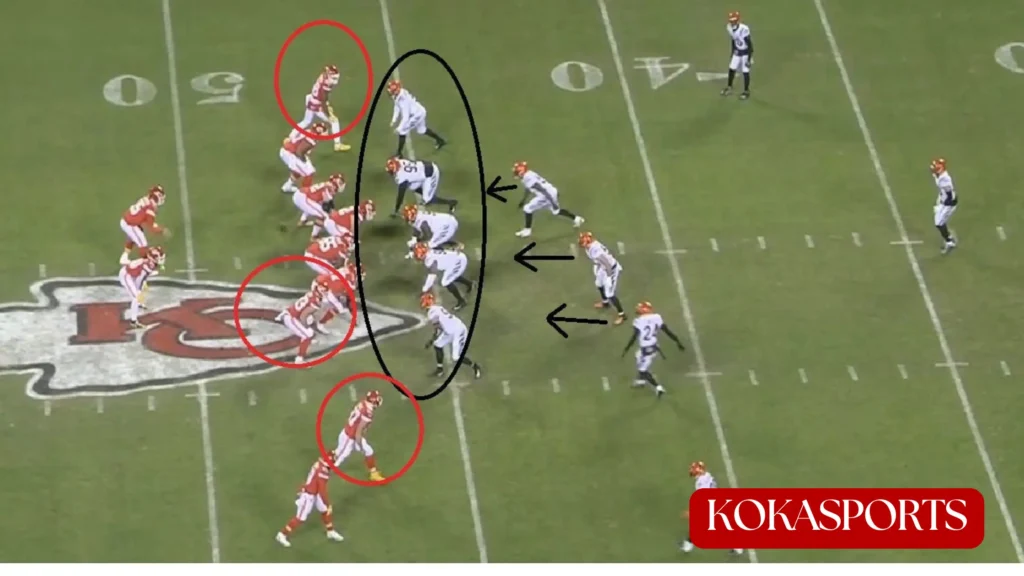
Traditionally, 13 personnel formations lean run. Three tight ends widen the blocking surface and add power for short yardage and goal-line carries. But the modern version is not run-only. Because defenses tend to answer three tight ends with bigger, slower personnel, offenses have learned to throw efficiently from these formations, especially on play action, by turning athletic tight ends loose against linebackers and safeties. Treating 13 personnel as a pure running formation is out of date.
How Defenses Line Up Against 13 Personnel
Defenses respond to 13 personnel by getting bigger or staying disciplined. Many will bring in a base defense or heavier front, adding linebackers or defensive linemen to hold up against the run. Others have started staying in lighter nickel packages with two deep safeties, betting that they can handle the run while keeping enough speed to defend play action. The formation and motion tools above are designed to punish whichever choice the defense makes, which is the whole point of running heavy personnel with skill players who can both block and catch.
Strengths and Weaknesses of 13 Personnel Formations
The strength of these formations is versatility and power. They widen the run game, create blocking angles, and disguise pass concepts behind a heavy look, while motion lets the offense shift the picture at the last second. The weakness is a lack of speed and spacing compared to receiver-heavy sets, and the grouping can tip a run tendency if the offense is predictable. The best 13 personnel offenses lean on tight ends who can both block and run routes, which keeps the defense guessing rather than keying on the run.
Frequently Asked Questions
What formations can you run from 13 personnel?
You can run balanced heavy sets, strong-side overloads, bunch and stacked tight end looks, goal-line jumbo packages, and even spread looks created by flexing or motioning a tight end wide.
Can all three tight ends catch passes in 13 personnel?
Yes, as long as they line up legally. Only the two players on the ends of the line are eligible, so offenses keep one or two tight ends off the line as H-backs or wings to make sure all three can catch passes.
Is 13 personnel only for running?
No. It leans run and is a staple in short yardage, but modern offenses also pass efficiently from it using play action and tight end mismatches.
How do defenses defend 13 personnel?
Defenses either bring in heavier personnel to stop the run or stay in a lighter two-safety look to defend the pass. The offense uses formations and motion to attack whichever choice the defense makes.
Conclusion
13 personnel formations turn three tight ends into a puzzle for the defense. The one rule to remember is that only the two end men on the line can catch a pass, which is why the H-back and wing alignments matter so much when you carry three tight ends. From balanced heavy sets to goal-line jumbo packages to spread looks built on motion, these formations let an offense run, pass, and disguise its intent from the same grouping. Master how they line up, and you will see why 13 personnel has become one of the most flexible weapons in the modern game.