
Smash concept football is a two-receiver passing combination that pairs a short hitch underneath with a deep corner route over the top, forcing one defender to cover two routes at once. That defender usually the cornerback cannot do both. If he sits on the hitch, the corner route runs past him. If he drops with the corner route, the hitch is open in front of him. Either way, the quarterback throws where the defender is not.
It is one of the most durable ideas in football, running from youth leagues to the NFL. This guide covers the routes, the quarterback’s read, why it punishes Cover 2, how it holds up against other coverages, and how defenses fight back.
What Is the Smash Concept in Football?
Smash is a concept, not a route. That distinction matters.
A route is what one receiver runs. A concept is a combination designed to attack a specific defender. Smash pairs two routes on the same side so they stress one defender vertically one in front of him, one behind him.
The basic structure
| Player | Typical route | Purpose |
|---|---|---|
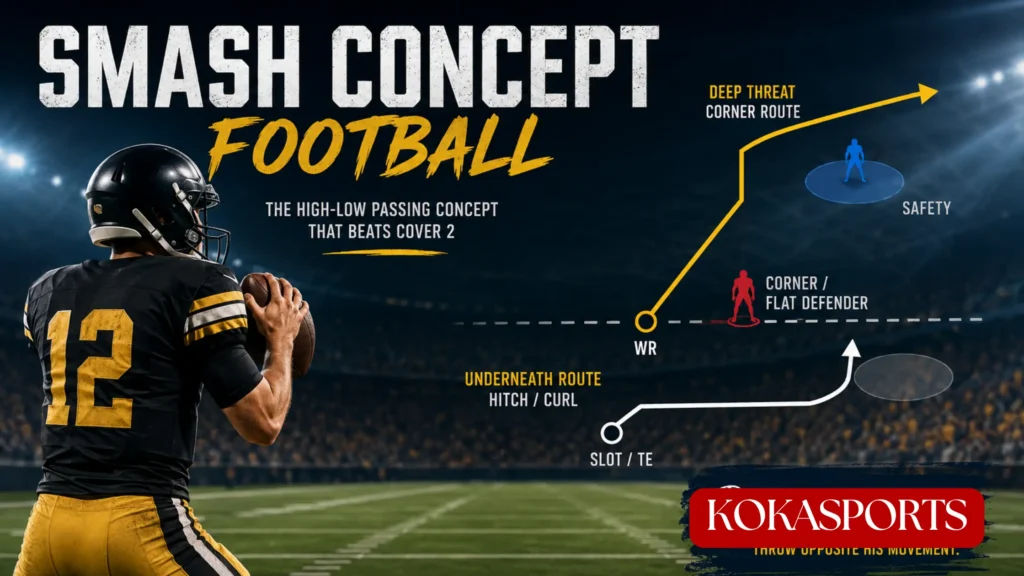
| Outside receiver (#1) | Hitch, 5–6 yards | Underneath option, forces the defender to react fast |
| Slot or tight end (#2) | Corner route, breaking around 10–12 yards | Deep outside option, attacks the space behind |
| Quarterback | Reads the flat defender | Throws opposite the defender’s reaction |
In Air Coryell terminology, that corner route is a seven route, which is why some playbooks call the concept “smash-seven.”
Why it creates a high-low read
“High-low” means putting two routes at different depths in the same defender’s zone, so that covering one leaves the other open.
The geometry is simple. The hitch settles at five or six yards. The corner route breaks at ten to twelve and climbs toward the sideline and the pylon. One defender is being asked to cover a window at six yards and another at eighteen, in the same vertical strip of grass, at the same time.
He cannot. That is the whole idea.
The defender in conflict
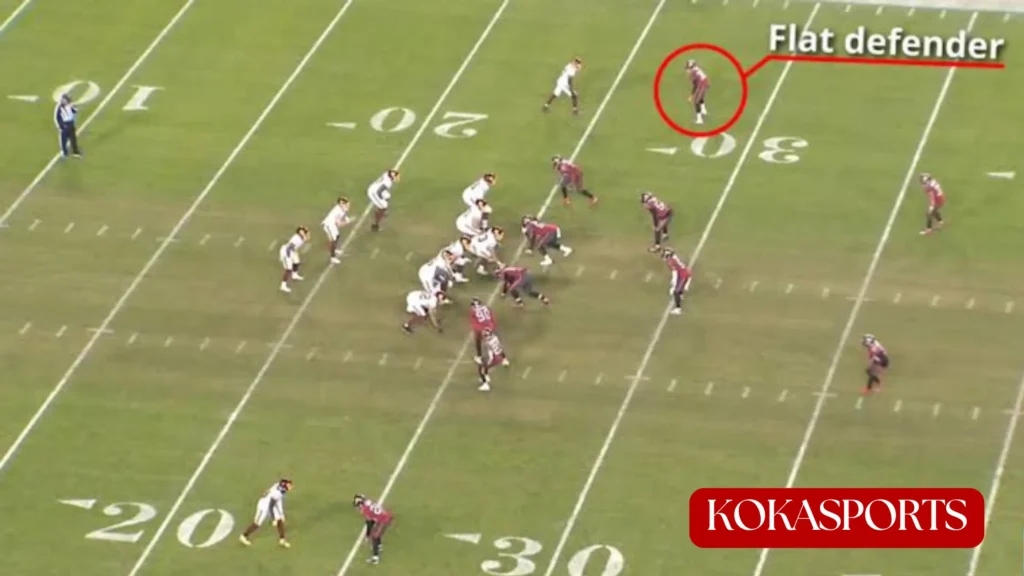
The key player is the flat defender whoever is responsible for the short outside zone on that side.
In Cover 2, that is the cornerback. In Cover 3, it is usually an outside linebacker or nickel. The concept does not actually care which player it is. It cares that somebody has that job, and that somebody else is behind him.
How Does the Smash Concept Work?
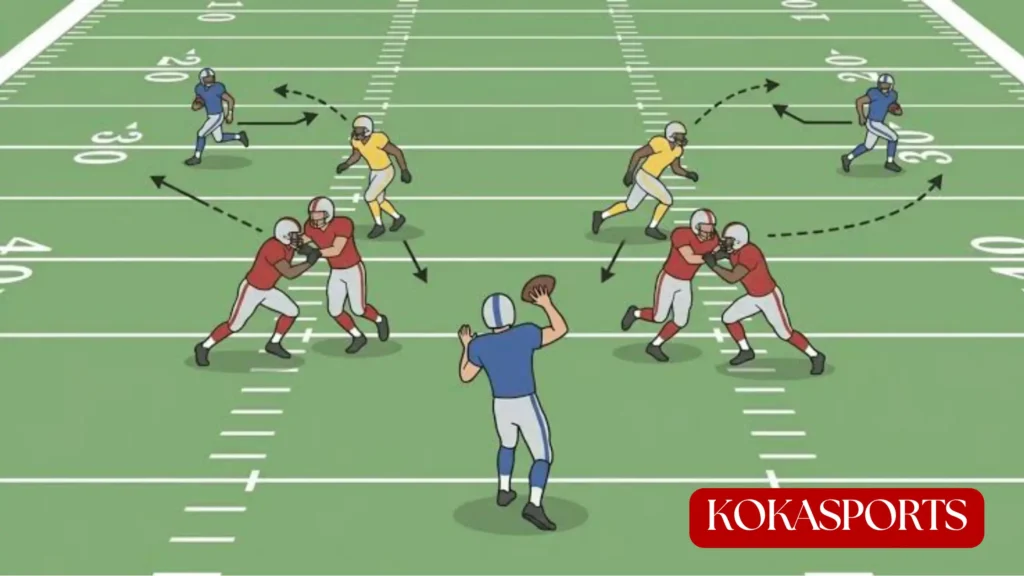
The underneath route
The outside receiver pushes vertically for five or six yards, then stops and turns back to the quarterback. It is a simple route, and it needs to be its job is to make the flat defender react immediately.
The throw should go to the receiver’s hip away from the defender, arriving as he turns.
The corner route
The inside receiver a slot or a tight end stems vertically, then breaks at roughly 45 degrees toward the sideline. The break comes around ten to twelve yards, but the aiming point is much deeper, often twenty-plus yards down the boundary.
That gap between break point and landing point is what makes the route work. The receiver is running away from the flat defender and away from the safety at the same time.
The quarterback’s job
He reads one defender and throws opposite the reaction.
Defender sinks to take the corner route away → throw the hitch, immediately. Defender squats on the hitch → hitch up in the pocket and throw the corner route behind him.
That is the concept. Two routes, one defender, one decision.
Why Is Smash Concept Football So Effective Against Cover 2?
Because Cover 2 has a hole in it, and smash is built to find it.
In Cover 2, two safeties split the deep half of the field and the cornerbacks drop into the flats. That leaves an area of soft coverage along the sideline behind the cornerback, in front of and outside the safety, roughly twelve to twenty yards deep.
Coaches call it the honey hole. It is the single most reliable weakness in the coverage.
The corner route is designed to land in exactly that spot. As Big Blue View explains in its breakdown of the concept, the number two receiver has natural outside leverage on a deep-half safety, and the cornerback is forced into a bind gain depth and give up the quick hitch, or squat and give up the throw behind him.
Most well-coached corners choose to give up the hitch. Five yards and a tackle beats twenty yards and a first down. That is the correct decision, and smash still wins by making him make it.
Smash Against Other Coverages
Here is where a lot of articles overstate things. Smash is not a universal answer. What it is, reliably, is a concept that punishes any zone structure with one flat defender and one deep defender to that side.
Against Cover 3
The picture changes. The cornerback bails into a deep third, and the flat responsibility shifts to an outside linebacker or nickel.
That means the corner route is now running toward a defender who started deep, rather than past one who started shallow a much tougher throw. But the underneath route often comes open faster, because the new flat defender is starting from inside and has ground to cover.
So smash works against Cover 3, but it usually pays underneath rather than deep. The mistake is calling smash expecting a big play and forcing the corner route into a deep-third corner.
Against Cover 4
Quarters coverage puts two safeties over the top with rules to carry vertical routes from the slot. When the safety carries the corner route, the deep throw gets contested and the clean high-low picture breaks down.
There is a real exception, though: play-action. In quarters, linebackers often become the flat defenders, and they have to honor the run fake first. That hesitation can rebuild the conflict the coverage was designed to prevent.
Against man coverage
The read stops being a read and becomes a matchup.
With corners locked onto the hitch runners, the corner route often has enormous space to work nobody is sitting in the honey hole because there are no zones. A quick slot receiver or an athletic tight end against a safety in space is a good problem for an offense to have.
The trade-off is that press coverage can wreck the hitch’s timing entirely.
Against cloud and trap coverage
Some defenses deliberately squat the corner on the hitch with safety help rolled over the top. This “cloud” look is designed to invite the throw and jump it. Against this, the underneath route becomes dangerous, and the quarterback needs to recognise it pre-snap.
Common Ways to Run the Smash Concept
Mirrored 2×2. The classic. Run smash on both sides out of a balanced set, and the quarterback picks the better matchup pre-snap. He should commit to one side trying to work both makes him late on everything.
From trips (3×1). With three receivers to one side, the extra man can run a middle-read post. When the safety widens to help on the corner route, he vacates the middle, and the post runs straight into that space.
With a backside post or dagger. Even from 2×2, pairing smash on one side with a post on the other puts the play-side safety in his own conflict: help on the corner, or protect the middle.
Play-action smash. Run action pulls linebackers forward and freezes the flat defender for a beat. That beat is often all the corner route needs.
Switch releases and motion. Sending the receivers on crossing releases makes the coverage identification harder and can create better leverage for the corner route.
Route tags. Coaches swap the hitch for an out or a fade-stop, letting the receiver run away from a squatting corner rather than settling in front of him.
With a seam tag. A tight end or inside receiver runs straight up the seam. The seam route holds the deep middle safety in place, so he can’t drift over to help on the corner route, which makes smash work against Cover 3 and Cover 4.
Smash is also a red zone staple. When the field shortens and vertical routes die, a corner route to the pylon still has somewhere to go.
The Quarterback’s Read on Smash
Pre-snap
Count the safeties. Two-high suggests the classic Cover 2 picture. Single-high points toward Cover 3 and a different answer.
Then check the corner’s depth and leverage. A soft cushion often means a free hitch. A safety shaded inside of the slot suggests the corner route has room.
Be aware that defenses disguise. A two-high shell can rotate into a single-high look after the snap.
Post-snap
Confirm the coverage, then key the flat defender and let him make the decision for you.
The most common progression is high to low to checkdown: look at the corner route first, come down to the hitch, then find the back underneath if the defense has both covered.
Throwing it
On the corner route, work toward the sideline and away from the safety. Leading a receiver inside on a corner route is how interceptions happen.
On the hitch, throw it on time and let the receiver work after the catch.
And take the easy one when it is there. Forcing the corner route because it is worth more yards is the single most common way quarterbacks turn this concept into a turnover.
Strengths and Weaknesses
Strengths. It is simple to teach and simple to read. It works from many formations, produces both a safe underneath throw and a genuine shot play from the same call, and does not need to change based on coverage the way some concepts do.
Weaknesses. Match coverages can pass routes off and dissolve the high-low picture. Cloud and trap looks can turn the hitch into a risk. Press coverage disrupts timing. Poor spacing lets one defender split the difference and cover both. And because the corner route takes time to develop, pressure kills it.
Smash vs Other Passing Concepts
Sail builds a three-level stretch to one side deep, intermediate out, and flat. Smash uses two levels and a sharper read.
Flood sends multiple receivers to one side at staggered depths. Broader and more horizontal.
Mesh uses crossing routes underneath to create natural picks against man. Smash attacks vertically instead.
Dagger pairs a deep in-breaker with a clear-out, working the middle rather than the boundary.
Stick is quick-game, designed to get the ball out immediately, without smash’s deep option.
The short version: smash attacks outside the hashes and stresses one defender vertically. Most other staples work the middle, work horizontally, or stress a different level.
How Defenses Try to Stop Smash
Cloud the corner and roll safety help. Play match rules so defenders pass off the corner route rather than chase it. Press the outside receiver to break the timing. Disguise the shell so the quarterback cannot confirm the picture in time. And rush the passer the corner route is the slowest-developing part of the play.
None of these are free. Each gives something else up, which is why the concept has survived for decades.
Is Smash Used in College and NFL Football?
Yes, at every level. Weekly Spiral’s film breakdown documents NFL teams running it against both zone and man looks, and it has long been a favourite on third down and in the red zone across college and professional offenses.
The reason is teachability. A high school team can install the base version in one practice, and an NFL staff can dress it up with motion, tags and backside answers without changing what the quarterback reads. If you are still learning the basics, our guide to how many players are on a football team covers the personnel groupings behind concepts like this.
FAQs For Smash Concept Football
What is the smash concept in football?
A two-receiver combination pairing a short hitch by the outside receiver with a deeper corner route by the inside receiver. Together they put the flat defender in a high-low bind, and the quarterback throws opposite his reaction.
Is the smash concept good against Cover 2?
Yes it is the classic Cover 2 answer. The corner route attacks the honey hole between the flat cornerback and the deep-half safety. Execution still matters, and defenses can adjust with cloud coverage or safety rotation.
What does the quarterback read on smash?
The flat defender, not the receivers. If that defender gains depth to take the corner route, the quarterback throws the hitch. If he squats on the hitch, the quarterback throws the corner route behind him.
Can you run smash against Cover 3?
Yes, but expect a different result. The cornerback drops into a deep third and a linebacker or nickel takes the flat, so the underneath route usually comes open rather than the deep corner. Forcing the corner route here is risky.
What routes are used in the smash concept?
A hitch at five to six yards from the outside receiver, and a corner route breaking around ten to twelve yards from the slot or tight end. Coaches frequently substitute an out, a fade-stop or another tagged route underneath.
Conclusion
The smash concept endures because it solves a problem with geometry rather than talent. Two routes, one defender, one decision and whatever he chooses, he is wrong somewhere.
That simplicity is why it works at every level of football. The quarterback is not reading a coverage or scanning a field. He is watching one man and throwing to the space that man abandoned.
Defenses have spent decades building answers: cloud looks, match rules, disguised shells. All of them give up something else. As long as somebody has to defend the flat while somebody else defends deep, this concept will have a home in the playbook.