
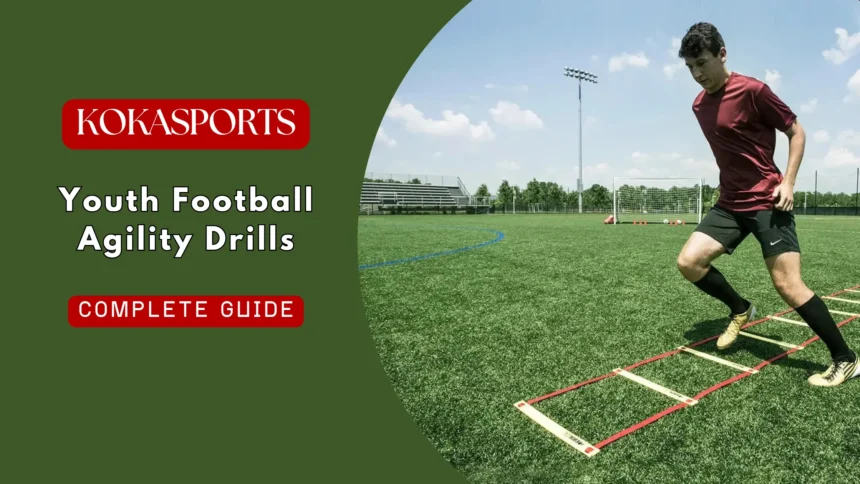
Fast feet win football games. The player who can plant, cut and explode a half-second before everyone else is the one who breaks the tackle, sticks to the receiver or slips through the gap. That quickness is not a gift reserved for a lucky few. It is a skill, and the right youth football agility drills build it one practice at a time.
This guide gives you ten drills you can run with almost no equipment, each with a simple setup, clear instructions and a coaching tip. You will also get the safety guidance, practice structure and progress checks that separate a productive session from a chaotic one. Everything here is grounded in recommendations from national governing bodies and sports-science organizations, so you can coach with confidence.
What Agility Really Means in Youth Football
Agility is often confused with straight-line speed, but they are not the same thing. Speed is how fast a player runs in one direction. Agility is the ability to change direction quickly, react to what an opponent or teammate does, and keep balance while doing both.
According to the National Strength and Conditioning Association, agility sits alongside speed, strength, power, balance and coordination as a core athletic quality that should be developed across childhood and adolescence. Good youth football agility drills train several of these qualities at once:
- Speed: covering ground quickly so a player can beat an opponent to a spot.
- Balance: staying stable and centered while cutting, planting or taking contact.
- Coordination: controlling the feet and body so movements stay smooth under pressure.
- Reaction time: reading an opponent and responding without hesitation.
When a young player improves in these areas, it shows up everywhere: sharper routes, tighter coverage, better tackling angles and more confidence on every snap.
Why Agility Training Matters for Young Players
Agility work is not only about performance. The NSCA notes that well-structured training for young athletes can help reduce the risk of injury while improving movement quality, and its guidance treats every child as an athlete who deserves safe, age-appropriate development. You can read the organization’s view on youth agility in its pediatric agility and coordination article.
Childhood and early adolescence are also a strong window for building coordination and movement patterns that carry into every sport a player tries later. The goal at the younger ages is not perfect technique or fast times. It is body confidence, quick feet and a love of moving. Technical sharpness follows naturally as players mature.
Before You Start: Warm-Up and Safety
Never send young players straight into cutting and sprinting cold. A dynamic warm-up raises the heart rate, loosens the joints and lowers injury risk. Five to ten minutes of light movement does the job:
- Jog and skip the length of the field
- High knees and butt kicks
- Arm circles and leg swings
- Carioca (grapevine) steps
- A few build-up sprints at about 70 percent effort
Keep drills age-appropriate and progress gradually. USA Football, the sport’s national governing body, recommends teaching one skill at a time and matching the difficulty of a drill to the age and experience of the group. Pair players of similar size, give full rest between hard efforts, and stop a drill the moment form breaks down. Quality always beats quantity.
Equipment You Need
The good news is that agility training is cheap. For almost every drill below you only need:
- A set of cones (tennis balls, shoes or flags work too)
- An agility ladder (optional, but useful)
- A football for the game-realistic versions
10 Youth Football Agility Drills
Run these drills as a full circuit or pick three to five for a single session. They are ordered from simplest to most game-like, so you can choose the right entry point for your group.
1. Agility Ladder Runs
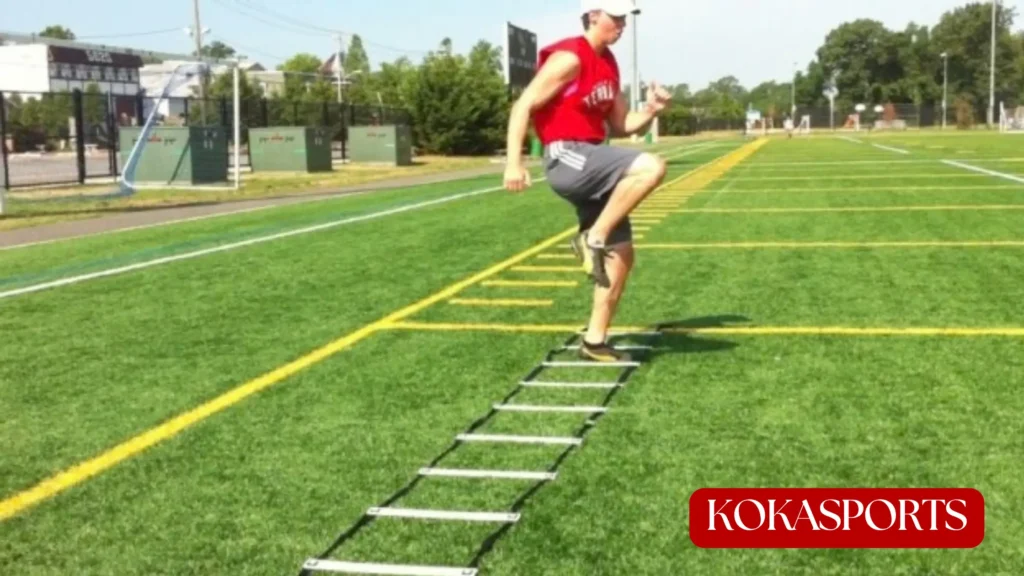
Setup: Lay an agility ladder flat on the ground. Line players up single file at one end.
How to run it: Players move through the ladder using three patterns in sequence: one foot in each square, two feet in each square, then a lateral shuffle. After the last rung, they sprint five yards to a cone and jog back to the line.
Coaching tip: Speed comes from quick, light contacts, not from lifting the knees high. Keep eyes up and arms pumping.
2. Four-Corner (Box) Drill
Setup: Place four cones in a square, five yards apart. Players start just outside the first cone.
How to run it: Backpedal to the second cone, shuffle to the third, sprint to the fourth, then shuffle back to the start, moving around the square without crossing the feet.
Coaching tip: Stay low with bent knees. A low center of gravity makes every change of direction smoother and faster.
3. Zig-Zag Cone Drill
Setup: Set up five or six cones in a staggered zig-zag pattern, a few yards apart.
How to run it: Players weave through the cones at a controlled, fast pace, planting on the outside foot to cut at each cone.
Coaching tip: This is not an all-out sprint. Control beats raw speed here, so players learn to plant and redirect cleanly. It mirrors the footwork of running sharp routes, which you can explore further in our flag football route tree guide.
4. T-Drill
Setup: Arrange four cones in a T shape: one at the base, one ten yards ahead, and one five yards to each side of the middle cone.
How to run it: Sprint from the base to the middle cone, shuffle left to the left cone, shuffle all the way right to the right cone, shuffle back to the middle, then backpedal to the start.
Coaching tip: Face forward the entire time. The drill trains players to shuffle and backpedal without turning their hips, which is exactly what defenders need.
5. 5-10-5 Pro Agility Shuttle
Setup: Set three cones in a line, five yards apart. The player starts at the middle cone.
How to run it: Sprint five yards to one side and touch the line, sprint ten yards to the far side and touch, then sprint back through the middle. This is the same test used at the NFL Combine, so it is a proven measure of change-of-direction speed.
Coaching tip: Low hips and short, choppy steps at each turn save precious time. Time the reps so players can chase their own best score.
6. Mirror Drill
Setup: Pair players up, facing each other across a line about three yards wide.
How to run it: One player leads, moving laterally, forward and back in any order. The partner mirrors every movement and tries to stay within arm’s reach. Switch roles after 30 to 45 seconds.
Coaching tip: There is no pattern to memorize, so this is pure reaction. It teaches players to read body movement, a skill that transfers straight to one-on-one coverage.
7. Foot Fire (Quick Feet) Drill
Setup: Players stand in an athletic stance with feet slightly wider than the shoulders. No equipment needed.
How to run it: On your whistle, players chop their feet as fast as possible in place, staying on the balls of the feet with arms pumping. On a second whistle, they react by sprinting, backpedaling or cutting in the direction you point.
Coaching tip: This is a great opener. It raises the heart rate, builds quick feet and gets players reacting before they even touch a cone.
8. Lateral Shuffle to Sprint
Setup: Place two cones about ten yards apart with a start cone to the side.
How to run it: Players shuffle laterally between the two cones, then react to your call or a dropped ball and immediately explode into a forward sprint.
Coaching tip: The value is in the transition. Going from sideways movement to linear acceleration is one of the most common patterns in a real game.
9. Reaction Cone Drill
Setup: Place four or five cones in a cross or arc around a single player standing in the middle.
How to run it: Call out or point to a cone. The player sprints to touch it and returns to the center before the next call, which comes every three to four seconds.
Coaching tip: Vary the calls so there is no rhythm to rely on. Forward, backward and lateral movements all get trained in one drill, and players learn to stay ready.
10. Partner Chase
Setup: Mark a box roughly fifteen by fifteen yards. Pair players as chaser and runner.
How to run it: The runner tries to evade the chaser inside the box for a set time, cutting and changing speed to escape. The chaser mirrors and reacts, trying to stay close enough to make a tag.
Coaching tip: This is the most game-realistic drill on the list. For the youngest players, framing agility work as a chase or tag game keeps effort high because it never feels like exercise.
How to Fit Agility Into Your Practice
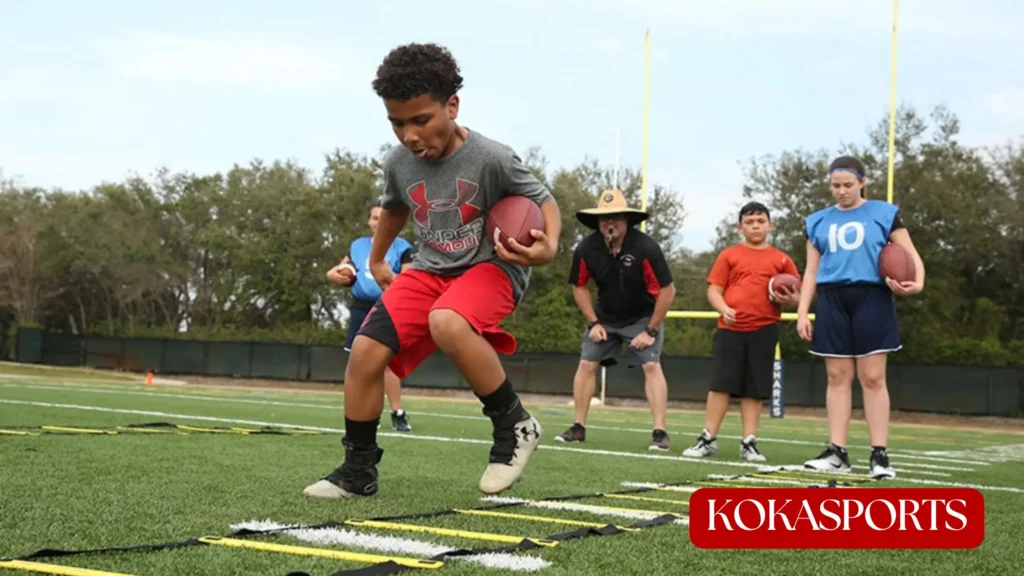
A common question is how often young players should train agility. The honest answer is that it should be part of regular, varied activity rather than a separate weekly workout. The CDC’s Physical Activity Guidelines recommend that children and teens ages 6 through 17 get 60 minutes or more of moderate-to-vigorous activity every day, including muscle-strengthening and bone-strengthening activity on at least three days a week. Agility drills fit neatly inside that daily movement.
In practice, a block of 15 to 20 minutes of agility work inside a normal session is plenty for most youth teams. Three to five drills, run well with good rest, beats six drills rushed through with sloppy form. If you want help structuring the whole session around these drills, use our football practice plan template to slot agility work into a complete, time-boxed plan.
Common Mistakes to Avoid
Even good coaches fall into a few traps with agility training:
- Chasing speed over form. Sloppy cuts build bad habits and raise injury risk. Slow a drill down until the movement is clean, then add speed.
- Skipping the warm-up. Cutting and sprinting on cold muscles is asking for a tweak. Always warm up first.
- One line, one player moving. If ten players stand and watch one go, you have lost the practice. Set up multiple lines so everyone is active.
- No progression. As players improve, the drills should get harder. Add a ball, a reaction cue or a time target to keep them challenged.
How to Measure Progress
You cannot improve what you do not track. A few simple methods show whether your youth football agility drills are working:
- Timed drills. Record times for the 5-10-5 shuttle or the T-drill every few weeks and watch them drop.
- Video review. Filming a drill lets players see their own foot position and body shape, which often lands better than verbal coaching.
- Quality checks. Watch for lower hips, cleaner cuts and less hesitation over the season. Those are signs the work is paying off.
Frequently Asked Questions
At what age can kids start agility drills?
Children as young as 6 to 8 can begin simple agility and coordination work. Keep instructions short, keep the drills playful, and prioritize fun and movement confidence over precision. More structured training can come as players mature.
How often should youth players do agility training?
One 15 to 20 minute block inside a regular practice is enough for most youth teams. Agility develops through repetition over months, not through a single intense session, and it fits inside the daily activity health authorities already recommend.
How many drills should I include in one session?
Three to five is the right range for most age groups. Fewer drills done well, with good progressions, produce more learning than a long list run in a rush.
Do players need special equipment?
No. Cones and a little space cover almost everything. An agility ladder helps, but shoes, flags or tennis balls can stand in as markers. A football adds game realism when players are ready for it.
What is the best single agility drill for football?
There is no single best drill, but reaction-based drills like the mirror drill and reaction cone drill come closest to real game movement because they force players to read and respond rather than follow a set pattern.
Conclusion
Agility is one of the most coachable skills in youth football, and you do not need expensive gear or complicated systems to build it. Start with a solid warm-up, run three to five of these youth football agility drills with clean form, add a reaction element as players improve, and track a couple of simple measures over the season. Do that consistently and you will see quicker feet, sharper cuts and more confident players by the time the games matter most.