

Mesh concept football is a passing design built around two receivers running shallow crossing routes from opposite sides of the formation, passing within a yard of each other over the middle. That crossing point the mesh creates natural traffic that makes man coverage extremely difficult to play, while the same routes stretch zone defenders horizontally.
It is arguably the most widely used pass concept in football today, running from youth flag leagues to the NFL. This guide covers the routes, the mesh point rules that most explanations skip, the quarterback’s progression, the common variations, how it adapts to 5v5 and 6v6 flag football, and how defenses fight back.
What Is the Mesh Concept in Football?
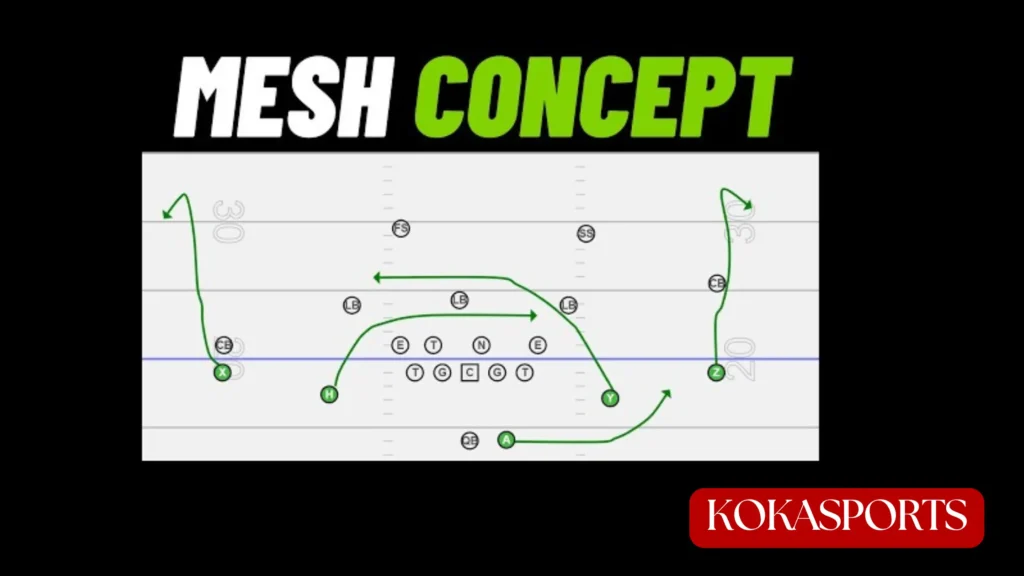
Mesh is a full concept, not a single route. The two crossers are the engine, but the play almost always includes supporting routes that give the quarterback answers when the crossers are covered.
The idea is old. Shallow crossing routes were a staple of LaVell Edwards’ pass-heavy BYU offense, and Hal Mumme and Mike Leach built on that foundation when they developed the Air Raid at Kentucky in the late 1990s. As CougCenter explains in its breakdown of the Air Raid playbook, shallow crossers run under five yards from the line of scrimmage became a central part of that system.
From there it spread everywhere. It survived the spread revolution, pattern-match defenses and the rise of RPOs, because it solves a permanent problem: how do you create space in the middle of the field faster than defenders can react?
The answer is to make two defenders occupy the same small piece of grass at the same moment.
How Does the Mesh Concept Work?
The mesh point
Two receivers from opposite sides run shallow crossers, typically at around five to six yards, and cross close enough to touch. Some teams have their receivers high-five as they pass. That is not showmanship it is a depth check.
Here is the rule most explanations leave out. One receiver runs over and one runs under, and they are not equal partners.
The over receiver sets the depth of the mesh, usually about five yards. The under receiver sets the mesh his job is to adjust and make the over receiver right. If the over man runs it at seven yards, the under man runs it at six. He is responsible for the spacing, not the other way round.
Aim for roughly one yard of vertical separation. Run both crossers at identical depth and they collide, defenders stay glued to them, and the whole point of the play is lost.
Why the traffic matters
Against man coverage, the defender covering the under receiver has to get over the top of the crossing traffic. That fraction of a second is the entire concept. The receiver comes out the other side with separation nobody had to beat anyone to earn.
Against zone, the crossers do something different. They pull underneath defenders sideways and open windows behind them.
What the receivers do after the mesh
This is the second rule that matters. Against man, the crossers keep running the defender is chasing, so give him more field to chase across. Against zone, they sit down in the first open window after clearing the mesh.
Same route, two completely different endings. Receivers who cannot tell man from zone will kill this play.
What Routes Are Used in a Mesh Concept?
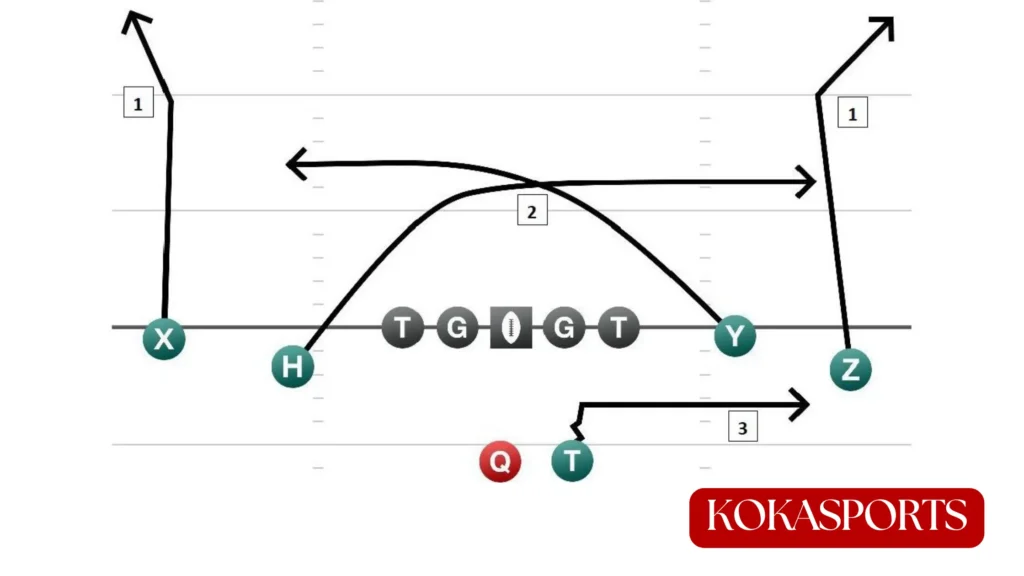
The two shallow crossers at five to six yards. The foundation.
The sit route. A receiver settles in the middle of the field above the mesh, usually around eight to ten yards. This is the answer when underneath defenders chase the crossers and vacate the space behind them. Against zone it is often the best throw on the play.
A corner or vertical route. Somebody has to threaten the top of the field. Without it, safeties squat on everything underneath and the whole concept gets compressed. This route frequently exists to occupy defenders rather than to be thrown.
The rail or wheel route. A running back releases toward the sideline and turns upfield. This is the rail concept element you will see attached to mesh, and it does two jobs at once: it stresses the corner vertically and drags the flat defender away from the crossers. Sometimes a flare or swing from the back is enough to clear that space.
Between them, these routes attack every level and both sidelines, which is why the concept is so hard to defend with one call.
Mesh Concept Progression: How the Quarterback Reads It
Progressions vary considerably by system, so treat this as the common structure rather than a universal rule.
The important thing to understand first: the mesh is usually not the first read. The crossers take time to develop and clear the traffic. If the quarterback stares at them from the snap, he will be late on everything else.
A typical order runs something like this. Check the pre-snap picture if the corner route has an obvious matchup or space advantage, that decision gets made before the snap. After the snap, work the back on the rail or swing, then the first crosser as he comes clear, then the sit route, then the second crosser.
Air Raid teams often teach the progression as fixed regardless of coverage, which is a large part of the concept’s appeal. The quarterback is not solving a puzzle. He is working a sequence and throwing to the first man who is open.
Coverage recognition still matters, because it tells him what the receivers will do. Man coverage means the crossers keep running and he should lead them. Zone means they will sit, and he should throw them the ball where they stop.
Why Is the Mesh Concept Effective?
Against man coverage, it is one of the best answers in football. Defenders must chase receivers across the formation through traffic, and the natural rub at the mesh point creates separation without anyone needing to win a one-on-one. It is especially popular in the low red zone, where man coverage is common and the field is short.
Against zone, it works differently but still works. The crossers pull underneath defenders horizontally, and the sit route drops into the window they leave behind. The quarterback is looking for open grass rather than a beaten defender.
Defensive communication is the deciding factor. Zone defenders have to pass the crossers off cleanly. Man defenders have to decide, in real time, whether to fight over or under the traffic and to do that without colliding with each other. Any hesitation and somebody comes open.
Mesh Concept Variations
Basic mesh. Two crossers, a sit, a vertical, a back releasing. The install version.
Mesh with a corner route. Adding a corner over the top creates a high-low stretch and gives the quarterback a shot play attached to a short-game concept.
Mesh-rail. Emphasises the back’s route up the sideline. Useful when defenses commit heavily to the middle.
Mesh from empty. Removing the back and spreading five receivers gives the crossers more room and makes coverage identification easier if nobody follows a motioning player, it is zone.
Mesh with motion. Sending a receiver across the formation before the snap both diagnoses the coverage and creates a better angle into the mesh.
Mesh into flood. Some teams show mesh action and convert it into a three-level flood, using the defense’s own recognition against it.
The principle across all of them: the crossers stay the same, and what changes is what sits behind and above them.
Mesh Concept in Flag Football: 5v5 and 6v6
Mesh is a staple of flag football, and for a specific reason most flag defenses play man, and moving receivers are very hard to cover man-to-man.
But the smaller field changes the details.
5v5
With a quarterback, a center and three eligible receivers, there is no spare body. Two receivers run the mesh, the third clears out deep, and the center’s sit route becomes the outlet.
Tighten the mesh point. On a short field, defenders widen quickly, so the rub needs to happen sooner than it would in eleven-man. And give the quarterback a clear hot rule against the rush the underneath outlet is the pressure answer.
6v6
The extra player is the difference. Now there is a flat route available as the outlet, freeing the center or an inside receiver to work the sit. You can also run genuine trips looks, which distorts how the defense distributes itself before the ball is snapped.
One honest caveat for both formats: mesh is a move-the-chains concept, not a shot play. The deep route is a clear-out, not the primary. And against a two-deep zone that squats underneath defenders on the five-yard level, the crossers run into traffic with no rub to spring them. Call something else.
Mesh vs Other Passing Concepts
| Mesh | Flood |
|---|---|
| Crossing routes at the same depth | Layered routes at three depths |
| Attacks the middle of the field | Attacks one sideline |
| Best against man coverage | Designed to stress zone defenders |
| Rub creates separation | Spacing creates separation |
Not every crossing play is a mesh. A single drag route is not mesh; a shallow cross concept with one crosser and a dig behind it is not mesh either. What defines it is two crossers from opposite sides meeting at a defined point with a defined depth relationship.
Compared with smash, which puts one defender in a vertical bind outside the hashes, mesh works horizontally through the middle. They are complementary calls, not competing ones. If you want the fundamentals behind these formations, our guide to how many players are on a football team covers the personnel side.
Common Mesh Concept Mistakes
Running both crossers at the same depth, so they collide instead of meshing. Drifting upfield during the cross, which destroys the spacing. Meshing too far from the ball, so the traffic happens after defenders have already widened. Receivers who sit against man or keep running against zone. Quarterbacks who lock onto the crossers from the snap and never work the progression. And forgetting the backside a lot of mesh completions come from the second crosser arriving late, after everyone has committed to the first.
How Defenses Stop the Mesh
The main answers are communication-based. Banjo and switch rules let defenders trade assignments at the crossing point rather than chasing through traffic. Pattern-match coverage does the same thing more systematically. Zone teams squat underneath defenders at the crossers’ depth, walling off the routes and removing the rub.
Beyond that: reroute the crossers early to break the timing, keep linebackers disciplined at the right depth, and rush the passer, since the concept needs a beat to develop. Weekly Spiral’s film breakdown notes that the drag takes long enough to develop that it cannot be the first read which is exactly the window a pass rush attacks.
FAQs For Mesh Concept Football
What is mesh in football?
A passing concept built on two shallow crossing routes from opposite sides of the formation, meeting over the middle at around five to six yards. The crossing creates traffic against man coverage and horizontal stress against zone.
What is a mesh route in football?
Strictly, there is no single “mesh route” mesh is the concept. The individual routes are shallow crossers or drags. The mesh is the point where they intersect, and the depth relationship between them is what makes it work.
What are the basic rules of the mesh concept?
One receiver runs over, one runs under, with about a yard of vertical separation. The under receiver adjusts to make the over receiver right. Against man the crossers keep running; against zone they sit in the first open window.
What is the mesh concept in flag football?
The same crossing structure adapted to a smaller field. In 5v5 the center’s sit route is the outlet; in 6v6 a flat route fills that role. The mesh point is tightened so the rub happens before defenders widen.
What is the difference between mesh and flood?
Mesh uses crossing routes at similar depth to attack the middle and beat man coverage. Flood layers routes at three depths toward one sideline to stress zone defenders. Different structures, different targets.
Conclusion on the Mesh Concept Football
Mesh has lasted because it does something no amount of scheming has fully solved: it puts two receivers in the same small space and asks defenders to sort it out while running full speed.
The details are what separate a good version from a bad one. One yard of separation. The under man setting the mesh. Crossers who know whether to sit or keep running. Get those right and mesh concept football works at every level which is precisely why you see it everywhere from a Saturday morning flag field to Sunday afternoon in the NFL.