
Padel and tennis look like cousins at first glance. Both use rackets, both use a felt-covered ball, and both share the same familiar scoring of 15, 30, 40, game. But once you step onto the court, the padel vs tennis comparison reveals two sports that feel completely different. Padel is fast, social, and played inside glass walls, while tennis is a bigger, more physical game built around power and court coverage.
If you are trying to decide which one to pick up, or you just want to understand how they stack up, this guide breaks down every major difference. Every court, net, ball, and racket figure below is taken from the official rulebooks of the two governing bodies: the International Padel Federation (FIP) and the International Tennis Federation (ITF).
What Are Padel vs Tennis?
Tennis is the older and more globally established of the two. It is played on a large open court and rewards powerful serves, long baseline rallies, and wide court coverage.
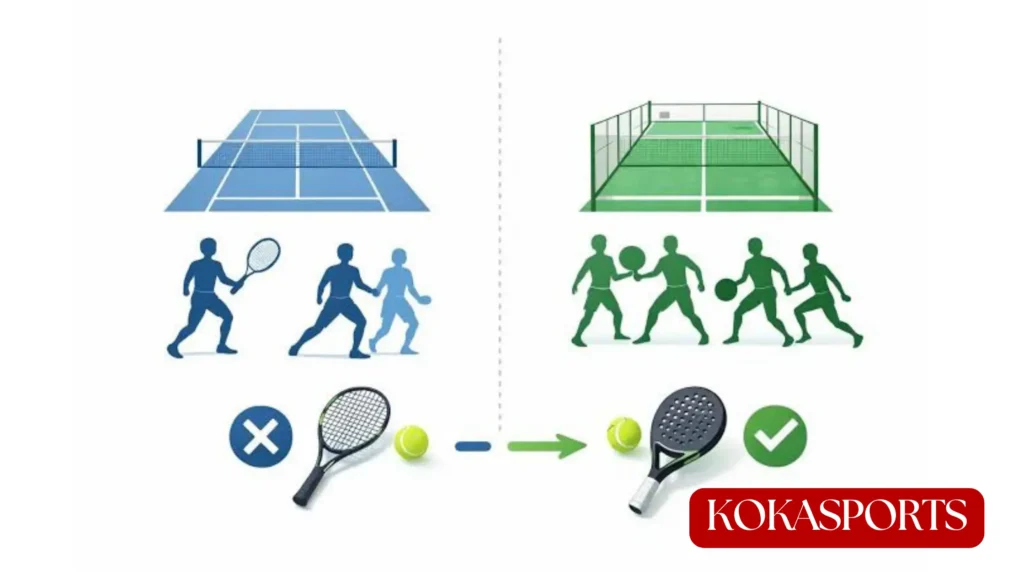
Padel is younger and growing fast. It was invented in Mexico in 1969 and became hugely popular in Spain and Argentina before spreading across Europe and now into the United States. It is played almost entirely in doubles on a smaller court that is enclosed by glass and metal mesh, and those walls are a live part of the game.
One quick point of clarification: the words “padel” and “padel tennis” usually describe the same modern glass-walled sport. That is different from the older American game of paddle tennis, sometimes called pop tennis, which uses a smaller court without glass walls.
Quick Comparison at a Glance
| Feature | Padel | Tennis |
|---|---|---|
| Court size (doubles) | 20 m x 10 m | 23.77 m x 10.97 m |
| Walls | Yes, glass and mesh | No |
| Net height (center) | 0.88 m | 0.914 m |
| Racket | Solid, no strings, perforated | Strung |
| Ball diameter | 6.35 to 6.77 cm | 6.54 to 6.86 cm |
| Serve | Underhand | Overhand |
| Usual format | Doubles | Singles or doubles |
| Scoring | 15, 30, 40, game | 15, 30, 40, game |
Court Size and Dimensions
The court is the first thing you notice. According to the FIP, a padel court is a rectangle measuring 20 meters long by 10 meters wide for doubles, with a small tolerance of 0.5 percent. When padel is played as singles, the court narrows to about 6 meters wide while keeping the same 20 meter length.
A tennis court, by contrast, is much larger. The ITF sets the length at 78 feet (23.77 meters). The width is 27 feet (8.23 meters) for singles and 36 feet (10.97 meters) for doubles once the outer alleys come into play.
Put simply, a padel court takes up roughly a third of the space of a tennis court. That smaller footprint is a big reason padel feels so different. There is far less ground to cover, which means shorter sprints, longer rallies, and a game that leans on teamwork and quick reactions rather than long baseline battles.
The Walls: Padel’s Defining Feature
If there is one thing that sets padel apart, it is the walls. A padel court is fully enclosed. Under FIP rules the back walls stand 4 meters high, typically built as 3 meters of solid rebound surface, usually tempered glass, topped by 1 meter of metal mesh fencing.
These walls are not just boundaries. They are part of play. After the ball bounces once on your side of the court, you are allowed to let it rebound off the glass and then return it. Skilled players even use the walls on purpose to create tricky angles. This single feature is what gives padel its long, dynamic, chess-like rallies.
Tennis has no walls at all. The boundaries are open lines painted on the surface, so once a ball passes you, the point is usually over. That open design rewards precision, spin, and raw power in a way padel does not.
Net Height
The nets are close in height but not identical. In padel, the FIP sets the net at 0.88 meters in the center, rising to a maximum of 0.92 meters at the ends.
In tennis, the ITF net sits at 0.914 meters (3 feet) in the center and rises to 1.07 meters (3.5 feet) at the posts. So the tennis net is a little taller overall, especially toward the sides.
Rackets and Paddles
The two sports use very different tools. A tennis racket has a long handle and a large hitting surface made of crossed strings.
A padel racket has no strings at all. It is a solid, thick piece of composite material with a hitting surface that is perforated by holes. Under FIP rules, those holes measure between 9 and 13 millimeters across the central area of the face. The federation also caps the size of a padel racket: the total length of head and handle together cannot exceed 45.5 centimeters, the width cannot exceed 26 centimeters, and the thickness cannot exceed 38 millimeters, with a small manufacturing tolerance of 2.5 percent on thickness.
There is one more padel rule that surprises newcomers. Every padel racket must have a non-elastic safety cord attached to the handle, no longer than 35 centimeters, and wearing it around your wrist during play is mandatory. It stops the racket from flying out of your hand during a fast swing. Tennis has no such requirement.
The Ball
The balls look almost the same, and they weigh the same, but they are not interchangeable.
A tennis ball, per the ITF, has a diameter between 6.54 and 6.86 centimeters and a weight between 56.0 and 59.4 grams. A fresh ball dropped from 254 centimeters onto concrete must bounce back between 135 and 147 centimeters.
A padel ball is slightly smaller and softer. FIP rules set its diameter between 6.35 and 6.77 centimeters, with the same weight range of 56.0 to 59.4 grams, and a rebound of 135 to 145 centimeters from the same drop height. The key difference is internal pressure, which is lower in a padel ball. That lower pressure reduces the bounce and speed just enough to keep rallies alive inside the tight, walled court.
Serving Rules
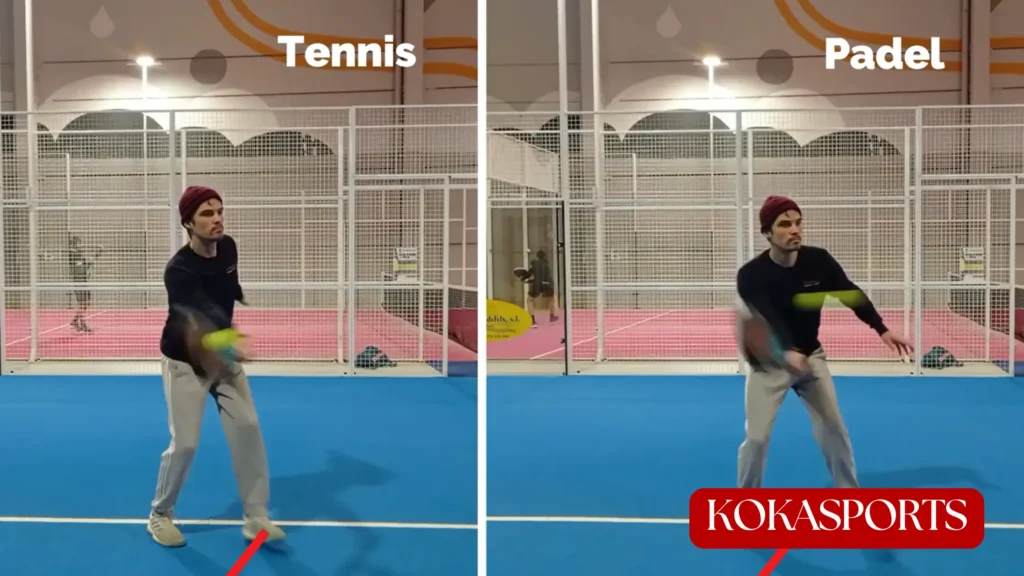
Serving is one of the clearest differences you can see from the sideline. In tennis, the serve is an overhead motion. The server tosses the ball up and strikes it from above the head, which is where a lot of the sport’s power and aggression comes from.
In padel, the serve must be underhand. FIP rules require the server to bounce the ball first, then strike it at or below waist height, sending it diagonally into the opponent’s service box. This gentler serve is a big reason padel is easier to pick up for a complete beginner.
Scoring
Here the two sports finally agree. Padel borrows tennis scoring almost exactly: points run 15, 30, 40, and game, and matches are usually played as the best of three sets.
The one modern twist worth knowing is that padel’s official rules include alternative deuce formats, including the Golden Point, where a single decisive point settles a game that reaches deuce. That format is common in professional padel and adds a jolt of tension that traditional tennis scoring does not have. If you want the full set of serving, scoring, and wall-play rules in one place, our complete guide to padel rules breaks them all down for beginners.
Singles vs Doubles
Tennis is played comfortably as both singles and doubles, and the singles game in particular is a showcase of individual endurance and shot-making.
Padel is built for doubles. The standard court is designed for four players, and the vast majority of padel is played two against two. It is possible to play singles on a narrower court, but doubles is the heart of the sport, which is part of why padel has such a social, community feel.
Which Is Easier to Learn?
This is the question most newcomers ask, and the general consensus among coaches and clubs is that padel is easier to learn than tennis. The smaller court means less ground to cover, the underhand serve is simple to master, and the walls keep the ball in play, so beginners enjoy real rallies almost immediately instead of chasing missed shots.
Tennis has a steeper learning curve. The overhand serve takes time to develop, the larger court demands more fitness, and rallies can end quickly until your technique improves. It is worth being clear that these points are widely shared observations rather than official rules, so treat them as guidance rather than fact.
Which Sport Should You Choose?
Both sports are excellent, and plenty of people play both. The right choice comes down to what you want out of a game.
Choose padel if you want a social, doubles-focused sport that is quick to learn, easier on the body, and full of long, tactical rallies. Choose tennis if you enjoy a bigger physical challenge, love the idea of powerful serves and full-court movement, and want the option to play competitive singles.
The good news for tennis players is that the shared scoring and racket-sport instincts make it easy to try padel, and many find the walls addictive once they get the hang of them. Whichever you pick, you are joining one of the fastest-growing corners of the racket-sport world.