
Two of the fastest growing racket sports in the world, but what are the differences between padel and pickleball? Below you will find a full comparison of both sports, from courts and equipment to rules, scoring, and which one might suit you best.
Padel and pickleball are different sports. The main differences are:
- Padel is played on an enclosed court with glass walls, while pickleball is played on an open court with no walls
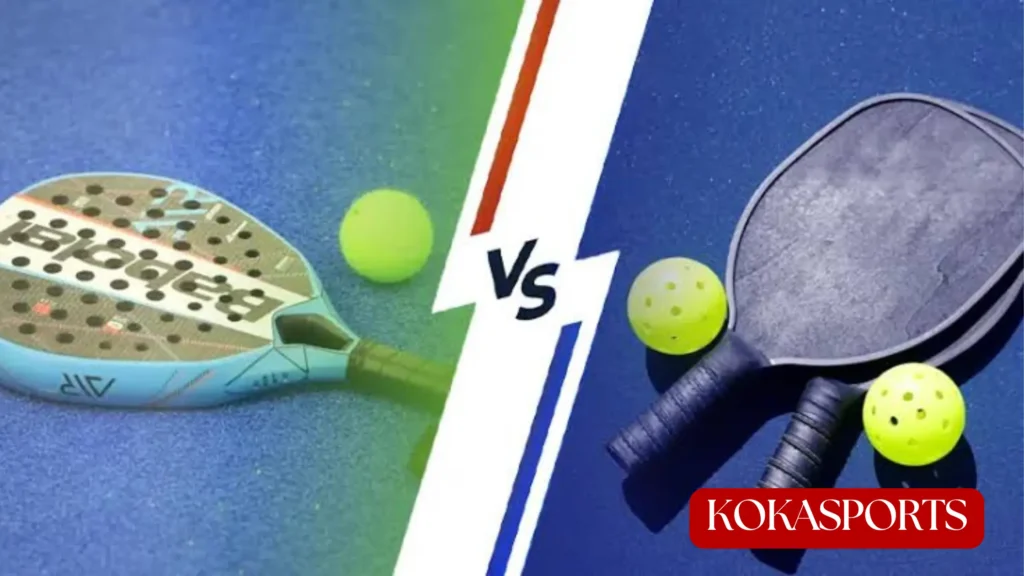
- Padel uses a solid perforated racket and a low pressure ball similar to a tennis ball, while pickleball uses a smooth solid paddle and a plastic ball with holes
- Padel is almost always played as doubles, while pickleball can be played as singles or doubles
- Padel lets you play the ball off the walls, while pickleball does not
Padel vs pickleball at a glance
Here is a quick side by side comparison, with every figure taken from the sports’ official governing bodies, the International Padel Federation (FIP) and USA Pickleball.
| Feature | Padel | Pickleball |
|---|---|---|
| Invented | 1969, Acapulco, Mexico | 1965, Bainbridge Island, Washington |
| Court size | 65.6 ft by 32.8 ft (20m by 10m) | 44 ft by 20 ft (13.41m by 6.10m) |
| Court type | Enclosed with glass walls and mesh fencing | Open court, no walls |
| Net height | 0.88m center, 0.92m sides | 34 in center, 36 in sides |
| Racket or paddle | Solid and perforated, up to 45.5cm long | Solid and smooth, max 24 in combined length plus width (max 17 in length) |
| Ball | Pressurized rubber, 2.5 to 2.66 in, lower pressure than tennis | Plastic with 26 to 40 holes, 2.87 to 2.97 in |
| Format | Doubles as standard | Singles or doubles |
| Serve | Underhand, diagonal | Underhand, diagonal |
| Walls used in play | Yes | No |
| Scoring | Tennis style (15, 30, 40, game, then sets) | To 11 points, win by 2, only the server scores |
| US players (2025) | About 1.07 million | About 24.3 million |
Where did padel and pickleball come from?
Although they are often mentioned in the same breath, padel and pickleball were invented on opposite sides of the world, only a few years apart.
Padel was created in 1969 in Acapulco, Mexico, when Enrique Corcuera built an enclosed court with walls on his property so the ball would stay in play. The sport spread quickly to Spain and then across Europe and Latin America, and it blends elements of tennis and squash.
Pickleball was invented a little earlier, in 1965 on Bainbridge Island near Seattle, Washington. Three friends improvised a game for their families using table tennis paddles, a plastic ball, and a badminton court. It combines ideas from tennis, badminton, and table tennis, and it has since become the fastest growing sport in the United States.
What are the differences between padel and pickleball courts?
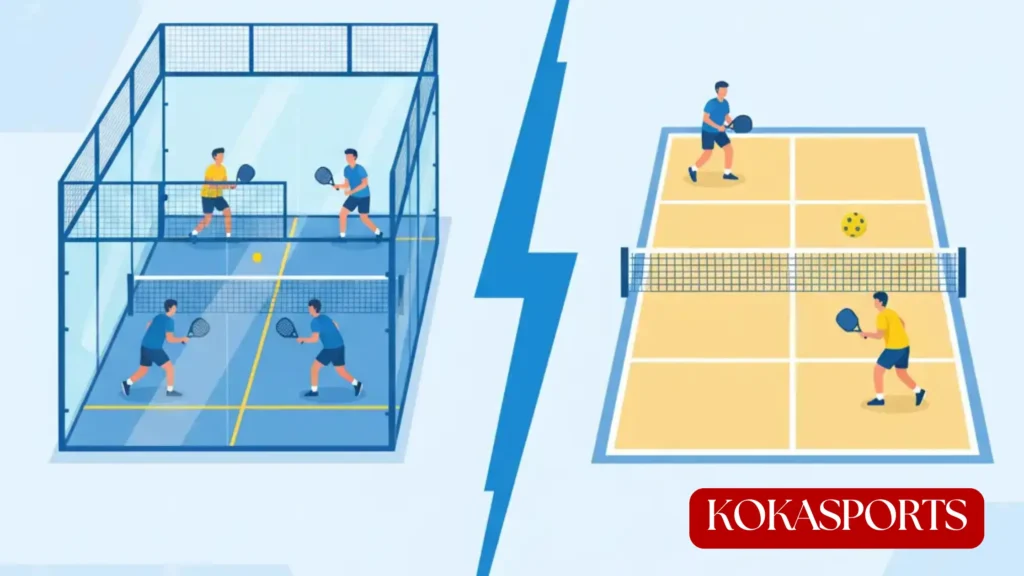
Padel and pickleball courts differ in size, layout, and how the space is used during play.
A padel court is a rectangle measuring 65.6 feet by 32.8 feet (20m by 10m), as set by the International Padel Federation (FIP). A pickleball court is much smaller at 44 feet by 20 feet (13.41m by 6.10m), and it is the same size for both singles and doubles under USA Pickleball rules.
The layouts are different too. A pickleball court has a non volley zone near the net, commonly called the kitchen, which extends 7 feet from the net on each side. A padel court has a tennis style service area, with the service line set 6.95m back from the net.
The biggest difference is how the court is used. A padel court is fully enclosed by glass walls and metal mesh fencing, and those walls are part of the game. The ball can rebound off them during rallies, which keeps play going and creates unusual angles. The end walls stand about 4m high, usually made up of a 3m glass wall with 1m of mesh fencing above it. Pickleball is played on a completely open court with no walls, so once the ball leaves the lines, the point is over.
Net heights differ slightly as well. A pickleball net sits 36 inches high at the sidelines and drops to 34 inches in the center. A padel net is 0.88m high in the center and 0.92m at the sides.
Key differences:
- Padel courts are enclosed with glass walls that are used in play, while pickleball courts are open
- Padel courts are larger, at 65.6 feet by 32.8 feet, compared to 44 feet by 20 feet for pickleball
- Pickleball has a 7 foot non volley zone near the net, known as the kitchen
- Padel walls allow the ball to rebound, while pickleball has no rebounds
What equipment do you need for padel and pickleball?
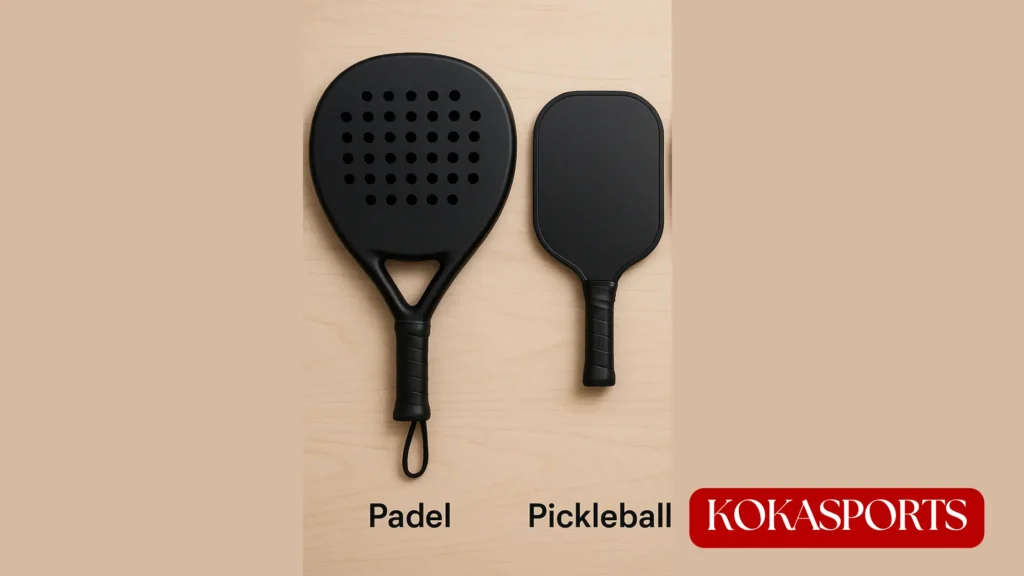
Both sports need only a paddle or racket and a ball, but the gear is built very differently for each game.
A padel racket is solid, has no strings, and is perforated with a pattern of holes across its hitting surface. Under FIP rules it can measure up to 45.5cm in total length, 26cm wide, and 38mm thick, and it usually has a foam core with a face made from fiberglass or carbon fiber. It also has a wrist cord that must be worn during play. The racket is shorter than a tennis racket and has a thicker profile to absorb the impact of the ball.
A pickleball paddle is also solid and stringless, but it is not perforated and its hitting surface must be smooth. USA Pickleball rules cap the combined length and width at 24 inches, with the length alone no more than 17 inches. There is no limit on thickness or weight, though most paddles sit between 6.5 and 14 ounces and are commonly around 15 to 16 inches long and 7 to 8.25 inches wide. Paddles are made from materials such as graphite, fiberglass, carbon fiber, and even wood.
The balls are different too. Padel uses a pressurized rubber ball that looks like a tennis ball but has slightly lower pressure, which gives it a lower bounce and helps players keep pace with rebounds off the glass. Pickleball uses a lightweight plastic ball with holes drilled through it, similar to a wiffle ball. Under the rules, these balls have between 26 and 40 holes and must be a single solid color.
Key differences:
- Padel rackets are perforated with holes, while pickleball paddles have a smooth, solid face
- Padel uses a low pressure ball similar to a tennis ball, while pickleball uses a plastic ball with holes
- Pickleball equipment produces a slower bounce and a gentler pace of play
What are the rule differences between padel and pickleball?
Padel is designed to be played as doubles, with two players on each side. Pickleball can be played as either singles or doubles, though doubles is the most common format.
Both sports begin with an underhand serve that is struck below waist height and sent diagonally into the opponent’s service area. In both games the ball can only bounce once on your side before you return it.
Padel is unique because you can use the walls. After the ball bounces on your side of the court, it may rebound off the back or side walls and still be live, which means you are constantly reading angles and using the walls to keep the ball in play. When you hit the ball to your opponent, it must bounce on their side of the court before it touches a wall, otherwise the shot is out. If you want to go deeper, our full guide to the rules of padel breaks down serving, faults, and wall play in detail.
Pickleball has its own signature rule, known as the two bounce rule. After the serve, the receiving team must let the ball bounce before returning it, and the serving team must then let the return bounce before playing on. Only after those two bounces can players start hitting volleys. There is also the kitchen rule: you cannot hit a volley while any part of your body is touching the non volley zone or its line.
Key differences:
- Padel is played as doubles, while pickleball can be singles or doubles
- Padel allows the ball to rebound off the walls, while pickleball does not
- Pickleball uses a two bounce rule before volleys can begin
- Pickleball has a no volley zone near the net, while padel does not
How does scoring work in padel vs pickleball?
Scoring is one of the clearest differences between the two sports.
Padel uses the same scoring system as tennis. Points within a game are counted as 15, 30, 40, and game, and matches are usually played as sets, where you need to win six games and lead by two to take a set. Many padel matches use a golden point at deuce, where the next point simply decides the game rather than needing a two point advantage.
Pickleball is scored very differently. Games are normally played to 11 points and must be won by two clear points, though some tournament games are played to 15 or 21. In traditional pickleball, only the serving side can score a point. In doubles, the score is called as three numbers, for example 5-3-2, which means the serving team has 5 points, the receiving team has 3, and the server is the second server on that team.
Key differences:
- Padel uses tennis style scoring with games and sets
- Pickleball games are usually played to 11 points, win by two
- In traditional pickleball, only the serving side can score
What shots are used in padel and pickleball?
Many of the shots are similar. Both sports use an underhand serve, groundstrokes off both wings, and volleys. Each game also has its own signature shots.
In padel, the walls open up a range of specialist shots. The bandeja is a controlled overhead played with slice to slow the ball down and keep you in an attacking position. The chiquita is a soft, low shot that drops at your opponent’s feet, which is useful when they are trying to move forward and take control of the net.
In pickleball, the standout shot is the dink. This is a soft shot played from near the net that just clears the top and lands in the kitchen, making it difficult to attack. Dinking is central to pickleball strategy because it forces patient, controlled exchanges rather than pure power.
Which is easier to learn, padel or pickleball?
Both sports are known for being welcoming to beginners, but pickleball is usually the quicker of the two to pick up. The court is small, the plastic ball moves slowly, and most new players can enjoy a proper rally within their first session. That accessibility is a big reason for its rapid growth.
Padel takes a little longer to click, mainly because of the walls. Learning to read rebounds and use the glass to your advantage is a skill that develops over time. Many regular players find that padel becomes more rewarding the longer they play it. Padel is also more physically demanding overall, since the court is larger and the ball tends to move faster, so you will usually cover more ground and work up more of a sweat.
How popular are padel and pickleball in the US?
Both sports are growing quickly in the United States, but pickleball is far ahead on raw numbers.
According to the Sports and Fitness Industry Association, around 24.3 million Americans played pickleball in 2025, making it the fastest growing sport in the country for five years running. Its appeal spans a wide range of ages, and it has moved well beyond its early reputation as a sport mainly for older players.
Padel is at an earlier stage in the US but climbing fast. In 2025 it passed one million American players for the first time, with just over 1.07 million participants recorded. Industry groups expect strong continued growth as more dedicated padel facilities open across the country.
Should you play padel or pickleball?
The right choice depends on what you are looking for.
If you want a sport that is easy to learn, social, and playable almost anywhere, pickleball is a great fit. Courts are widely available, the equipment is inexpensive, and you can get into a rally almost immediately.
If you enjoy longer rallies, wall play, and a more athletic game with plenty of strategy, padel is well worth trying. It does require a purpose built enclosed court, so you will usually need to find a dedicated padel club, but many players find the wall based rallies genuinely addictive.
The good news is that these sports are not mutually exclusive. Plenty of people play and enjoy both, and trying one often leads to a curiosity about the other.
FAQs About Padel vs Pickleball
Is padel the same as pickleball?
No. Padel and pickleball are separate sports with different courts, equipment, rules, and scoring. Padel is played on an enclosed court with glass walls and uses tennis style scoring, while pickleball is played on an open court and is usually scored to 11 points.
Which is easier, padel or pickleball?
Pickleball is generally easier to learn on your first try, thanks to its small court, slow ball, and simple rules. Padel takes a little longer to master because of the wall play, but many players find it very rewarding once it clicks.
Can you play padel on a pickleball or tennis court?
Not really. Padel needs a purpose built enclosed court with glass walls and mesh fencing, so it cannot simply be played on a pickleball or tennis court. Pickleball, by contrast, can be played on dedicated courts or set up on converted tennis courts and other flat surfaces.
Should I play padel or pickleball?
If you want something quick to learn, low cost, and easy to find, start with pickleball. If you enjoy longer, more athletic rallies and the challenge of using the walls, give padel a try. Trying both is the best way to see which one you prefer.