


Padel is one of the fastest growing racket sports in the world, and it is finally taking off across the United States. If you are not sure what a padel court is or how the game works, this guide breaks it down in plain English, with every detail checked against the official rules of the International Padel Federation (FIP).
What Is Padel?
Padel is a racket sport that blends the best parts of tennis and squash. It is almost always played in doubles on a small enclosed court, where the glass walls and metal mesh are part of the game. When the ball bounces off a wall, it stays in play, which leads to longer rallies and a social atmosphere that suits players of every age and skill level. It is easy to pick up on your first day, yet deep enough to keep you hooked for years.
Padel Court Dimensions and Structure
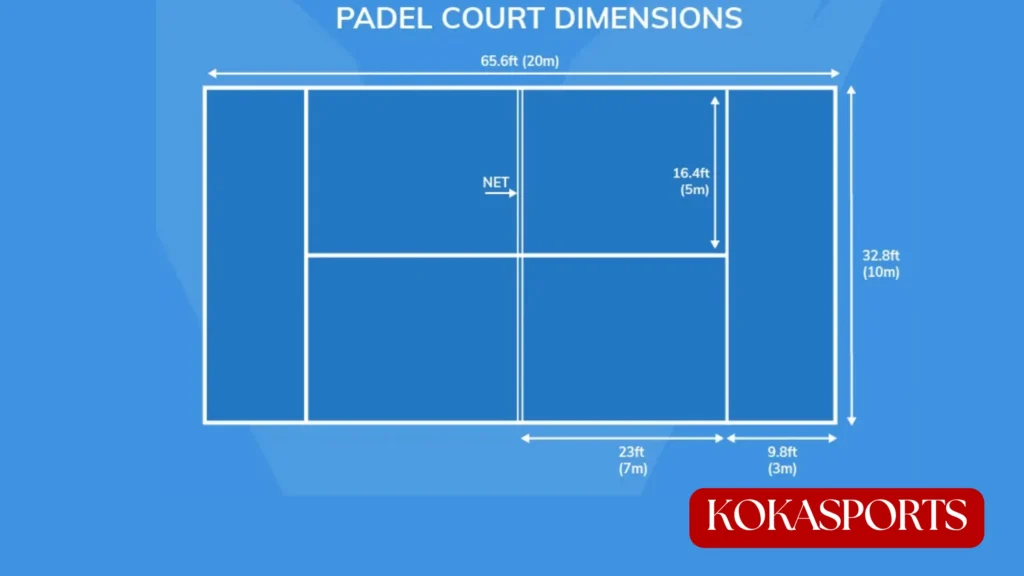
A padel court is smaller than a tennis court, which is a big reason the sport is spreading so quickly. You can fit one into far less space.
Court Size
Under official FIP regulations, a standard padel court measures 20 meters long by 10 meters wide (about 65.6 feet by 32.8 feet), with a small tolerance of 0.5 percent. That is roughly half the footprint of a tennis court. A net divides the court into two equal halves, and painted lines mark the service boxes on each side.
Walls, Mesh, and the Net
The court is fully enclosed by tempered glass and metal mesh fencing. The back walls stand about 4 meters high, usually 3 meters of solid glass topped by 1 meter of mesh. The net sits 0.88 meters high at the center and rises to 0.92 meters at the posts. These walls are not just a boundary. Players can use rebounds off the glass to keep the ball alive and open up clever angles.
Padel Court vs Tennis Court
A common question is whether you can just add walls to a tennis court and call it padel. The answer is no. A padel court is about a quarter smaller, and the walls are permanent structures, so padel needs its own purpose built court. Here is how the two compare.
| Feature | Padel Court | Tennis Court |
|---|---|---|
| Length | 20 m (65.6 ft) | 23.77 m (78 ft) |
| Width | 10 m (32.8 ft) | 10.97 m (36 ft, doubles) |
| Net height (center) | 0.88 m | 0.914 m |
| Walls in play | Yes, glass and mesh | No |
| Main format | Doubles | Singles or doubles |
How to Play Padel: Rules and Scoring
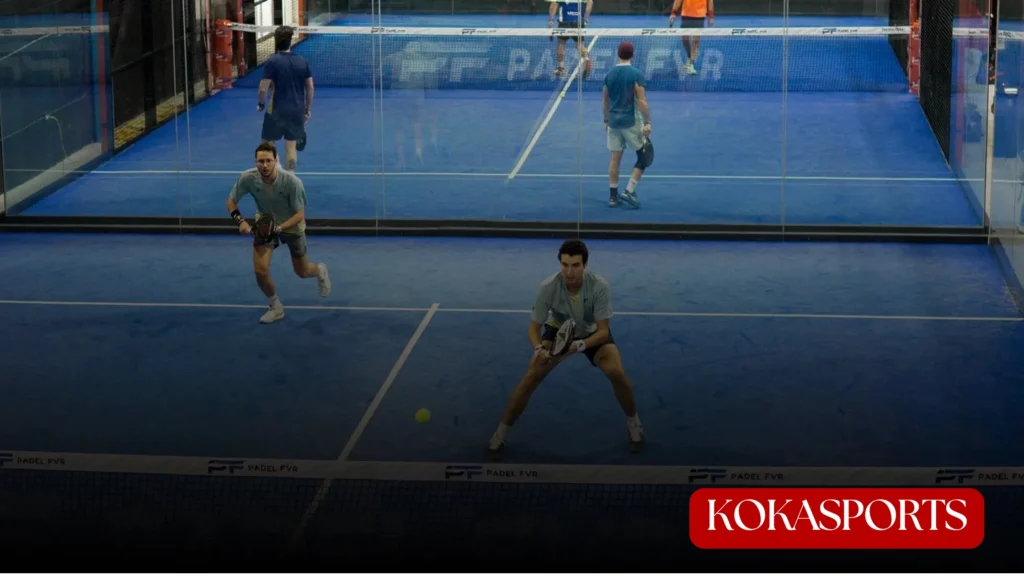
Padel uses the same scoring as tennis, so it feels familiar right away. Points run 15, 30, 40, and then game, and 40 to 40 is a deuce. A set goes to the first pair to reach six games with a two game lead.
The serve is what sets padel apart. You serve underarm by bouncing the ball on the ground and hitting it at or below waist level, then sending it diagonally into the opponent’s service box. This gentle serve is a big reason beginners can start rallying almost immediately.
Padel Rackets and Balls
Padel rackets are solid and stringless, with a perforated surface that gives you both control and power. They are made from materials like carbon and fiberglass over a foam core, and they are shorter and easier to handle than a tennis racket.
Padel balls look almost identical to tennis balls but sit at a slightly lower internal pressure, which produces a more controlled bounce. Under FIP rules a padel ball has a diameter between 6.35 and 6.77 centimeters and weighs between 56 and 59.4 grams.
A Quick History of Padel
Padel was invented in 1969 by Enrique Corcuera at his home in Acapulco, Mexico, and his wife, Viviana, wrote the very first rules. The sport reached Spain in the early 1970s through Prince Alfonso of Hohenlohe, who built the first European courts in Marbella, and it soon spread to Argentina and beyond. The International Padel Federation was founded in Madrid in 1991, and today padel is played by millions of people worldwide.
Where to Play Padel in the USA
Interest in padel is exploding across the country, and new clubs open every month. USA Padel, the official national body affiliated with the FIP, keeps a directory of courts, clubs, and tournaments, making it the best place to start when you want to find a court near you. Many tennis clubs, fitness centers, and resorts are also adding covered outdoor courts so members can play year round. If you are weighing your options, our separate padel vs pickleball guide compares the two.
Why Padel Is Booming
Padel is easy to learn, genuinely social, and endlessly fun. The compact courts are cheaper to build than tennis courts, the underarm serve welcomes total beginners, and the wall play keeps experienced players challenged.
Conclusion
A padel court is a compact, fully enclosed space where the walls become part of the game, and that single idea is what makes padel so addictive. With simple rules, a friendly underarm serve, and courts opening up nationwide, there has never been a better time to try it. Find a court near you, grab three friends, and see what all the excitement is about.