

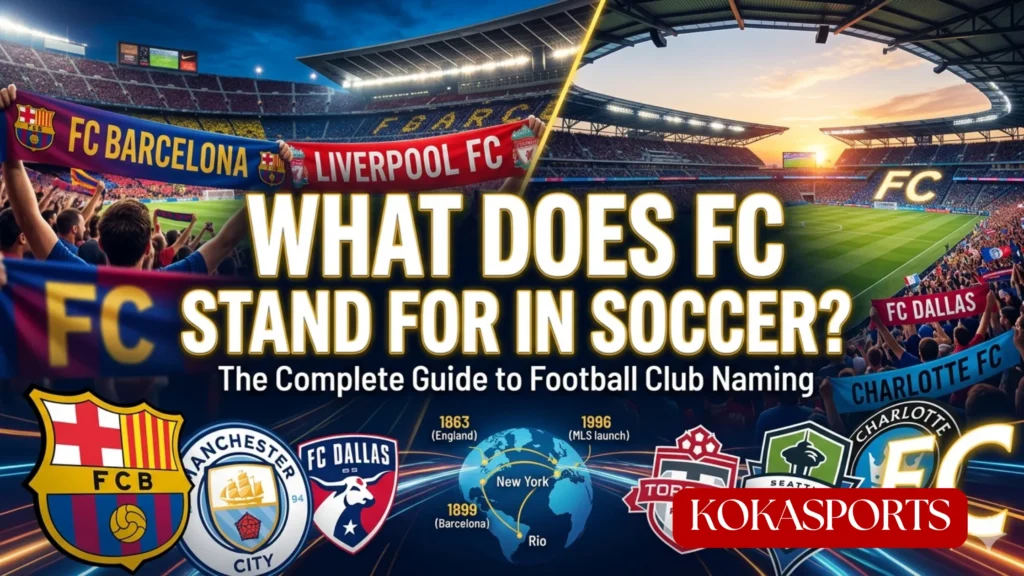
If you’ve ever watched a match featuring FC Barcelona, FC Cincinnati, or Charlotte FC and wondered what those two letters actually means. What does FC stand for in soccer? It’s one of the most common questions new and casual soccer fans ask. The answer is simple: FC stands for Football Club. But there’s a lot more to it than just two letters. This guide breaks down the history, the naming patterns, and why some clubs use FC while others don’t.
What Does FC Stand For in Soccer? The Direct Answer
FC stands for “Football Club.”
The term “football club” refers to an organized group of players competing in a league under the rules of association football the global name for the sport Americans call soccer.
You’ll see it written as FC, F.C., or spelled out in full. All three mean exactly the same thing.
💡 Pro Tip: The world calls it football. The U.S. calls it soccer. That’s why “Football Club” on an American team can feel strange but it’s the global standard.
The History Behind FC : Where Did It All Begin?
The initial use of FC traces back to England in the mid-1800s.
When the Football Association was founded in 1863, it standardized the rules of association football for the first time. As clubs formed across England, they began adding “Football Club” to their names to distinguish themselves from rugby clubs and cricket clubs competing for the same members.
Liverpool Football Club, founded in 1892, is a classic example. The words “Football Club” weren’t just a label they were a declaration of what kind of club it was.
As European football expanded globally through the late 1800s and 1900s, the FC naming tradition traveled with it reaching South America, Africa, Asia, and eventually North America.
Quick Takeaway: FC originated in 1860s England and spread worldwide alongside the growth of organized football.
Read More: Are Soccer and Football Cleats the Same? Everything You Need to Know
Why Do Some Clubs Use FC and Others Don’t?
There’s no rule requiring a professional soccer club to use FC. It’s always a choice.
Here’s a breakdown of the most common naming styles:
| Abbreviation | Full Meaning | Example |
|---|---|---|
| FC | Football Club | FC Barcelona |
| SC | Sports Club | Sporting CP |
| AC | Athletic Club | AC Milan |
| CF | Club de Fútbol | Valencia CF |
| United | No abbreviation | Manchester United |
Real Madrid one of the most famous clubs in the world skips FC entirely. Their full registered name is Real Madrid Club de Fútbol, but they simply go by “Real Madrid.”
Teams choose their names based on history, culture, and branding. Many club names were set long before FC became a global standard. Others deliberately chose a different style to reflect their regional identity.

💡 Pro Tip: FC (or the lack of it) says nothing about a club’s prestige or level. It’s purely an identity choice.
FC Meaning in Football : The 3-Type Naming Framework
Here’s a simple way to understand why any club does or doesn’t use FC. Every club falls into one of three categories:
| Type | Who They Are | Example |
|---|---|---|
| Heritage Clubs | Founded long ago, FC was part of their original identity | Liverpool FC, FC Barcelona |
| Expansion Clubs | Newer clubs that chose FC deliberately to align with global soccer culture | FC Cincinnati, Austin FC, New York City FC |
| Rebranded Clubs | Started with a different name, added FC during a modernization rebrand | FC Dallas (formerly Dallas Burn, rebranded 2005) |
This framework helps you immediately understand why a club carries FC whether it’s tradition, strategy, or reinvention.
What Is FC in Soccer? MLS and the American Adoption
Early Major League Soccer clubs used very American-sounding names Columbus Crew, New England Revolution, New York Red Bulls. These names were designed to appeal to U.S. sports fans familiar with franchise-style naming.
Why MLS Teams Use FC
As soccer in America grew and clubs chased global audiences, the shift toward FC accelerated. Using FC signals professionalism, connects clubs to worldwide football culture, and helps attract international players and sponsors.

Here’s how major league soccer clubs split on the naming question:
Clubs that use FC:
- FC Dallas rebranded from Dallas Burn in 2005, one of MLS’s first FC adopters
- FC Cincinnati carried FC from its USL roots into MLS in 2019
- Toronto FC Canada’s flagship MLS club, FC since founding in 2006
- Austin FC launched 2021, FC from day one
- Charlotte FC launched 2022, continuing the modern FC trend
- Seattle Sounders FC places FC at the end rather than the front
- New York City FC co-owned by Manchester City, the FC connection is intentional
- Atlanta United FC and Minnesota United FC blend American identity with global style
- Vancouver Whitecaps FC Canada’s West Coast MLS representative
Clubs that skip FC:
- Real Salt Lake modeled after Spanish naming conventions, uses “Real” instead
- Columbus Crew kept its original blue-collar American identity
- New England Revolution named after American history
This different naming split inside a single league shows just how flexible the FC convention really is.
Quick Takeaway: MLS clubs use FC to connect with global soccer culture. It’s deliberate branding, not a requirement.
Famous FC Clubs That Shaped the Abbreviation
These clubs didn’t just carry the FC name they built the global meaning behind it:
- FC Barcelona one of the most recognized clubs on the planet, based in Spain
- FC Bayern Munich Germany’s most successful club and a premier league-level European force
- Manchester City FC English Premier League powerhouse with global reach
- FC Porto Portugal’s most decorated club in European competition
- Toronto FC North America’s most recognized FC club internationally
When soccer fans anywhere in the world see FC on a jersey, these are the clubs that gave those two letters their weight.
FC vs F.C. : Any Difference?
No functional difference at all.
F.C. with periods was the older British style. FC without periods is the modern standard used by most clubs and leagues today. Both are simply an abbreviation for Football Club. The choice between them is purely stylistic some official documents still use F.C. while modern club branding almost always drops the periods.
Frequently Asked Questions
What does FC mean in FIFA?
FC means Football Club in FIFA exactly the same as in real soccer. EA Sports itself rebranded its flagship game to EA Sports FC in 2023, keeping the abbreviation because it’s the universal identifier for a football club in global soccer culture.
Is FC only used in soccer?
Primarily yes. While a few rugby and other sports club organizations carry FC, the abbreviation is overwhelmingly associated with professional soccer worldwide. When sports fans see FC, soccer is the immediate association.
What’s the difference between FC and CF?
CF stands for Club de Fútbol the Spanish-language equivalent of Football Club. Used widely across Spanish-speaking countries, CF carries the exact same meaning of FC in a different language. Both refer to an organized soccer club.
Does every club have to use FC?
No. FIFA sets no rule requiring FC. The football association in each country may have registration requirements, but using FC is always optional. Many clubs including some of the world’s biggest don’t use it at all.
Why do American teams use FC instead of something else?
American soccer clubs use FC to bridge local identity with global football culture. It signals that the club is part of the worldwide beautiful game tradition, not just a domestic franchise. It also resonates better with international soccer players and global sponsors.
What FC Really Tells You About a Club
At its core, FC means more than just two letters on a badge. When a club puts FC in their team name, they’re communicating three things:
- We are organized a formal club structure, not just a casual group
- We belong to a tradition connected to 160+ years of global football history
- We are serious about the sport, the league, and the culture around it
Whether it’s a founding member of the English Premier League or a brand-new MLS expansion side, those two letters carry the same meaning.
Conclusion : What Is FC in Soccer?
FC stands for Football Club two letters that connect every club carrying them to the very roots of the sport.
It started in England in the 1860s under the rules of association football, spread across European football and the world, and arrived in American soccer through MLS clubs that wanted to signal they were part of something global.
From Seattle Sounders FC and Charlotte FC to FC Barcelona and Liverpool Football Club, the abbreviation is the same everywhere: an organized club, competing in the beautiful game, carrying the weight of football history in just two letters.