


How many soccer players on the field? Twenty-two, or eleven from each team, and one of those eleven on each side must be the goalkeeper. That is the standard for professional, international and adult soccer everywhere in the world.
The number can change during a match. A red card reduces a team to ten, and youth competitions use smaller formats entirely. This guide covers the positions, the squad-versus-starting-eleven distinction, what happens after a sending-off, and the formats used at every level from under-6 to the World Cup.
How Many Players Are on a Soccer Field at One Time?
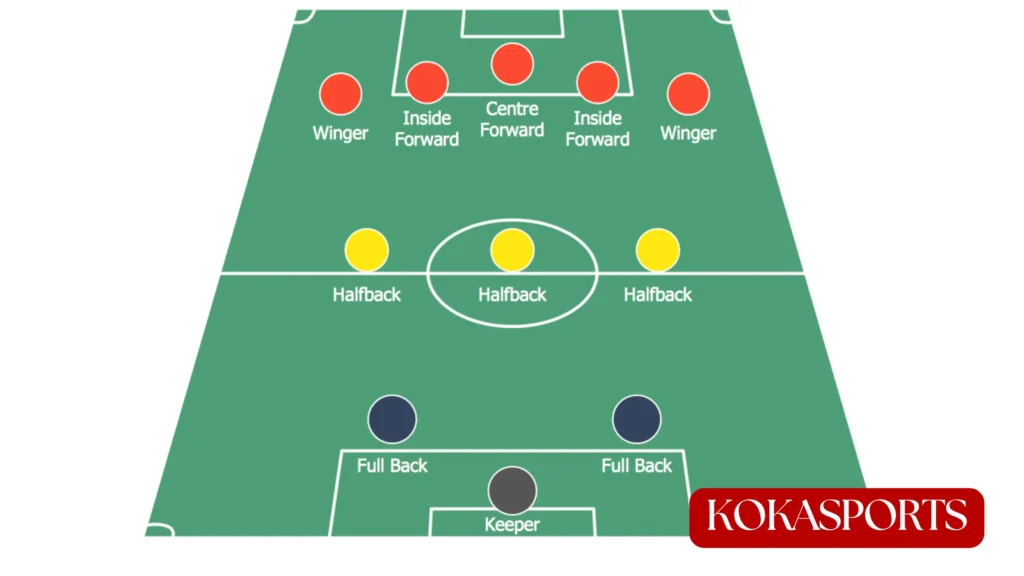
Eleven per team, twenty-two in total.
That figure comes from Law 3 of the Laws of the Game, maintained by IFAB, which states that a match is played by two teams, each with a maximum of eleven players, one of whom must be the goalkeeper.
Three numbers get confused constantly, so let us separate them:
- Eleven: players from one team on the field
- Twenty-two: players from both teams combined
- More than twenty-two: the total including substitutes, who are not on the field
Note that eleven is a maximum, not a requirement. A team can legally start with fewer, though at professional level this essentially never happens.
The referee and assistant referees are on the field but are not players. A standard professional match has twenty-two players and usually four or more match officials, and at the top level several more working on video review off the pitch.
How Many Players Does Each Team Have on the Field?
One goalkeeper and ten outfield players.
The goalkeeper is the only player permitted to handle the ball, and only inside their own penalty area. They also wear a different colour shirt so officials and teammates can identify them instantly.
The other ten are outfield players, and here is the important part: those ten are not locked into fixed positions. A coach distributes them across defence, midfield and attack however the tactics demand. The count stays at ten; the arrangement changes every week.
What Are the 11 Positions in Soccer?
This is where a common misunderstanding lives. There are eleven players, but there is no fixed list of eleven official positions.
Goalkeeper. One per team. Stops shots, organises the defence, and increasingly starts attacks with their feet.
Defenders. Usually three or four. Centre-backs defend the middle of the pitch directly in front of the goalkeeper and handle most aerial duels. Full-backs cover the wide areas on either side of them. Wing-backs are full-backs with far more attacking responsibility, used in formations built on three centre-backs rather than four defenders.
Midfielders. Usually three to five. Defensive midfielders shield the back line. Central midfielders link defence and attack. Attacking midfielders operate closer to the forwards. Wide midfielders work the flanks.
Forwards. Usually one to three. A striker is the central goalscorer. Wingers attack from wide positions and either cut inside to shoot or deliver crosses. A false nine drops deep instead of playing on the shoulder of the last defender.
So: are there eleven positions in soccer? Not exactly. There are eleven players filling roles drawn from a much larger vocabulary, and a modern player often occupies two or three of those roles within a single match.
Why Do Soccer Teams Have 11 Players?
Largely historical accident, then habit.
When the Football Association codified the rules in England in 1863, eleven-a-side was already the common format in the public schools where the game was developing. There is a persistent story that it came from eleven boys sharing a dormitory. It is a good story with little evidence behind it. What is certain is that eleven stuck, and it has not changed in over 160 years.
What it produces is balance. Eleven players on a full-size pitch is enough to defend properly, contest midfield and attack, without the field becoming so crowded that space disappears. Add four more per side and the game would seize up. Take four away and it would become a track meet.
Formations redistribute those same eleven. A 4-4-2 uses four defenders, four midfielders and two forwards. A 4-3-3 shifts a midfielder forward. A 3-5-2 trades a defender for a midfielder. Different shapes, identical headcount.
How Many Players Are on a Soccer Team Including Substitutes?
More than eleven, and the exact number depends entirely on the competition.
At the highest level, Law 3 permits up to five substitutes from a named list of as many as fifteen, with an additional substitute allowed in extra time where competition rules permit. Crucially, teams get only three substitution opportunities to make those five changes, so substitutions often come in pairs. Half-time does not count against the three.
For the 2026/27 season, IFAB increased the allowance in senior international friendlies to eight substitutes, or up to eleven if both teams agree beforehand. Friendlies only. This does not apply to competitive matches.
Lower down, the rules loosen considerably. Youth, veterans, disability and grassroots football can use return substitutions, where a substituted player comes back on. That is not permitted in the professional game.
The key distinction: substitutes change which eleven players are on the field, not how many. Bring one on and another must come off. The count never rises.
Does the Number Change at the World Cup?
No. A World Cup match starts with eleven players per team, twenty-two in total, exactly like any other match.
What is different is the squad. Tournament squads are considerably larger than a matchday bench, because teams need cover across weeks of competition and cannot call up replacements freely once the tournament is underway.
The 2026/27 Laws of the Game were implemented at the 2026 World Cup, including new time-wasting measures: a ten-second limit for substituted players to leave the field, and five-second countdowns on slow throw-ins and goal kicks. None of these change the player count. For more on the tournament itself, see our World Cup 2026 fan’s guide.
How Many Players in High School Soccer?
Eleven per team, the same as the professional game.
High school soccer in the United States follows NFHS rules, which keep the eleven-a-side format but differ from IFAB in other respects, particularly substitutions, which are far more generous than the professional five. High school rules typically allow substitutions at various stoppages, and substituted players can usually return to the field later in the game, something the professional game does not permit. The reasoning is developmental: school programmes exist partly to give more students playing time.
Some state associations modify rules further. If you need specifics on substitution windows, roster limits or game length, check your state association rather than assuming the FIFA rulebook applies.
How Many Players Are on the Field for Kids’ Soccer?
Fewer, and deliberately so.
Under U.S. Soccer’s Player Development Initiatives, mandatory for all member organisations including US Youth Soccer, US Club Soccer and AYSO since 2017, youth formats scale with age:
| Age group | Format | Goalkeeper? |
|---|---|---|
| U6-U8 | 4v4 | No |
| U9-U10 | 7v7 | Yes |
| U11-U12 | 9v9 | Yes |
| U13 and older | 11v11 | Yes |
The reasoning is straightforward. Fewer players on a smaller field means more touches per child, more involvement, and more chances to make decisions. Twenty-two seven-year-olds on a full pitch produces a swarm around the ball and very little learning. The youngest format has no goalkeeper at all, which keeps every child moving rather than standing alone at one end.
Does U12 soccer use 11 players?
Under the U.S. Soccer standard, no. U12 plays 9v9, eight outfield players plus a goalkeeper. Full 11v11 begins at U13.
That said, leagues vary in practice, and some competitive clubs move players to 11v11 earlier. If your U12 team is playing eleven-a-side, that is a league decision rather than the national standard. Always check your specific league.
One note for the current season: U.S. Soccer is transitioning from birth-year age groupings to an August-to-July system beginning in 2026-27, so some players will shift age groups during the changeover.
What Happens After a Red Card?
The dismissed player leaves the field and cannot be replaced. Their team plays the rest of the match a player short.
That is what makes a red card so costly. It is not a temporary penalty like a hockey power play, where the team returns to full strength after two minutes. In soccer the disadvantage lasts the rest of the match, however many minutes remain.
The arithmetic:
- Normal match: 11 v 11 (22 players)
- One red card: 10 v 11 (21 players)
- Two red cards to the same team: 9 v 11 (20 players)
A team that has already used all its substitutes and then loses a player to a red card cannot restore its numbers at all. If a goalkeeper is sent off, the team must put an outfield player in goal, usually sacrificing an attacker to do it.
Can a Team Play With Fewer Than 11 Players?
Yes, down to a point, and that point is seven.
Law 3 states that a match may not start or continue if either team has fewer than seven players. Lose a fourth player to a red card and the match is over.
The 2026/27 Laws sharpened this. The seven-player minimum now expressly excludes temporary situations such as a temporary dismissal or a player briefly off the field under the treatment protocol. And where a team is responsible for dropping below seven, by walking off in protest for instance, it will in principle forfeit the match.
Seven is a genuine floor, not a technicality. It has ended professional matches, most often in heated derbies where a cluster of red cards leaves one side unable to field a legal team and the referee has no choice but to abandon.
Players on the Field vs Players on the Team
| Term | What it means |
|---|---|
| Starting XI | The eleven players who begin the match |
| Players on the field | Whoever is currently playing, usually 11, fewer after a red card |
| Substitutes | Named players on the bench, eligible to come on |
| Matchday squad | Starting XI plus named substitutes |
| Full roster | Every player registered to the club |
Most confusion about soccer team size comes from these five things being treated as one number. They are not. A club might have thirty players registered across the season, name eighteen for a particular match, start eleven of them, use three substitutes, and finish with ten after a sending-off. Every one of those figures is correct, and every one answers a different question.
FAQs About How Many Soccer Players on the Field?
How many soccer players are on the field at a time?
Twenty-two, or eleven from each team, including one goalkeeper per side. That number holds for professional, international and adult amateur soccer worldwide, and can drop if a player is sent off.
Are there 12 players on a soccer team?
No. Eleven play at once. A team has more than eleven players in its squad, but only eleven of them can be on the field at any moment. Anyone else must be a substitute waiting on the bench.
Are there 11 or 12 players on a football team?
Both soccer and American football field eleven players per team. The similarity ends there. American football uses separate offensive, defensive and special teams units with unlimited substitution between plays, so far more than eleven players appear in a game.
How many players are on the field after a red card?
Twenty-one, if one player is dismissed. The sent-off player cannot be replaced, so their team continues with ten against eleven. A second dismissal makes it nine against eleven, and so on down to the seven-player minimum.
How many soccer players are on the field for kids?
It depends on age. Under U.S. Soccer standards, U6-U8 plays 4v4 without goalkeepers, U9-U10 plays 7v7, U11-U12 plays 9v9, and full 11v11 begins at U13.
Conclusion
So, how many soccer players on the field? Twenty-two at kick-off: eleven per team, one of whom is the goalkeeper on each side.
Substitutions swap individuals in and out without changing that total. Red cards do change it, permanently, for the rest of the match, down to a hard minimum of seven players per side. And youth soccer uses smaller formats by design, so a nine-year-old’s game will have fourteen players on a much smaller field.
But whenever you turn on a professional match, the answer is the same one it has been since 1863: eleven against eleven.