


You’ve watched a match, seen players racing across the pitch, and thought wait, exactly how many players are on a soccer team? Is it 11? 22? And why does your kid’s U9 league use so few players compared to a professional game?
The short answer: 11 per team. But the full answer covers official rules, youth formats, substitution history, and one surprising rule most fans have never heard of.
Quick Answer: How Many Players Are on a Soccer Team?
In a standard soccer match, each side fields exactly 11 players one goalkeeper and ten outfield players. Both teams together put 22 players on the field at kickoff.
Here’s a quick reference across all major formats:
| Format | Players Per Team | Total on Field |
|---|---|---|
| Standard 11v11 | 11 | 22 |
| 9-a-side | 9 | 18 |
| 7-a-side | 7 | 14 |
| 5-a-side / Futsal | 5 | 10 |
| 4-a-side (U6–U8) | 4 | 8 |
| Beach Soccer | 5 | 10 |
| Indoor Soccer | 6 | 12 |
What the Laws of the Game Say About Team Size
Most fans assume FIFA writes all the rules. In reality, the International Football Association Board (IFAB) is the official rulemaking body. FIFA applies IFAB’s laws, but IFAB owns them.
Under IFAB Law 3, a standard match requires 11 players per team to start. But here’s the rule almost nobody talks about:
A side must field at least 7 players to start or continue play.
A club does not need a full eleven to keep the match going. Drop below fewer than seven players through red cards, injuries, or both and the referee abandons the game. Above that threshold, play continues even with a short-handed side.
This surprises most fans who assume 11 is both the starting number and the hard minimum throughout the ninety minutes.
What Happens When a Team Has Fewer Players Mid-Match?
A red card means an immediate exit and no replacement. The side plays short for the rest of the game.
- 10 players: Manageable. Teams adjust their formation and defend more compactly.
- 9 players: Very tough. The manager usually packs the defensive shape.
- Fewer than 7 players: The referee stops the match entirely.
Important: The same applies to injuries. Once all substitution slots are used, no further swaps are allowed an injured player either plays on or the side is down to fewer players on the field.
How Many Players Are on a Soccer Field? The 11-Player Blueprint
Understanding the number is just the start. Here’s The 11-Player Blueprint a simple way to see how a squad is structured from goalkeeper to attack.
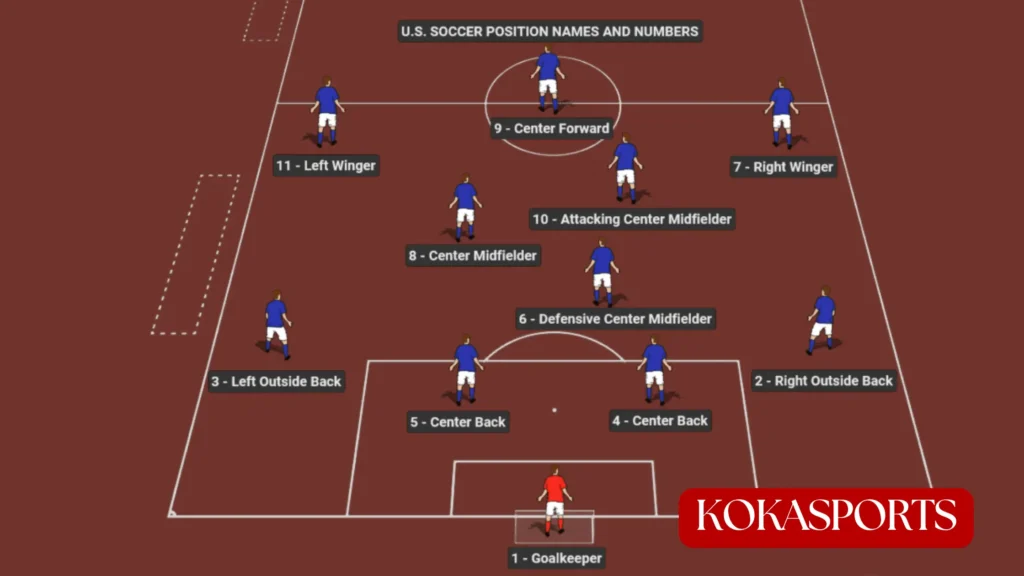
Every side has four layers:
- 1 Goalkeeper the last line of defense
- Defenders protection in front of the goal (usually 3–5)
- Midfielders the link between defense and attack (usually 3–5)
- Forwards the attacking threat up front (usually 1–3)
The exact split between these layers is determined by the formation the coach picks. Teams arrange the same eleven players in very different ways to suit their style and their opponent.
The Goalkeeper : One Position, Unlimited Responsibility
Every side has one goalkeeper. This is the only player allowed to use their hands inside the penalty area the large marked box in front of the goal.
Step outside that box, and the goalkeeper cannot touch the ball with their hands. They become a regular outfield player until they return inside the boundary.
Modern goalkeepers do far more than stop shots. Many operate as a “sweeper-keeper” stepping off their line to intercept through-balls, starting attacks with pinpoint passing, and directing the defense in front of them.
💡 Pro Tip: The goalkeeper is counted within the eleven. There are no separate counts. It is always one goalkeeper and ten outfield players eleven total on each side.
Defenders : The Foundation
The defender line protects the penalty area and works to stop the opposing team from scoring.
The most common arrangement is four defenders: two center-backs in the middle, two full-backs on the flanks. Some sides use three or five depending on the chosen setup.
- Center-backs: Guard the central zone. Dominant in the air, strong in duels, and tactically aware.
- Full-backs (left/right back): Cover the wide channels. In modern football, they push forward and often overlap with midfielders.
- Wing-backs: Used in a five-defender system. These players cover the entire flank deep defense to advanced attack.
Midfielders : The Engine Room
The midfielder is the most versatile role in the game. They connect defense and attack, and their responsibilities shift based on their specific type:
- Defensive Midfielder: Sits just ahead of the back line. Wins the ball back and breaks up attacks before they develop.
- Central Midfielder: Covers the full middle third. Controls tempo, distributes passes, and supports both sides of the game.
- Attacking Midfielder: Operates in the final third. Creates chances, arrives late into the box, and is often the team’s most creative player.
The “double pivot” two defensive midfielders alongside each other has become one of the most popular midfield shapes in modern football.
Forwards and Strikers : The Finishing Line
Forwards are positioned closest to the goal. Their core job: score goals.
- Striker: The main goal threat. Hunts space in and around the penalty area and attacks the ball with pace, movement, or aerial ability.
- Wide forwards / Wingers: Operate out wide, cut inside to shoot, or deliver crosses for the striker to attack.
- Second striker / attacking player: Drops deeper to link play and create overloads in the final third.
The number of forwards depends entirely on the formation: a 4-3-3 uses three; a 4-4-2 deploys two strikers; a 4-5-1 plays with one up front. Every arrangement is still built around the same eleven players on the field just distributed differently.
The Roster Confusion: On the Field vs Bench vs Full Squad
This is where most people get confused. “11 on a soccer team” does not mean the club only has eleven players. Here is the clearest way to think about it The Roster Confusion Framework:
| Layer | Number | What It Means |
|---|---|---|
| Active players field at a time | 11 | Playing during the match |
| Bench (substitute players) | Up to 12 | Ready to come on |
| Full team roster | 23–35+ | All registered players at the club |
| World Cup squad (2022 onward) | 26 | FIFA expanded from 23 players in 2022 |
When a club announces a “25-man squad,” that means 25 are registered for the season. During a game, only 11 are on the pitch and the rest are either sitting as substitute players on the bench or not included in the matchday squad at all.
This three-layer picture solves most confusion about team composition in the professional game.
Substitution Rules: How Many Substitutes Can a Team Make?
A substitute replaces a player already active on the pitch. Here’s how the rules work today and the history behind them.
How Substitution Rules Evolved
- Pre-1958: No substitutions. Injured players stayed on or the side played short.
- 1958: First substitutions introduced in international competition.
- 1970s: Two substitutions became standard across the professional game.
- Up to 2018: Three substitutions were the global standard.
- 2020 (COVID rule change): IFAB temporarily allowed five substitutions to protect player welfare during compressed fixture schedules.
- Post-2020: Five substitutions permanently adopted in the Premier League, La Liga, Bundesliga, Serie A, MLS, and Champions League.
How the 5-Substitute Rule Works
Teams can make up to five swaps but only across three stoppages (plus halftime). This prevents constant disruptions.
Deciding how many substitutes to use comes down to match management: fresh legs to maintain intensity, tactical changes to shift shape, or countering opposing players who are dominating the game.
Pro Tip: In youth leagues and recreational play, rolling substitutions are common players can come off and return multiple times. This keeps everyone involved and gives all squad members proper playing time.
Youth Soccer: How Many Players by Age Group?
Youth football does not start with the full eleven-a-side format. Team size is scaled to age and development, following US Youth Soccer and FIFA grassroots guidelines.
This progression is called The Player Development Pyramid:
| Age Group | Format | Players Per Team | Field Size (approx.) |
|---|---|---|---|
| U6–U8 | 4v4 | 4 | 25 × 20 yards |
| U9–U10 | 7v7 | 7 | 55 × 35 yards |
| U11–U12 | 9v9 | 9 | 70 × 45 yards |
| U13 and above | 11v11 | 11 | Full size |
Why Smaller Formats Produce Better Players
Youth soccer research consistently supports smaller-sided games for young players. Here’s why:
- More time to touch the ball: Fewer players per side = more touches per child per session.
- More decisions: Players face real game situations more often, developing faster.
- Better engagement: Every player stays involved nobody is standing on the sideline.
- Cleaner learning of soccer positions: Roles are simpler and more natural to understand in small groups.
Smaller really is smarter at the development stage.
Different Soccer Formats and Their Team Sizes

The 11v11 game known as association football is the full version of the sport. But the game is played in many different soccer formats globally, each built around a different number of players on each side.
Standard Soccer (11v11)
The format used in all major professional competitions: Premier League, Champions League, World Cup, MLS, and every senior league worldwide.
- 11 players per team on a full-size soccer field
- Governed by IFAB’s Laws of the Game
- A standard soccer match runs two 45-minute halves
Futsal : Five Players Per Team
Futsal is an official FIFA format not just indoor soccer. It is played on a hard court with a smaller soccer ball that has reduced bounce, and five players per team including the goalkeeper.
- No walls the ball goes out of bounds as in outdoor play
- Famous for developing close control and quick thinking under pressure
- Elite players on the national team level, including Messi and Ronaldo, have credited futsal in their early development
Beach Soccer : Five Players Per Team
Played on sand with five players per side including the goalkeeper. Three 12-minute periods replace the standard two halves. Rolling substitutions are allowed throughout.
FIFA governs beach soccer and holds a Beach Soccer World Cup. This format is played by millions globally yet is completely absent from most guides on this topic.
Indoor Soccer : Six Per Team
Common in North America, arena football (indoor soccer) is played with boards along the sidelines. Teams use six players including the goalkeeper.
Unlike futsal, the ball stays in play off the boards, keeping the action continuous and fast. Indoor soccer is especially popular in colder regions where outdoor play is seasonal.
Recreational Formats (5v5, 7v7, 9v9)
These serve adult recreational leagues and community programs. Basic soccer rules apply but players per side are adapted to smaller fields and local participation numbers.
Why Does Football Use 11 Players? The History
Why 11? The answer is more interesting than most people expect.
When the Football Association wrote the first formal rules for the sport in 1863 in England, early matches had no fixed number sometimes 15 or even 20 players per side were used. The number 11 emerged through practice and the influence of English public schools.
One popular theory: English cricket team formations also used 11 players. Many of the same people who organized early soccer also played cricket, and 11 felt like the natural number for a competitive team sport on grass.
By 1872 the first official international match between England and Scotland both sides fielded eleven players on the pitch. The format proved ideal: large enough to cover a full soccer field effectively, small enough that every individual had real impact on the game’s outcome.
Over 150 years later, the number has never changed. Every tactical revolution from the 2-3-5 “pyramid” to the modern 4-3-3 and 3-5-2 has happened inside the same team has 11 players framework. It is the one constant in an ever-evolving sport.
5 Common Misconceptions About How Many Players Are on a Soccer Team
1. “A soccer team has 11 players”
✅ Correct version: 11 are players are on a soccer pitch at once. The full club squad has far more team on the field is separate from the full registered roster.
2. “You can always substitute an injured player”
✅ Correct version: Once all slots are used, no further swaps are possible. An injured player continues or the side plays short.
3. “The goalkeeper counts separately from the outfield players”
✅ Correct version: One goalkeeper counts as part of the eleven. It’s always one goalkeeper and ten outfield players not eleven plus one.
4. “Youth football uses the same team size as the pros”
✅ Correct version: The number of players scales by age. Fewer players per side at younger ages is intentional and research-backed.
5. “Referees are counted as players on the field”
✅ Correct version: The referee and their assistants are officials, not players. A match has 1 main referee and 2 assistants none counted toward the 22 players.
FAQs
How many players are on a soccer team including substitutes?
A matchday squad includes 11 starters plus up to 12 players on the bench up to 23 total. National team squads at the World Cup expanded to 26 in 2022. Full club rosters often reach 30 or more.
How many players are on the field in a soccer game?
In a standard match: 22 players total at kickoff 11 per side. The number can drop during play when players receive red cards, as the defending team or attacking team that loses a player cannot bring on a replacement.
Can a soccer team have more than 11 players on the field?
No. More than 11 players allowed on the pitch at once results in the referee stopping play. The extra player is removed and the opposing team typically receives a free kick.
How many referees are on a soccer field?
A standard match has 1 main referee on the field and 2 assistant referees on the sidelines. A 4th official manages substitutions. In top competitions, VAR officials operate remotely. None count toward players are on the field.
What is the minimum number of players needed to continue a match?
IFAB Law 3: the minimum is 7. Drop below that if a number of players falls below seven through red cards or injury and the referee must abandon the match.
Conclusion : Soccer Team Size at a Glance
- Standard match: 11 players per side 22 players total on the pitch
- On the bench: up to 12 substitute players per team
- Full team roster: 23–30+ players at a professional club
- Substitutions: Up to 5 per match across 3 intervals in professional soccer
- Minimum to play: 7 players the referee stops play below this threshold
- Youth formats: Scale from 4v4 (U6–U8) to 11 players on the field per side at U13+
- Alternative formats: Futsal and Beach Soccer use 5 per side; indoor uses 6
- Officials: 3 referees on and near the field not counted as players
- 11-player standard unchanged for 150+ years in soccer
How many players are on a soccer team goes well beyond one number. Whether you’re a parent at your child’s first match, a new fan finding your footing, or a coach planning team formations and team composition these are the rules the beautiful game is built on.
The structure of 11 players per team is not just a regulation. It is the framework everything else in soccer was designed around.