


You’re watching a high school baseball game. The scoreboard hits the 7th inning but the game ends early. Or keeps going. Or stops due to rain with no clear winner. So how many innings in high school baseball does a game actually have?
Most high school baseball games are 7 innings long. But the real answer is more complex mercy rules, weather stoppages, extra innings, and tournament formats can all change the final number. This guide breaks down every scenario so you’ll never be confused again.
What Is the Standard Number of Innings in High School Baseball?
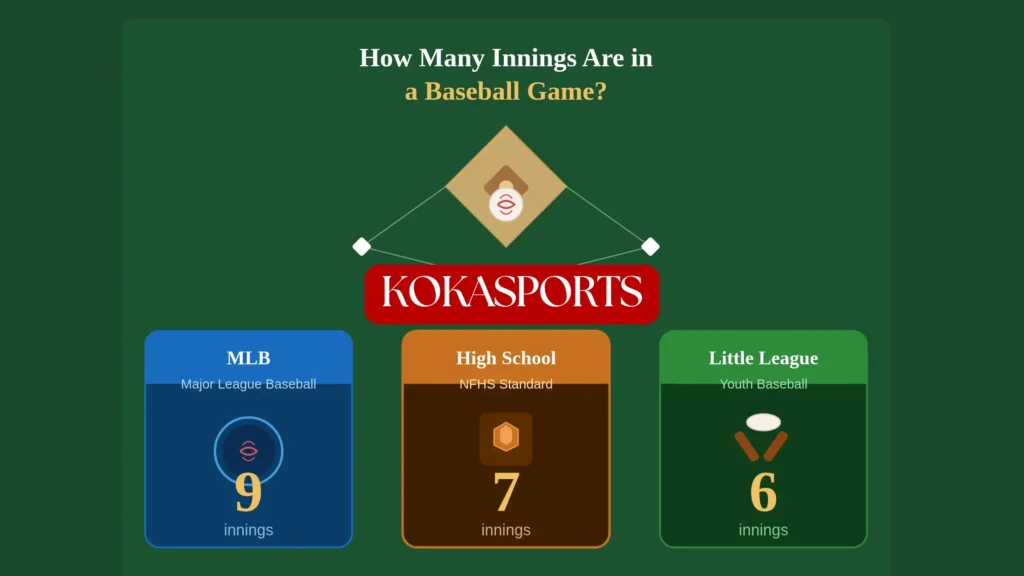
A standard high school baseball game is 7 innings. That is the official rule set by the National Federation of State High School Associations (NFHS) the governing body that writes the rulebook for high school sports across the United States.
The federation of state high school athletics organizations in each state typically adopts these rules as their baseline, though some state high school associations may make adjustments for their specific competitions.
Each inning follows the same structure used at every level of baseball:
- The visiting team bats first (top of the inning)
- The home team bats second (bottom of the inning)
- Each side gets 3 outs before switching
Once both halves are complete, that’s one full inning. Seven of those equals a complete regulation game.
💡 Pro Tip: A game doesn’t always need all 7 innings to be “official.” Under NFHS rules, a game is considered regulation after five full innings (or 4½ if the home team is ahead).
Why Does High School Baseball Play 7 Innings Instead of 9?
This is the question almost no competitor article answers and it’s a great one.
High school baseball uses 7 innings primarily because of time and scheduling constraints. Games are played on school days or early evenings. A full nine innings standard in MLB and college baseball would push games past 3 hours regularly, creating issues with:
- Academic schedules and curfews
- Field availability and lighting
- Pitcher workload and player safety (especially for younger arms)
- Doubleheader feasibility during the regular season
The 7-inning format keeps games competitive, manageable, and safer for developing high school players. It also mirrors what you’ll find in seven-inning games played during MLB doubleheaders major league baseball itself adopted the format for twin bills during the 2020 season and has used it since.
💡 Pro Tip: If your state uses a regular season games schedule with back-to-back games, 7 innings helps protect pitchers from overuse a genuine safety concern at the high school level.
Exceptions to the 7-Inning Rule : When High School Baseball Games Go Shorter or Longer
This is the most important section and the one most articles get wrong or skip entirely.
The standard number of innings is 7, but several real-world situations change that number.
The Mercy Rule (Run Rule)
The mercy rule sometimes called the run rule ends a game early when one team builds an insurmountable lead. Under standard NFHS guidelines:
- 10 runs after 5 innings (or 4½ if the home team leads) ends the game
This means the game ends before all 7 innings are played. It protects losing teams from extended blowouts and keeps the schedule on track.
State-level variations exist. For example:
| State | Mercy Rule Threshold |
|---|---|
| Illinois | 10 runs after 5 innings |
| Texas | 10 runs after 5 innings |
| California | 10 runs after 5 innings |
| Florida | 10 runs after 5 innings |
⚠️ Warning: Always check your specific state athletic association rules. Some states apply mercy rules after 6 innings or use different run thresholds for playoff games vs. regular season.
Extra Innings : When the Game Is Tied After 7
If the game is tied after 7 innings, extra innings continue until one team leads at the end of a complete inning (or the home team scores to walk it off).
In tournament and playoff game formats, some states use an extra inning tiebreaker placing a runner on second base at the start of each extra frame to speed up resolution. This is similar to the rule used in World Baseball Classic play and international formats governed by the World Baseball Softball Confederation.
Extra innings continue until there’s a winner there’s no hard cap in most standard high school formats, though time limits may apply in specific tournaments.
Rain Delays and Suspended Games
Weather is one of the most common reasons the game is called before completion.
Under NFHS rules:
- If a game is called before it becomes official (before 5 innings), it may be replayed in full
- If it’s called after becoming official, the score at the last completed inning stands
- If the game is terminated mid-inning after becoming official, the score reverts to the last completed inning
⚠️ Warning: If the home team is batting in the bottom of an inning and the game is called, specific rules determine whether that inning counts — know your rulebook.
Doubleheaders and JV Games
In doubleheader situations, the second game is often shortened to seven innings which it already is or sometimes reduced further to 5 innings or governed by a time limit. JV and sophomore-level high school games sometimes play fewer innings due to time restrictions.
The 3-Phase Inning Strategy: How Smart Coaches Approach a 7-Inning Game
Here’s a unique framework you won’t find in any other article.
Because high school baseball typically seven innings, strategy is compressed. A coach can’t afford to wait until the 8th inning to make a move. Smart coaches think in three phases:
Phase 1 :Early Innings (1–2): Establish and Observe
- Set the rotation, identify the opposing pitcher‘s tendencies
- Get runners on base; build pressure early
- Protect your own pitcher’s arm avoid unnecessary pitch counts
Phase 2 : Middle Innings (3–5): Execute and Adjust
- This is where games are won or lost in 7-inning formats
- A coach should be aggressive with the run game here
- Monitor the mercy rule threshold both as a threat and an opportunity
- Pitching changes are critical; there’s less time to recover from a bad outing
Phase 3 : Late Innings (6–7): Finish or Extend
- Every bat matters no padding of at-bats like in nine innings
- Closer-style pitching should be deployed even for one or two outs
- In a tie game, the mindset shifts completely play for one run at a time
💡 Pro Tip: A coach who treats inning 4 like inning 7 will outmaneuver opponents who are still “settling in.”
How Many Innings in High School Baseball vs Every Other Level : Complete Comparison
High school rules is easier when you see how innings in high school baseball compare to other formats.
| Level | Standard Innings | Mercy Rule | Extra Innings Format |
|---|---|---|---|
| MLB / Major League | 9 | No | Runner on 2nd (since 2020) |
| College Baseball | 9 | Yes (10 runs/7 inn.) | Runner on 2nd (NCAA) |
| High School (NFHS) | 7 | Yes (10 runs/5 inn.) | Standard extra innings |
| Little League | 6 | Yes | Yes |
| Little League Games (Minors) | 6 | Yes | Limited |
| Youth Rec | Varies | Often yes | Sometimes |
College baseball games use 9 innings with an NCAA mercy rule kicking in after 7. Professional baseball whether major league baseball, the minors, or Nippon Professional Baseball (Japan’s top baseball league) uses 9 as the standard.
Even the average MLB game of around 3 hours reflects that 9-inning pace. By contrast, most high school baseball games wrap up in 90 to 120 minutes under the 7-inning format.

Fun fact: The longest professional game ever played lasted 33 innings a league baseball minor league game between the Pawtucket Red Sox and Rochester Red Wings in 1981. That’s nearly 5 complete high school baseball games worth of innings played.
Frequently Asked Questions About Innings in High School Baseball
How many innings in a high school baseball game?
Seven innings. That is the official standard under NFHS rules for varsity high school baseball. The number of innings played can be fewer due to mercy rules or weather, and more due to extra innings.
Can a game end before 7 innings?
Yes. A regulation game can be called official after five innings (4½ if the home team leads). Mercy rules, weather, or a game is called situation can end play before 7.
Is high school baseball 7 or 9 innings?
High school baseball is 7 innings. Nine innings is the standard for college baseball and professional baseball including MLB. The shorter format reflects time, safety, and scheduling realities of the high school environment.
hat is the mercy rule in high school baseball?
The mercy rule ends a high school baseball game when one team leads by 10 or more runs after five innings. Some states use different thresholds always verify with your state high school associations.
Do six innings count as a complete game?
Not under standard rules. Six innings is not enough to be a full game — a completed game requires 7 innings (or 5 under official game conditions). However, if a game is called before completion before 5 innings, it typically must be replayed.
How long does a 7-inning high school game take?
Most run 90 to 120 minutes. This is significantly shorter than the average MLB game, making high school games more accessible for families and fans.
What Parents and Fans Should Know Before Attending a High School Game
If you’re new to watching high school baseball, here’s what to expect:
- Games last roughly 90–120 minutes plan accordingly
- The visiting team always bats first in each inning
- A scoreboard shows the score by inning, runs, hits, and errors
- If the home team is winning big after 5 innings, the game may end via mercy rule this is normal and not a negative
- Playoff games may use different inning or tiebreaker rules than regular season play
- “League baseball games” during the season follow standard NFHS rules; tournament games may vary
Key Takeaways
- High school baseball games are 7 innings long under NFHS rules
- Games can end in fewer innings due to mercy rules (typically 10 runs after 5 innings) or weather
- Extra innings are played when the score is tied after 7
- College baseball and MLB use 9 innings; Little League uses 6
- A regulation game is official after 5 complete innings
- State associations can modify these rules always verify locally
- Smart coaches treat the 7-inning format differently than 9 innings every at-bat counts earlier
Now that you understand exactly how many innings in high school baseball are played — and all the exceptions you’re ready to watch, coach, or play the game with full confidence.