

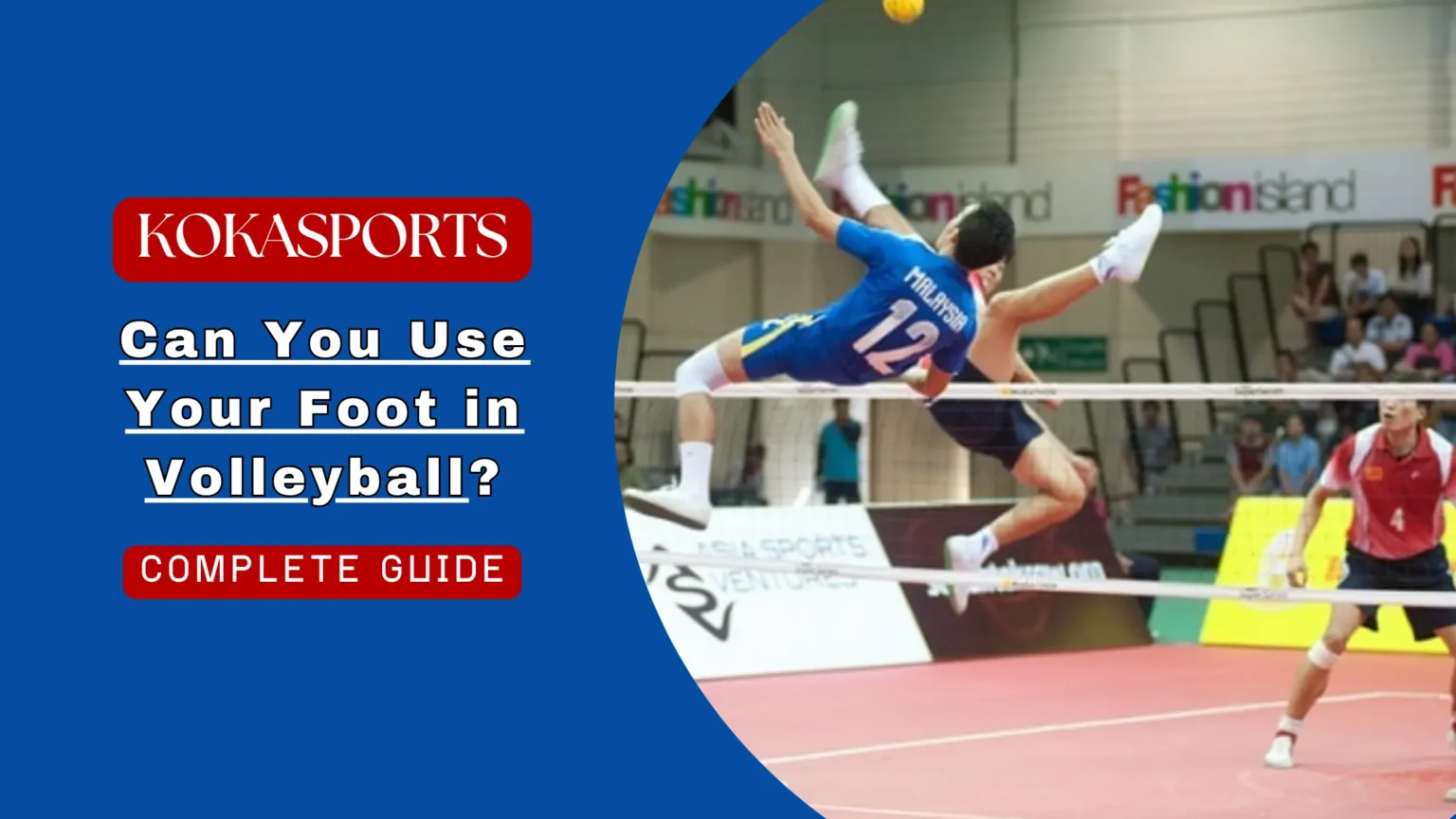
You’re mid-rally. The ball is dropping fast too low for your arms. You flick it up with your foot, and the rally continues. Legal play or a fault? If you’ve ever played volleyball and wondered can you use your foot in volleyball, you’re not alone. Millions of players debate it every season.
The short answer: yes, you can use your foot in volleyball. But there’s more to it than a simple yes. The rules vary slightly by league, level, and format and there are still ways a foot contact can be called illegal. This guide covers everything: official rules, real-game scenarios, and exactly when using your feet makes tactical sense.
Quick Answer: Can You Use Your Foot in Volleyball?
Yes it’s completely legal. According to the official rules set by the Fédération Internationale de Volleyball (FIVB), the ball may touch any part of the body, and that includes the foot. As long as the contact is clean (no prolonged hold), counts within your team’s three-touch limit, and the ball stays in bounds, foot use is perfectly within the rules of volleyball.
The one hard exception: the serve must always be struck by hand. You cannot kick a serve.
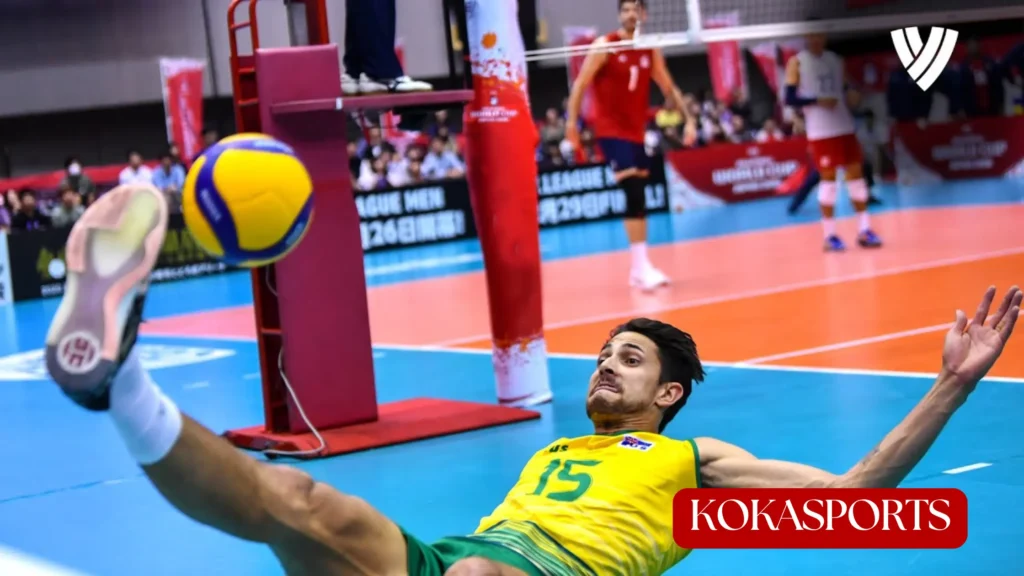
💡 Pro Tip: This rule applies at nearly every level of organized play international, college, high school, and most recreational leagues. Always confirm with your specific league’s rulebook if you’re unsure.
The History of Foot Use in Volleyball: How the Rules Changed
Why this rule exists helps you trust it in real games.
Pre-1993: Why Foot Contact Was Banned
When William G. Morgan invented volleyball in 1895, the sport was designed as a hands-and-arms game. Contact with the body below the waist was explicitly prohibited similar in concept to how soccer bans handball. This kept the game clean and easy to officiate at a time when the sport was still developing.
For nearly 100 years, any contact with the body below the waist was an automatic fault.
The 1993 FIVB Rule Change : What Actually Changed and Why
In 1993, the FIVB officially amended its rules to allow contact with any part of the body, including the feet. The change was driven by the sport’s evolution at the professional level. Defenders were making spectacular saves that referees were calling faults even when the touch was clean and the ball clearly stayed in play. The governing federation recognized that penalizing athleticism was hurting the spectator experience and competitive quality.
The new language was simple: the ball shall be hit, not caught or thrown, and may make contact with any part of the body.
For the most up-to-date international volleyball rules, the FIVB official rules glossary is the definitive reference used by referees and coaches worldwide.
NCAA’s 1999 Adoption : How USA Aligned With International Rules
It wasn’t until 1999 that the NCAA formally aligned its volleyball rules with the FIVB standard in the United States. USA Volleyball followed a similar timeline. This is a detail that trips up a lot of players many American players who started before 1999 remember being taught that foot contact was illegal, and that muscle memory of the old rule can persist for decades.
Official Volleyball Rules for Using Your Feet: What Every Governing Body Says
This is the section most articles get wrong. Let’s be precise about what each organization actually permits.
| Governing Body | Foot Contact Legal? | Key Condition | Exception |
|---|---|---|---|
| FIVB (International) | Yes | Clean contact, no prolonged hold | Serve must be by hand |
| USA Volleyball (USAV) | Yes | Follows FIVB Rule 9.2 | Serve must be by hand |
| NCAA (College) | Yes | Ball may touch any part of the body when hitting | Serve must be by hand |
| NFHS (High School) | Yes | Aligns with FIVB standard | Serve must be by hand |
| Youth / Recreational | Varies | Depends on house rules | Check with your league |
FIVB International Rules : The Global Standard for Foot Use
FIVB Rule 9.2 states that contact with any part of the body is permitted. This is the global standard followed by professional leagues worldwide. At this level, foot use in emergency defense situations is seen regularly and perfectly accepted by officials.
NCAA Collegiate Rules : Foot Contact at the University Level
The NCAA volleyball rulebook is explicit: the ball can touch any part of the body when hitting, as long as it does not come to rest there. This mirrors the international standard. College coaches actively teach that players may use any available body part in desperate situations.
NFHS High School Volleyball Rules : What Young Players Need to Know
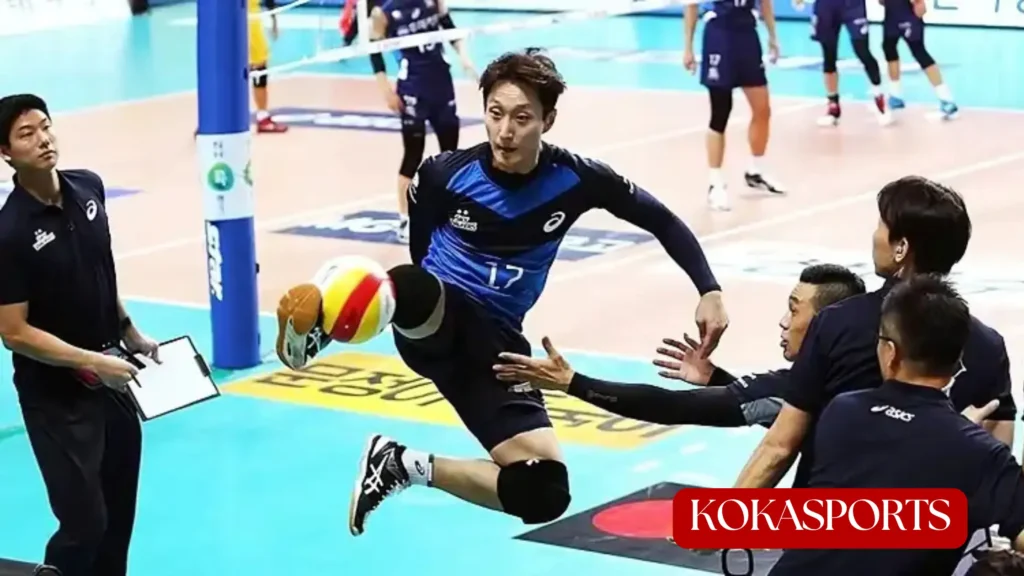
The National Federation of State High School Associations (NFHS) also permits foot contact. If you’re a high school volleyball player, using your foot to save a ball during a rally is entirely within the rules. However, referees at the youth level may be quicker to call a “lift” if the contact looks prolonged or awkward.
Recreational and Youth League Rules : When House Rules Override Official Rules
This is the gap that no other guide addresses clearly. Many recreational leagues write their own house rules and some of them, especially youth programs for players under 12, actively disallow foot contact. The reasons vary: simplifying play, reducing injury risk, or just keeping the game moving faster for beginners.
⚠️ Warning: Before your next rec league game, ask the organizer or check the rulebook. Do not assume that because FIVB allows it, your Thursday night league does too. The official rules don’t automatically apply in every gym.
Indoor vs Beach Volleyball: Are the Foot Rules Different?
No the core rule is the same. Both indoor and beach volleyball operate under FIVB rules that permit any body part contact, including the foot. But the practical reality looks very different.
Indoor Volleyball Foot Contacts : Rules and Realistic Scenarios
In indoor volleyball, foot saves happen but they’re relatively rare. The faster court surface, the 6-player team structure, and tighter positional discipline mean players usually get into position to use their arms. A foot save indoors is almost always an emergency play, not a tactical choice.
Beach Volleyball Foot Use : Why It’s More Common on Sand
Beach volleyball is where foot contact shows up far more often. With only two players covering the whole court, unpredictable ball movement off the sand, and the need to cover enormous ground quickly, using a foot to redirect a low ball is a natural extension of defensive skill. The looser formation and slower, bouncier sand make it physically easier to get a clean foot contact.
When and How to Play the Ball With Your Foot in Volleyball: The 3-Scenario Framework
Here’s what every other article misses entirely: not just whether you can use your feet, but when and how.
There are two realistic scenarios where foot contact makes sense in a real game. Each one requires a different technique.
Scenario 1 : The Emergency Toe Save: Keeping a Low Ball Alive
When it happens: The ball is dropping inside the 3-meter line at ankle height, with no time to dive.
How to do it:
- Keep your weight forward on the balls of your feet
- Extend your dominant foot forward contact should be on the top of the foot, not the toe tip
- Flick upward, not forward your goal is to get the ball up so a teammate can play it
- Follow through with your leg to avoid a “lift” call
The top of the foot gives the most surface area and reduces the chance of a prolonged contact violation. Think of it like a short chip in soccer minimal backswing, controlled follow-through.
💡 Pro Tip: If you’re close to the net, aim your foot save backward toward your setter. Getting the ball to a teammate with any kind of accuracy from a foot contact is already a win.
Scenario 2 : The Lateral Foot Dig: Side-Reach When Arms Can’t Get There
When it happens: The ball is traveling parallel to the sideline, low and fast, and extending your arms would mean your body falls away from the play.
How to do it:
- Drop your hip toward the ball’s direction
- Use the inside of your foot (the arch area) this gives a flatter, more predictable rebound angle
- Think of it as a redirecting surface, not a kick
This is harder than the toe save and takes practice. But it’s a legitimate defensive tool used at high levels of play especially in beach volleyball.
Why Most Volleyball Players Don’t Use Their Feet : The Control Problem Explained
It’s legal. So why doesn’t every player do it constantly?
Arm Reaction Time vs Leg Reaction Time : The Science Behind the Choice
Research in sports biomechanics consistently shows that upper limb reaction time is significantly faster than lower limb reaction time. Your arms respond to visual stimulus in approximately 160–190 milliseconds. Your legs take roughly 200–240 milliseconds. In a sport where the ball can travel at speeds exceeding 100 km/h in professional play, that gap matters enormously.
The National Strength and Conditioning Association (NSCA) highlights that upper limb reaction advantages are especially significant in fast-moving ball sports : making your arms and hands the superior tool for consistent volleyball ball control.
Beyond reaction time: using your forearms gives you a larger, flatter contact surface that’s naturally angled toward your target. The foot’s irregular shape and ankle mobility limitations make consistent direction control much harder.
5 Situations Where Foot Use Actually Makes Tactical Sense
Despite the control challenges, there are moments where a foot save is the right call:
- The ball is below knee height and you’re already off-balance diving is too slow, foot is faster
- You’re near a wall or boundary and can’t reach with your arm without falling out
- The ball ricocheted off a teammate and is dropping at your feet unexpectedly
- You’re in beach volleyball and a deep sand dive would take too long
- A short serve lands at your toes and lifting your arm would mean bending awkwardly late
In all five cases, the foot is a better tool than nothing and better than letting the ball hit the floor.
Sports Where Feet Are Central: Footvolley, Sepak Takraw, and Hybrid Net Sports
If using your feet in volleyball sounds exciting, there are entire sports built around exactly that concept.
Footvolley : Brazil’s Barefoot Sport Where Hands Are the Foul
Footvolley originated on the beaches of Rio de Janeiro in the 1960s. It combines beach volleyball’s net and scoring system with soccer’s no-hands restriction. Players may use their feet, head, chest, and knees to hit the ball but touching it with hands or arms is a fault. Footvolley has gained massive global popularity and has been considered for Olympic inclusion multiple times.
Sepak Takraw : The Sport That Proves Feet Can Dominate a Net Game
Sepak Takraw is a Southeast Asian sport played with a rattan ball over a net roughly the same height as a badminton net. Players use spectacular overhead bicycle kicks, spinning heel strikes, and knee deflections to pass and attack. It requires exceptional flexibility and athleticism proof that with enough training, foot use in a net sport can be genuinely precise.
💡 Want to improve your volleyball skills beyond the basics? Check out expert volleyball training tips and player guides at KokaSports a great resource for players at every level looking to level up their game.
Frequently Asked Questions About Foot Use in Volleyball
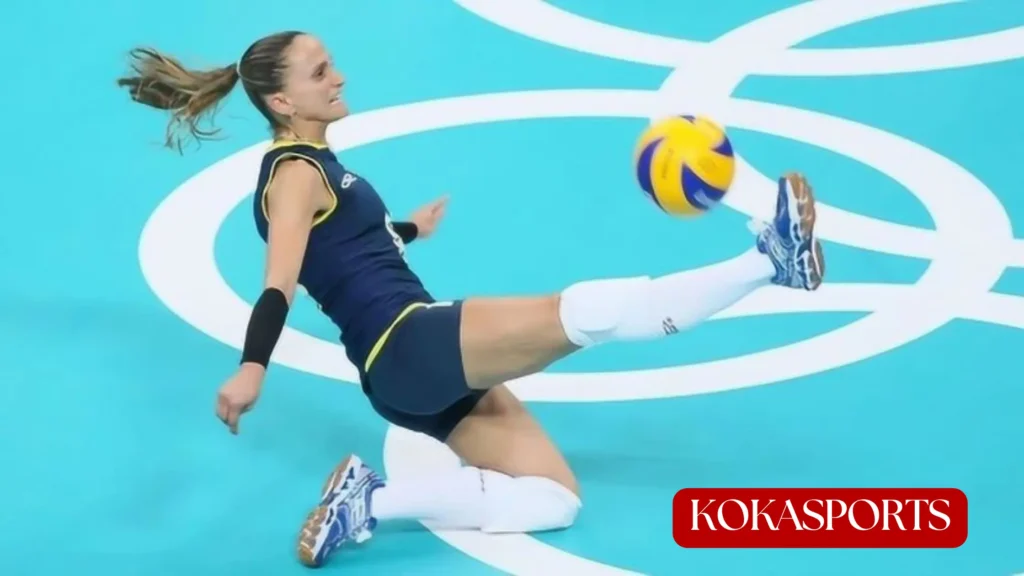
Can you kick a volleyball intentionally?
Yes intentional foot contact is completely legal under FIVB, NCAA, NFHS, and USA Volleyball rules, as long as it’s a clean strike.
Is it a fault if the ball accidentally hits your foot?
No accidental foot contact is not a fault; any part of the body can legally contact the ball regardless of intent.
Can you use your knee or head in volleyball?
Yes the rules cover the entire body, so knees, shoulders, chest, and head are all legal contact points.
Can you serve with your foot in volleyball?
No the serve is the one exception; it must always be struck by hand.
Does foot contact count as one of the three touches?
Yes a foot contact counts as one of your team’s three allowed touches, just like any arm or hand contact.
Do recreational leagues allow kicking the volleyball?
It depends most follow official rules, but some youth and rec leagues restrict foot use, so always check first.
What does the libero position have to do with foot rules?
Nothing special the libero follows the same body contact rules as every other player on the court.
Conclusion : Foot Use in Volleyball Is Legal Context Is Everything
So can you use your foot in volleyball? Absolutely yes. The game of volleyball has allowed full-body contact since the FIVB rule change in 1993, and virtually every format of played volleyball at every level has adopted this standard.
Here’s what to remember:
- Foot contact is legal under FIVB, NCAA, NFHS, USA Volleyball rules
- It counts as one of the team’s three touches
- Both accidental and intentional foot contacts are permitted
- The serve must always be executed by hand no exceptions
- Recreational and youth leagues may have their own house rules always check
- A prolonged foot contact (lift) is still a fault, regardless of body part
Using your feet won’t replace your arms and hands as the primary tool for passing the ball the control simply isn’t there for consistent play. But in the right moment, a clean foot to save a ball can keep a rally alive, swing a set, or win a match.
The players who hesitate to use any available body part leave points on the floor. The players who know the rules and trust them win more.