
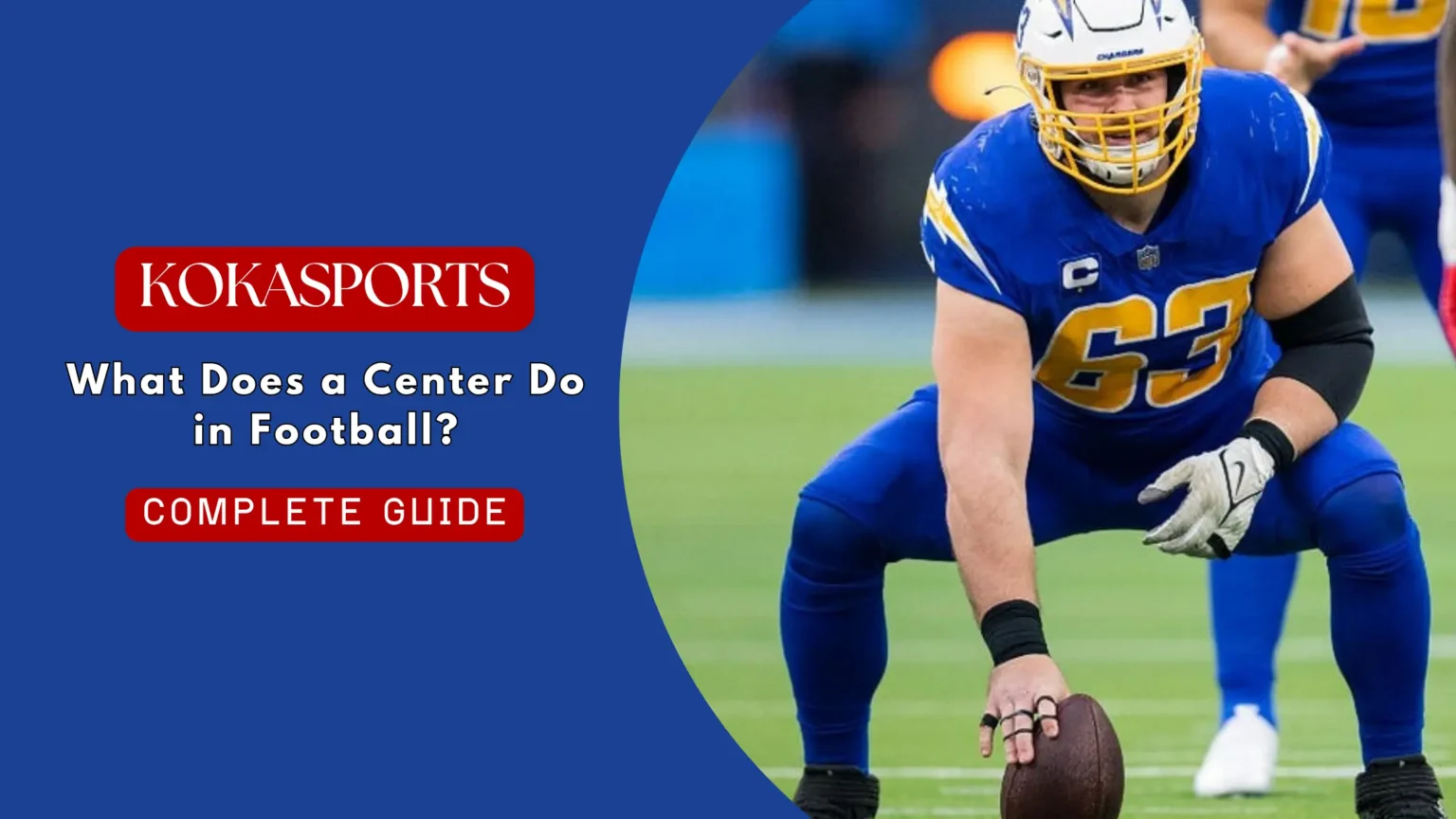
If you are asking what does a center do in football, here is the short answer. The center is the offensive lineman in the middle of the line who starts every play by snapping the ball to the quarterback, then blocks defenders, protects the quarterback, opens running lanes, and calls out the blocking assignments for the whole line. He is one of the most important and least appreciated players on the field.
The center is the one player almost nobody watches. We follow the ball, the quarterback, the receivers, but the center just disappears into the pile every snap. So one Sunday I decided to do something different and watch only the center for an entire drive, ignoring the ball completely.
It changed how I saw football. Before every snap he was pointing, talking, and adjusting his teammates. The instant the ball moved, he was firing into a defender while still delivering a clean snap, then fighting to hold the middle of the pocket. He might have been the busiest player on the field, and I had never once noticed him. This guide explains everything the center does, from the snap to the blocking calls, why the position matters so much, and what it takes to play it well.
A center in football is the offensive lineman who starts every play by snapping the ball to the quarterback. He also blocks defenders, protects the quarterback, creates running lanes, identifies defensive formations, and communicates blocking assignments to the rest of the line, making him one of the team’s most important players.
What Does a Center Do in Football?
Simple Definition
The center is the player who begins every offensive snap. He hikes the ball to the quarterback, then immediately blocks defensive linemen, protects the passer, and makes the protection calls that tell his linemates who to block. In short, he is the starting point and the on-field organizer of the offense.
Why Every Play Starts With the Center
Nothing happens until the center snaps the ball, which makes him the foundation of every play. An accurate, consistent snap is essential, since a single bad exchange can blow up the entire down. He also works hand in hand with the quarterback to time the snap and set the protection, so the offense lives and dies by his reliability, which is why coaches prize a steady, mistake-free center even though fans rarely notice the position.
Where Does the Center Line Up?
Position on the Offensive Line
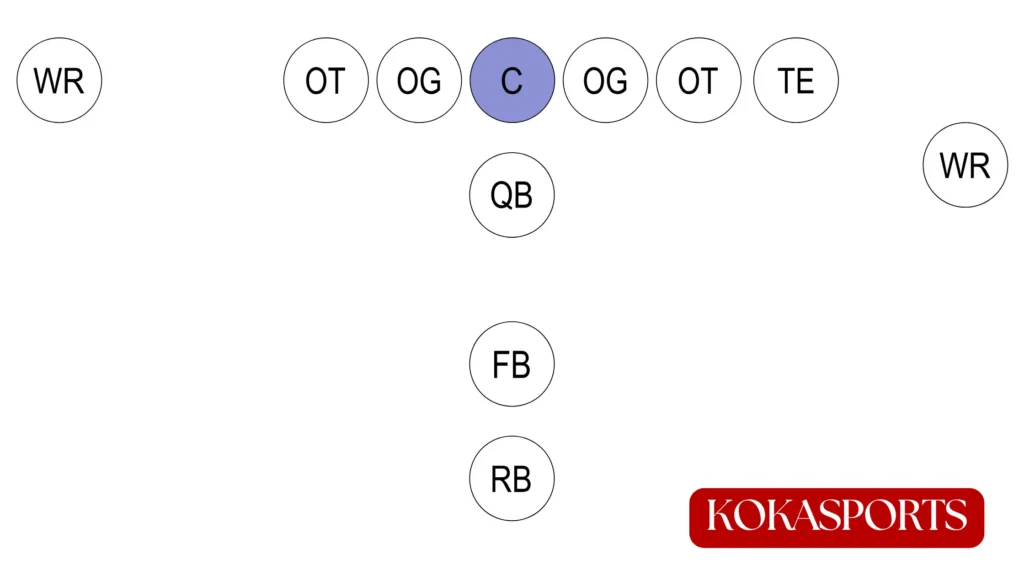
The center lines up in the very middle of the offensive line, directly over the ball, with a guard on each side and the tackles on the outside. From left to right, the offensive line positions run left tackle, left guard, center, right guard, and right tackle.
Why the Middle Position Matters
That central spot is no accident. Because he stands in the heart of the line, the center can see the whole defensive front, control the interior blocking, and identify where the pressure is likely to come from. His view of the field is what makes him the natural communicator for the entire unit, and it is why so much of the line’s pre-snap thinking runs through him.
The Main Responsibilities of a Center
The center’s job stacks several demanding tasks on top of one another. He snaps the football, whether from under center, out of the shotgun, or in the pistol, and he has to do it accurately every single time. The moment the ball is gone, he becomes a blocker, taking on defensive linemen with one-on-one blocks, double teams, reach blocks, and down blocks depending on the play.
He also protects the quarterback by anchoring the interior of the pocket and stopping pressure up the middle, which is the most dangerous kind for a passer. On running plays he drives defenders off the ball and helps open lanes through drive blocking, zone blocking, and the occasional pull. And throughout all of it, he reads the defense, spots the linebackers and blitzes, and calls out the blocking assignments so the line moves as one.
What Happens Before the Snap?
A center does some of his most important work before the ball is ever snapped. He reads the defensive alignment to understand what the defense is showing, then identifies the Mike linebacker, the key defender used to set the entire protection. Once he has the picture, he communicates with the guards, adjusts the blocking scheme to match the look, and coordinates with the quarterback on the snap count and any last-second changes. This pre-snap chess match often decides whether a play succeeds.
What Does a Center Do During Passing Plays?
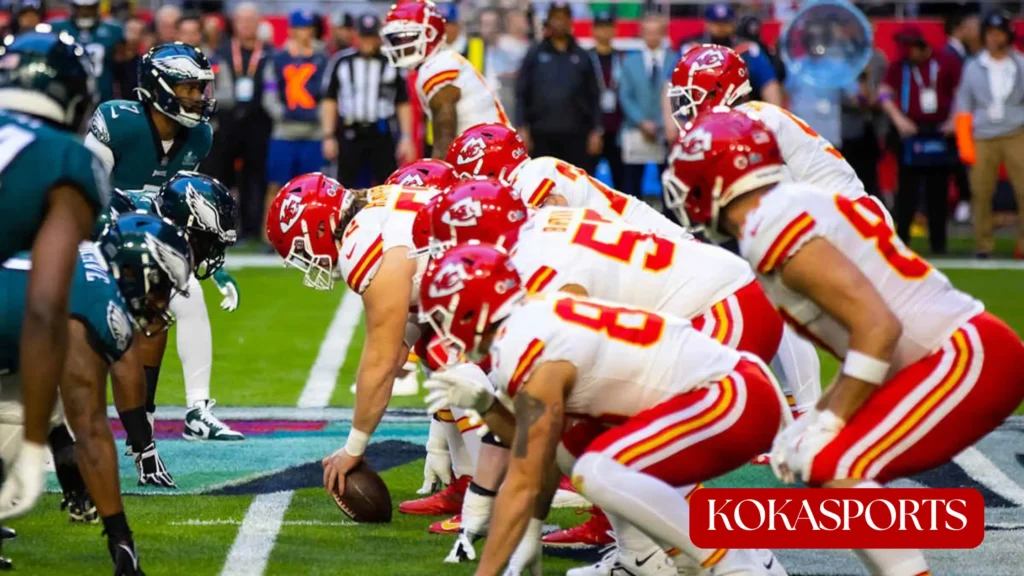
On passing downs, the center starts by delivering a clean snap, then immediately engages the defensive tackle or nose tackle lined up over him. His top priority is preventing interior pressure, since a rusher up the middle reaches the quarterback fastest and gives him nowhere to step. When his man drops or stunts, he slides to help a guard, and he is always scanning for blitzers, ready to pick up a linebacker or defensive back coming through the gap. All of it serves one goal, keeping the pocket clean and intact.
What Does a Center Do During Running Plays?
On running plays, the center’s job is to create movement and open lanes. He fires off the ball to drive his defender backward, working zone blocks in concert with his guards or attacking specific gaps in a gap scheme. He frequently combines with a guard on a double team to move a big defensive tackle, then climbs to the second level to block a linebacker. That ability to clear the first defender and then reach a linebacker is what springs runs for big gains.
Types of Blocks a Center Performs
A center has to master a full toolbox of blocks. The drive block is a straight-ahead power block to move a defender off the ball. The reach block lets him cut off a defender lined up to his side. A combo block is a double team with a guard before one of them peels off to the linebacker, while a straight double team focuses all that force on one defender. He also uses cut blocks low to the ground, pull blocks where he leaves his spot to lead elsewhere, and trap blocks that ambush an unsuspecting defender. Knowing which to use, and when, is a craft in itself.
Skills Every Great Football Center Needs
The best centers blend physical and mental gifts. They need strength to anchor against powerful tackles, quick hands and good footwork to win the initial contact, and balance and agility to block while snapping and then climb to moving targets. Mental toughness keeps them steady on every snap.
Just as important is the mind. Football IQ lets a center diagnose defenses in an instant, and elite communication and leadership let him organize four other linemen play after play. A great center is part athlete and part field general.
Physical Requirements for a Football Center
At the NFL level, centers typically stand around 6 feet 2 to 6 feet 4 and weigh roughly 290 to 310 pounds, big enough to anchor but agile enough to move. College centers tend to be slightly smaller and still developing their frames, while high school centers vary widely and are often chosen as much for smarts and toughness as size. The ideal center combines power, balance, quick feet, and a sharp football mind.
Center vs Other Offensive Line Positions
| Position | Main Responsibility |
|---|---|
| Center | Snaps the ball, blocks, calls protections |
| Left Guard | Interior blocking |
| Right Guard | Interior blocking |
| Left Tackle | Protects the quarterback’s blind side |
| Right Tackle | Edge protection |
While every lineman blocks, the center carries far more communication responsibility than the guards or tackles. Guards focus on interior blocking and sometimes pull, and tackles handle edge protection, especially the blind side. Only the center snaps the ball, reads the front, and makes the calls that set everyone else’s job, which is what sets the position apart.
Why the Center Is Often the Leader of the Offensive Line
Because of all that responsibility, the center is usually the leader of the offensive line. He makes the protection calls, reads the defense and relays what he sees, and helps younger linemen understand their assignments. He also controls the rhythm of the offense by getting the line set and ready on time. In many ways, the center is to the offensive line what the quarterback is to the offense.
Common Mistakes Centers Make
The most damaging center errors start with the snap, since a bad exchange can lose the play before it begins. Missing a blitz pickup or letting a defender win with poor footwork or lost leverage puts the quarterback in immediate danger. Centers also have to avoid pre-snap false starts and the holding penalties that come from losing a block and grabbing to recover. Consistency, not flash, is what defines a good center.
Famous NFL Centers Who Mastered the Position
A handful of centers showed just how valuable the position can be. Jason Kelce of the Eagles became a future Hall of Famer with rare athleticism, brilliant second-level blocking, and fiery leadership. Creed Humphrey of the Chiefs has emerged as the gold standard among active centers, almost never allowing pressure. Travis Frederick anchored a dominant Cowboys line, and Maurkice Pouncey was a nine-time Pro Bowler and the heart of Pittsburgh’s offense.
Two more defined earlier eras. Jeff Saturday protected Peyton Manning for years and was famous for his pre-snap intelligence. Nick Mangold anchored the Jets’ line for over a decade as a seven-time Pro Bowler and one of the finest centers of his generation. Mangold passed away in 2025 and is remembered as one of the very best to ever play the position. Every young center can learn something from how these players combined toughness, technique, and smarts.
How Coaches Train Football Centers
Coaches develop centers through repetition of the fundamentals. Snap drills build the accurate, automatic exchange that everything depends on, while blocking and footwork drills sharpen the technique to win at the point of attack. Coaches also drill hand placement for clean, legal blocks, build strength in the weight room, and lean heavily on film study so a center learns to recognize fronts and blitzes before they happen. The mental reps matter as much as the physical ones.
Can a Center Catch or Run the Football?
Normally a center is an ineligible receiver, so he cannot catch a pass or run the ball on a standard play. There are exceptions, though. On rare trick plays a lineman can become eligible if he reports to the officials, centers occasionally recover fumbles, and in unusual short-yardage or trick situations a lineman might end up carrying the ball. Those moments are rare, but they do happen and always delight the crowd.
FAQs
What does a center do in football?
The center snaps the ball to start every play, then blocks defenders, protects the quarterback, opens running lanes, reads the defense, and calls the line’s blocking assignments.
Is the center the most important offensive lineman?
He is arguably the most important because he touches the ball every play, makes the protection calls, and organizes the entire line, though the blind-side tackle is also premium.
Does the center call the plays?
He does not call the offensive plays, but he often makes the line’s blocking and protection calls, identifying the defense and adjusting assignments before the snap.
Why does the center touch the ball every play?
Because he snaps it. Every offensive play begins with the center delivering the ball to the quarterback, which is the official start of the down.
Can the center score a touchdown?
Rarely. A center is usually an ineligible receiver, but he can score on a recovered fumble in the end zone or on a trick play if he reports as eligible.
How hard is it to play center?
Very hard. The center must snap accurately, block immediately, read defenses, and communicate, all at the same time, which makes it one of the most demanding positions.
Conclusion
So, what does a center do in football? He starts every play with the snap, then blocks, protects the quarterback, opens running lanes, and runs the communication for the entire offensive line. It is a job built on consistency, intelligence, and toughness.
The center may never get the attention of the quarterback or the running back, but the offense cannot function without him. His blend of physical skill, sharp football mind, and leadership makes him the quiet foundation of everything the offense does.
The next time you watch a game, try what I did and follow the center for a drive. Once you see how much he handles on every single snap, you will never overlook the position again.