

In wheel route football, a wheel route is a pattern where a player starts with a short move toward the sideline, like a quick flat route, then turns and races straight up the field along the sideline. The path curves like a wheel turning, which is how it got its name. It is one of football’s most effective passing routes because it tricks defenders into expecting a short throw and then leaves them behind on a deep one. Running backs, slot receivers, wide receivers, and tight ends all run it.
I still remember the first time I really saw a wheel route do its job. A running back had been catching little dump-off passes near the sideline all game, the boring kind that pick up four or five yards. Every time, the linebacker covering him crept up a step closer, ready to jump that short throw.
Then late in the game, the back ran the exact same look, the linebacker bit hard on the short route, and the back just turned up the sideline and took off. He was wide open for a long touchdown, and you could feel the whole stadium realize at once that the offense had been setting that up all day. That is the magic of the wheel route, and this guide breaks down everything about it, how it works, who runs it, why it is so hard to stop, and how it compares to other routes.
What Is a Wheel Route in Football?
A wheel route is one of football’s passing routes where a receiver or running back first runs a short route toward the sideline, then curves upfield and sprints deep along the boundary. It blends a short flat route with a deep go route into one path, giving it a unique spot on the route tree.
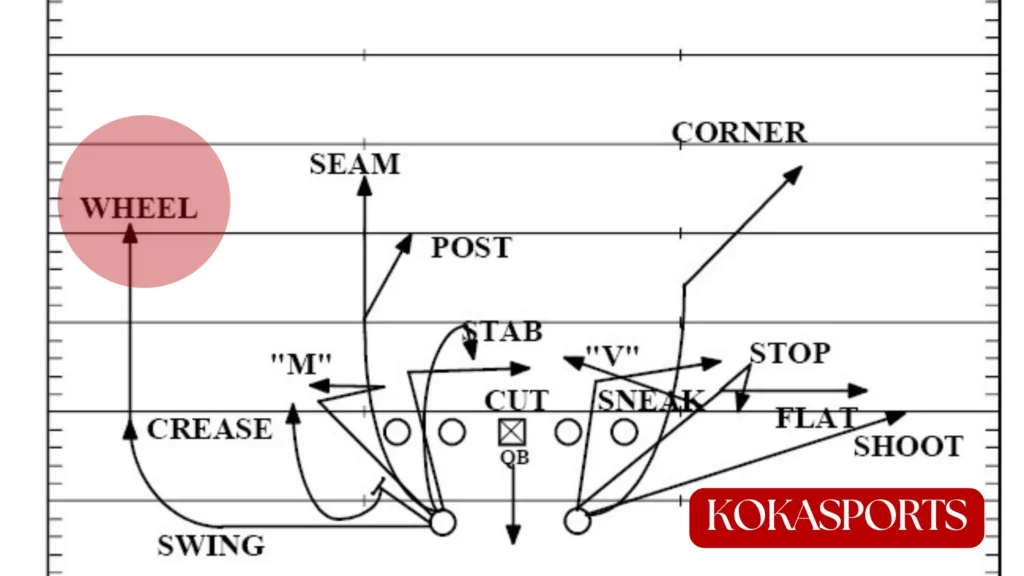
The name comes from the shape. As the player rounds from the flat into the vertical sprint, his path bends like the curve of a wheel. The offensive purpose is simple but powerful: sell a short, harmless route, get the defender to relax or jump it, then explode deep before he can recover.
How Does a Wheel Route Football Work?
Starting Position
The wheel usually starts from the backfield or the slot. A running back lines up next to the quarterback, or a slot receiver lines up inside, in a spot where a short catch looks like the obvious play.
Initial Flat Release
The player releases toward the sideline as if running a flat or swing route, often glancing back at the quarterback like a short pass is coming. This sell is the whole trick, since it invites the defender to drive on the short throw.
Turning Up the Sideline
Instead of stopping, the player rounds his path and turns straight upfield along the sideline. If the defender bought the fake, he is now a step behind and chasing.
Quarterback Timing
The quarterback has to let the route develop, holding the ball an extra beat while the player turns up the sideline. Then he throws over the top, leading the receiver down the boundary.
Catch Point
The catch happens deep along the sideline, with the receiver running under the ball. Done right, it turns a play that looked like a short gain into a big one.
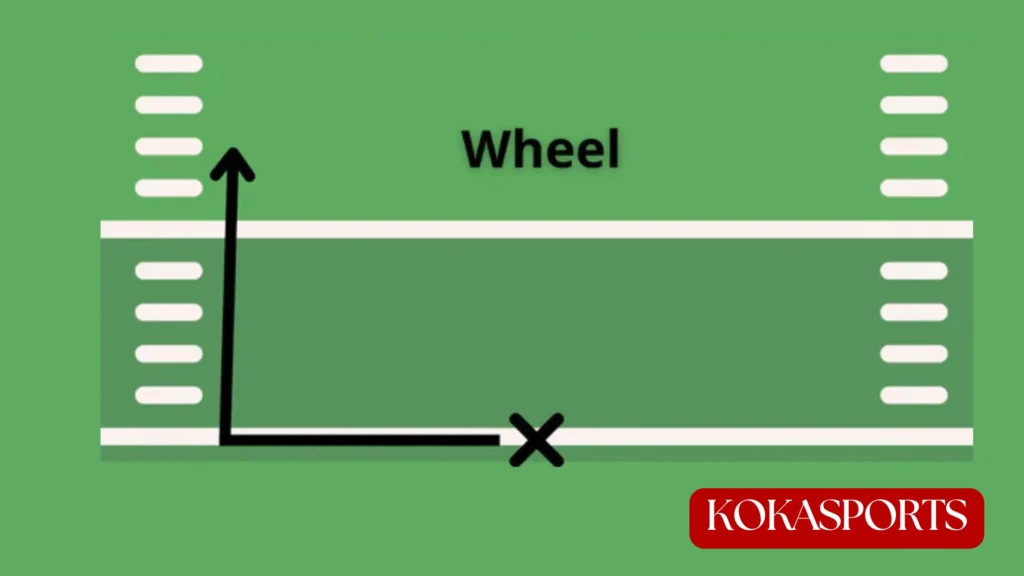
Wheel Route Diagram
Picture a common setup. A running back is in the backfield with receivers spread wide. At the snap, an outside receiver runs inside to clear space while the back releases to the sideline and wheels up the boundary. The quarterback reads the defender on the back, usually a linebacker or safety. If that defender jumps the short look or gets stuck in traffic, the back runs free up the sideline, with only a rotating deep safety able to help.
Which Players Run a Wheel Route?
Running Backs
Running backs are the classic wheel route runners. Against a linebacker who is slower in space, a back releasing out of the backfield and turning up the sideline is a serious mismatch.
Slot Receivers
Slot receivers run wheels to attack safeties and linebackers from the inside. Their quickness off the line makes the short sell believable before they burst deep.
Wide Receivers
Outside receivers sometimes run wheels as a double move, faking a short out and then turning up the field to beat a cornerback who jumps the first move.
Tight Ends
Tight ends use the wheel to exploit linebackers and safeties. A big tight end with a step on a slower defender becomes a tough deep target along the sideline.
Why Is the Wheel Route So Effective?
The wheel route wins by creating mismatches and using a defender’s own aggression against him. It often puts a fast back or receiver against a slower linebacker, a matchup the offense loves. It is also a proven answer against Cover 2, where a post-wheel combination forces the safety to take the post and leaves the corner scrambling to carry the wheel up the sideline. Above all, it leans on leverage, since the defender who bites on the short flat route has no chance to recover, which is exactly how a short-looking play turns into an explosive one.
When Do Teams Call a Wheel Route?
Coaches like the wheel in specific spots. It is a great third-down call when the offense needs a chunk of yards, and a sneaky red-zone weapon where the sideline gives the receiver a clear lane. It pairs perfectly with play-action, since the run fake pulls defenders up and opens the deep sideline. Teams also use it in the two-minute offense for a quick shot downfield. It can beat both man coverage, by winning a speed mismatch, and zone coverage, by sliding into the open space along the boundary.
How Quarterbacks Read a Wheel Route
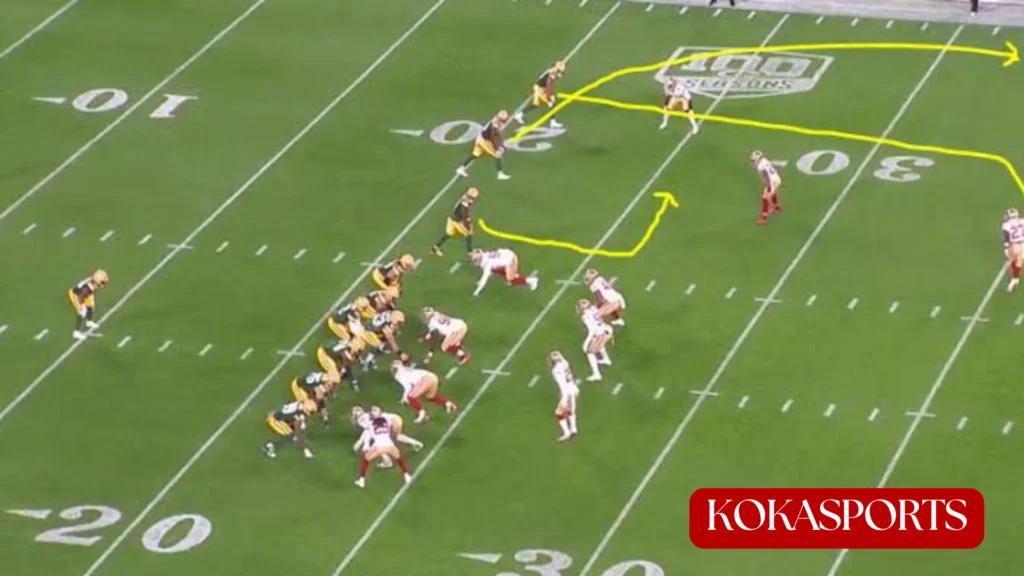
For the quarterback, the wheel is about patience and placement. He works his progression and waits for the route to turn up the sideline rather than throwing early. He checks the safety, since a deep safety rotating over can take the throw away, and he watches the linebacker’s movement to confirm the mismatch. When he throws, placement is everything. The ball should lead the receiver up the field and toward the sideline, and coaches preach that it is better to slightly overthrow than to underthrow, since an underthrow invites an interception.
Wheel Route vs Swing Route
| Feature | Wheel Route | Swing Route |
|---|---|---|
| Route depth | Deep | Short |
| Direction | Out then vertical | Out and shallow |
| Vertical stem | Yes, up the sideline | No, stays short |
| Target player | RB, slot, WR, TE | Mostly running backs |
| Purpose | Explosive play | Quick, safe gain |
The swing and the wheel start similarly, with a release toward the sideline, but the swing stays short and flat for an easy completion, while the wheel turns up the field to attack deep. The wheel is the high-risk, high-reward version.
Wheel Route vs Texas Route
| Feature | Wheel Route | Texas Route |
|---|---|---|
| Route shape | Out then up the sideline | Out then angle back inside |
| Breaking direction | Toward the sideline, vertical | Back toward the middle |
| Best against | Man and Cover 2 | Man coverage |
| Difficulty | Higher, needs timing | Moderate |
| Typical player | RB, slot | Running back |
The Texas route, a type of angle route, has the back release outside and then cut back inside over the middle, while the wheel keeps going up the sideline. One attacks the middle of the field, the other attacks the boundary.
Wheel Route vs Angle Route
The wheel and the angle route both start with an outside release from a back, which is where the similarity ends. The angle route breaks back inside toward the middle of the field for a quick, short completion, while the wheel turns up the sideline for a deep shot. They are almost mirror images, one working inside and short, the other outside and deep.
Wheel Route vs Go Route
The wheel and the go route both finish as vertical sprints, but they begin very differently. A go route is straight up the field from the snap, telling the defender immediately that it is a deep ball. The wheel disguises itself first with a short flat release, so the defender reacts to a short route before the vertical sprint begins. The wheel is essentially a go route with a built-in fake, and that fake is what often springs it open.
Best Offensive Plays That Use a Wheel Route
The wheel shows up in many concepts. A play-action wheel uses a run fake to clear the deep sideline, and a trips formation wheel floods one side so a back or slot can wheel behind the traffic. The mesh concept pairs crossing routes underneath with a back on a wheel, which is brutal against man coverage. A wheel-screen shows screen action one way while a wheel attacks the other, the double wheel sends two players up the sidelines to overload the coverage, and an empty formation wheel isolates a back or slot in space.
How Defenses Stop a Wheel Route
Defenses have answers if they are disciplined. The key is linebacker technique, carrying the back up the field rather than passing him off too soon. Safety help over the top can erase the deep throw, and zone exchanges let defenders trade off the wheel and the inside route cleanly. Cornerback communication is essential so nobody gets crossed up by the route combination, and bracket or match coverage can put two defenders on the threat. When defenders talk and stay disciplined, the wheel loses its surprise.
Common Mistakes When Running a Wheel Route
For receivers, the biggest mistake is turning up the sideline too early, which kills the short sell and lets the defender stay on top. Drifting inside instead of hugging the sideline shrinks the throwing window, and poor spacing with the clear-out routes can let defenders cover both. For quarterbacks, a late throw lets the defense recover, an underthrow risks an interception, and missing a safety rotating over the top can turn a big play into a turnover. Timing and discipline make or break the route.
Advantages of the Wheel Route
The wheel offers explosive-play potential, creates favorable mismatches, and stretches defenses vertically down the sideline. It is especially dangerous against man coverage, where a speed mismatch is hard to defend, and it carries strong yards-after-catch potential when a back catches it in stride with room to run.
Disadvantages of the Wheel Route
The downsides are real. The wheel requires precise timing between quarterback and receiver, and it needs solid pass protection because it takes longer to develop than a quick throw. A poorly thrown wheel can be intercepted, and a deep zone with a safety sitting over the top can take it away entirely. It is a weapon, but not a safe, every-down call.
Famous NFL Teams That Use Wheel Routes
Many of the league’s best offenses lean on wheel concepts. Teams like the Kansas City Chiefs, San Francisco 49ers, Miami Dolphins, Philadelphia Eagles, and New Orleans Saints have all used wheel routes to get athletic backs and receivers into space. The common thread is creativity, building the wheel into play-action and motion rather than calling it on its own, to turn a quick athlete loose down the sideline.
Famous Wheel Route Touchdowns
The wheel has produced countless memorable scores. Running back wheels against overmatched linebackers are a highlight-reel staple, tight end wheels have surprised defenses in big moments, and trick-play wheels off a fake have delivered some of the most stunning touchdowns fans remember.
Coaching Tips for Running a Perfect Wheel Route
For Running Backs
Sell the short route first, then round the turn smoothly without slowing down, and stay tight to the sideline as you climb.
For Wide Receivers
Make the initial move believable, keep your eyes ready to find the ball early, and use the boundary as an extra defender against the coverage.
For Quarterbacks
Be patient, let the route develop, lead the receiver up the field, and always check the deep safety before you cut it loose.
For Coaches
Pair the wheel with clear-out routes and play-action, and rep the timing constantly, since the whole play depends on it.
Wheel Route in Youth Football
In youth football, keep the wheel simple. Teach the basic idea of selling a short route and then turning up the sideline, and focus on spacing and timing rather than complex combinations. It works best once players are old enough to grasp route timing. The main coaching points are running under control and tracking the deep ball safely.
Wheel Route in College vs NFL Football
The wheel exists at every level, but the details change. In the NFL, the speed is overwhelming and the timing razor-sharp, with defenses reacting faster and disguising coverage better. College defenses can be more vulnerable because of bigger gaps in team speed, and college versions tend to be more straightforward than the layered NFL variations. The core route is the same, but the margin for error shrinks at the pro level.
FAQs
What is a wheel route in football?
A wheel route is a pattern where a player runs a short route toward the sideline, then turns and sprints deep up the boundary, blending a flat route with a go route.
Why is it called a wheel route?
Because the player’s path curves like a wheel as he rounds from the short sideline route into the vertical sprint up the field.
Who usually runs a wheel route?
Running backs run it most often, but slot receivers, outside receivers, and tight ends all run wheel routes to create mismatches.
Is a wheel route good against man coverage?
Yes. The wheel is excellent against man coverage because it often isolates a fast player on a slower defender and uses a fake to gain separation.
Conclusion
A wheel route is one of football’s most clever passing routes, a path that starts short toward the sideline and then turns up the field to attack deep. It works by disguising itself as a harmless short throw and then punishing any defender who bites.
Its power comes from mismatches, leverage, and timing, putting fast players against slower defenders and turning small looks into explosive plays. The keys are selling the short route, rounding the turn smoothly, and throwing it with patience and the right placement.
In today’s creative, mismatch-driven offenses, the wheel route is a staple for good reason. The next time you see a running back slip up the sideline wide open, you will recognize the setup, and know that the offense had been waiting all game to spring it.