


If you are asking what does PAT mean in football, here is the quick answer. PAT stands for Point After Touchdown. It is the scoring chance a team gets right after a touchdown, and the team can either kick the ball through the uprights for one point or run or pass it into the end zone for a two-point conversion worth two points.
I never thought twice about the PAT until a single missed one broke my heart. I was watching a close game where my team scored a late touchdown to pull within a point, lined up for the routine extra point everyone treats as automatic, and the kicker pushed it wide. They lost by that one point.
It hit me that the play I had ignored my entire life as a boring formality was actually one of the most quietly important moments in football. After that, I started paying real attention to the PAT, and there is far more to it than a simple kick. This guide explains exactly what a PAT is, how it works, the rules across different leagues, when teams kick versus go for two, and why this small play can decide big games.
PAT in football stands for Point After Touchdown. After scoring a touchdown worth six points, a team can attempt a PAT by kicking the ball through the goalposts for one extra point or running or passing the ball into the end zone for a two-point conversion.
What Does PAT Mean in Football?
Simple Definition
PAT stands for Point After Touchdown, the scoring opportunity that comes immediately after a team reaches the end zone. The scoring team has two choices. It can attempt an extra-point kick worth one point, or it can attempt a two-point conversion worth two points by running a play into the end zone. Either way, it is a chance to add to the six points a touchdown already provides.
Why Is It Called a PAT?
The name is simply a literal description of the play, the point a team can score after a touchdown. You will often hear it called the extra point, and the two terms are mostly interchangeable in everyday use. Technically, PAT refers to the whole try, while extra point usually means the one-point kick specifically.

How Does a PAT Work?
After a team scores a touchdown, play stops and the scoring team chooses how to attempt its PAT. For the extra-point kick, the offense lines up and the kicker boots the ball through the uprights with the help of a holder and a long snapper. For the two-point conversion, the offense instead runs a single play from scrimmage and tries to cross the goal line by run or pass.
The clock is stopped during a PAT, since these are untimed plays that do not run off the game clock. The ball is declared dead once the kick is good or no good, or once the two-point play succeeds or fails. After the attempt, the scoring team kicks off to the opponent as usual.
The Two Types of PAT Attempts
One-Point PAT (Extra-Point Kick)
The extra-point kick is the safer, more common choice. The long snapper sends the ball back to the holder, who places it down for the kicker to boot through the uprights. If it goes through, the team earns one point. It is the option teams reach for the vast majority of the time.
Two-Point Conversion
The two-point conversion is the bolder option. Instead of kicking, the offense runs a normal play from scrimmage near the goal line and tries to score by run or pass. Success is worth two points, but it is far harder to pull off, which makes it a calculated risk rather than a default.
PAT Rules in Football
The rules vary by level. In the NFL, the extra-point kick is snapped from the 15-yard line, making it roughly a 33-yard kick, while the two-point try is run from the 2-yard line. In college football, the ball is placed at the 3-yard line for both the kick and the two-point attempt. High school football generally uses the 3-yard line as well, though some specifics vary by state association, and youth leagues often follow similar rules with their own local tweaks. The biggest difference between leagues is simply where the ball is spotted, which changes how hard the kick is.
Where Is the Ball Spotted for a PAT?
In the NFL, the snap for the extra-point kick comes from the 15-yard line, while the two-point conversion is spotted at the 2. In the NCAA, the try is placed at the 3-yard line for both options, and high school football typically uses the 3 as well. That spot placement matters a lot, because the NFL’s longer kick is noticeably harder than the short attempts used in college and high school, which is exactly why the league moved it back.
PAT vs Two-Point Conversion
| Feature | PAT Kick | Two-Point Conversion |
|---|---|---|
| Points | 1 | 2 |
| Method | Kick | Run or pass |
| Risk | Lower | Higher |
| Success rate | Higher | Lower |
| Strategy | Safer | More aggressive |
The kick offers a near-certain single point with very little risk, which is why it is the standard choice. The two-point conversion offers double the reward but fails more often, so coaches save it for moments when the extra point genuinely matters. Choosing between them comes down to the game situation.
Why Teams Choose a PAT Instead of Going for Two
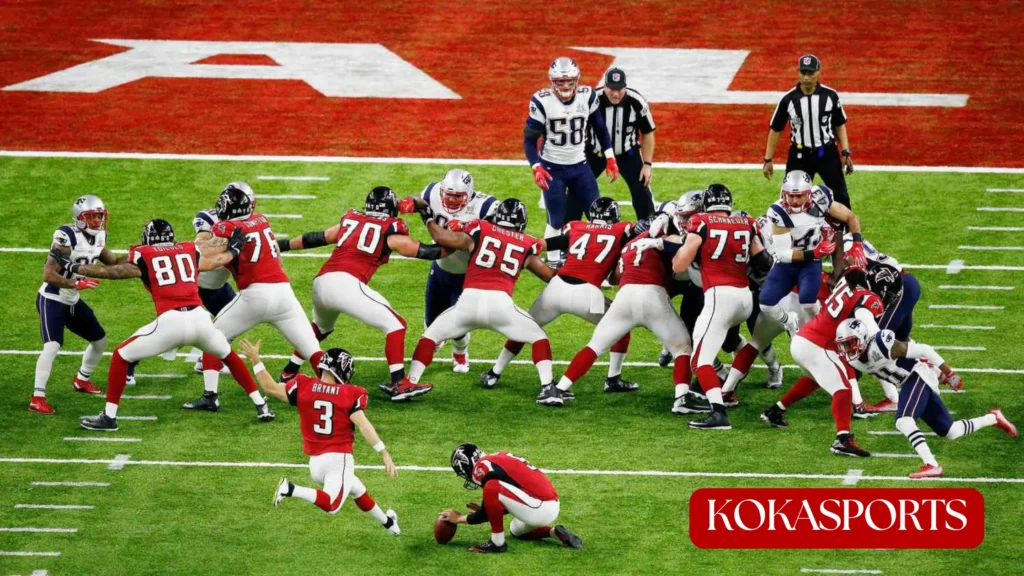
Most of the time, teams simply kick the extra point. The biggest reason is the high success rate, since the kick is made far more often than the two-point try. It is also easier to execute, with a clean snap, hold, and kick that teams practice constantly. Kicking is the smart move for protecting a lead and for general game management, because banking a near-guaranteed point keeps the score predictable and avoids unnecessary risk early in a game.
When Teams Go for Two Instead of Kicking
Teams go for two when the math demands it. Late in close games, a coach may need exactly two points to tie or win, so chasing those points becomes worth the risk. Bad weather that makes kicking unreliable, or a struggling kicking unit, can also push a team toward the offensive play. On top of that, modern teams increasingly lean on analytics, using win-probability charts that tell a coach precisely when the numbers favor going for two rather than kicking.
Can a PAT Be Blocked?
Yes, an extra-point kick can absolutely be blocked. Blocks usually happen when defenders get a strong push up the middle or time the snap to leap and get a hand on the ball. Defensive special teams units practice these rushes specifically. A blocked PAT often traces back to a slow snap, a poor hold, or a breakdown on the offensive line, all of which give the defense the split-second opening it needs.
What Happens if a PAT Is Missed?
If the kick misses, whether it sails wide or gets blocked, the team simply does not get the point, and the score stays where it was after the touchdown. The same goes for a failed two-point conversion, where the offense gets no points if it cannot cross the goal line. In every case, a missed PAT means the score remains unchanged, and as my own heartbreak proved, that single missing point can decide the outcome.
Can the Defense Score on a PAT?
Yes, and this surprises a lot of fans. Under modern NFL rules, a PAT is a live play, so the defense can return a blocked kick or a turnover on a two-point attempt all the way to the other end zone for two points of its own. College football has long had a similar rule allowing defensive returns for two points.
There is also one of the rarest plays in the sport, the one-point safety. If the defense gains possession during a conversion attempt and is then downed in its own end zone, the offense is awarded a single point. Most fans go their entire lives without ever seeing one.
History of the PAT in Football
The extra point has been part of football since its early days, evolving alongside the rest of the scoring system. For decades the kick was so short that it was practically guaranteed, with NFL kickers converting well above 99 percent of attempts. That near-certainty drained the play of any drama.
To fix that, the NFL made a major change in 2015, moving the extra-point kick back to the 15-yard line. As ESPN documented, the change made the extra point no longer automatic, and it also made the play live so defenses could score. The impact was real, adding a layer of risk to a play that had become an afterthought.
Famous PAT Moments in Football History
Over the years, the humble PAT has decided plenty of games. Game-winning extra points have sealed victories in the final seconds, and missed PATs have flipped outcomes that should have gone the other way, leaving kickers and teams haunted by a single point. Memorable two-point conversions have produced some of the most dramatic finishes in football, with teams gambling everything on one play to win rather than settle for a tie. These moments are exactly why the play deserves more respect than it usually gets.
PAT Success Rates
The numbers tell the story of why teams kick. Since the NFL moved the kick back, extra-point success has settled at around 94 percent, down from the near-perfect rates of the past. College kickers, working from the shorter distance, convert at an even higher clip. Two-point conversions, by contrast, succeed only about 48 percent of the time. The gap exists because a short kick is far simpler than executing a full offensive play against a defense packed near the goal line.
The Players Involved in a PAT
A successful kick is a team effort. The long snapper fires an accurate snap, the holder catches it and places it down with the laces out, and the kicker drives it through the uprights, all in about 1.3 seconds. The offensive line protects that operation by holding off the rush, while the defensive special teams unit tries to break through and block it. On a two-point conversion, the regular offense, including the quarterback, runs the play instead.
Common PAT Mistakes
Most failed PATs come down to a handful of errors. A bad snap or a poor hold can ruin the timing before the kicker even swings his leg. A blocked kick or a kick pushed wide ends the attempt with no points. And on two-point tries, a failed play, whether a stuffed run or an incomplete pass, leaves the team empty-handed. Because the margins are so thin, even a small mistake can cost a crucial point.
FAQs
What does PAT mean in football?
PAT stands for Point After Touchdown, the scoring chance after a touchdown to add one point with a kick or two points with a conversion.
Is a PAT worth one or two points?
It can be either. A successful extra-point kick is worth one point, while a successful two-point conversion is worth two.
What is the difference between a PAT and an extra point?
They are mostly the same thing. PAT refers to the whole try after a touchdown, while extra point usually means the one-point kick specifically.
Why do teams sometimes go for two?
Teams go for two when they need the extra point to tie or win late, when weather hurts kicking, or when analytics say the math favors it.
Can the defense score during a PAT?
Yes. The defense can return a blocked kick or a turnover on a two-point try to the other end zone for two points.
Conclusion
So, what does PAT mean in football? It stands for Point After Touchdown, the play that lets a team add one point with a kick or two points with a conversion right after scoring a six-point touchdown.
It may look like a routine formality, but the PAT is one of the most important scoring opportunities in the game. The choice between kicking for one and going for two can swing the outcome, and a single missed attempt can be the difference between winning and losing.
The next time you watch a game, do not look away when the extra-point team trots onto the field. As I learned the hard way, that quiet little play can decide everything.