

If you are asking when is the FIFA World Cup draw for the 2026 tournament, here is the straight answer first. The draw already happened. It took place on Friday, December 5, 2025, at the Kennedy Center in Washington, DC, and it set the 12 groups for the biggest World Cup in history. So if you landed here hoping to catch it live, you missed the live show, but the good news is that everything it decided is now locked in and easy to follow.
I remember the afternoon it happened. I had blocked out the time the way some people block out a final, even though the whole thing barely ran an hour and a half. There is something strange about a ceremony where nobody kicks a ball, yet 48 nations walk away with their entire summer reshaped. One pull of a ball and a team goes from a comfortable group to a nightmare. That is why people still search for it months later.
This guide walks through the whole thing. When the draw was, what it actually is, how it worked, who was in it, the pots, and what happened after.
When Is the FIFA World Cup Draw?
Expected Date for the 2026 FIFA World Cup Draw
The FIFA World Cup draw date for 2026 was Friday, December 5, 2025. The live show kicked off at noon Eastern time and was beamed around the world through FIFA’s media partners. By the time it ended, all 12 groups had taken shape, and fans in all 16 host cities finally knew the early shape of the tournament.
If you are reading this closer to the tournament itself, the thing to remember is that the draw is done. The 2026 World Cup itself starts on June 11, 2026 and runs to the final on July 19. The draw was the moment several months earlier when the road to those dates came into focus.
Why FIFA Has Not Finalized the Draw Earlier
People often wonder why FIFA waits so long to hold the draw. The reason is simple. FIFA cannot draw teams into groups until it knows, more or less, who the teams are. The qualification process runs right up to the end, so the draw has to sit late enough that most of the field is confirmed.
By early December, 42 of the 48 teams had qualified. The remaining six spots were still open, so FIFA used placeholders for them and held the draw anyway. Those final six were settled in the playoffs at the end of March 2026, which slotted neatly into the empty spaces left during the draw.
Official FIFA Announcements and Updates
FIFA announced the draw venue back in August at the White House, with FIFA President Gianni Infantino and US President Donald Trump revealing that Washington would host it. The seeding pots were confirmed on November 25, based on the FIFA world ranking published on November 19. Everything official came straight through FIFA’s own channels and the host announcements, which is always the safest place to check rather than relying on rumors.
What Is the FIFA World Cup Draw?
Purpose of the World Cup Draw
At its core, the World Cup group draw is the event that decides who plays who in the group stage. Before the draw, you know which teams have qualified, but you have no idea how they will be split up. After it, every group is set, and the entire shape of the tournament is suddenly clear.
It is the moment the tournament stops being a list of 48 names and turns into a real bracket. That is why fans treat it like an event in its own right.
How Teams Are Assigned to Groups
Teams are not just thrown together randomly. FIFA splits them into four pots, then pulls one team from each pot into every group. With 12 groups of four for 2026, that means each group ends up with one team from Pot 1, one from Pot 2, one from Pot 3 and one from Pot 4.
This is the fifa draw procedure in its simplest form. Strong teams are spread out so you do not end up with four giants in one group and four minnows in another.
The Role of FIFA Rankings
The FIFA world ranking is the backbone of the whole thing. The pots are built almost entirely on where teams sit in the rankings, with the higher ranked sides landing in the higher pots. The three hosts are the one exception, and I will get to that.
How Does the FIFA World Cup Draw Work?
Seeding Pots Explained
For 2026, the 48 teams and the playoff placeholders were spread across four pots of 12, using the November 2025 ranking. Pot 1 held the strongest teams plus the hosts. Pot 2 held the next tier, Pot 3 the middle group, and Pot 4 the lowest ranked qualifiers along with the six playoff spots that were still undecided.
Geographic Restrictions and Rules
The pots are only half the story. FIFA also applies geographic rules so groups do not get crowded with teams from one region. No group can hold more than one team from the same confederation, with a single exception. Europe has so many qualified teams that groups are allowed up to two European sides, but never more.
This is why you sometimes see a draw pause while officials sort out where a team can legally go. The software and the officials work together to make sure no rule is broken as the balls come out.
Drawing Teams Into Groups
The draw started with Pot 1. The three hosts had their spots fixed in advance, with Mexico placed in position A1, Canada in B1 and the United States in D1. The rest of Pot 1 was then drawn into the remaining groups, always taking the top position in each.
After that, the draw moved through Pot 2, then Pot 3, then Pot 4, filling out each group one pot at a time. A preset allocation pattern decided exactly which slot each team took within its group, which keeps the schedule balanced once everything is mapped onto venues and dates.
How Match Schedules Are Determined
The draw itself sets the groups, but the full 2026 World Cup schedule came right after. FIFA unveiled the complete 104-match fixture list the very next day, on December 6, once the groups were known. The fixtures were then fine tuned to balance kickoff times, travel and conditions across four time zones and three host countries.
FIFA World Cup 2026 Format Changes
Expansion to 48 Teams
The headline change for 2026 is the jump from 32 teams to 48. This is the first time the field has ever been this big, and it changed the draw too, since FIFA now had to build 12 groups instead of the old eight.
Number of Groups and Matches
The 48 teams sit in 12 groups of four, labeled A through L. That produces 104 matches in total, well up from the 64 we were used to in recent tournaments. More teams and more groups meant a longer, fuller draw than ever before.
New Knockout Stage Structure
With 12 groups, the knockout maths changed. The top two from each group advance, and they are joined by the eight best third placed teams. That fills a brand new Round of 32, which then flows into the Round of 16, the quarterfinals, the semifinals and the final. A team chasing the trophy could end up playing eight matches to lift it.
Which Teams Will Participate in the Draw?
Qualified Nations
When the draw was held, 42 nations had already booked their place. They came from every confederation, including first time qualifiers who had never reached a World Cup before. Every one of them arrived with a full squad, and if you have ever wondered exactly how many players make up a soccer team, that side of the setup is worth a look too. Those teams went into the pots according to their ranking and were drawn into groups on the day.
Host Countries Automatically Qualified
The three host countries, the United States, Canada and Mexico, qualified automatically as is standard for any host. All three were placed in Pot 1 regardless of their ranking, and their group positions were fixed before a single ball was drawn. This is part of how the fifa world cup host cities planning works, since organizers need to know early where the hosts will play.
Remaining Qualification Spots
The final six places were still open at the time of the draw. Four would come from the European playoffs and two from the inter-confederation playoffs. FIFA put placeholders in Pot 4 for all six, with confederation rules applied to each playoff path so no group could break the regional limits once the winners were known. World Cup qualification for those last spots finished at the end of March 2026.
FIFA World Cup Draw Pots Explained
Pot 1 Teams
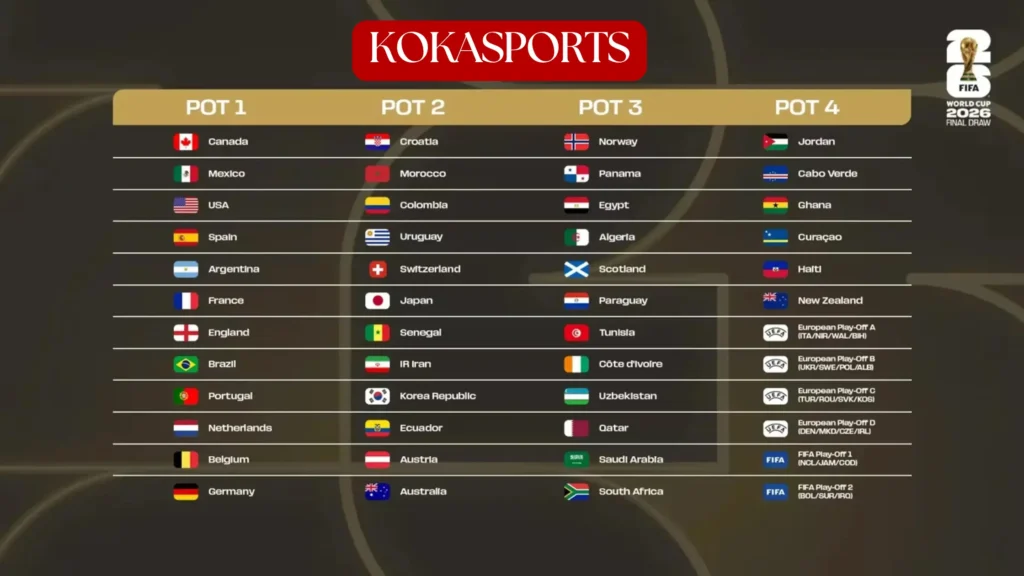
Pot 1 was the heavyweight pot. It held the three hosts, Canada, Mexico and the United States, alongside Spain, Argentina, France, England, Brazil, Portugal, the Netherlands, Belgium and Germany. If you wanted to avoid an early giant, this was the pot you feared.
Pot 2 Teams
Pot 2 carried strong sides who just missed the top tier, including Croatia, Morocco, Colombia, Uruguay, Switzerland, Japan, Senegal, Iran, South Korea, Ecuador, Austria and Australia. Plenty of these teams are more than capable of upsetting a Pot 1 side.
Pot 3 Teams
Pot 3 held the next group, with Norway, Panama, Egypt, Algeria, Scotland, Paraguay, Tunisia, Cote d’Ivoire, Uzbekistan, Qatar, Saudi Arabia and South Africa. A few of these are dangerous on their day and made some groups far trickier than they looked on paper.
Pot 4 Teams
Pot 4 mixed the lowest ranked qualifiers with the six playoff placeholders. It featured Jordan, Cabo Verde, Ghana, Curacao, Haiti and New Zealand, plus the spots reserved for the European and inter-confederation playoff winners.
How FIFA Rankings Affect Pot Placement
Every one of those placements traced back to the rankings. Outside the hosts, the higher a team ranked in November, the higher its pot. It is a clean system, and it rewards teams that turn up to qualifiers and friendlies in good form rather than coasting.
Where Will the FIFA World Cup Draw Take Place?
Potential Host City
The 2026 World Cup draw took place in Washington, DC, at the John F. Kennedy Center for the Performing Arts. FIFA leaned into the idea of staging it in a cultural landmark in the host nation’s capital, and the Kennedy Center fit that bill.
Previous World Cup Draw Locations
This follows a long pattern of grand draw venues. The 2022 draw was held in Doha, Qatar, on April 1, 2022, while the 2018 draw took place in Moscow in December 2017. FIFA always picks a setting with some weight to it, because the draw has become a show in its own right.
Draw Ceremony and Special Guests
The 2026 ceremony had the usual mix of football legends and big names presenting the pots and pulling the balls. The whole production was built for a global television audience, which is why it ran so smoothly.
What Happens After the FIFA World Cup Draw?
Final Group Confirmation
Once the draw ended, the 12 groups were essentially set, with only the six playoff placeholders left to fill. After the March 2026 playoffs, those last teams dropped into their reserved slots and every group was fully confirmed.
Match Schedule Release
The match schedule landed the day after the draw. Suddenly fans had exact dates, kickoff times and venues for all 104 games, which turned the abstract groups into a real calendar people could plan around.
Ticket Sales and Travel Planning
This is the point where everything gets practical. With groups and fixtures known, ticket sales and travel planning kicked into another gear. Fans could finally see where their team would play and start booking flights and hotels across the host cities instead of guessing.
Memorable FIFA World Cup Draws in History
2022 Qatar World Cup Draw
The 2022 draw in Doha gave us some brutal pairings and the usual gasps when big names landed together. It set the stage for a tournament that ended with one of the great finals.
2018 Russia World Cup Draw
The 2018 draw in Moscow showed how one ceremony can shift the mood of an entire tournament before a ball is kicked.
Biggest Group of Death Examples
Every draw produces at least one so called group of death, where three or four strong teams land together. Half the fun of any draw is the instant scramble to decide which group earned that label this time, and 2026 was no different.
How Fans Can Watch the FIFA World Cup Draw Live
FIFA Official Broadcasts
The 2026 draw was carried live through FIFA’s official broadcast partners around the world. For future draws, the official FIFA broadcast is always the most reliable way to watch, since it carries the full ceremony from start to finish.
Streaming Platforms
Alongside television, the draw streamed through FIFA’s own digital platforms and partner streaming services. If you ever miss a draw live, the full replay usually lands on those same platforms within hours.
Social Media Coverage
Social media is where the draw really comes alive now. Clips of each group forming spread within seconds, and it is the fastest way to catch up if you could not watch in real time.
Impact of the Draw on Tournament Predictions
Strongest Potential Groups
The moment the groups were set, the predictions started. Analysts immediately flagged the toughest groups, the ones stacked with multiple contenders, and those became the must watch sections of the tournament.
Easiest Paths to the Knockout Stage
On the flip side, a few teams clearly drew kinder paths. A favorable group and a manageable knockout route can carry a side a long way.
How Analysts Evaluate Draw Results
Analysts weigh up rankings, form, travel, and even which cities a team plays in. The distances between host cities and the climate in different venues all feed into who really got an easy ride and who did not.
Frequently Asked Questions About the FIFA World Cup Draw
When is the FIFA World Cup draw expected to take place?
For 2026, the draw was held on December 5, 2025, in Washington, DC. Future World Cup draws are usually held a few months before the tournament, once most teams have qualified.
How are World Cup groups determined?
Teams are split into four pots based mainly on the FIFA rankings, then one team from each pot is drawn into each group, with rules that keep teams from the same region apart.
How many teams will be in the 2026 World Cup?
48 teams, the largest field in World Cup history, split into 12 groups of four.
Can teams from the same confederation be drawn together?
Generally no. Groups can hold only one team per confederation, with the single exception of Europe, which can have up to two teams in the same group.
Where can I watch the World Cup draw live?
Through FIFA’s official broadcast partners on television, FIFA’s own streaming platforms, and partner streaming services, with clips spreading fast on social media.
Conclusion
So when people ask when is the FIFA World Cup draw, the answer for 2026 is that it already happened, on December 5, 2025, at the Kennedy Center in Washington, DC. It set the 12 groups, shaped the path of all 48 teams, and kicked off the real countdown to a tournament that starts on June 11, 2026.
The draw matters because it turns a list of qualified nations into a living tournament. It decides who has an easy start and who walks into a group of death, and it gives fans the first real glimpse of how the summer might unfold.
If you want to stay ahead of every detail, follow FIFA’s official announcements rather than rumors. The groups are set, the schedule is out, and the only thing left now is the football itself.