
An H back football is a hybrid offensive position that combines the blocking responsibilities of a fullback with the receiving ability of a tight end. The player lines up in multiple spots on the field, goes in motion before the snap, and creates matchup problems that defenses struggle to solve. It is one of the most versatile and underappreciated positions in the game.
I know that because I spent an entire Sunday afternoon arguing about it with my friend .
He had been watching football for twenty years. He knew the game. But the moment the H-back started moving around the formation before the snap, My friend looked at me and said, “What is that guy even doing? He is not a tight end. He is not a running back. Just pick a position.”
I told him that was exactly the point.
By the end of the game, my friend still was not fully convinced. So I went home and put everything I know about the H-back position into one place. This article is the result of that conversation.
What Is an H-Back in Football?
Definition of the H-Back Position
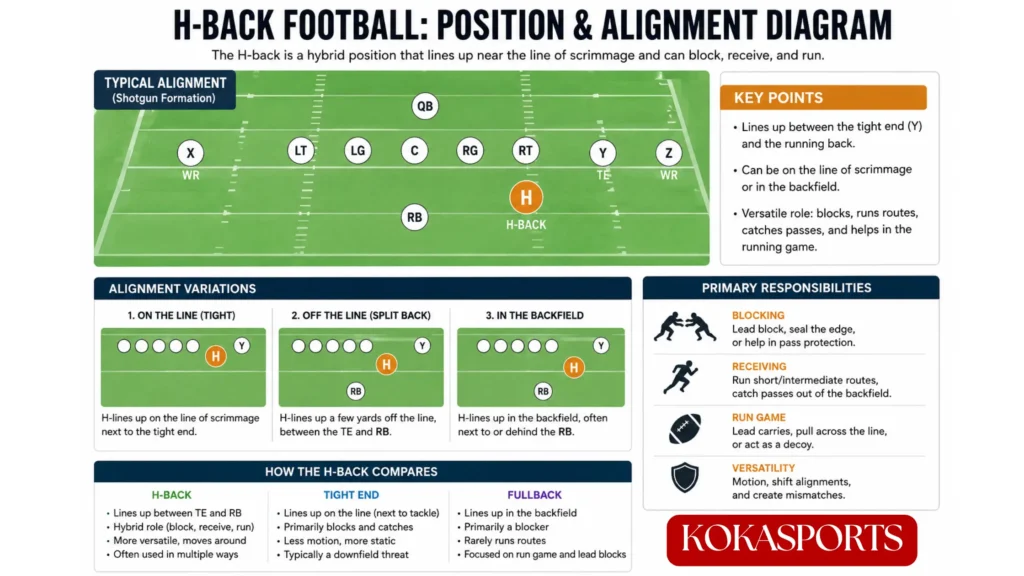
The H-back is a hybrid offensive position that sits at the intersection of the tight end, fullback, and occasionally the wide receiver.
The letter “H” does not stand for anything official. Coaches simply use it as a label in the playbook to identify a player who does not fit neatly into any single traditional category. He blocks. He catches. He runs routes. He goes in motion. And he forces the defense to make decisions before the ball is even snapped.
When I explained this to my friend he said, “So he is just a guy who cannot decide what he wants to be.”
I told him no. He is a guy who decided to be everything.
Where the H-Back Lines Up on the Field
This is the part that confused my friend the most and honestly it confuses most casual fans at first.
The H-back does not have one fixed alignment. On one play he might line up as a wing just outside the offensive tackle. On the next he drops into the backfield next to the quarterback. On the third he lines up on the line of scrimmage like a tight end and then goes in motion across the entire formation before the snap.
That movement is not random. It is designed to create confusion and force the defense to reveal its coverage before the ball is hiked.
How the Position Evolved Over Time
The H-back position grew out of the West Coast and run-and-shoot offenses that became popular in the 1980s and 1990s.
Coaches wanted a player who could do more than one thing. The traditional fullback was becoming a diminishing asset as a pure blocker. The tight end was getting faster and more involved in the passing game. The H-back was the answer to what happens when you combine those two positions into one body.
Joe Gibbs and the Washington Redskins were among the first teams to truly build an offense around the H-back role. Gibbs won three Super Bowls using it. That alone should settle any argument about whether the position matters.
What Does an H-Back Do in Football?
Blocking Responsibilities
Blocking is still the foundation of the H-back position, especially at the NFL level.
The H-back leads on running plays. He gets to the point of attack before the ball carrier and clears the path. Because he aligns in different spots, he creates a blocker in space rather than just at the line of scrimmage. That is significantly harder to defend than a traditional fullback who always comes from the same place.
My friend argued that any big guy can block. I asked him to name the last time he saw a 250-pound man chase down a linebacker in the open field and seal him away from the ball carrier.
He went quiet for a moment.
Receiving Duties
The H-back is a genuine receiving threat. That is what truly separates him from a traditional fullback.
He runs real routes out of the backfield, from wing alignments, and off the line of scrimmage. Linebackers are usually too slow to cover him. Safeties do not always want to come into traffic against someone his size. Cornerbacks are too small to handle the physical matchup.
There is no clean answer for a defense. That is the whole point.
Running and Motion Assignments
H-backs carry the ball on occasion, though that is a small part of the job.
The more important contribution is pre-snap motion. When the H-back moves before the snap, the offense watches how the defense responds. If a defender follows him, it is man coverage. If nobody moves, it is zone. That information changes the play call in real time and gives the quarterback a significant advantage before the game even begins.
Special Teams Contributions
Most H-backs also contribute on special teams.
Their combination of size, speed, and football intelligence makes them reliable as blockers on punts and kickoffs. Coaches who value roster versatility appreciate a player who can be on the field in multiple phases of the game without being a liability in any of them.
H-Back vs Tight End
Key Similarities
The H-back and the tight end share a lot of common ground.
Both are bigger than wide receivers but faster than offensive linemen. Both can block and catch. Both are involved in the running game and the passing game. Put them side by side in a lineup and a casual fan might not see a difference immediately.
My friend actually made this point during our argument. He said, “Just call him a tight end and move on.”
Major Differences
The difference is alignment and role emphasis.
A tight end almost always lines up on the line of scrimmage next to the offensive tackle. His primary job on most plays is to block at the point of attack, with receiving as a secondary function depending on the scheme.
The H-back lines up off the line of scrimmage more frequently. His positional flexibility is built into the design of the offense. And his involvement in the passing game tends to be more deliberate and more developed than a traditional in-line tight end.
Another critical difference is where they block. A tight end engages defenders at the line of scrimmage. An H-back blocks in space, at the second level, and in the open field. Those are completely different skill sets.
Which Position Is More Versatile?
The H-back is more versatile. It is not a close comparison.
A tight end fits into more offensive systems than a fullback does. But the H-back fits into more systems than almost any other position on the roster. His ability to align anywhere and serve multiple functions makes him uniquely valuable in modern football.
H-Back vs Fullback
Alignment Differences
The fullback almost always lines up directly behind the quarterback or just off the quarterback’s hip in a two-back formation.
The H-back has no permanent home. He can occupy the fullback’s spot but he can also be somewhere else entirely depending on what the play design requires.
Blocking Roles Compared
Both positions are primarily blockers. That part is consistent.
The difference is where they block. The fullback leads through the hole at the line of scrimmage. The H-back might do the same thing, but he also blocks linebackers in space, kicks out edge defenders, and handles assignments that require athleticism beyond what a traditional fullback provides.
Receiving Ability and Route Running
This is where the H-back separates himself clearly.
A traditional fullback might catch ten or fifteen passes in an entire season. An H-back in a pass-heavy scheme might catch forty or fifty. His route running is more developed, his hands are more reliable, and his role in the passing game is a genuine part of the offensive plan rather than an afterthought.
That receiving dimension is the primary reason teams have shifted toward the H-back and away from the pure fullback over the past two decades.
Where Does the H-Back Line Up?
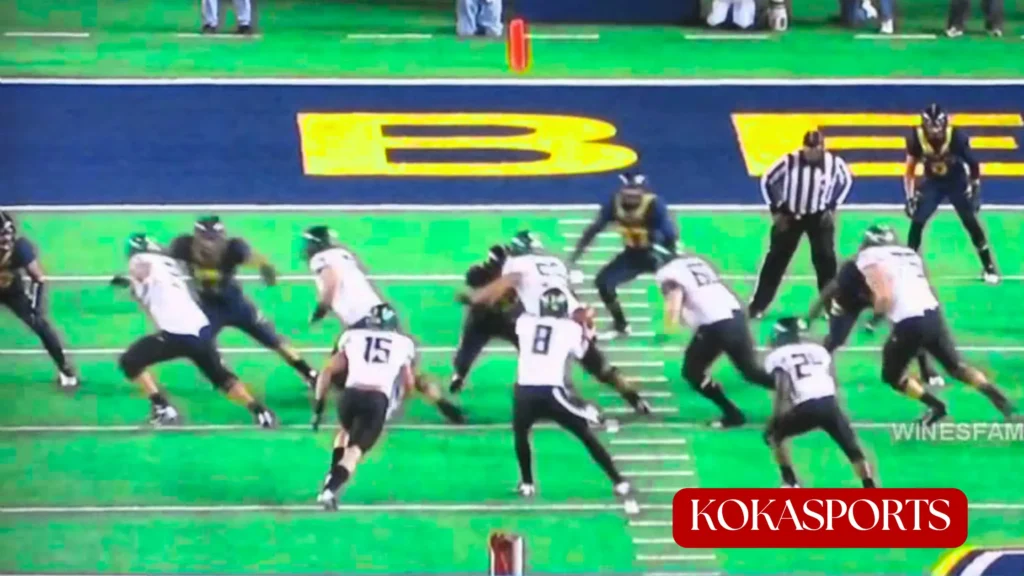
Backfield Alignments
When the H-back lines up in the backfield he is usually offset to one side behind the offensive tackle.
From there he can lead block into any gap, release into a route out of the backfield, or take a direct handoff. It is a familiar alignment that still gives the offense multiple options before the defense can fully commit.
Wing Formations
In a wing alignment the H-back lines up just outside the tight end or tackle, slightly off the line of scrimmage.
This is one of his most common spots in modern offenses. It gives him a clean release into a route, a direct angle to block a linebacker, and it forces the defense to make an immediate decision about assignment and coverage responsibility.
Motion Before the Snap
The H-back goes in motion more than almost any other position in football.
Coaches use that motion to read coverages, create mismatches, and place the H-back in a better position to execute his assignment. A defense that has to chase him around the formation before the snap cannot be as disciplined or as prepared as it needs to be.
This was actually the moment in the game when my friend started asking better questions. He watched the H-back go in motion twice in a row and said, “Wait, why does that linebacker keep following him?”
I told him that was exactly the information the offense was looking for.
Skills Needed to Play H-Back Football
Blocking Technique
The H-back must be a committed and technically sound blocker. There is no version of this position that works without it.
He has to handle linebackers, chip defensive ends, and cut off safeties in open space. That demands solid footwork, proper pad level, and the willingness to engage physical contact on every single play regardless of whether he is also being targeted as a receiver.
Speed and Agility
The H-back needs enough athleticism to threaten a defense in space.
He does not require wide receiver speed. But he must be fast enough to stress linebackers in coverage and create separation after the catch in traffic. A player who cannot threaten anyone as a receiver simply gets ignored by defenses, which eliminates the entire strategic value of the position.
Route Running
Legitimate H-backs run legitimate routes.
Short crossing patterns, seam routes, wheel routes out of the backfield. They have to create separation against linebackers and generate yards after contact in the middle of the field. The route running is not decorative. It is a core part of why the position works.
Football IQ and Versatility
This is the most important skill of all and the hardest to develop.
An H-back must understand the entire offense. He needs to know blocking assignments, route combinations, motion adjustments, and protection schemes. He is often the most football-intelligent player on the field at any given moment.
Coaches value high football IQ at this position above almost everything else because the job simply requires too much to be done effectively by someone who only understands one role.
Why Teams Use an H-Back
Offensive Flexibility
The primary reason teams use an H-back is the flexibility one player provides across an entire offense.
He can block on one play, run a route on the next, go in motion to diagnose coverage on the third, and be a pass protection asset on the fourth. That kind of versatility from a single roster spot changes what a coordinator can do on a weekly basis.
Creating Mismatches
The H-back creates structural mismatches almost automatically.
A linebacker covering him is usually too slow. A safety covering him is usually too small. A cornerback covering him is usually too light for the physical confrontation. There is no clean defensive answer. That ambiguity is built into the design of the position.
Improving the Running Game
The H-back gives offensive coordinators more ways to construct running plays.
He can lead through any gap, not just the traditional lanes a fullback attacks. He can kick out edge defenders, crack down on linebackers, or seal the second level depending on the play design. That variety makes the running game meaningfully harder to defend.
Helping in Pass Protection
H-backs are also important in pass protection schemes.
When blitzes arrive from unexpected angles, the H-back is frequently the player responsible for identifying and picking up the free rusher. His ability to process stunts and blitz packages quickly is often what keeps the quarterback upright on passing downs.
Famous H-Back Players in Football History
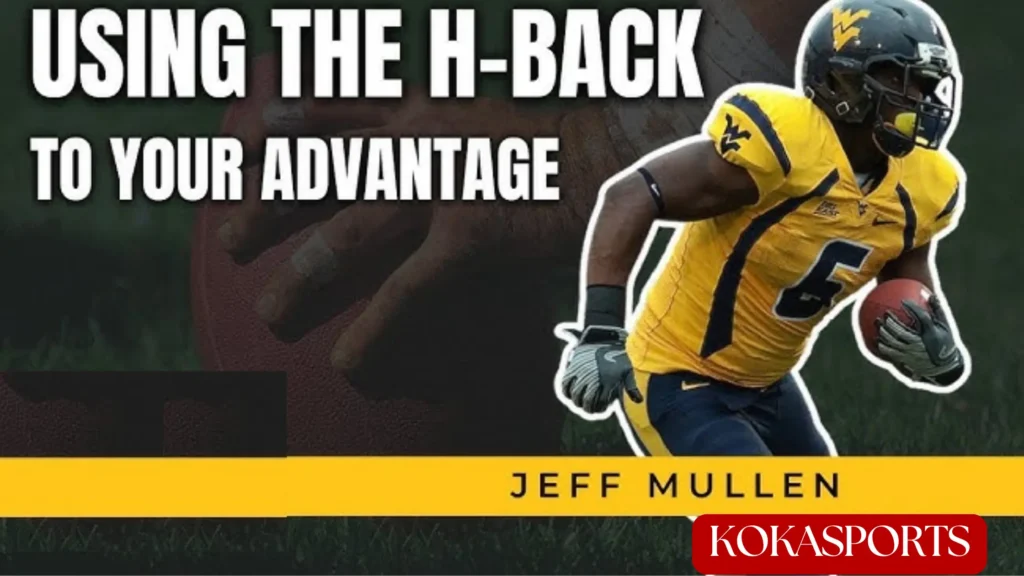
Chris Cooley
Chris Cooley played for the Washington Redskins from 2004 to 2012 and was one of the most complete examples of what the H-back position can look like at the NFL level.
He was listed officially as a tight end but he functioned as a true H-back within Joe Gibbs’ system. He was a legitimate receiving threat, a committed blocker, and a player comfortable lining up in multiple alignments without losing effectiveness in any of them.
Delanie Walker
Delanie Walker began his career as primarily a blocking tight end before developing into a reliable receiving threat during his time in San Francisco and later in Tennessee.
His career arc is a strong example of how a player with natural H-back skills can evolve and become progressively more valuable as he develops the receiving side of his game alongside his blocking ability.
Kyle Juszczyk’s Hybrid Role
Kyle Juszczyk is officially listed as a fullback on the San Francisco 49ers roster but he functions more like an H-back than any traditional fullback you will find in the modern NFL.
He catches passes regularly, aligns in multiple formations, and is one of the highest-paid players at his position in the league. His value and his contract are proof that the skills associated with the H-back position command real respect at the highest level of the game.
Other Notable H-Backs
Lorenzo Neal was one of the finest blocking fullbacks of his era and fits the H-back profile in terms of the impact he had on running games throughout his career.
Mike Alstott with the Tampa Bay Buccaneers blurred the line between fullback and H-back effectively with his receiving ability and physical presence in the backfield.
H-Back Football in College vs NFL
College Football Usage
The H-back is used extensively in college football, particularly within spread and Air Raid systems that have incorporated more hybrid positions over time.
Many college offenses deploy the H-back as a motion player who generates pre-snap information and creates easy reads for the quarterback. The position also serves as a natural landing spot for athletes who fall between traditional size categories and need a role that fits their specific skill set.
NFL Usage
The NFL has moved away from traditional two-back formations that once featured fullbacks and H-backs prominently.
But the position has not disappeared. It has evolved. Many teams now use tight ends in H-back roles or create hybrid personnel packages that achieve the same strategic effect without officially labeling the position on the depth chart.
Why Some Teams Favor the Position
Teams that commit to a ground-based offensive identity tend to use H-backs more consistently than pass-first organizations.
The San Francisco 49ers under Kyle Shanahan are the most prominent current example. Shanahan’s outside zone running scheme depends on a blocker who can reach the second level efficiently, and the H-back is central to making that system work at a high level.
Advantages and Disadvantages of the H-Back Position
Benefits for Offenses
The benefits are substantial.
One player who can block, catch, run, create pre-snap confusion, and contribute on special teams is an enormous asset. The positional flexibility alone gives coordinators weekly options that no other single position provides in the same way.
Challenges for Players
The position is genuinely demanding.
The H-back has to be proficient at too many things simultaneously. He has to embrace blocking even when his receiving skills might suggest a more prominent role. He has to process a larger portion of the playbook than most skill position players. And he often receives far less recognition than his actual contribution deserves.
Future of the Position
The H-back is not fading from the game.
Football continues to evolve toward more versatile personnel and more creative formation design at every level. The specific label may continue to change but the underlying concept of a hybrid blocker-receiver who can align anywhere and serve multiple functions will always have a place in a well-constructed offense.
How Coaches Develop H-Back Players
Training Drills
Coaches develop H-backs by building a wide range of skills simultaneously rather than specializing in any single area.
Weekly practice includes route running, blocking technique, pass protection assignments, and motion adjustments. The objective is to make the player comfortable and confident in every situation so his effectiveness does not depend on the specific alignment he is given on any particular play.
Strength and Conditioning
H-backs need the lower body strength to generate power as a blocker and the quickness to run effective routes against linebackers.
That combination requires a specific and disciplined conditioning program. Blocking power, contact resilience after the catch, and the cardiovascular capacity to perform at a high level in the fourth quarter are all essential components of their physical development.
Learning Multiple Roles
The most important part of developing an H-back is teaching him to think like an offensive coordinator.
He has to understand not just his own assignment but why the play is designed the way it is. He has to know what the quarterback is reading, recognize blitz packages before the snap, and adjust his responsibilities in real time when the defense does something unexpected.
The H-backs who reach and sustain elite levels are invariably the ones who approach the position as students of the full game rather than athletes executing a narrow job description.
FAQs About H Back Football
Is an H-back a tight end?
No. The H-back has more positional freedom and a bigger role in the passing game than a traditional tight end.
Can an H-back carry the football?
Yes, occasionally. Usually in short yardage situations or on designed runs out of the backfield.
What is the difference between an H-back and a fullback?
The H-back does everything a fullback does but adds route running, receiving ability, and positional flexibility on top of it.
Do NFL teams still use H-backs?
Yes. The 49ers have built their entire offense around it and several other teams use the role without officially labeling it.
Conclusion
My friend and I watched that game to the final whistle.
By the fourth quarter he had stopped arguing. He was just watching the H-back. The motion. The lead block. The catch on third and six that moved the chains.At the end he sat back and said, “Okay. That guy does a lot.”
That is the H-back in football. A blocker, a receiver, a mismatch problem, and one of the most important players on the field. He just never gets the credit. Find him before the snap next time you watch a game. Once you see what he does, you will never stop looking for him.