
If you want the short version, Cover 5 defense is a coverage that uses two deep safeties splitting the field into halves, with every underneath defender playing man-to-man on a receiver. It is most often called 2-Man, and it is one of the most aggressive pass coverages in football because it pairs tight man coverage with deep safety help over the top.
I still remember the first time I heard a coach yell out Cover 5. I was young, just starting to pay real attention to defenses, and I assumed the number told me how many deep defenders were back there. Five deep, I figured. It made sense in my head. So I spent a whole drive completely confused about what I was watching, because there were clearly only two safeties deep.
It turns out the numbers in coverage names are not a neat little ladder, and Cover 5 is the perfect example of that. Once someone finally explained it to me, the whole thing clicked. This guide is everything I wish that younger version of me had known, from what Cover 5 is and how it works snap to snap, to who does what, its strengths and weaknesses, and how it stacks up against every other coverage.
What Is Cover 5 Defense?
Definition of Cover 5 Defense
Cover 5 defense is a two-deep, man-under coverage. Two safeties sit deep and each takes responsibility for half of the field, just like they would in a Cover 2 shell. Underneath them, the cornerbacks, linebackers, and slot defenders all play man-to-man against the receivers in front of them.
That combination is where the nickname 2-Man comes from. The 2 refers to the two deep safeties, and Man refers to the man-to-man coverage underneath. So when you hear someone say 2-Man, they are talking about the exact same thing as Cover 5.
Why the Name Cover 5 Can Be Confusing
The confusion I felt as a kid is common, and it comes from the coverage numbering system itself. The numbers do not describe how many deep defenders there are in a tidy order. Cover 2 has two deep defenders, but so does Cover 5, even though the names suggest they should be very different.
The real difference is what happens underneath. Cover 2 plays zone underneath, while Cover 5 plays man. So the simplest way to keep it straight is to remember that Cover 5 is basically Cover 2 with man coverage instead of zone. The deep shell looks the same, but the underneath rules are the opposite.
Basic Responsibilities in Cover 5
In Cover 5, the two safeties protect the deep halves and act as the safety net for everything thrown over the top. The cornerbacks lock onto the outside receivers in man coverage, usually with help inside. Linebackers take running backs and tight ends, while nickel and dime defenders handle slot receivers in passing situations. Everyone underneath has a man, and the safeties clean up deep.
How Cover 5 Defense Works
Pre-Snap Alignment
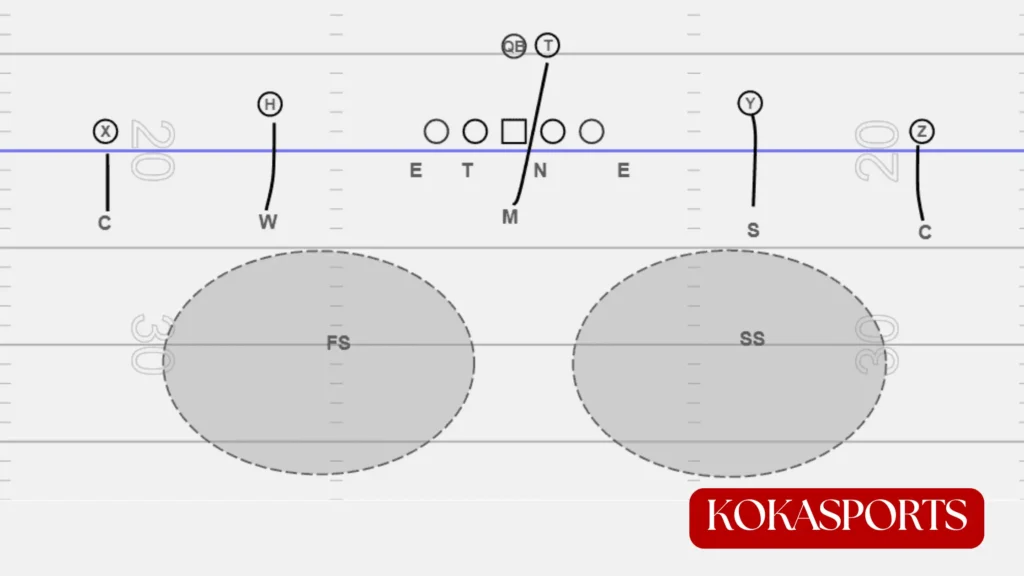
Before the snap, Cover 5 shows a two-high safety look, meaning both safeties line up deep, roughly splitting the field. This is the same picture an offense sees from a few other coverages, which is part of the appeal, since it can be hard to read. Underneath, the corners and other defenders line up over the receivers they are about to cover.
Post-Snap Responsibilities
After the snap, the two safeties drop and each takes a deep half, keeping everything in front of them and erasing any deep ball thrown into their area. The underneath defenders stick to their man, mirroring routes wherever they go, and because they have safety help over the top, they can play tight and aggressive without fearing a deep shot.
Coverage Structure Diagram
If you picture the field, the two safeties cover the back half, one on each side, splitting it down the middle. Underneath them, the corners take the outside, the nickel takes the slot, and the linebackers take the backs and tight ends, each glued to a man. There are no underneath zones to settle into, so every defender outside the two safeties is responsible for a body, not an area.
Cover 5 Defense Player Responsibilities
Cornerbacks
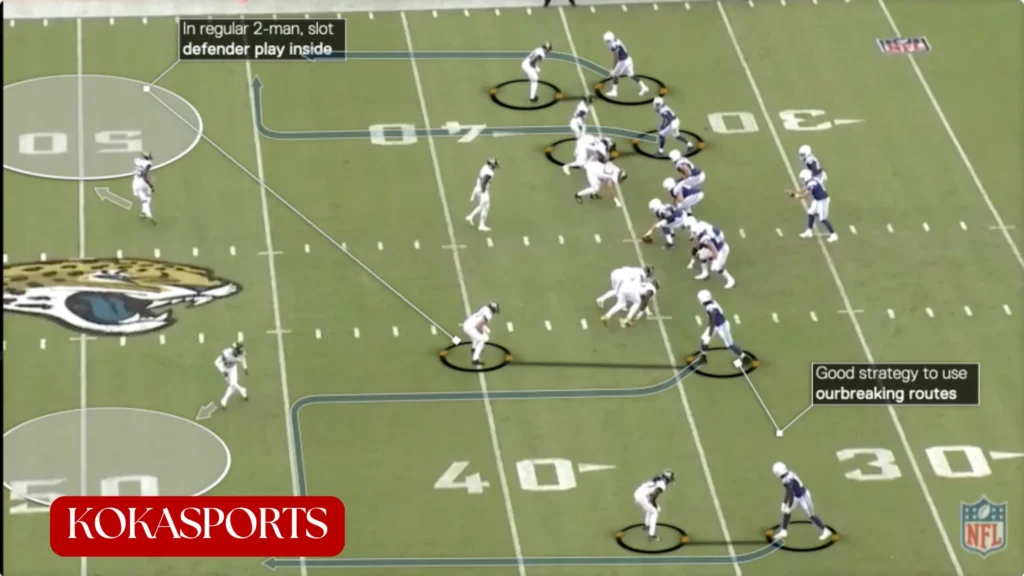
Cornerbacks are the stars of Cover 5. They often press the receiver at the line, jamming the route and disrupting the timing of the play. With a safety over the top, they can use trail technique, meaning they sit on the inside hip of the receiver, take away the shorter routes, and funnel anything deep toward their safety help.
Safeties
The safeties are the safety net, and their job is to prevent the explosive play. Each one owns a deep half and stays patient, reading the quarterback while keeping every receiver in front. Good safety play here is about angles and discipline, since one bad step can turn a contained play into a touchdown.
Linebackers
Linebackers take the running backs and tight ends in man coverage, which means they have to move in space. If their back stays in to block, the linebacker can become a free rusher or spy, and some Cover 5 calls send a linebacker on a blitz, trusting the tight man coverage behind it.
Nickel and Dime Defensive Backs
In passing situations, teams bring on extra defensive backs, the nickel and dime, to match up with slot receivers. They are quicker and better in coverage than a linebacker would be against a shifty slot, which is a big reason Cover 5 holds up so well on clear passing downs.
Advantages of Cover 5 Defense
Strong Against Deep Passes
The two deep safeties make Cover 5 very tough to beat over the top. Any deep ball has a defender waiting in that half of the field, so the offense rarely gets a clean shot at a long touchdown.
Excellent Man Coverage Support
Man coverage on its own can be risky, but Cover 5 softens that risk with deep help. Defenders can play tight, knowing a mistake will likely be cleaned up by the safety behind them.
Helps Defend Elite Wide Receivers
Against a star receiver, Cover 5 lets a corner sit on his routes underneath while a safety shades over the top. That essentially brackets the receiver between two defenders, making it very hard for him to win cleanly.
Effective in Third-and-Long Situations
On third and long, the offense needs a chunk of yards, and Cover 5 takes away the deep ball while contesting everything underneath.
Creates Tight Throwing Windows
Because every receiver is covered closely, there are very few open targets. The quarterback has to be accurate and decisive, and any hesitation can turn into a sack or a forced throw.
Weaknesses of Cover 5 Defense
Vulnerable to Quarterback Scrambles
The biggest catch with Cover 5 is that the man defenders have their backs to the quarterback, with their eyes locked on their receiver. That means nobody is watching the passer, so a quarterback who escapes the pocket can take off and run for big yards before anyone reacts.
Can Struggle Against Mobile Quarterbacks
Following the same idea, a mobile quarterback is a real problem. With defenders chasing receivers and not watching the backfield, a running quarterback can pick up easy yards.
Susceptible to Crossing Routes
Crossing routes give Cover 5 trouble because they force man defenders to run across the field and through traffic. When two routes cross, defenders can collide or get held up, and a receiver can come free in the middle.
Requires Skilled Defensive Backs
Cover 5 only works if your defensive backs can actually cover man-to-man. If a corner or nickel cannot stay with his man, there is no underneath zone help to bail him out.
Potential Run Defense Issues
With two safeties deep and several defenders locked in coverage, Cover 5 can leave the defense a little light against the run.
Cover 5 Defense vs Other Football Coverages
Cover 5 vs Cover 1
Cover 1 uses a single deep safety with man coverage underneath, often called man free. Cover 5 uses two deep safeties instead of one.
Cover 5 vs Cover 2
Cover 2 and Cover 5 share the same two-deep shell, but underneath they are opposites. Cover 2 plays zone underneath, while Cover 5 plays man.
Cover 5 vs Cover 3
Cover 3 drops three defenders into deep zones and plays zone underneath as well. It is more conservative and easier on the secondary, but it gives up more underneath completions.
Cover 5 vs Cover 4
Cover 4, often called quarters, splits the deep part of the field among four defenders and tends to pattern match. It is great against deep and intermediate routes but leaves fewer defenders for the underneath.
Cover 5 vs Cover 6
Cover 6 is a split-field coverage, playing quarters on one side and Cover 2 on the other. It is a zone-based answer to specific formations.
When Do Teams Use Cover 5 Defense?
Obvious Passing Downs
Cover 5 shines on clear passing downs, when the offense almost has to throw.
Red Zone Situations
In the red zone, the field is compressed and there is less deep area to defend. That makes the tight man coverage of Cover 5 very effective, since receivers have little room to get open.
End-of-Game Scenarios
Late in games, when an offense needs a big play, Cover 5 takes away the deep ball and forces underneath throws.
Against Pass-Heavy Offenses
Teams that love to throw the ball often see plenty of Cover 5, because it is one of the better answers to a strong passing attack.
NFL and College Examples of Cover 5 Defense
Teams Known for Using Cover 5
Cover 5 is more of a situational call than a base defense, so most teams across the NFL and college football use it at some point, especially on passing downs.
Famous Defensive Coordinators
Coaches with a reputation for aggressive man coverage have long featured 2-Man in their game plans.
Notable Game Situations
You will most often see Cover 5 show up in big third-and-long moments or late-game situations where a defense absolutely needs a stop.
Modern Trends in Two-High Safety Defenses
Modern defenses have shifted heavily toward two-high safety looks to defend today’s passing offenses. Cover 5 fits that trend, since it starts from the same two-deep picture, though many teams pair it with zone-match coverages out of the same look to keep offenses guessing.
How Offenses Attack Cover 5 Defense
Crossing Routes
Offenses love crossing routes against Cover 5 because they make man defenders chase across the field and run into traffic.
Pick and Rub Concepts
Pick and rub concepts are designed to create legal contact that frees up a receiver.
Quarterback Runs
Since the man defenders are not watching the backfield, designed quarterback runs and scrambles are a clean way to attack Cover 5.
Running Back Checkdowns
If a linebacker struggles to cover a quick running back, a simple checkdown can turn into a big gain in space.
Tight End Mismatches
A big, athletic tight end against a smaller defensive back, or a quicker one against a slower linebacker, is a classic mismatch.
How Defenses Adjust Within Cover 5
Press Man Variations
Defenses can press at the line to disrupt timing, jamming receivers and throwing off the route before it starts.
Off-Man Techniques
Alternatively, defenders can play off coverage, giving a cushion to avoid getting beaten deep or by a quick release.
Blitzing From Cover 5
Because the underneath is locked in man, defenses can blitz an extra rusher and trust the coverage to hold.
Disguising Coverage Before the Snap
Since Cover 5 starts from a two-high look shared by other coverages, defenses can disguise their intentions and rotate at the snap.
Common Cover 5 Defense Mistakes
Losing Leverage
If a defender loses his leverage, he gives the receiver a clear path to the open part of the field.
Poor Safety Angles
A safety who takes a bad angle can turn a contained play into a disaster.
Communication Breakdowns
Man coverage with motion and bunch formations requires constant communication.
Failure to Handle Motion
Pre-snap motion is used to test whether a defense is in man or zone, and to create confusion. If defenders fail to pass off or follow motion correctly, the coverage can break down before the snap.
Is Cover 5 Defense Still Effective in Modern Football?
Impact of Spread Offenses
Spread offenses stretch defenses out and create space, which can challenge any man coverage. Still, Cover 5 holds up because it answers the spread’s deep threats with two safeties while matching receivers underneath.
Evolution of Defensive Schemes
Defensive schemes keep evolving, but the core ideas behind Cover 5 remain useful.
Why NFL Teams Continue to Use It
NFL teams continue to use Cover 5 because it answers a specific problem very well. When you need to take away the deep ball and contest every underneath route at the same time, few coverages do it better.
FAQS About Cover 5 Defense
Is Cover 5 the Same as 2-Man?
Yes. Cover 5 and 2-Man are two names for the same coverage, with two deep safeties and man coverage underneath.
How Many Deep Safeties Are Used?
Two. Cover 5 uses a two-high safety shell, with each safety responsible for a deep half of the field.
Is Cover 5 Good Against the Run?
Not especially. With two safeties deep and defenders locked in coverage, Cover 5 can be a little light against the run compared to single-high coverages.
What Is the Biggest Weakness of Cover 5?
The biggest weakness is the running quarterback. Since man defenders have their eyes on receivers and their backs to the passer, a quarterback who scrambles can find open grass.
Which NFL Teams Use Cover 5 Most Often?
It is used league-wide as a situational call rather than a base defense, and teams with strong man-coverage corners tend to rely on it the most.
Conclusion
So when someone asks what Cover 5 defense is, the answer is a two-deep, man-under coverage, better known as 2-Man. Two safeties guard the deep halves while every defender underneath locks onto a receiver, creating tight windows and taking away the deep ball.
Its strengths are clear. It is excellent on passing downs, strong against deep shots, and a great tool for slowing down a top receiver. Its weaknesses are just as clear, mainly scrambling quarterbacks, crossing routes, and a softer front against the run.
Coaches keep coming back to Cover 5 because it does a specific job better than almost anything else. As long as offenses love to throw the ball deep, defenses will keep reaching for the coverage that erases the deep ball while squeezing every underneath route. And the next time you hear a coach call Cover 5, you will know it has nothing to do with five deep defenders.