
Every football play starts in the trenches. Before a quarterback can throw or a running back can find a hole, the offense has to deal with the players lined up right in front of them: the defensive line. The fight between these two groups is called the “Battle of the Trenches,” and whichever team wins it usually wins the game.
The defensive line has two main jobs: stop the run and pressure the quarterback. Every player up front does both, but each of the d line positions handles those jobs differently. In this guide, we break down every position, how each fits into the 4-3 and 3-4 defenses, and the stances, techniques, gaps, and moves every fan and young player should know. For the bigger picture, check out our guide to what are the 11 positions in football.
What Are D Line Positions?
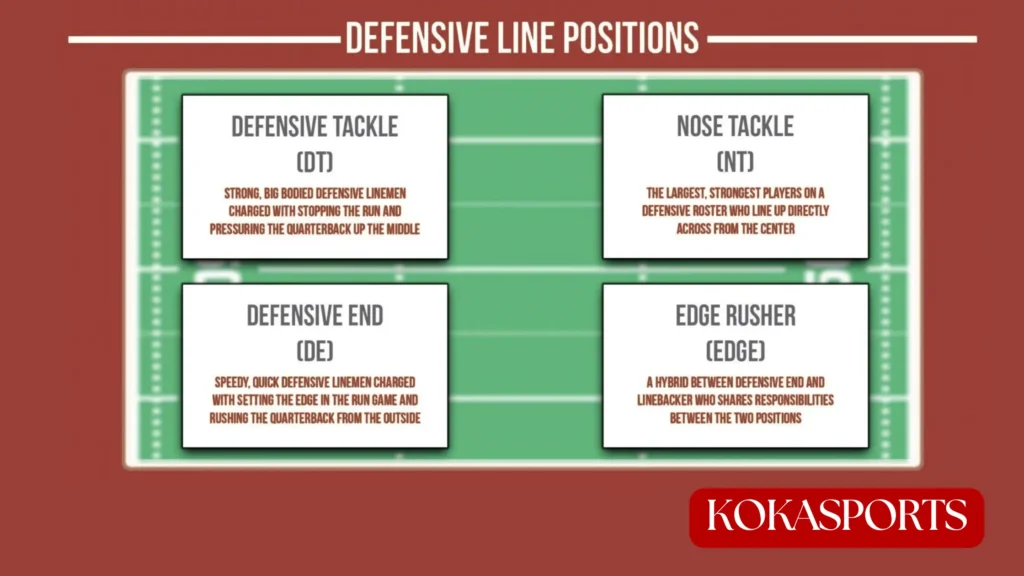
D line positions are the spots played by defensive linemen, the defenders who line up directly on the line of scrimmage across from the offensive line. There are three traditional d line positions:
- Defensive End (DE)
- Defensive Tackle (DT)
- Nose Tackle (NT), also called the nose guard
Today, a fourth label is also common: the EDGE rusher, a hybrid who blends the defensive end and outside linebacker roles. Most defenses use three or four defensive linemen, depending on the scheme.
The Job of the Defensive Line
Against the run, linemen have two jobs: disrupt the offensive line and tackle the ball carrier as close to the line of scrimmage as possible. If the runner gets past them, they chase him downfield to help finish the play. Even without making the tackle, keeping blockers busy lets the linebackers run free to the ball.
Against the pass, linemen try to collapse the pocket, force bad throws, and get sacks. They also keep the quarterback from escaping, and some schemes, like the zone blitz, even ask a lineman to drop back into pass coverage.
On the outside, linemen must keep contain, so the ball carrier or quarterback cannot escape around the edge.
When the line can create pressure on its own, the rest of the defense can drop more players into coverage.
D Line Positions Explained
Defensive End (DE)
According to the NFL’s official glossary of football terms, defensive ends line up at each outside end of the defensive line and try to force their way into the backfield to pressure or sack the quarterback or stop the running back.
On runs, the defensive end must set the edge and force ball carriers back inside. On passes, ends are usually a team’s top sack producers.
Teams often split ends into two types. The strong side end lines up on the tight end side and is usually bigger and better against the run. The weak side end is often the faster pass rusher. The faster end is traditionally placed on the right side of the defense, which is the blind side of a right-handed quarterback.
Defensive Tackle (DT)
The NFL defines defensive tackles as players typically lined up opposite the guards who push into the offensive line to disrupt plays or stop running gains. A 4-3 defense has two defensive tackles.
Their first job is to occupy interior blockers so linebackers can reach the ball. On passes, they push the pocket up the middle, which can flush the quarterback toward the ends.
In a 4-3, one tackle is usually bigger and handles double teams. The other, called the under tackle or 3-technique, lines up on the outside shoulder of a guard and shoots through gaps at the snap. This player is built for quickness, ideally weighing close to 300 pounds.
Nose Tackle (NT)
The nose tackle lines up directly across from the center, almost nose to nose. The NFL’s glossary ties the nose guard to the 3-4 defense, though some 4-3 teams also use one, so it is best described as mainly a 3-4 role.
The nose tackle usually controls both A gaps, the spaces on each side of the center. This is called two-gapping. He often faces a double team from the center and a guard, and if he holds his ground, the linebackers are free to make plays.
Nose tackle is widely considered the most physically demanding position in football. The ideal 3-4 nose tackle often weighs around 335 pounds or more. These players rarely lead the stat sheet, because their job is to create space for teammates.
EDGE Rusher
“EDGE” is not an official rulebook position, but it has become a standard label. At the NFL Scouting Combine, edge rushers now work out as their own group, separate from interior linemen and linebackers.
An EDGE player lines up outside and has one main mission: get to the quarterback. In a 4-3, that is usually a defensive end. In a 3-4, it is often an outside linebacker standing up on the line.
How D Line Positions Fit in the 4-3 vs 3-4 Defense
Defensive formations are named by numbers. The first number is the defensive linemen, and the second is the linebackers.
The 4-3 defense uses four linemen (two ends and two tackles) and three linebackers. The defensive line is the focal point, and it is generally considered strong against the run.
The 3-4 defense uses three linemen (a nose tackle and two ends) and four linebackers. The outside linebackers become the main pass rushers, and the extra linebacker helps in coverage.
Teams usually choose based on personnel. A deep group of linemen fits the 4-3, while a great nose tackle and strong linebackers fit the 3-4. Most modern teams use both.
Nickel Package: How the D Line Changes
The NFL defines the nickel as a formation for expected passing situations, where a fifth defensive back replaces a linebacker. Many teams keep four linemen in nickel and send in their best pass rushers on obvious passing downs.
Gap Control vs Man Control
There are two core ways to play on the defensive line:
- Gap control (one-gap): Each lineman is responsible for one specific gap and attacks it at the snap. This is the most common way teams control the line of scrimmage, and it fits most 4-3 defenses.
- Man control (two-gap): The lineman plays through the blocker in front of him and controls the gaps on both sides. These players usually line up head up in a 0, 2, 4, or 6-technique. This style is common in the 3-4, especially for the nose tackle.
Defensive Line Stances
- Two-point stance: Standing up, no hands down. Used by linebackers and many EDGE rushers.
- Three-point stance: One hand down. The most common stance for ends and tackles.
- Four-point stance: Both hands down. Low and powerful, often used by nose tackles and in goal line situations.
Coaches also adjust the stance to the situation. An attack stance, with the feet a bit narrower, is used in passing situations to get upfield fast. An attack read stance is the base stance for run situations, when the lineman needs to read the block before reacting.
A hand on the ground is one of the easiest ways to tell a defensive lineman from a linebacker before the snap. A good stance is low and balanced, with weight on the balls of the feet. In the trenches, the low man usually wins.
D Line Techniques: The 0 to 9 Numbering System
The word “technique” means two different things on the defensive line. It can mean a player’s alignment (where he lines up), or his fundamentals (stance, hand fighting, and get-off). This section covers alignment. We cover fundamentals further down.
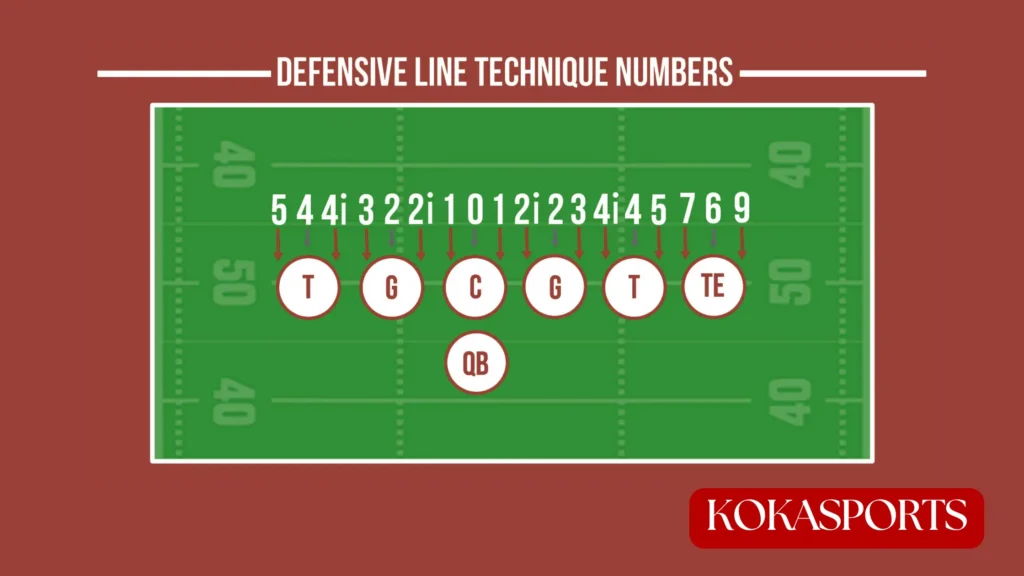
When an analyst calls a player a “3-technique” or “5-technique,” they are describing where he lines up. Coaches number alignments from 0 to 9, counting outward from the center.
Even numbers mean head up:
- 0: Over the center
- 2: Over a guard
- 4: Over a tackle
- 6: Over a tight end
Odd numbers mean outside shoulder:
- 1: Outside shoulder of the center
- 3: Outside shoulder of a guard
- 5: Outside shoulder of a tackle
- 9: Outside shoulder of the tight end
“i” techniques mean inside shoulder:
- 2i: Inside shoulder of a guard
- 4i: Inside shoulder of a tackle
- 7: Inside shoulder of the tight end (technically a “6i,” but almost everyone calls it a 7)
A 3-4 nose tackle usually plays a 0-technique, a 4-3 under tackle plays a 3-technique, and a traditional 3-4 end plays a 5-technique. That is why scouts call players a “0-tech,” “3-tech,” or “5-tech” as a shortcut for their role.
Gap Responsibilities: The A, B, C and D Gaps
Gaps are the spaces between offensive linemen, and every defender is responsible for one.
- A gap: Between the center and a guard
- B gap: Between a guard and a tackle
- C gap: Between a tackle and the tight end (or outside the tackle if there is no tight end)
- D gap: Outside the tight end
There are gaps on both sides of the ball. Alignment usually tells you the gap: a 2i controls the A gap, while a 3-technique attacks the B gap.
Common Defensive Fronts
A front describes how linemen are arranged before the snap. Names vary by team, but three are widely used:
- Over: The 3-technique lines up toward the offense’s strong side.
- Under: The 3-technique lines up toward the weak side.
- Bear: Linemen cover the center and both guards, a popular short yardage and goal line look.
Defensive Line Fundamentals
Alignment only puts a lineman in the right place. Winning the rep takes sound fundamentals.
- Explosive get-off: Exploding off the ball at the snap. The first two steps often decide who wins the rep.
- Hand combat: Linemen strike with their hands to gain leverage and create separation. Good hand placement and keeping the hands apart, so a blocker cannot swat them together, are key.
- Pad level: Playing low wins leverage against bigger blockers.
- Knowledge: Smart linemen know their assignment and read the situation before every snap, including down and distance, score, time, field position, and offensive personnel.
- Effort: Great technique means little without a relentless motor. Many sacks and tackles come from simply outworking the blocker.
USA Football’s guide to defensive line techniques is a great resource for young players, teaching how to beat base, down, and reach blocks with a focus on stance and hand placement.
Run-Stopping Techniques
- Stack and shed: The lineman engages the blocker, often with a hard punch, controls him, then quickly sheds the block to make the tackle.
- Attack-react: The lineman attacks and penetrates a gap right away to disrupt the play before it develops.
- Re-trace: If a lineman rushes upfield and the play turns out to be a screen or draw, he reverses course and chases the ball.
Pass-Rush Moves and Stunts
These are the pass-rush moves you will see most often:
- Bull rush: Striking with both hands and driving the blocker straight back.
- Rip move: Driving an arm up under the blocker’s arm to turn the corner.
- Dip and rip: Dipping the inside shoulder low first, then ripping through.
- Swim move: Knocking the blocker’s hands down and bringing an arm over the top, like a swimming stroke.
- Spin move: Getting the blocker to lean, then spinning off him.
- Long-arm: Extending one arm into the blocker’s chest to turn speed into power.
- Stemming: Faking an outside rush, then cutting back inside.
Pass rushers must also keep rush lane integrity. Each rusher stays in his lane so the quarterback cannot escape through an opening.
A stunt is a planned move where linemen switch gaps after the snap to confuse blockers. In the common TEX stunt, the tackle crashes out first and the end loops inside behind him. When it works, the offensive line ends up blocking the wrong players.
Defensive Line Drills
Technique is built through repetition at practice. The most common types of d line drills are:
- Hand combat drills: Teach linemen to strike, fight off blockers, and create separation.
- Block-shedding drills: Teach linemen to get off blocks quickly and make plays on the ball.
- Run-stopping drills: Teach linemen to hold their ground and control their gaps.
D Line Jersey Numbers and Common Penalties
Under official NFL numbering, defensive linemen wear numbers 50 to 79 and 90 to 99.
Because they line up so close to the ball, linemen commit two penalties more than anyone:
- Offside: Any part of a player’s body is in the neutral zone before the snap. It is a five-yard penalty.
- Encroachment: A defender enters the neutral zone and contacts an offensive player or the ball before the snap.
Unlike the offense, the defense has no required formation. A defender may line up anywhere on his side of the line, which lets defenses shift fronts and disguise stunts.
Size and Build for Each Position
- Nose tackle: The biggest player on the line, built with raw power and a low center of gravity.
- Defensive tackle: Big but quick, able to burst through gaps.
- Defensive end: Taller and more athletic, with long arms and speed.
- EDGE rusher: Usually the lightest and fastest, built to bend around the corner.
Conclusion
The defensive line is the foundation of every good defense. Ends set the edge, tackles push the pocket, nose tackles eat double teams, and EDGE rushers bring the speed. Once you understand the d line positions, along with stances, techniques, gaps, and moves, you will start to see why plays succeed or fail in the trenches.
FAQs About D Line Positions
How many d line positions are there?
There are three traditional d line positions: defensive end, defensive tackle, and nose tackle. Many now add the EDGE rusher as a fourth.
What is the difference between a defensive tackle and a nose tackle?
A nose tackle lines up directly over the center, mostly in a 3-4. A defensive tackle usually lines up across from a guard, often in a 4-3.
What is a 3-technique in football?
A 3-technique is a lineman on the outside shoulder of a guard, usually a defensive tackle attacking the B gap.
What is a 5-technique in football?
A 5-technique is a lineman on the outside shoulder of a tackle. It is usually a defensive end or edge rusher, and it is the classic alignment for 3-4 ends.
What numbers do defensive linemen wear in the NFL?
Defensive linemen wear numbers 50 to 79 and 90 to 99.
What is the hardest d line position to play?
Nose tackle, because the player faces constant double teams on nearly every snap.