
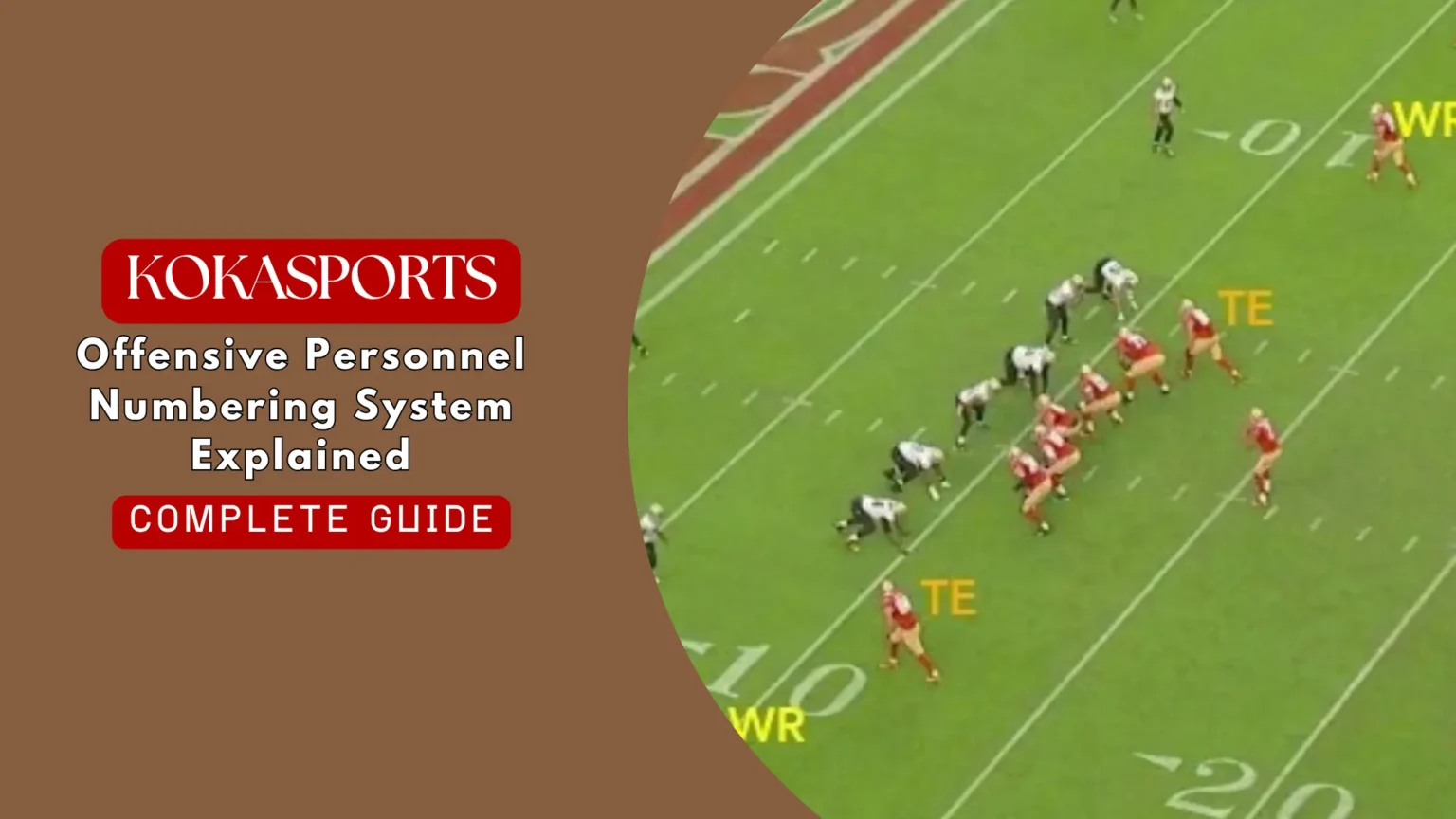
When coaches and analysts say “11 personnel” or “21 personnel,” they are using the offensive personnel numbering system, a quick two-digit code that tells you exactly which skill players an offense has on the field. It can look confusing at first, but the logic behind it is simple and never changes. This guide breaks down how the system works, how to read any grouping in seconds, and how both offenses and defenses use the code to gain an edge. Once you learn it, you will understand a play call the moment the personnel jogs onto the field.
What Is the Offensive Personnel Numbering System?
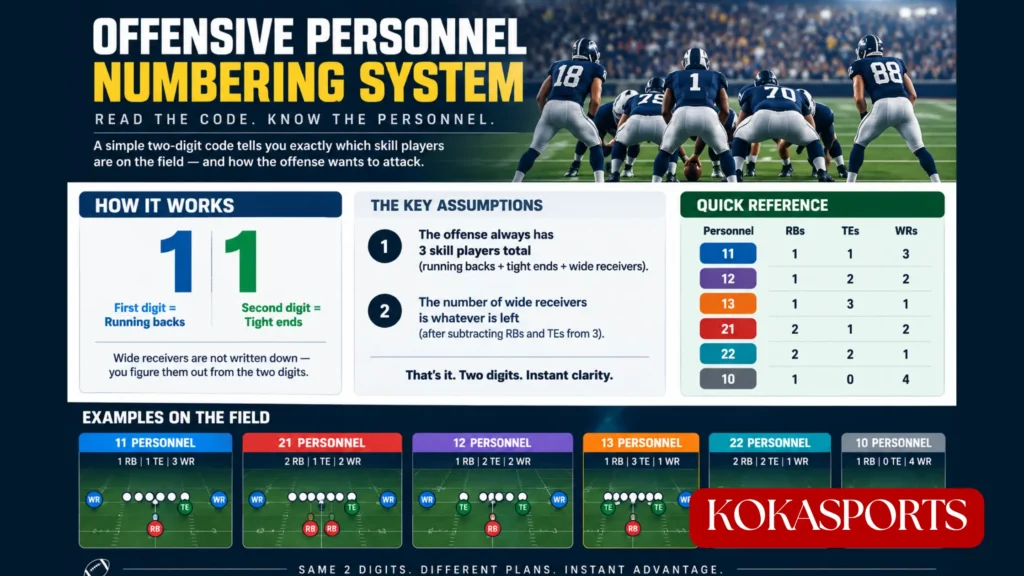
The offensive personnel numbering system is a two-digit label that describes the skill players an offense sends onto the field. The first digit is the number of running backs. The second digit is the number of tight ends. The number of wide receivers is not written down, because you can work it out from the two digits you already have.
For example, 11 personnel means 1 running back and 1 tight end, which leaves 3 wide receivers. 21 personnel means 2 running backs and 1 tight end, which leaves 2 wide receivers. The code is short on purpose. A coach can say a single two-digit number, and every player instantly knows who belongs on the field.
The Two Assumptions That Make the Code Work
The system leaves two things unsaid because they almost never change. Every grouping assumes there is one quarterback and five interior offensive linemen on the field. Those six players are a constant, so the code does not bother to count them.
That leaves five spots. Since a play starts with 11 offensive players, and six are already accounted for, the remaining five have to be skill players: running backs, tight ends, and wide receivers. The numbering system exists to describe those five, and only those five.
This ties directly to the rules of the game. Under the official rules, an offense must have at least seven players on the line of scrimmage, and only the two players on the very ends of that line can catch a pass. The four players in the backfield are also eligible. Add it up and you reach a maximum of five eligible skill players, alongside the quarterback and the linemen who cannot catch a forward pass. You can read the rule for yourself in the official NFL rulebook. That rule is the reason the code only ever needs two digits.
How to Read the Numbers
Reading a grouping takes three quick steps.
First, look at the first digit for the number of running backs. Second, look at the second digit for the number of tight ends. Third, add the two digits together and subtract the total from five to find the number of wide receivers.
Try it with 12 personnel. The first digit is 1 running back. The second digit is 2 tight ends. That adds up to three, and five minus three leaves 2 wide receivers. So 12 personnel is 1 running back, 2 tight ends, and 2 wide receivers. The same three steps work for any grouping you will ever come across.
Why Wide Receivers Are Not in the Number
People new to the code often ask why receivers get left out. The answer is that they are the leftover. Once you know the running backs and tight ends, the receivers are simply whatever remains of the five skill spots.
There is a strategic reason too. Defenses read personnel to guess run or pass. Running backs and tight ends are the clearest signals of a run, so those are the two positions the code puts front and center. The receiver count falls out automatically, and the defense already knows it.
The Asterisk: Reading an Extra Offensive Lineman
Now and then you will see a grouping written with an asterisk, such as 11* personnel. The asterisk means the offense has taken out a skill player and added a sixth offensive lineman, usually for extra power near the goal line or in short yardage. In that case, 11* would be 6 offensive linemen, 1 running back, 1 tight end, and 2 wide receivers. It is a small piece of shorthand, but it shows up in coaching charts and advanced stat sheets, so it helps to recognize it. You can find more on the convention in this gridiron personnel grouping reference.
Quick-Reference Chart: Reading Every Grouping
The table below shows how the code translates into players on the field. It covers every grouping you are likely to see in a real game.
| Personnel | Running Backs | Tight Ends | Wide Receivers |
|---|---|---|---|
| 00 | 0 | 0 | 5 |
| 01 | 0 | 1 | 4 |
| 02 | 0 | 2 | 3 |
| 10 | 1 | 0 | 4 |
| 11 | 1 | 1 | 3 |
| 12 | 1 | 2 | 2 |
| 13 | 1 | 3 | 1 |
| 20 | 2 | 0 | 3 |
| 21 | 2 | 1 | 2 |
| 22 | 2 | 2 | 1 |
| 23 | 2 | 3 | 0 |
| 30 | 3 | 0 | 2 |
| 31 | 3 | 1 | 1 |
| 32 | 3 | 2 | 0 |
The numbering can stretch further on paper, but you will almost never see it. Groupings with four running backs or four tight ends are essentially unheard of at any level, so treat the chart above as the practical range.
Reading the Code by Family
It helps to group the numbers into families based on what they tell you.
Spread groupings such as 00, 01, and 10 have zero or one tight end and load up on receivers. When you read one of these, expect a pass-first look built to stretch the field from sideline to sideline.
Balanced groupings such as 11, 12, 20, and 21 mix run and pass threats. 11 personnel is the most common grouping in modern football and serves as the base package for nearly every NFL team.
Heavy groupings such as 13, 22, and 23 pile on tight ends and backs for power running and short yardage. 13 personnel, for instance, puts 1 running back and 3 tight ends on the field and is a favorite in goal-line situations. For a full breakdown of that package, see our guide on what 13 personnel is in football.
Option groupings such as 30, 31, and 32 use three running backs. You will mostly see these in flexbone and wishbone systems at the high school and service-academy level, where the triple option still thrives, rather than in the NFL.
Edge Cases the Numbering System Handles
What If There Are More Than Two Running Backs?
Three-back groupings do exist, mostly in option offenses. When a team lines up in a flexbone with three backs, coaches may still label it by the standard code, or they may classify a player differently depending on how he is used. A back who flexes out wide can be counted as a receiver instead. In those gray areas, the label comes down to how the coach chooses to define the role.
Groupings You Will Almost Never See
Because the code is just math, you can write groupings like 04 or 41 on paper. In reality, no team fields four tight ends or four running backs, so those numbers stay theoretical. When you are learning the system, focus on the groupings in the chart above and treat the rest as trivia.
How Defenses Use the Numbering System
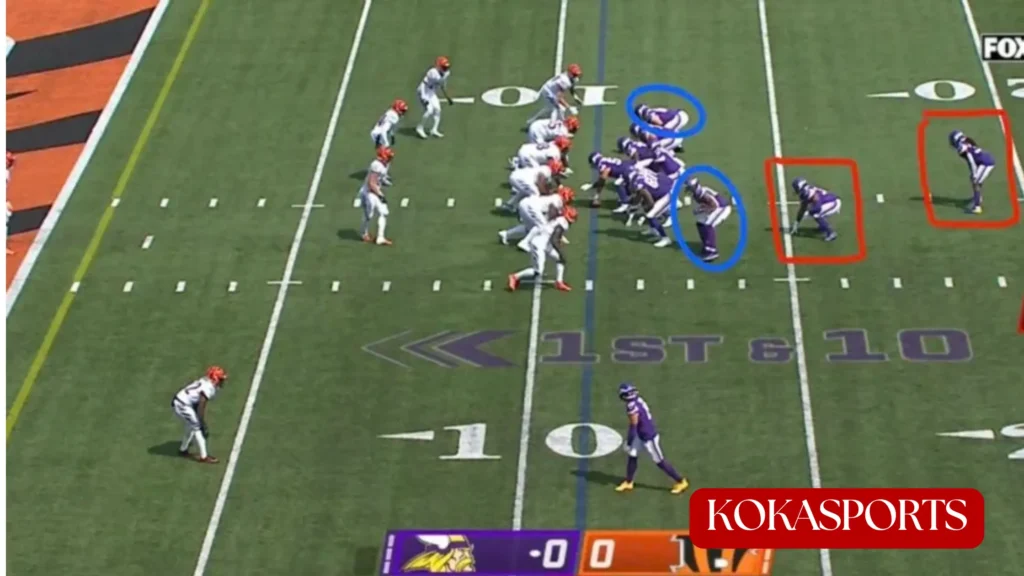
The offense is not the only side reading the code. Defenses watch which personnel jogs on and substitute to match.
Against three or more receivers, defenses bring in extra defensive backs. A fifth defensive back creates a nickel defense, which is the common answer to 11 personnel. A sixth defensive back creates a dime defense, which is a logical response to 10 personnel and its four receivers. Push further and you reach quarter and half-dollar looks with seven or eight defensive backs, saved for desperate passing situations.
Against heavy groupings with multiple tight ends and backs, defenses go the other way and add linebackers or defensive linemen to hold up against the run. The whole substitution battle plays out in the few seconds between plays, and the personnel numbering system is the shared language both sides use to win it.
Frequently Asked Questions
What does the offensive personnel numbering system mean?
It is a two-digit code where the first number is the running backs on the field and the second number is the tight ends. The wide receiver count is whatever is left of the five skill spots.
Why is the quarterback not counted?
Because there is always exactly one quarterback. The system leaves out anything that never changes, which includes the quarterback and the five interior offensive linemen.
Why are wide receivers not in the number?
Receivers are the remainder. Once you subtract the running backs and tight ends from five, the number left over is the receivers, so the code does not need a third digit.
What is the most common personnel grouping?
11 personnel, which is 1 running back, 1 tight end, and 3 wide receivers. It has been the base package across the NFL for years because it balances the run and the pass.
Conclusion
The offensive personnel numbering system turns a jumble of players into a clean two-digit code. Remember the two things it assumes, one quarterback and five linemen, and the rest is simple subtraction. First digit for running backs, second digit for tight ends, and the receivers are whatever remains. Learn to read it, and you will start to see the game the way coaches do, spotting the run and pass clues before the ball is even snapped.