

Padel is one of the fastest-growing sports in the United States, and it is easy to see why. It blends the social feel of doubles tennis with the wall play of squash, which keeps rallies alive and makes the game fun from your very first match. If you are about to step onto a court for the first time, this guide to the padel rules walks you through everything you need to know, from serving and scoring to wall play. Every point here is verified against the official rulebook from the International Padel Federation (FIP), the sport’s global governing body.
Padel at a Glance
Before your first rally, here are the essentials:
- Players: 4, in two teams of two. Padel is always played as doubles.
- Court: an enclosed rectangle, 20 meters long by 10 meters wide (about 66 by 33 feet), surrounded by glass and metal-mesh walls.
- Equipment: a solid, perforated racket with no strings, plus low-pressure balls.
- Scoring: 15, 30, 40, game, exactly like tennis.
- Serving: underhand, below the waist, and hit diagonally.
- Walls: the glass and mesh are part of the game, and you can play the ball off them.
The Court and Equipment
The Court
A regulation padel court is 20 meters long and 10 meters wide, split down the middle by a net. On each side, a service line runs parallel to the net at a distance of 6.95 meters, and a center service line divides each side into two service boxes. The net sits 0.88 meters high in the middle and rises to 0.92 meters at the ends.
What makes padel special is the enclosure. At each end, the back is 4 meters tall, built from 3 meters of solid wall (usually glass) topped by 1 meter of metal-mesh fencing. These walls are not just a boundary. They are an active part of every point.
The Racket and Balls
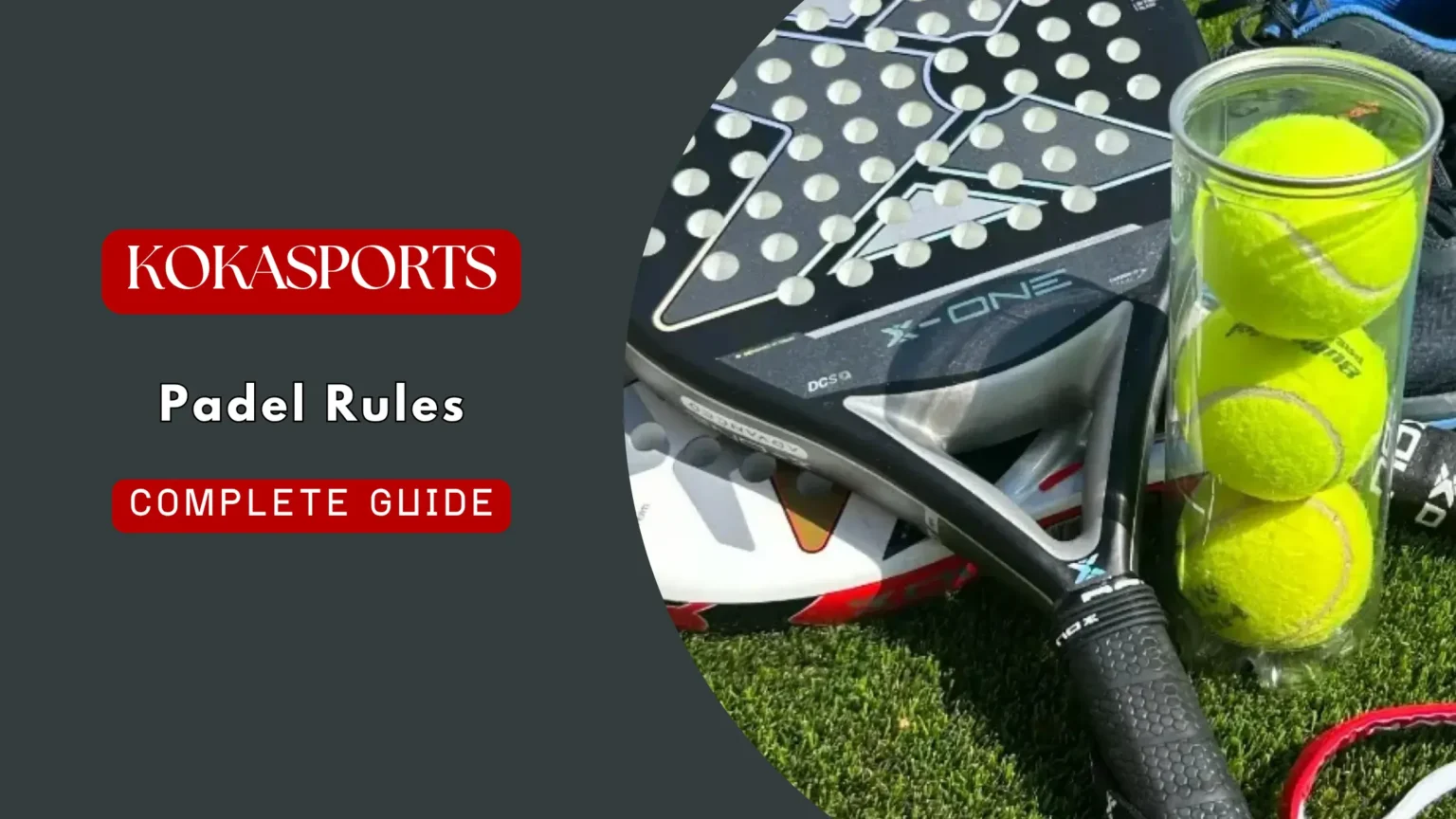
A padel racket is shorter than a tennis racket and has no strings. Instead, it has a solid hitting surface perforated with holes drilled through it. One rule that surprises new players is the wrist strap. The racket must have a cord attached to the handle that you wear around your wrist, and using it is mandatory, not optional. It keeps the racket from flying out of your hand and injuring someone.
Padel balls look almost identical to tennis balls but carry slightly lower pressure, so they move a touch slower. The official diameter is between 6.35 and 6.77 centimeters, and the weight is roughly 56 to 59 grams.
How Scoring Works
Padel uses the same scoring system as tennis. You win points as 15, 30, 40, and then game. The first team to win six games, with a lead of at least two games, wins the set. If the teams tie at five games each, they play on until one side wins by 7-5. If they reach 6-6, they play a tie-break instead, which the first team to reach seven points wins, again by a margin of two points. Matches are usually the best of three sets.
Golden Point or Advantage
At 40-40 (deuce), there are two common ways to finish the game. In the traditional format, a team must win two points in a row to take the game. Many clubs and professional events instead use the golden point, where a single deciding point settles the game. On the golden point, the receiving team gets to choose which side they want to receive the serve. Teams switch ends of the court after every odd game.
How to Serve

The serve is designed to start the rally, not to overpower your opponent. To serve legally, you must:
- Stand behind the service line with at least one foot on the ground.
- Bounce the ball on the court first, then hit it.
- Make contact at or below waist height.
- Hit the ball underhand and diagonally, into the service box across from you.
You get two serves, just like tennis. After a legal serve, the ball can bounce and then touch the glass back wall and still be live. But if the ball bounces in the box and then hits the metal fence, it is a fault.
Faults and Lets
A serve is a fault if it lands outside the correct service box, is struck above the waist, or touches the fence after bouncing. Two faults in a row and you lose the point. If the serve clips the net and still lands in the correct box without touching the fence, it is a let, and you simply take the serve again.
Playing Off the Walls
The walls are what make padel feel different from any other racket sport. Here is the one rule that matters most: on your side of the court, the ball must bounce on the ground before it touches any wall or fence. Once it has bounced, you can play it off your own back glass, and skilled players can even send it back over the net that way when they are under pressure.
When your shot lands on the opponent’s side, it can bounce and then fly into their walls or fence, which often creates awkward angles for them to handle. What you cannot do is hit the ball directly into a wall or fence before it has bounced on the ground.
Winning and Losing Points

Most beginner points end on simple mistakes. Keep the ball in play and you are already doing a lot right. Your team loses the point if:
- The ball bounces twice on your side before you return it.
- You or your partner get hit by the ball while it is in play.
- You hit the ball into a wall or fence before it bounces on the opponent’s side.
- Anyone touches the net, posts, or cables while the ball is live.
- You hit the ball twice, or both partners hit it on the same shot.
- You drop your racket or break your wrist strap during the point.
You also cannot reach over the net to hit the ball, with one exception. If the ball bounces on your side and then spins back over the net on its own, you are allowed to reach over and play it.
Running Outside the Court
Yes, you really can leave the court during a point. If a ball is hit hard and bounces out through one of the side doors, you are allowed to run outside and return it, as long as the court has the proper safety space and access doors. Pulling this off is one of the most spectacular plays in the sport.
Padel vs Tennis
Although the scoring is identical, padel plays very differently. The court is much smaller and fully enclosed, the serve is underhand rather than overhead, and the walls keep the ball alive far longer. The solid racket produces less raw power but more control, and because padel is always doubles, it rewards teamwork and smart positioning over brute strength.
Simple Strategy for Your First Match
Padel rewards patience more than power. For your first few games, focus on keeping the ball in play, moving with your partner, and using the glass to buy yourself time instead of rushing every ball. Talk constantly, calling “mine” or “yours” so you never collide or leave a ball between you. Move up to the net together to attack, and drop back together when your opponents lob you.
FAQs About Padel Rules
Is padel easy to learn?
Yes. The underhand serve, smaller court, and doubles format make it very beginner-friendly, and the walls help keep rallies going even while your technique is still developing.
Is padel the same as pickleball?
No. Padel is played on an enclosed court with walls, uses tennis-style scoring, and uses a solid perforated racket. Pickleball is played on an open court with different serving and scoring rules.
Do I have to wear the wrist strap?
Yes. Under the official rules, the wrist cord is required. Dropping your racket or breaking the strap during a point actually costs you the point.
Can I use tennis balls for padel?
It is not recommended. Padel balls have lower pressure and are built for the smaller court, so tennis balls behave differently and can put extra stress on your racket.
Do you need a referee?
No. Outside of professional tournaments, players call their own lines and keep their own score. Padel is meant to be social and fun.
Once you understand the serve, the scoring, and how the walls work, the rest comes quickly with time on court. In the United States, the sport is overseen by USA Padel, the national governing body recognized by the FIP, which is a helpful resource for finding sanctioned clubs and tournaments near you. When you are ready to step on court, read our full guide on how to get started playing padel, then grab three friends and start your first rally.