


A side out in volleyball occurs when the receiving team wins a rally, earning them both a point and the right to serve. In modern rally scoring, a side out results in an immediate point and a clockwise rotation for the winning team.
Now that you have the quick answer let’s go deeper.
Have you ever watched a volleyball game and heard someone shout “side out!” and had no idea what just happened? You are not alone.
In this guide, you will learn exactly what does side out mean in volleyball, how rotation works after a side out, how it differs in beach volleyball, and why coaches track it as a key stat today.
What does Side Out mean in Volleyball?
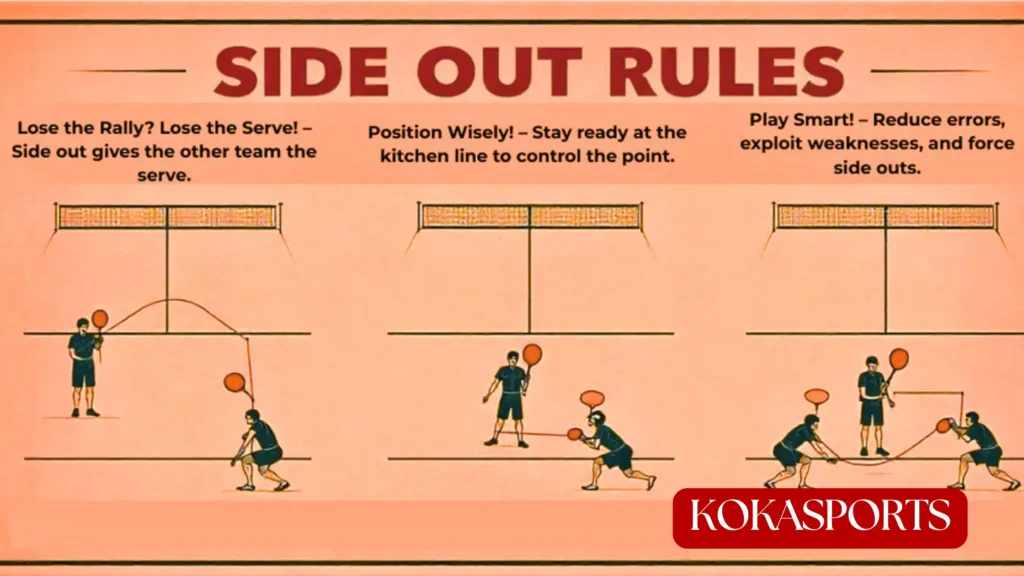
A side out in volleyball happens when the receiving team wins the rally and gains the right to serve.
In simple words the team that was NOT serving wins the point. Now they get to serve next.
In today’s game, when the receiving team wins a rally, they also score a point. So a sideout gives you two things at once the serve AND a point.
Where Does the Word Come From?
The term comes from the old days when volleyball was played differently. Back then, if the receiving team won the rally, the serve would go “out” to the other “side.” That is how the name stuck even though the scoring system has changed a lot since then.
Why Does It Still Matter?
Even today, the sideout is fundamental to volleyball. Coaches track something called sideout percentage and sideout percentage measures how often the receiving team wins when the opponent is serving.
A team with a high sideout percentage is very hard to beat. In competitive volleyball, teams that win more than 55% of their side outs almost always win the set.
Read More: Can You Kick the Ball in Volleyball? The Complete Guide to Feet in Volleyball Rules
How a Side Out Works : Step by Step
Here is exactly what happens during a side out. Think of it like a chain of events.
Step 1 — The Other Team Serves
The serving team hits the ball over the net to start the rally. The receiving team must pass, set, and attack the ball to try to win the point.
Step 2 — The Receiving Team Wins the Rally
The receiving team wins the rally when:
- A player blocks a ball and it drops on the serving team’s side of the net
- The ball hit by the serving team lands out of bounds
- The serving team makes an error like failing to go over the net cleanly
- A player spikes the ball and it lands on the opposing team’s court
When any of these happen it is a sideout.
Step 3 — The Team Earns the Right to Serve
The team that wins the rally earns the right to serve next. This is the exact moment a sideout is achieved. The team has now achieved a sideout and takes full control of the next play.
In today’s rally scoring, they also get a point added to their score right away.
Step 4 — Players Rotate One Position Clockwise
Before serving, all players in the six-player lineup shift one spot clockwise. This is called rotation.
Think of it like a clock. Everyone moves one step in the direction the clock hands turn.
The player who rotates into the back-right spot becomes the new server. This rotation is mandatory skipping it gives a point to the opposing team.
Step 5 — The New Server Sends the Ball Over
The new server hits the served ball to the other side. The cycle begins again.
Now the other team is the receiving team and they will try to win their own sideout.
Side Out in Beach Volleyball
How It Works With Two Players
Beach volleyball is played with only two players on each side. So there is no big six-person rotation like in indoor six-player matches.
When a sideout happens in beach volleyball, the two partners simply swap who serves next. No big rotation just a simple switch between the two players.

Indoor vs Beach Volleyball Side Out Comparison
| Feature | Indoor Volleyball | Beach Volleyball |
|---|---|---|
| Team size | 6 players | 2 players |
| Rotation after sideout | Full clockwise shift | Partners swap serving |
| Set target | 25 points (sets 1–4) | 21 points (sets 1–2) |
| Sideout tracking | Yes | Yes |
| Scoring system | Rally scoring | Rally scoring |
In both formats, the sideout still exists as a key moment in every match. Elite beach volleyball teams at the Olympics track their sideout rate just as closely as indoor teams do.
Why Sideout Percentage Matters More in Beach Volleyball
With only two players on each side, every single rally carries more pressure. There is no one to hide behind.
Elite beach teams aim for a 50–60% sideout rate in big tournaments. When a team struggles defensively to pass the serve cleanly, their offensive options shrink fast and the opponent takes control of the match.
Side Out Scoring vs Rally Scoring

The Old Way : Side-Out Scoring System
A long time ago, volleyball was played using the side-out scoring system. Here is the big difference from today:
Under the old rules, only the serving team could score a point. The receiving team could win the rally but they would NOT get a point. They would only get the serve.
So a team could only score a point when they were already serving. The team that served the ball had a massive advantage. Games were longer and much more tense.
The New Way : Rally Scoring
In 1999, the FIVB switched to rally scoring. Now every rally gives a point to whoever wins it no matter who served.
This made games faster, more exciting, and much better for TV broadcasts. The change completely transformed how score points are earned in the sport.
Side Out Scoring vs Rally Scoring : Comparison Table
| Rule | Old Side-Out Scoring | Modern Rally Scoring |
|---|---|---|
| Who can score? | Serving team only | Any team |
| Side out = point? | No | Yes |
| Game length | Longer | Shorter |
| Serve advantage | Very high | Balanced |
| Used today? | No | Yes |
Under the old system, the serving team could score while the receiving team could only hope to get the serve back. Today, winning a point is possible for both teams on every single rally which makes every volley count.
Real-World Examples
Example 1 — Beginner Recreational League
Imagine you are playing in a school volleyball game. Your team is receiving serve.
The other team serves. Your setter calls for the pass, then jumps to set the ball to your hitter. The hitter attacks the ball toward the right side of the court and spikes the ball hard. It lands in point!
That is a sideout. Your whole team rotates one spot clockwise. Your new server steps up and hits the ball to start the next rally.
Example 2 — Club Volleyball
In club volleyball, coaches watch sideout percentage every single set. If a team’s rate drops below 45%, the coach knows the serve-receive is breaking down.
Maybe the front row is out of position. Maybe the first-ball offense is not converting. The coach makes a substitution bringing in a stronger passer to better receive a serve and give the team a cleaner touch on the ball after the pass.
A clean pass leads to a better set. A better set gives the hitter more chances of scoring. That is how sideouts are won.
Common Mistakes to Avoid
Mistake 1 — Rotating Too Early
Some players get excited after winning a rally and rotate before the referee signals. This is a positional fault and gives the other team a team a point.
Fix: Always wait for the whistle before rotating.
Mistake 2 — Thinking a Sideout Means No Point
Many beginners still think a sideout only gives you the serve not a point. This made sense under the old side-out scoring system, but not today.
Fix: In today’s rally scoring, the receiving team wins a rally and always gets a point. Always.
Mistake 3 — Forgetting to Swap in Beach Volleyball
In beach volleyball, partners must alternate serving after every sideout. Forgetting to swap is a rule violation that gives the opposing team a free point.
Fix: Say “your serve” or “my serve” out loud after every sideout so both partners stay on track.
Expert Tips for Players and Coaches
Beginner Tips
- Know your rotation order before the set starts confusion costs points
- After every sideout, say “rotate!” loudly so the whole team moves together
- Watch where the server stands it tells you where the ball is hit most often
- Remember: winning a point happens on every rally now stay locked in every play
Intermediate Tips
- Use a W-formation when you receive a serve it spreads your passers to cover the most court space
- Know your libero’s role in rotation they are your best weapon for winning sideouts defensively
- Study how the serving team serves so you can set up smarter offensive options after the pass
Advanced Tips
- Track your hitting percentage alongside sideout percentage both numbers together show where your attack breaks down
- Use substitution patterns to get your best passers in position when the pressure is highest
- In beach volleyball, vary your serve speed and direction to cut down the opponent’s chances of scoring off a clean pass
Sideout Rate Reference Table
| Sideout Rate | What It Means |
|---|---|
| 60%+ | Elite – very hard to beat |
| 55–59% | Strong – wins most sets |
| 45–54% | Average – room to improve |
| Below 45% | Danger zone – fix serve receive now |
Frequently Asked Questions
What does side out mean in volleyball?
A sideout in volleyball means the receiving team wins the rally and earns the right to serve. In today’s rally scoring system, the receiving team wins a point at the same time.
What is a side out in beach volleyball?
In beach volleyball, a sideout happens when the non-serving team wins a rally and earns the right to serve. Because there are only two players, the partners swap serving instead of doing a full rotation.
How does rotation work after a sideout?
After a sideout, the team that won rotates all six players one position clockwise. The player who moves into the back-right position becomes the new server. Skipping this is a fault.
What is the difference between side out scoring and rally scoring?
Under the old side-out scoring system, only the serving team could score the receiving team could not. Under today’s rally scoring, any team that wins a rally scores a point, including the receiving team.
When did volleyball switch from side out scoring?
The FIVB officially switched to rally scoring in 1999 to make matches shorter and more TV-friendly.
What is a good sideout percentage?
In competitive volleyball, a sideout rate of 55% or higher is considered strong. Below 45% usually signals a serious serve-receive problem that needs to be fixed quickly.
Key Takeaways
- A side out in volleyball means the receiving team wins the rally and earns the right to serve
- In today’s rally scoring, a sideout also gives the receiving team a point
- After a sideout, the team rotates all six players one spot clockwise before serving
- In beach volleyball, a sideout means the two partners swap serving no full rotation needed
- Sideout percentage is one of the most powerful stats in the game track it every set
Conclusion
Side outs are the heartbeat of volleyball. Every time the receiving team wins a rally, the entire momentum of the match shifts rotation, pressure, and scoring opportunities all change in a single moment. Whether you are watching from the stands, playing in a recreational league, or coaching a club team, understanding the side out gives you a much deeper perspective on the game’s strategy.
Teams that master the side out by attacking effectively after a clean pass and staying mentally sharp on defense are almost always the ones standing on the winning side of the net. When a setter delivers a perfect ball, a thunderous kill follows, and the crowd erupts, that is the power of a perfectly executed side out.