


The single wing formation is one of the oldest and most effective offensive schemes in the history of football and it still wins games today. At its core, the single wing is an unbalanced, run-heavy offensive formation that uses a direct snap to a tailback instead of a traditional quarterback under center.
Originally developed in the early 1900s, this powerful offense has made a remarkable comeback at the youth football, Pop Warner, and high school levels, proving that a century-old scheme can still confuse and dominate modern defenses. This guide covers everything football coaches need to know about the single wing from its rich history to its modern-day playbook applications.
What Is the Single Wing Formation?
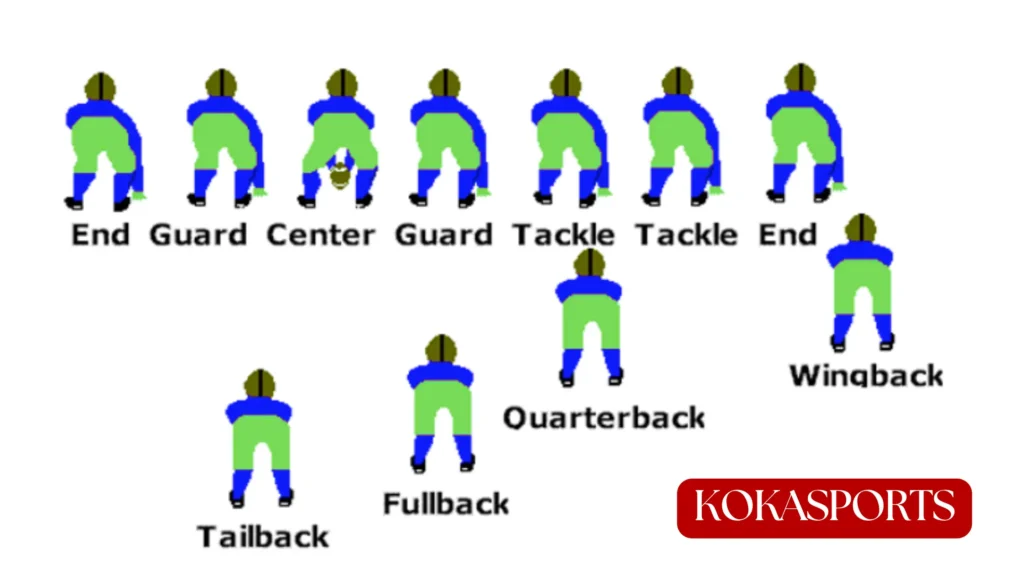
The single wing is an offensive formation built around an unbalanced line and a direct snap system. Unlike a modern spread offense or T-formation set, the single wing places the tailback several yards behind the line of scrimmage to receive the direct snap from the center. There is no quarterback in the traditional sense the tailback functions as the primary ballcarrier, passer, and playmaker all in one position.
Key Positions and Alignment
The formation features four core positions in the backfield:
- Tailback — The engine of the entire offense. Receives the direct snap and is responsible for running plays, play action fakes, and most of the passing game.
- Blocking back — Lines up just behind the offensive line and serves as the lead blocker, functioning similarly to a fullback in other systems.
- Fullback — Positioned deeper in the backfield to add blocking support or serve as a secondary ballcarrier.
- Wingback — Aligns just outside the tight end on the strong side of the formation, creating the “wing” that gives this offense its name.
The unbalanced line is one of the formation’s most defining characteristics. By placing more offensive lineman on one side of the center, the single wing creates a natural strong side and a weak side, forcing defenses to adjust their alignment before every snap. This creates pre-snap confusion that is especially devastating at the youth level.
Read More: Wing-T Formation and Wing-T Offense: Football Strategy for Youth Teams
How the Single Wing Compares to Other Formations
| Feature | Single Wing | Spread Offense | Double Wing |
|---|---|---|---|
| Snap type | Direct snap | QB under center or shotgun | Direct snap |
| Primary threat | Run-first | Pass-first | Run-first |
| Line alignment | Unbalanced | Balanced | Unbalanced |
| Key player | Tailback | Quarterback | Two wingbacks |
| Best for | Youth/HS | College/Pro | Youth football |
The double wing and double-wing formation are close cousins of the single wing, both relying on similar blocking schemes and misdirection. However, the single wing offense places greater emphasis on the tailback as a multidimensional threat, while the double-wing formation distributes the ball-carrying duties more evenly.
The History of the Single Wing Formation
To truly appreciate the single wing, you need to understand its place in the history of football. The formation was developed by legendary coach Pop Warner in the early 1900s. Warner, who also known for what some called the Carlisle formation because he formulated most of the offense while coaching at the Carlisle Indian Industrial School, used the powerful Carlisle formation also referred to by some as the scheme as the Carlisle formation to revolutionize how american football was played. His star player, Jim Thorpe, was one of the most dominant athletes of the era and thrived within this system.

The single wing dominated college football playbooks and professional football through the 1920s, 1930s, and into the 1940s. Entire college football programs built their identity around using the single wing. It was the gold standard of offensive football a strong running formation that also featured a deceptive spinner series and a litany of plays designed to exploit defensive overreactions.
The formation in 1952 began to fade from prominence with the widespread advent of the T-formation, which placed a quarterback directly under center and made calling plays faster and more flexible. The T-formation offered a new offensive structure that spread quickly through college football and the professional ranks. By the time formation in the 1940s was giving way to the modern era, most programs had abandoned the single wing entirely.
Why the Single Wing Still Works in Modern Football
Despite its age, running the single wing at the youth level remains one of the most effective strategies a head coach can employ. Here is why the single wing offense continues to thrive:
Misdirection and Deception
The single wing is built on misdirection. The spinner series, double teams at the point of attack, and the deceptive backfield motion make it extremely difficult for young defenders to identify where the ball is going. At the youth level, where defensive assignments are less disciplined, this misdirection is devastating.
Simplified Blocking Schemes
One of the biggest advantages of using the single wing at the youth level is its simplified blocking system. Offensive lineman do not need complex pass-protection assignments. Instead, they execute different blocking angles and double teams focused at the point of attack. This makes it easier to teach and faster to install a critical advantage for youth football coaches working with limited practice time.
Built-in Versatility
A successful single-wing system is never one-dimensional. A well-designed playbook includes running plays off tackle, sweeps to the weak side, play action passes, reverses, and even a punt formation disguised within the same backfield set. The precision single-wing system allows a single-wing coach to present multiple threats from identical pre-snap looks, making it nearly impossible for youth defenses to prepare.
The Unbalanced Line Advantage
The unbalanced single wing creates immediate numerical advantages. By shifting the offensive line to one side, the offense overloads the strong side of the formation with blockers. Defenses that fail to adjust leave the strong running formation an open lane. Defenses that do adjust open up the weak side. Either way, the unbalanced line puts the offense in control.
Running the Single Wing Offense: Practical Tips for Coaches
For youth football coaches looking to implement this offense formation, here are the key principles to keep in mind:
- Find your tailback first. The entire single-wing formation depended on having an athlete who can handle the direct snap, run with power, and at least threaten to pass. Your best athlete belongs at tailback.
- Master two or three core plays before expanding your playbook. A traditional single wing system works best when players execute with confidence. Build your playbooks around your personnel.
- Use motion to stress the defense. Pre-snap motion from the wingback or fullback forces youth football teams to communicate adjustments in real time — something most young defenders struggle to do.
- Study available resources. There is a growing world on YouTube of single wing football coaches sharing film, drills, and offense might-expanding concepts that can help you build your system from scratch.
- Commit to the run game. The beast offense and beast formation concepts popular in youth leagues today trace their DNA directly to the single wing. Both systems prioritize dominating the line of scrimmage with physical, downhill running plays.
Coaches who have ran the wing at the high school and youth levels consistently report that once players master the backfield timing and the offensive line blocking angles, the system runs itself. Winning youth football is about execution, and the single wing is one of the most executable systems in pop warner and youth football.
The Single Wing Formation in Today’s Game
While modern football at the college and professional level has largely moved away from this offensive scheme as the Carlisle era, the single-wing continues to find success at the youth level and occasionally at the football level of high school. Coaches who use the formation effectively understand that it is not just about nostalgia it is about using different blocking angles, misdirection, and an unbalanced line to win the championship game before the opponent can even adjust.
A new offensive wave of youth coaches has discovered what Pop Warner knew over a century ago: the use the single-wing formation and you control the line of scrimmage. The single wing formation remains one of the most adaptable, teachable, and effective systems in youth football. Whether you are building a standard punting formation into your package or installing a full precision single-wing system, the principles of this formation hold up at every football level.
Conclusion
The single wing formation has stood the test of time for one simple reason: it works. From Jim Thorpe dominating defenders in the early 1900s to football coaches winning youth football championships today, the principles of the single wing direct snaps, an unbalanced line, and relentless misdirection remain as effective as ever. Whether you are running the single wing for the first time or refining an existing system, commit to the playbook, trust your tailback, and attack the line of scrimmage with purpose. The single-wing offense is not a relic of the past. It is a strong running formation built for winning at any level.
FAQs
What is the base single wing formation?
An unbalanced line with a tailback taking a direct snap, a blocking back, fullback, and one wingback outside the tight end.
What does a single wing mean?
One wingback aligned outside the tight end, creating an unbalanced formation built for power running and misdirection.
Who created the single wing offense?
Pop Warner created it in the early 1900s at the Carlisle Indian Industrial School, where Jim Thorpe made it dominant.
What is a double wing formation?
Two wingbacks on opposite sides of the line, spreading the run threat to both sides using misdirection and an unbalanced line.