

The line of scrimmage is an imaginary line that stretches across the football field from sideline to sideline, marking the exact spot where the ball is placed at the start of each play. In American football, this line is the foundation of every offensive and defensive decision made during a football game. Without it, there would be no structure to how teams set up, no rules for who can go where, and no way to fairly govern the snap. Whether you’re watching the NFL or a high school football match on a Friday night, the line of scrimmage is the first concept you need to know.
Every coach at every level of the game from youth leagues to the NFL builds their entire formation strategy around this single rule. Getting it right is the difference between a clean play and a costly penalty.
What Is the Line of Scrimmage in Football? The NFL’s Core Rule Explained
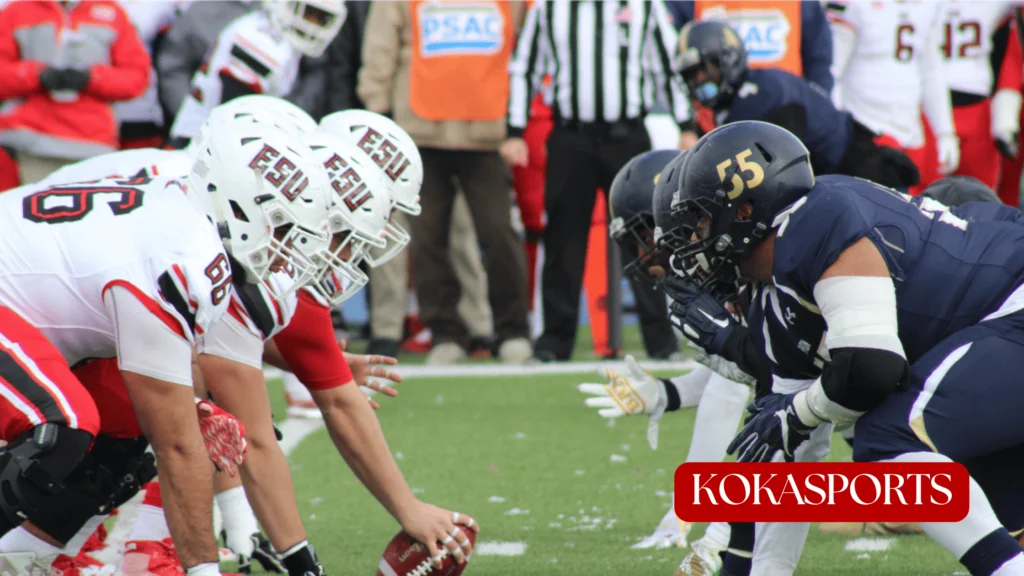
The line of scrimmage in football is not physically painted on the football field. It is an imaginary line that passes through the nose of the ball, running parallel to the goal lines and extending from one sideline to the other sideline. Officials reset this line after every play by spotting the ball where the previous play ended.
There are technically two scrimmage lines on every down one on the offensive side and one on the defensive side. The space between them is called the neutral zone, which spans roughly one yard the length of the football itself. No player from either team may enter this zone before the center snaps the ball. Crossing into the neutral zone early results in a penalty, typically a false start for the offense or encroachment for the defense.
The yard line where the ball is placed establishes the original line of scrimmage for that down. This resets completely after every play, making each new down a fresh contest for both the offensive team and the defensive players.
Read Also: What is Scrimmage in Football: Complete Guide
How NFL Players Line Up at the Line of Scrimmage: Offensive and Defensive Formation Rules
The way a football team arranges its formation at the line of scrimmage shapes everything about how a play will develop. Both the offensive team and the defense follow strict rules about where each player can legally stand before the snap.

Offensive Line Player Positions at the Line of Scrimmage
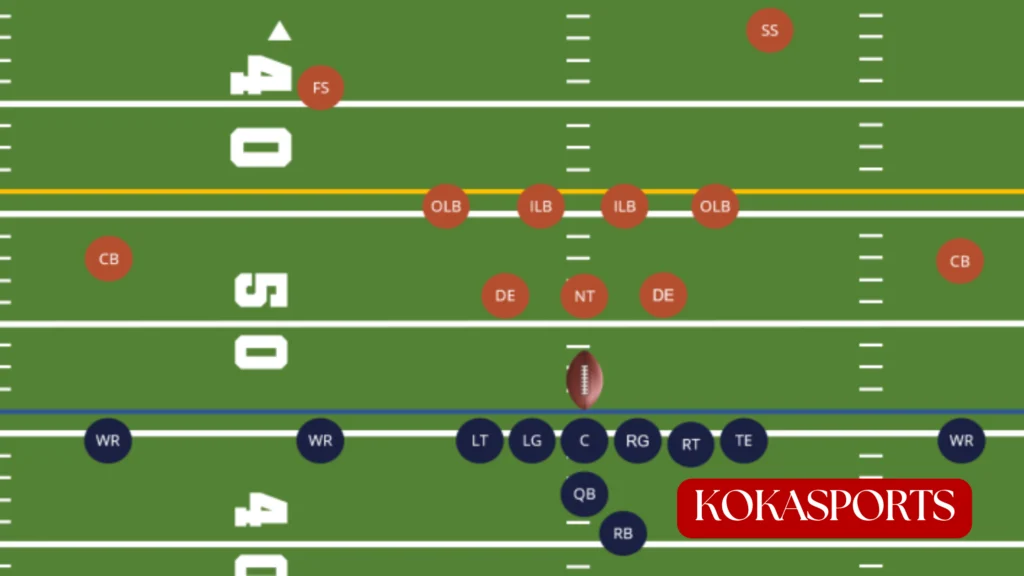
The offense must have at least 11 players on the field, with a minimum of seven players on the line at the start of each play. These seven form the backbone of the offensive line the center, two guards, and two tackles make up the interior, with the two ends on the outside. The center is the only player who touches the ball before the snap; they snaps the ball directly to the quarterback to begin the play.
Players on the line must be set in their stance for at least one second before the snap in most formations. This prevents the offense from causing confusion through rapid movement. The offensive lineman is typically the largest football player on the field, selected specifically for their ability to block at the point of attack.
The offensive players who line up at the interior guards and the center are not eligible receivers. Only the two outside players at either end of the offensive line, plus any players lined up at least one yard behind the line of scrimmage, qualify as eligible receivers. This distinction is critical for every passing play.
Eligible Receiver Rules for NFL Football Players
An eligible receiver must meet specific criteria under both NFL and college rules. Eligible receivers must be lined up at one of the two outer ends of the scrimmage line, or positioned at least one yard behind it in the backfield. Any offensive player covered by another player at the line meaning they are not at the end of the line is automatically ineligible to catch a forward pass. Only the outside players at the ends of the formation remain eligible on that snap.
Violations of these rules result in an illegal formation penalty, which costs the offensive team five yards and a replay of the down. Illegal formation calls are among the most preventable mistakes in the game, yet they remain common at every level because of the complexity of modern formation sets.
Defensive Line Player Alignment Rules in Football
The defensive line sets up directly opposite the offensive line, just beyond the neutral zone on the defensive side. Defensive players have considerably more freedom in their pre-snap alignment they can position themselves anywhere on their side of the line of scrimmage, from directly across the center to wide near the sideline. This flexibility is what allows defensive coaches to disguise their coverages and rush packages.
A defensive line that shifts or stunts just before the snap can confuse the offensive blocking assignments, as long as no player enters the neutral zone early. The moment a defensive player crosses the line before the snap, the penalty is automatic.
Behind the Line of Scrimmage: How NFL Football Players Use Space
One of the most important concepts in football is what happens behind the line of scrimmage. The quarterback must throw all forward passes from behind the line of scrimmage once the QB crosses the line, only a lateral is legal. Running backs taking handoffs often begin their runs well behind the line of scrimmage before attacking the hole opened by the offensive line.
Pass rushers on the defensive line fight to penetrate behind the line of scrimmage to sack the quarterback or disrupt the play before it develops. When a defensive player breaks through to make a tackle in the backfield, it is called a tackle for loss one of the most impactful plays a defensive unit can produce.
Coaches at all levels design entire game plans around controlling this space. Offensive coordinators use motion, misdirection, and formation shifts to prevent the defensive line from reading the play. Defensive coordinators use pre-snap movement and disguised coverages to force the quarterback into mistakes.
Line of Scrimmage Penalties in NFL Football: What Players and Coaches Must Avoid
Penalty enforcement at the line of scrimmage is one of the most frequent officiating duties in a football game. Both offensive and defensive players must exercise discipline before the snap or risk costing their team valuable yards.
| Penalty | Side | Cause |
|---|---|---|
| False Start | Offense | Offensive player moves before the snap |
| Encroachment | Defense | Defensive player enters the neutral zone |
| Offsides | Defense | Defensive player beyond the line at snap |
| Illegal Formation | Offense | Fewer than 7 on the line; wrong eligible receiver setup |
| Illegal Motion | Offense | Ineligible player moves before snap |
| Delay of Game | Offense | Play clock expires before the snap |
An illegal formation call is especially frustrating for coaches because it is entirely self-inflicted. Poor communication, misaligned personnel, or a player lining up in the wrong position are the usual causes. In the NFL, these mistakes are magnified because opposing coaches and analysts review every formation on film.
Line of Scrimmage Rules Across NFL, College, and High School Football
The line of scrimmage rules are largely consistent from the NFL all the way down to high school football, but there are meaningful differences worth knowing for any serious football fan or player.
NFL Football Line of Scrimmage Standards
In the NFL, the virtual line of scrimmage is represented on television broadcasts as the familiar yellow first-down marker graphic. On the actual football field, only the ball and the referee’s placement define the line. NFL officials are the most experienced in the world at enforcing neutral zone violations, and coaches can expect even slight infractions to be flagged.
The NFL also enforces strict rules on how many eligible receivers a team can have on the line. Eligible receivers must report to officials when lining up in an unusual position, such as an offensive lineman lining up at tight end. Failure to report results in a penalty.
College and High School Football Line of Scrimmage Differences
In a college football game, the core line of scrimmage rules mirror the NFL, but the pace of officiating and enforcement can vary. High school football uses the same basic structure, though the level of sophistication in formation design is naturally lower. A player at the high school level may not fully grasp eligible receiver rules, making illegal formation calls more common at that level.
Why the Line of Scrimmage Is the Most Important Line in American Football
No other rule in American football governs as much of the game as the line of scrimmage. It controls:
- Where each player must stand before the snap
- Which players are eligible to catch passes
- Whether a quarterback can legally throw forward
- What counts as a tackle for a gain or loss
- How far the offense must advance the ball in four downs
- Where the defensive line can set up before the snap
- When a penalty is triggered before the play even begins
- How coaches design every formation in their playbook
From the goal line to the far end of the football field, from the opening snap to the final extra point attempt, every single play in an American football game begins at the line of scrimmage. It runs sideline to sideline, separates offense and defense, and defines the terms of competition on every single down.
Conclusion
The line of scrimmage is far more than a technical rule it is the heart of American football. It tells every player where to stand, tells every coach what formations are legal, and tells every official what to watch before the snap. From NFL stadiums to high school football fields, the same imaginary line governs every play. The offensive line and defensive line clash across it on every snap. The quarterback throws from behind it. Eligible receivers must align correctly relative to it. Illegal formation penalties punish those who violate it. Master the line of scrimmage and you understand the DNA of football itself.
FAQs
What is the line of scrimmage?
An imaginary line across the football field where the ball is placed before each play begins.
Why do 7 players have to be on the line of scrimmage?
NFL rules require 7 offensive players on the line to ensure a legal formation and prevent unfair blocking advantages.
How do you use line of scrimmage in a sentence?
The quarterback was tackled two yards behind the line of scrimmage for a loss.
Is line of scrimmage spicy?
No it’s a football rule, not a food, though a goal-line stand can certainly heat things up.