

Team uniforms started as simple sportswear. A basic way to tell who was on your side, eventually evolving from heavy cotton into today’s breathable, ergonomic jerseys. But modern uniforms do much more than just keep players comfortable. Here are 5 reasons why what athletes wear matters more than you think.
Beyond the Arena: Identity and Fan Culture
Basketball uniforms aren’t just for the team to wear, either. If anything, with professional teams, they arguably mean more to fans and the community, not the players themselves. Players are often transient, whereas fandom doesn’t go away.
The NBA has had hundreds of iconic jerseys in its long history, but every basketball fan remembers their first. Whether it’s the ’90s era Michael Jordan classic or a Luka Dončić 77 (sorry, Dallas fans!), a jersey is our first connection to our heroes, the city, becoming part of the ever-growing tradition.
When a fan wears that jersey, whether it’s at the game or casually, it reflects a bond between player, team, and community. It’s a physical representation of that inexplicable feeling of joy, the bouts of suffering, the rollercoaster ride that is being a basketball fan.
Spotting Teammates: Split-Second Decisions
We’ve already alluded to it, but it’s worth a section. NBA basketball is quick; it’s defined by split-second decisions that make the difference. Players never move without intention; hundreds, if not thousands, of plays are practiced before they’re executed in front of the fans.
Clear uniforms help players process gameplay just that much faster. When a playoff series is decided by a last-minute buzzer beater, making sure you can actually spot your teammate is clearly important.
It seems an obvious point, but when the opposite happens, you really see why. In the 2020-21 season, the Atlanta Hawks and OKC Thunder played wearing their alternate uniforms (a new trend in the NBA).
Usually, it’s not a problem.
In this game, however, both teams wore red (or at the very least, reddish) uniforms, confusing players, fans, and broadcasters. People just couldn’t tell the difference. The NBA had to step in to ensure teams wear, well, differently colored jerseys.
Wearing the Tradition: Confidence and Pride
When Larry Bird was first drafted by the Celtics in 1978, he knew he was about to join a famous, storied NBA franchise. He was no dummy, of course.
But Larry Legend himself has admitted that he didn’t quite appreciate the gravity of what joining the Celtics meant until he put on the jersey during his first training camp.
There, he learnt that if you’re not going to play the game the right way, with class, you’re not fit to be a Celtic. Wearing the Boston green meant something. It still means something.
It not only highlighted that sense of responsibility, but it also imbued him with confidence. Wearing your team’s jerseys is like having a superhero cape. You aren’t just representing a team you’re embodying an enduring symbol for the fans and channeling the legacy of the players who came before you.
Professionalism: Jerseys and Uniforms Off the Court
A basketball uniform extends beyond the court; it’s not just for game night. You’ll see the team colors in team photos, banners, hallways, social media posts, fundraising activities, community events, you name it.
Uniforms that form part of a cohesive branding strategy help make basketball programs look more established and professional, even for small-market teams. It tells others that the organization is serious about playing winning basketball.
Uniforms give players the sense that they’re part of something real, a proper team. That’s why we have moments like the scene in the Mighty Ducks, when they finally get their jerseys in a literal unboxing moment. Once you put on that uniform, you’re part of a unit, a single entity on the court.
Branding: Opportunity for Sponsorship
Everyone loves to hear about jerseys in the context of the history of NBA basketball, your favorite player wearing number #23 or #34, with the team’s city on the chest. They’re the stories that drive our nostalgia, that give us those historic moments on mental replay.
But NBA basketball is also a business. And jerseys are great for sponsorship and media opportunities. It gives sponsors visibility, with NBA jerseys now carrying subtle 2.5-inch-by-2.5-inch corporate logos on the shoulder. A small, but highly lucrative bit of advertising space.
Some fans complain about the recent increase in corporate sponsorship in the NBA. Sometimes, it can go a little too far, true. But they also become part of the legend, like football (soccer) fans, who think about SEGA and Arsenal, Pirelli and Inter Milan, Sharp and Manchester United.
Plus, it drives the revenue needed to upgrade stadium facilities and sign big-name players. All in all, a necessary evil at worst, and a win-win at best.
More Than Fabric and Numbers
Yes, the jersey has a practical job. It separates teams, shows individual player names and numbers, whilst keeping players comfortable on the court. But that’s just a small part of it.
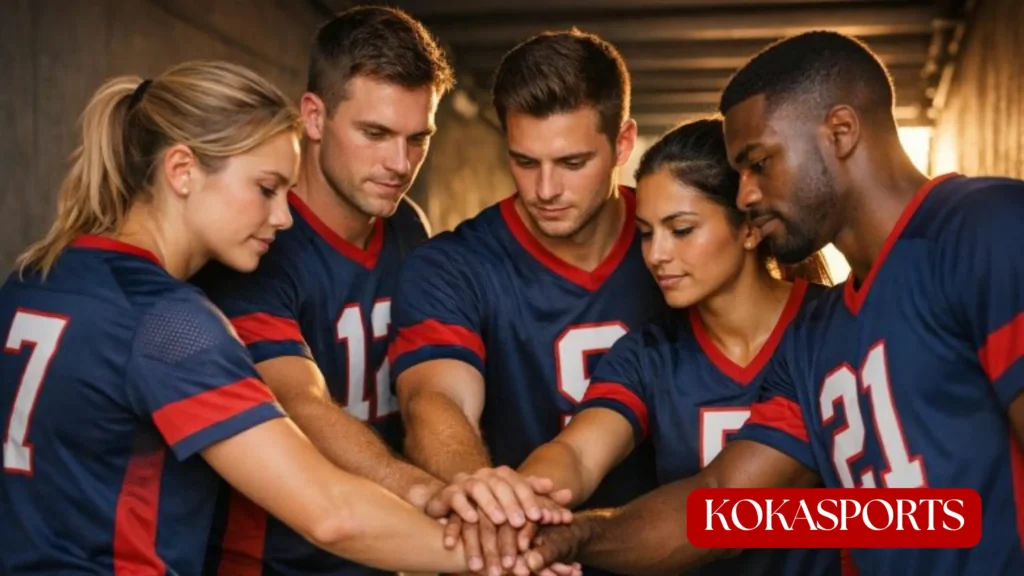
Jerseys build unity, both in the stadium and the community. They lift the confidence of players and fans. They are signifiers of an era, timestamps of tradition. They prove that a simple piece of fabric can carry the weight of a lifetime.
Frequently Asked Questions
Why do basketball teams wear different colored uniforms?
Beyond tradition, distinct colors let players identify teammates instantly during fast-paced play. When colors clash like the 2020-21 Hawks vs. Thunder game where both wore red it confuses players, fans, and broadcasters alike.
What do home and away jerseys mean in the NBA?
Historically, home teams wore white or light colors and visitors wore darker “road” jerseys. The NBA has since loosened these rules, letting teams use a wider rotation of alternate and statement uniforms throughout the season.
Why are there sponsor logos on NBA jerseys?
The NBA introduced small 2.5-inch corporate patches on the shoulder as a revenue source. The money helps fund facility upgrades and player signings, though some fans feel it intrudes on the traditional look.
Do uniforms actually affect player performance?
Not directly through stats, but players like Larry Bird have spoken about how wearing the jersey instills confidence, pride, and a sense of responsibility to live up to a franchise’s legacy.
Why do fans buy and wear team jerseys?
A jersey is a fan’s physical link to their team, city, and favorite players. It represents belonging to a community and carries the emotional highs and lows of being a supporter.
Conclusion
A team uniform may look like a simple piece of fabric, but it carries far more weight than its threads suggest. It keeps players comfortable and recognizable on the court, yes but it also builds identity, fuels confidence, strengthens branding, and bonds fans to the teams they love. From Larry Bird pulling on Celtic green to a kid wearing their first jersey in the stands, uniforms turn individuals into a unit and spectators into a community. They’re not just what teams wear they’re what teams mean.