

A court in India ruled that poker and rummy require skill. A ministry in Colombia granted sports recognition to its national poker federation. In November 2024, the International Mind Sports Association voted to include poker among its member disciplines. These are not theoretical debates. They are administrative decisions made by judges, government officials, and international bodies. The question of what counts as a sport is being answered in real time, and the answers are shifting.
What IMSA’s Vote Means
The International Mind Sports Association held its Annual General Assembly in Sao Paulo, Brazil, on November 16, 2024. Members voted unanimously to grant poker full membership. This places poker in the same category as chess, bridge, draughts, Go, and mahjong under the IMSA umbrella.
IMSA was established in 2005 to promote games that require strategic thinking, problem-solving, and mental agility. Its affiliate members include the World Bridge Federation, the International Federation of Chess, the World Draughts Federation, and the International Go Federation, among others. The organization has spent two decades building institutional credibility for mind sports. Poker now sits within that structure, subject to the same expectations of governance and competition.
The World Poker Federation, which represents over 49 national federations across five continents, led the effort. WPF President Igor Trafane stated after the vote:
“Our mission now is to build the foundation that every major sport already has: standardized regulations, professional pathways, player protections, and international competitions.”
Mental Discipline Across Formats
The cognitive demands of card games remain consistent across settings. A player seated at a casino table and someone playing poker online both face the same mathematical calculations, opponent reads, and bankroll decisions. Chess players competing through online servers encounter identical strategic depth to those moving pieces across a physical board. The format changes, but the mental load does not.
IMSA’s recognition of poker alongside chess, bridge, and Go reinforces this point. These games share requirements for pattern recognition, sustained concentration, and adaptive thinking that persist regardless of where competition takes place or how participants engage.
Courts and Ministries Weigh In
The Allahabad High Court in India issued a ruling that classified poker and rummy as games of skill rather than gambling. The division bench comprising Justice Shekhar B Saraf and Justice Manjeev Shukla observed that when skill predominates over chance in determining outcomes, the activity qualifies as a game of skill. The court found that poker and rummy meet this standard because results depend on player decisions and strategic planning rather than randomness alone.
Colombia’s Ministry of Sports granted sports recognition to the Colombian Poker Federation after verifying compliance with all legal requirements. This certification, valid for five years, allows the federation to access institutional benefits, promote official competitions, and represent Colombia internationally. The ministry’s statement framed poker as a mental sport built on skill, logic, discipline, and competitive structure.
These are not academic positions. They carry regulatory and legal weight with direct consequences for players and governing bodies.
The Esports Comparison
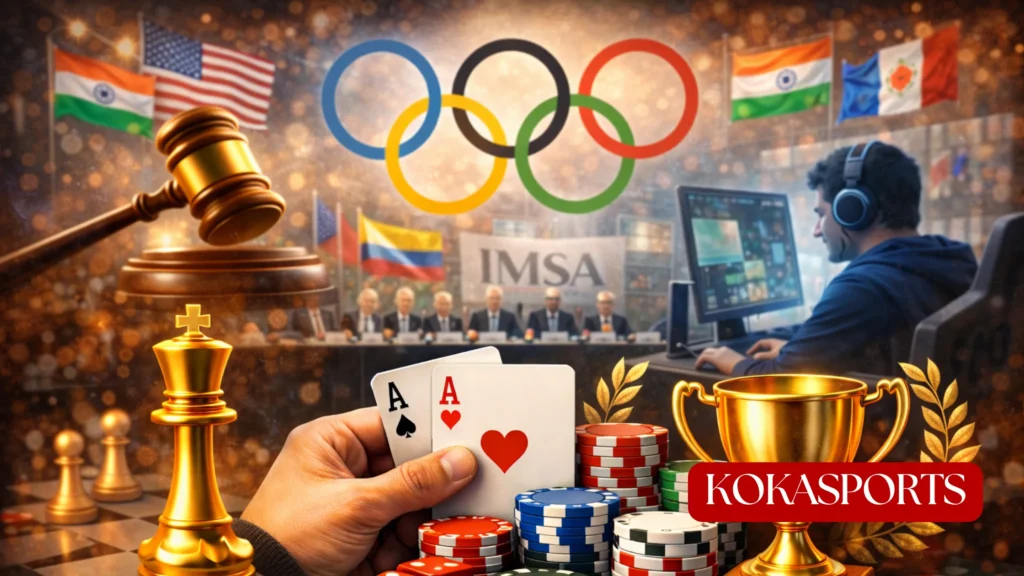
Esports followed a parallel path toward institutional recognition. In July 2024, the 142nd session of the International Olympic Committee approved the creation of The Olympic Esports Games. The vote was unanimous. The first edition was scheduled for 2027 in Riyadh, Saudi Arabia, with a 12-year partnership signed between the IOC and Saudi authorities.
That partnership collapsed in October 2025. The IOC and the Saudi Olympic and Paralympic Committee cancelled their agreement. The Esports World Cup Foundation and the IOC ended their collaboration. Reports indicated that IOC President Coventry objected to a proposal that would have placed a new esports federation under Saudi government control without a democratic process.
The IOC announced it would “develop a new approach” and “pursue a new partnership model” with the goal of hosting the inaugural Games “as soon as possible,” highlighting the fragility of governance in emerging competitive formats.
Intellectual Property Creates Friction
One obstacle distinguishes competitive gaming from traditional sports. An analysis from the Harvard Journal of Sports and Entertainment Law identified the core issue:
“Nobody owns the game of basketball. The IOC does not have to pay the NBA a fee to organize a basketball tournament and distribute video of the games on television. The game of basketball is free to play and unencumbered by any IP rights. On the other hand, a video game is owned by the developer of that game and typically licensed to a publisher for distribution.”
Game publishers like Riot Games, Valve Corporation, and Activision Blizzard control their respective titles. Any international competition requires licensing agreements. Broadcasting arrangements must account for multiple ownership stakes. This is a structural difference from physical sports, where governing bodies control rules but not the underlying activity itself.
The same analysis suggests a path forward exists through carefully structured licensing agreements and mutual recognition of ownership rights. The practical arrangements are possible, but they require more negotiation than assembling a running track.
What Mind Sports Demand
Poker combines strategy, psychology, mathematics, adaptability, endurance, and emotional control. A hand of Texas Hold’em requires probability calculations, opponent modeling, and bankroll management in real time. A tournament lasting several hours tests sustained concentration and physical stamina in ways that resemble marathon sessions in chess or bridge.
Mind sports promote memory retention and recall. Players must remember past moves and anticipate future actions. The demand for focus reduces distraction and improves mental clarity over time. These are measurable cognitive effects, not abstract claims about value or entertainment.
The question of what counts as a sport often reduces to physical exertion. This framework excludes chess, bridge, and Go, all of which have established competitive traditions, governing bodies, and international recognition. IMSA’s existence suggests a parallel category already operates with institutional support.
Fragmented Governance
Traditional sports operate under centralized bodies. FIFA governs football. The ITF governs tennis. The rules are standardized, and the pathway from amateur to professional is defined.
Esports and card games lack this structure. Individual game publishers, tournament organizers, and teams set their own rules and regulations. This fragmentation creates inconsistencies across regions and formats. The WPF’s stated mission to build standardized regulations and professional pathways addresses this gap directly.
Colombia’s ministry recognition and IMSA’s vote represent steps toward institutional formalization. The WPF now has a framework for international competition under a recognized body. National federations in 49 countries have a coordinating structure. This is infrastructure building, not promotion.
The Answer Depends on Who You Ask
A court in India says poker is skill. A ministry in Colombia says poker is sport. IMSA says poker belongs alongside chess. These institutions have answered the question within their respective jurisdictions.
The IOC has not. The Olympic Esports Games remain in development with no confirmed host or format. Intellectual property issues complicate any future agreement. The path to Olympic recognition for card games runs through obstacles that do not apply to athletics.
The classification debate is not purely semantic. It determines access to funding, legal status, broadcasting rights, and player protections. The answers emerging from courts, ministries, and international assemblies carry consequences for millions of players and an industry built around competition.
Conclusion
The debate over whether poker and other competitive card games qualify as sports is no longer driven by opinion alone. Courts, ministries, and international governing bodies are making binding decisions that redefine how skill-based competition is recognized and regulated. IMSA’s inclusion of poker, judicial rulings on skill dominance, and formal sports recognition at the national level all point toward a broader understanding of sport that extends beyond physical exertion.
What remains unresolved is not the presence of skill, but the structure required for global standardization and recognition. As governance frameworks evolve and institutional barriers are addressed, the definition of sport continues to expand in ways shaped by authority, legality, and competitive integrity rather than tradition alone.
FAQs
Is poker officially recognized as a sport?
Yes, IMSA granted poker full membership as a mind sport in November 2024, alongside chess and bridge.
Are poker and rummy games of skill or luck?
India’s Allahabad High Court ruled poker and rummy are games of skill, not gambling, because player decisions determine outcomes.
Can poker players compete in the Olympics?
Not yet poker lacks Olympic recognition, though esports are moving toward inclusion with the proposed Olympic Esports Games.