
If you have ever watched a game and heard an announcer say “the offense is in 12 personnel,” you may have wondered what those numbers actually mean. This guide has football personnel groupings explained in plain language, so you can finally read an offense before the ball is even snapped. Personnel groupings are a simple code that tells you which skill players an offense has on the field. Below we break down the numbering system, walk through every common grouping, and show why coaches on both sides of the ball care so much about it.
What Are Personnel Groupings in Football?
A personnel grouping is a two-digit label that describes the skill players an offense sends onto the field. The first digit is the number of running backs. The second digit is the number of tight ends. The number of wide receivers is not listed, because you can work it out yourself.
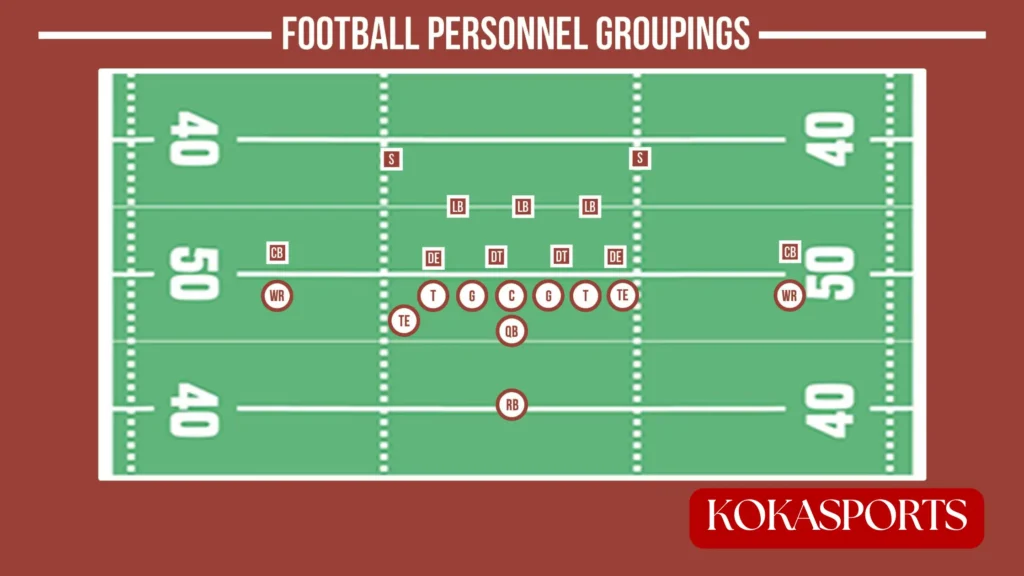
Here is why. Every offensive play starts with 11 players. Five of those are offensive linemen and one is the quarterback, and those six spots almost never change. That leaves five spots for the skill players: running backs, tight ends, and wide receivers. So if you know how many running backs and tight ends are on the field, the rest have to be wide receivers.
For example, 12 personnel means 1 running back and 2 tight ends, which leaves 2 wide receivers. 21 personnel means 2 running backs and 1 tight end, which also leaves 2 wide receivers. The math is always the same: subtract the two digits from five to find the receiver count.
Why Only Five Skill Players?
The cap of five skill players comes straight from the rulebook, not from coaching preference. Under the official rules, an offense must have at least seven players on the line of scrimmage, and only the two players on the very ends of that line are eligible to catch a pass. The remaining four players line up in the backfield and are also eligible. That adds up to a maximum of five eligible receivers, alongside the quarterback and the interior linemen who cannot catch a forward pass. You can read the full rule in the official NFL rulebook. This is the foundation that makes the entire personnel system work.
The Asterisk: When an Extra Lineman Comes In
Occasionally you will see a grouping written with an asterisk, such as 11* personnel. The asterisk means the offense has swapped a skill player for an extra offensive lineman, usually to add power in short-yardage or goal-line situations. In that case 11* would be 6 offensive linemen, 1 running back, 1 tight end, and 2 wide receivers. It is a small detail, but it shows up in real coaching charts and advanced stat sheets, so it is worth knowing. You can find more background on the convention in this gridiron personnel grouping reference.
Personnel Grouping vs Formation
People often mix up personnel and formation, but they are two different things. Personnel tells you which types of players are on the field. Formation tells you where those players line up. The same 12 personnel can be arranged in a tight I-formation, a balanced pro set, or a spread shotgun look. Understanding this difference matters, because a defense reacts to the personnel first and then adjusts to the formation.
Every Offensive Personnel Grouping Explained
Below is a quick breakdown of the groupings you will see most often, from light spread packages all the way to heavy short-yardage sets.
10 Personnel (1 RB, 0 TE, 4 WR)
A pure spread package. With four wide receivers and no tight end, the offense is built to throw the ball and to stretch the defense from sideline to sideline. It is the backbone of air raid and run-and-shoot systems.
11 Personnel (1 RB, 1 TE, 3 WR)
The most common grouping in modern football. It balances the run and the pass, which is why nearly every NFL team uses it as its base package. Three receivers force the defense to stay light, while the tight end keeps the run game honest.
12 Personnel (1 RB, 2 TE, 2 WR)
A flexible package that has grown in popularity as teams replace old-school fullbacks with athletic tight ends. It can line up to run power or spread out to pass, which makes it hard for a defense to guess the play.
13 Personnel (1 RB, 3 TE, 1 WR)
A heavy, run-leaning package with three tight ends and a single receiver. It is a favorite in short-yardage and goal-line situations, though modern teams now use pass-catching tight ends to throw from it as well. For a full breakdown, see our guide on what 13 personnel is in football.
20 Personnel (2 RB, 0 TE, 3 WR)
Two backs and no tight end. It pairs backfield versatility with three receivers and often shows up out of shotgun or pistol looks, where either back can run, catch, or block.
21 Personnel (2 RB, 1 TE, 2 WR)
The classic pro-style package with a halfback and a fullback. It once ruled the NFL and still appears in power-running situations, but it is far less common in today’s pass-first league.
22 Personnel (2 RB, 2 TE, 1 WR)
A heavy grouping used to pound the ball in short yardage. Two backs and two tight ends give the offense extra blockers up front and a clear intention to run.
23 Personnel (2 RB, 3 TE, 0 WR)
An extreme goal-line and short-yardage package with no wide receivers at all. Everything about it is built to move the pile forward one yard at a time.
00, 01, and 02 Personnel (Empty Backfield)
These spread packages remove the running back entirely and load up on receivers and tight ends. They are pass-first looks, usually saved for obvious throwing downs and two-minute situations.
30, 31, and 32 Personnel (Heavy Backfield)
Three-back groupings are rare at the pro level but live on in option-based and old-school power schemes such as the flexbone and the wishbone, where multiple ball carriers threaten the defense.
Why Personnel Groupings Matter
Personnel groupings are the starting point of the chess match between coordinators. When an offense sends out a grouping, it signals intent. Three tight ends hint at a run. Four receivers hint at a pass. Smart offenses use that expectation against defenses by running from spread looks or throwing from heavy ones.
The grouping also lets both teams communicate in an instant. A coach can call “11” or “21” and every player immediately knows who belongs on the field. That speed is essential in a game built around a short play clock.
How Defenses Respond
Defenses substitute to match what the offense shows. Against spread groupings with three or more receivers, defenses bring in extra defensive backs. A fifth defensive back creates a nickel defense, and a sixth creates a dime. Against heavy groupings with multiple tight ends and backs, defenses go the other way and add linebackers or defensive linemen to hold up against the run. This whole substitution battle plays out in the few seconds between snaps, and winning it can decide the play before it even begins.
Which Groupings NFL Teams Use Most

11 personnel is the clear leader. For more than a decade it has been the base package for most of the league, used on roughly half of all offensive snaps and far more than that for some pass-heavy teams. It fits the modern game, where speed and spacing win.
At the same time, heavy personnel is on the rise. The share of snaps with two or more tight ends has climbed in recent seasons to around a third of all plays league-wide, and a few teams now build a real part of their offense around three-tight-end looks. The trend suggests coaches are once again valuing size and versatility, not just raw speed, which keeps groupings like 12 and 13 personnel relevant.
Frequently Asked Questions
What does 11 personnel mean?
11 personnel means 1 running back and 1 tight end, which leaves 3 wide receivers. It is the most common grouping in football.
Why are wide receivers not in the personnel number?
Because the receiver count is implied. With five skill spots available, you subtract the running backs and tight ends from five to find the number of wide receivers.
What is the most common personnel grouping in the NFL?
11 personnel. It has been the league’s base package for years because it balances running and passing threats on nearly every down.
What is heavy personnel?
Heavy personnel refers to groupings with extra tight ends or running backs, such as 12, 13, 21, 22, and 23. These packages add blockers and are used for power running and short-yardage situations.
Conclusion
Personnel groupings turn a confusing pile of players into a simple, readable code. Once you know that the first number is running backs and the second is tight ends, you can decode any grouping in seconds and start to predict what an offense wants to do. From the spread looks of 10 personnel to the bruising power of 23 personnel, each package tells a story about how a team wants to win. Learn the code, watch the substitutions, and the game opens up in front of you.