


Have you ever watched a basketball game and wondered how many people on basketball team? You are not alone. This is one of the most common questions people ask when they first get into basketball.
The short answer is simple: 5 players from each team play on the court at the same time. But there is a lot more to it than that.
In this guide, you will learn everything you need to know positions, bench players, roster sizes, and how team size changes across different leagues. This article explains everything about basketball team size in a simple way.
How Many People on a Basketball Team? (Simple Answer)

Here is the fast answer:
- 5 players from each team play on the court at one time
- 10 total players are on the court at the same time
- Teams have extra players waiting on the bench
- Full rosters are much larger than what you see on the court
This is true in almost every league from the NBA to your local recreational basketball league.
Read More: How Long Is a Baseball Game? Complete Guide to MLB Game Times
Why Basketball Teams Have 5 Players
Have you ever wondered why the game of basketball uses exactly 5 players per side? It was not random. There are real reasons behind it.
- It keeps the game fast and exciting Too many players would crowd the rectangular court
- Each player has a clear role With only 5, everyone has a job to do
- It creates better teamwork Fewer players means more passing and cooperation
- The court size fits 10 players well The standard basketball court was designed with 5-on-5 in mind
According to the rules set during the first college basketball games in the late 1800s, five players per side became the standard and it has stayed that way ever since. The basketball committee that standardized the sport decided this number created the best balance between spacing, teamwork, and competition.
NBA Team Size : How Many Players Are on an NBA Basketball Team?

The National Basketball Association (NBA) is the top professional basketball league in the world.
It has clear rules about how many players each team can have.
Active Roster vs Full Roster in the NBA
According to official NBA rules, an NBA team can carry 15 players on its full roster.
But on game day, only 13 players are active. The other 2 are listed as inactive and cannot play that night.
Here is a simple breakdown:
- Full roster: 15 players
- Active on game day: 13 players
- Inactive on game day: 2 players
NBA Two-Way Contracts and Their Impact on Team Size
The NBA also allows teams to sign players on two-way contracts.
These are special deals where a player splits time between the NBA squad and its development league called the G League.
Each team can have up to 2 two-way contract players. That means a team can have up to 17 players under contract in total 15 standard + 2 two-way.
This gives teams more flexibility to develop young talent without using a full roster spot.
NBA G League and Practice Squads
The G League is like the “minor league” of the NBA.
Teams use it to develop younger players. These lineup members are not on the main roster but can be called up when needed.
This system helps teams stay deep and competitive all season long.
How Many People on a Basketball Team Play on the Court at One Time?
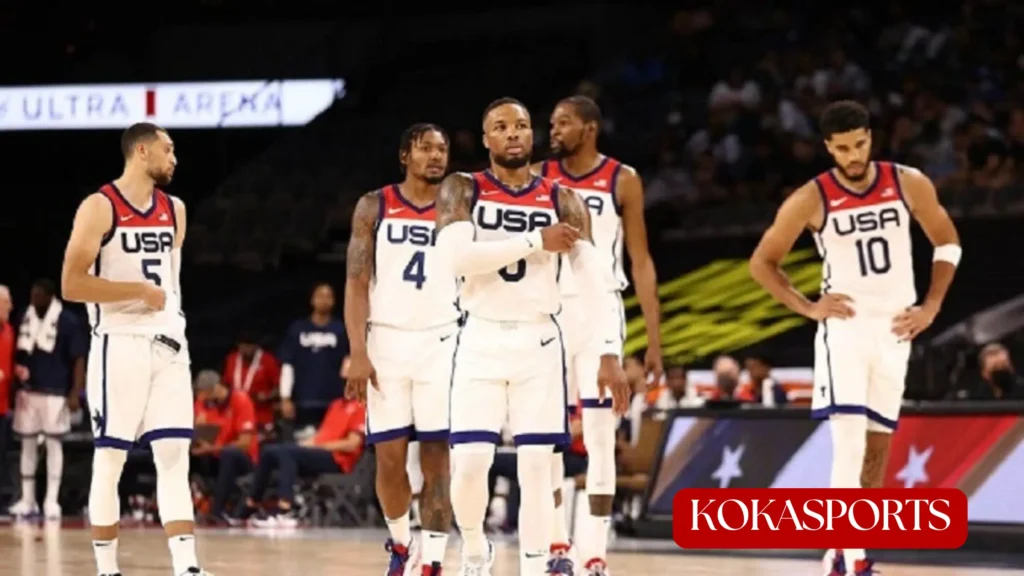
This is simple.
In any basketball game, there are always five players on the court from each team. That makes 10 players on the floor at the same time 5 from one side and 5 from the opposing team.
This rule is the same in the NBA, FIBA, NCAA, and most amateur basketball leagues. It does not matter how big or small the teams are overall the team on the court is always capped at five.
What Happens When Players Foul Out?
Each player can only collect a certain number of personal fouls before they are removed from the game. This is called “fouling out.”
Here are the foul limits by league:
- NBA: 6 fouls to foul out
- College basketball: 5 fouls to foul out
- High school basketball: 5 fouls to foul out
When a player fouls out, a substitute must come in. If no eligible players are left which is very rare the team may forfeit.
Substitutions : How Teams Rotate Players
Basketball allows unlimited substitutions.
A player can come off the bench, go on the court, come back off, and return again — as many times as the coach decides.
Coaches use substitutions to:
- Rest tired starters
- Match up better against the opposing team’s lineup
- Bring in specialists for key moments
- Put stronger defensive player options on the floor to stop the other team from scoring
Basketball Positions : The 5 Players on the Court Explained
Every squad on the court has five positions. Each has a different job. Learning basketball positions helps you understand why certain players do what they do.
Point Guard (PG) : The Floor General
The point guard is usually the quickest player on the team.
Their main job is to bring the ball up the court and set up plays for teammates. Think of them as the “captain” on the floor. Famous point guards include Stephen Curry and Magic Johnson.
Shooting Guard (SG) : The Scorer
The shooting guard is one of the best scorers on the team.
They are great at shooting from far away. Even short players can thrive at this position if they are fast and skilled. This role requires sharp shooting and constant movement without the ball.
Small Forward (SF) : The Versatile Wing
The small forward is the most flexible of all different positions on the court.
They can score, defend, rebound, and do a bit of everything. LeBron James is one of the most famous small forwards in history.
Power Forward (PF) : The Hybrid Big
The power forward is a big, strong player who works near the basket.
In modern basketball, many power forwards can also shoot from long range — these are called “stretch fours.” Taller players usually fill this role because of their size and reach.
Center (C) : The Anchor
The center is usually the tallest player on the team. In fact, this player is usually the tallest person on the entire court.
Their job is to defend the basket, grab rebounds, and score up close. The center anchors both the offensive team’s post plays and the defensive lineup. Shaquille O’Neal and Kareem Abdul-Jabbar are all-time legends at this position.
💡 Tip: In modern basketball, the lines between positions are blurring. This is called positionless basketball where players can handle multiple roles at once.
Bench Players : The Unsung Heroes of Basketball Team Dynamics
Not every player starts the game.
Players who are not in the starting lineup are called bench players. They sit on the sideline and wait for their turn. But do not underestimate them strong team dynamics depend on every squad member knowing their role.
What Is a Bench Player in Basketball?
A bench player is simply someone who does not start.
They come in when a starter needs rest or the coach wants a different matchup against the opposing team. In the NBA, of the 13 active members, 5 are starters and up to 8 are reserves.
Why Bench Depth Wins Championships
Many NBA championships have been won thanks to strong bench lineups.
When starters get tired late in games, a deep bench keeps the team competitive. Squads with weak reserves often struggle in long playoff series even if their starters are elite.
The Sixth Man : Basketball’s Most Valuable Reserve
The “Sixth Man” is the best player on the team coming off the bench.
They are talented enough to start but are used as the first substitute instead. The NBA gives out a Sixth Man of the Year Award every season. Players like Lou Williams and Jamal Crawford won it multiple times.
A great sixth man can completely shift the momentum of a basketball game.
How Many People on a Basketball Team in Different Leagues
Not all basketball leagues follow the same rules. Basketball team sizes vary depending on the level of play. Here is a full breakdown:
| League | Players on Court | Total Roster |
|---|---|---|
| NBA | 5 | 15 |
| FIBA (International) | 5 | 12 |
| NCAA (College) | 5 | 13–17 |
| High School | 5 | 10–15 |
| 3-on-3 Basketball | 3 | 4 |
NBA Team Size Rules
- Full roster: 15 players
- Active on game day: 13 players
- Plus up to 2 two-way contract players
FIBA : International Basketball Team Size
FIBA (Fédération Internationale de Basketball) governs international basketball worldwide.
According to FIBA’s official basketball rules:
- Each squad can have up to 12 players per game meaning a team has 12 available members on the bench and court combined
- 5 players per team are on the court, and 7 sit on the bench
FIBA rules are used in the Olympics, the Basketball World Cup, and European leagues. As FIBA states in its official rulebook, players per team on the active game roster must not exceed 12.
NCAA : College Basketball Team Size
In collegiate basketball, there is no hard roster cap, but scholarship limits apply.
Most teams carry 13 to 17 players. The rules for the players on the floor are the same as the NBA always five players on each side.
High School Basketball Team Size
According to the Federation of State High School Associations (NFHS), high school basketball teams typically carry 10 to 12 players.
Rules vary slightly by state. Most programs have a Varsity (top) squad and a JV (Junior Varsity) team for developing players. Rules for high school and college basketball are very similar when it comes to court play.
3-on-3 Basketball Team Size
3-on-3 basketball is played on half a court with one hoop.
It became an Olympic sport at Tokyo 2020. Each team has 4 players 3 players on the court and 1 substitute. It is very popular in recreational basketball and street ball culture.
Amateur and Youth Basketball Team Sizes
Amateur basketball and youth leagues have the most flexible rules. The focus here is fun, learning, and development not strict competition.
Recreational Basketball
In adult recreational basketball leagues, teams usually carry 8 to 12 players on their roster.
You typically need at least 4 players to start a game if some members are absent.
Youth Basketball (Ages 6–14)
Youth squads are usually smaller often 6 to 10 players on the roster.
Coaches at this level make sure every player gets equal time on the court. Younger age groups may also use lower basketball hoops, smaller courts, and simplified rules.
Street Basketball and Pickup Games
In pickup games, team size depends entirely on who shows up.
You might play three players vs. three, or 4 vs 4, or the classic two teams of five players. There are no official rules in pickup basketball just play and have fun.
Basketball Rules That Govern Team Size and Rosters
Basketball rules around rosters are set by each league’s governing body. Here are the key ones every fan and player should know.
Minimum Players Required to Start a Game
- NBA: At least 8 eligible players must be available to begin
- FIBA: Minimum of 5 players per team required
- High school: Usually at least 5, depending on state rules
If a team cannot meet the minimum, the game may be forfeited.
Roster Deadlines and Transactions
During the season, teams can add and cut players through trades and signings.
The NBA has a trade deadline in February. After that, most moves are frozen until the off-season. Teams can also sign players to 10-day contracts to fill short-term gaps caused by injuries.
Injury and Hardship Exceptions
Both FIBA and the national basketball governing bodies have provisions for injury situations.
In the NBA specifically, if a team has 4 or more players unavailable, the Hardship Exception allows them to sign an extra member temporarily even if they are already at the roster limit.
This keeps competition fair when injuries pile up.
Common Mistakes Beginners Make About Basketball Team Size
Here are the most common things people get wrong:
- ❌ Thinking the team is only the 5 starters The full roster has many more players
- ❌ Assuming all leagues follow NBA rules FIBA, NCAA, and high school all differ
- ❌ Ignoring bench players Bench depth can decide who wins and loses
- ❌ Not knowing foul-out rules Different leagues have different foul limits
- ❌ Forgetting 3-on-3 has different rules Only 3 players per side on the court, not 5
✅ Pro Tip: Always check your specific league’s rulebook. The different types of players and roster rules can vary a lot across basketball leagues.
Frequently Asked Questions About Basketball Team Size
How many people on a basketball team play at once?
Exactly five players on the court from each team making 10 total players on the floor during live play.
How many players are on an NBA team?
An NBA team carries 15 players on its full roster, with 13 players active on game day and 2 inactive.
How many players are on the court at any given time?
There are 10 players on the court at any given time 5 from each team.
What are the five positions in basketball?
The five positions are Point Guard, Shooting Guard, Small Forward, Power Forward, and Center. Each has a unique role in playing basketball.
How many bench players does an NBA team have?
Of the 13 active players on each team, 5 start and 8 are reserves. Coaches typically rotate the lineup based on matchups and fatigue.
How many players are on a high school basketball team?
High school basketball teams typically carry 10 to 12 players, depending on the state’s rules.
Conclusion on Basketball Team Size
Here is what you learned:
- 5 players from each team are on the court at all times 10 players on the floor total
- NBA rosters carry 15 players, with 13 players active each game
- The five positions PG, SG, SF, PF, and C each have a unique and important role
- Bench players and strong team dynamics matter just as much as the starting five
- Basketball team size changes by league from professional players in the NBA to youth and amateur basketball squads
- The standard team rule is consistent: 5 players per team on the court, whether you are watching top professional basketball or a local rec game
Understanding these basics gives you a real head start whether you are just starting out, coaching a youth team, or simply watching your favorite squad compete.