

So, how many periods in ice hockey? A standard ice hockey game has three periods, each lasting 20 minutes, for a total of 60 minutes of regulation time.If you are new to hockey, one of the first things you want to know is how the game is structured. Unlike football or basketball, hockey does not use quarters or halves. Instead, hockey uses periods.
So, how many periods in hockey? A standard hockey game consists of three 20-minute periods of play. That means hockey is played in three equal segments, each 20 minutes long, with breaks in between. This guide will walk you through everything from how each period works, to what happens in overtime, the shootout, and beyond.
How Many Periods in Ice Hockey?
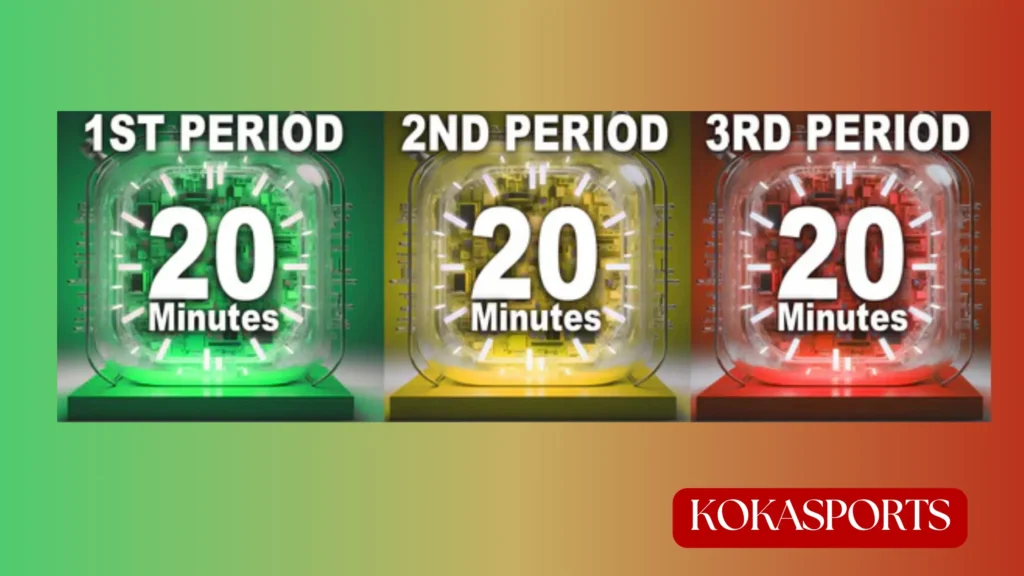
The number of periods in ice hockey is three. Each period is 20 minutes of actual playing time, making the total regulation time 60 minutes. How many periods are in hockey at every level NHL, college, international is almost always the same answer: three. Here is a fast-reference table:
| Structure | Details |
|---|---|
| Number of Periods | 3 |
| Length of Each Period | 20 minutes |
| Total Regulation Time | 60 minutes |
| Intermissions | 2 (each ~17–18 minutes) |
| Real-World Game Duration | ~2.5 to 3 hours |
Read More: How Long Is a Hockey Game? Complete Guide to NHL, College & Recreational Game Duration
Hockey Game Structure: Full Breakdown
How Many Periods in Ice Hockey? Full Breakdown
A standard hockey game is played in three periods, each lasting 20 minutes of actual play time. So the total regulation time is 60 minutes. However, a real hockey game from start to finish usually takes about 2.5 to 3 hours when you factor in stoppages, intermissions, and penalties.
The reason ice hockey uses periods instead of halves or quarters comes down to the nature of the sport. The ice needs to be maintained, and three periods gives the crew two chances to resurface the ice, keeping it fast and smooth for players.
A Short History of Hockey Periods
Hockey did not always use three periods. In the early 1900s, games were split into two halves, just like soccer. It was the National Hockey Association (NHA) the predecessor to the NHL that changed this in 1910–1911.
The switch happened for a very practical reason: ice quality. After 30 minutes of play, the ice surface would become rough, choppy, and slow. By splitting the game into three segments, crews could clean the ice twice per game, which dramatically improved play quality. This change essentially revolutionized hockey as a sport and set the template that every major league follows today.
The First Period
Every game begins with a face-off at center ice. The first period sets the tone. Coaches often use this segment to test the opposing team’s defensive structure and see how players respond. Teams are fresh, legs are fast, and the ice is clean.
A few key facts about the first period:
- Teams play 5-on-5, meaning six players on the ice per side (five skaters plus one goalie)
- Coaches watch for early penalties and take note of line matchups
- It is common to see fewer goals in the first period as both sides play cautiously
The Second Period
The second period is where many experts say games are truly won or lost. One unique rule is that teams switch ends at the start of this period, meaning they now attack and defend opposite zones. This adds a layer of strategy to game flow.
The second period is also statistically the period with the most goals per game across the NHL. Players are warmed up, systems are in place, and momentum swings happen frequently.
The Third Period
The third period is where everything gets decided in regulation. Teams protecting a lead will focus heavily on their defensive zone, blocking shots and limiting the opposing team’s chances. Teams trailing will often pull their goalie late in the period sometimes with two minutes or less remaining to get an extra skater on the ice.
This is also when the most dramatic moments happen. Empty-net goals, last-second ties, and massive comebacks all tend to occur in the final minutes of the third period.
Intermissions: The Breaks Between Periods
Between the first and second periods, and again after the second, there is an intermission. In the NHL, each intermission is approximately 17 to 18 minutes long.
During this time:
- The Zamboni machine comes out to resurface the ice
- Players head to the locker room to rest and strategize
- Coaches make adjustments to lines and systems
- Fans enjoy entertainment, music, and in-arena promotions
- TV broadcasts show analysis and highlights
In playoff games, intermissions can be slightly longer due to broadcast requirements and ice preparation.
Overtime Rules in Hockey
Regular Season Overtime
In the regular season, if the game is tied after regulation, a five-minute overtime period is played. This overtime is played at 3-on-3, meaning only three skaters per side (plus the goalie). This format was introduced by the NHL in 2015 and has made overtime far more exciting by creating huge open spaces on the ice.
The format is sudden death the first team to score wins. If a team scores, the game is over immediately. If no one scores in the five-minute overtime period, the game goes to a shootout.
Playoff Overtime Rules
Playoff hockey is a completely different experience. There are no shootouts in the playoffs. Instead, if the game remains tied, teams play full 20-minute periods of 5-on-5 hockey until someone scores. The overtime period is played under sudden death rules the moment one team scores, the game ends.
There is no limit to how many overtime periods can be played in the playoffs. The longest game in NHL history took place in 1936, when the Detroit Red Wings and Montreal Maroons played six overtime periods before the game was finally decided.
“Playoff overtime is the purest form of hockey. Every shift, every shot, every save could end the series.” common sentiment among NHL analysts
Here is a comparison of regular season vs. playoff overtime:
| Rule | Regular Season | Playoffs |
|---|---|---|
| Format | 3-on-3 | 5-on-5 hockey |
| Length | Five-minute OT | 20-minute periods |
| Tiebreaker | Shootout if tied | Keep playing |
| Sudden Death | Yes | Yes |
| Max Overtimes | 1 + shootout | Unlimited |
Shootout Explained
How the NHL Shootout Works
If the game is tied after the five-minute overtime in the regular season, the shootout begins. The shootout is one of the most dramatic moments in hockey.
Here is how it works:
- Each team selects three shooters to attempt one-on-one attempts against the opposing goalie
- The team shoots alternately one shot per team at a time
- Whichever team scores more out of three attempts wins
- If still tied after three rounds, it goes to sudden death one shooter per team until one team shoots the puck in and the other does not
The shootout only happens in the regular season. It is never used in playoff hockey, where the game must be decided by actual team play.
No Shootouts in the Playoffs
Many fans and analysts debate the shootout. Critics argue it reduces hockey to a skills contest rather than a team plays situation. Supporters say it keep games exciting and gives fans a definitive winner every night.
Penalties and Power Plays
Penalty rules are a huge part of how hockey flows across all three periods. When a player breaks a rule, the referee calls a penalty and the offending player must sit in the penalty box for a set amount of time.
Here are the main types of penalties:
- Minor penalty 2 minutes in the penalty box (most common)
- Major penalties 5 minutes in the penalty box (for more serious infractions like fighting)
- Penalty shot A free one-on-one attempt against the goalie, awarded in specific situations
Power Play Explained
A power play is when one team on the power play has more skaters than the other due to a penalty. Typically, this means five skaters against four. The team with more players uses this advantage to generate scoring chances.
- Power play units are usually the best offensive players on the team
- A well-executed power play can completely shift momentum
- Penalty time carries over between periods
How Many Periods in Other Hockey Leagues?
The number of periods in ice hockey is consistent across almost every major league. Here is how they compare:
| League/Competition | Periods | OT Format |
|---|---|---|
| NHL | 3 × 20 min | 5-min 3-on-3, then shootout |
| AHL | 3 × 20 min | Similar to NHL regular season |
| NCAA College Hockey | 3 × 20 min | 5-min OT, ties allowed |
| IIHF / Olympics | 3 × 20 min | OT + shootout |
| Youth Hockey | 3 periods (shorter) | Varies by age group |
The AHL follows nearly the same structure as the NHL, making it an easy transition for players moving up. In youth hockey, the game consists of three 20-minute segments in principle, but period lasts shorter in practice often 15-minute periods for younger age groups.
FAQs: How Many Periods in Ice Hockey
How many periods in ice hockey?
A hockey game consists of three 20-minute periods, making the total regulation time 60 minutes.
How many periods are in hockey at other levels?
Almost every level of hockey college, international, minor leagues uses the same three-period format.
What is the number of periods in ice hockey for the Olympics?
Olympic hockey also uses three periods of 20 minutes each, identical to the NHL format.
Does hockey have quarters?
No. Hockey uses periods, not quarters. Three periods make up a full regulation game.
What happens if it is tied after three periods?
In the regular season: a five-minute 3-on-3 overtime, then a shootout if still tied at the end. In the playoffs: unlimited 20-minute overtime periods until someone scores.
Can an NHL game end in a tie?
No. Since 2005, every game has a winner, decided by overtime or shootout if needed.
Conclusion
So, how many periods in ice hockey? The answer is three three 20-minute periods of regulation play, for a total of 60 minutes. But as you now know, the number of periods in ice hockey is just the starting point.
From the dramatic tension of playoff overtime to the sudden-death pressure of a shootout, every part of a hockey game has a purpose. Whether you are watching your first game or your hundredth, ice hockey rewards fans who know the structure and now you do.