

If you see four wide receivers spread across the field before the snap, you are looking at one of the most dangerous formations in modern football. That is 10 personnel football and it has quietly taken over the NFL, college football, and even high school offenses across the country. Whether you are a coach, a fantasy football player, or just a fan trying to decode what you are watching on Sunday, this guide explains everything you need to know.
What Is 10 Personnel Football?
10 personnel football is an offensive personnel package that puts 1 running back, 0 tight ends, and 4 wide receivers on the field alongside 5 offensive linemen and the quarterback. The name comes from a simple two-digit numerical system used across all levels of football the first digit represents the number of running backs, and the second digit represents the number of tight ends.
So 1 + 0 = 10 personnel.
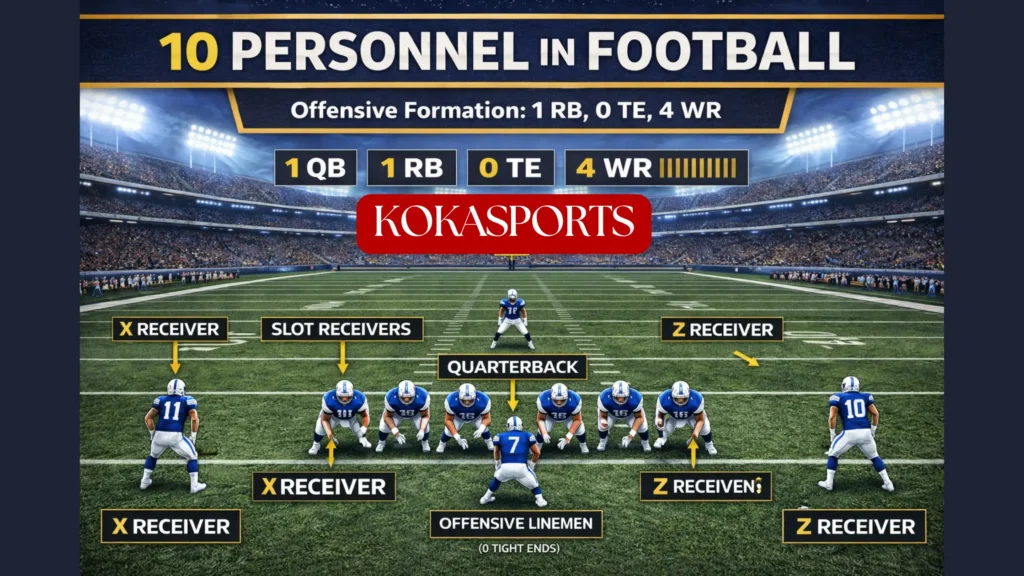
Here is exactly who lines up on the field:
| Position | Players on Field |
|---|---|
| Quarterback | 1 |
| Running Back | 1 |
| Tight Ends | 0 |
| Wide Receivers | 4 |
| Offensive Linemen | 5 |
| Total | 11 |
This makes 10 personnel one of the lightest, fastest, and most pass-friendly personnel groups in all of football. It puts maximum stress on a defense by flooding the field with receivers and it is the backbone of modern NFL offenses built around speed and spacing.
Read Also: What is 10 Personnel in Football?
Football Personnel Packages Explained: Every Group You Need to Know
To fully grasp 10 personnel offense, you need to see it next to every other grouping. Here is the complete map of offensive personnel packages used in football today:
| Package | RBs | TEs | WRs | Best Used For |
|---|---|---|---|---|
| 00 personnel | 0 | 0 | 5 | Five wide receivers, pure passing |
| 01 personnel | 0 | 1 | 4 | Zero running backs, spread passing |
| 10 personnel | 1 | 0 | 4 | Spread offense, creating mismatches |
| 11 personnel | 1 | 1 | 3 | Most common NFL package |
| 12 personnel | 1 | 2 | 2 | Two tight ends, balanced attack |
| 13 personnel | 1 | 3 | 1 | Three tight ends, power run |
| 20 personnel | 2 | 0 | 3 | Two running backs, no tight end |
| 21 personnel | 2 | 1 | 2 | Traditional pro-style offense |
| 22 personnel | 2 | 2 | 1 | Heavy run, goal line situations |
| 23 personnel | 2 | 3 | 0 | Short-yardage, goal line power |
Each of these different personnel groupings sends a clear message to the defense before the play even starts. Heavy packages like 22 personnel and 23 personnel scream run. Light packages like 10 personnel and 00 personnel scream pass or at least make the defense think pass, which is part of the strategy.
Key Insight: The best offensive coordinators use different personnel groupings to keep defenses guessing. Running out of 10 personnel when the defense expects a pass is one of the most effective ways to gain big yardage in modern football.
Why 10 Personnel Offense Dominates the NFL
The shift toward 10 personnel in the NFL is not accidental. It is the direct result of the league becoming a passing game first league. Over the past 15 years, NFL offenses have moved away from heavy, run-first groupings and toward lighter, faster packages built to attack defenses through the air.
Here is why this personnel package works so well:
- It forces the nickel defense onto the field. When four receivers line up, defenses must replace a linebacker with a defensive back just to keep up in coverage. That is an automatic win for the offense before the play starts.
- It creates a natural mismatch. Linebackers left on the field against quick slot receivers in space is one of the biggest problems a defense can face. The offense exploits this every single play.
- It spreads the box for the run game. With four receivers threatening vertically, safeties cannot crowd the line of scrimmage. That gives the running back clean lanes to attack.
- It maximizes your best athletes. Instead of having a fullback or extra tight end blocking on the edge, you put another playmaker on the field who demands attention.
- It creates tempo advantages. With zero tight ends to substitute, offenses can hurry to the line quickly and run a no-huddle attack that prevents defenses from substituting their own personnel.
The Kansas City Chiefs: A Modern Case Study
The Kansas City Chiefs are the gold standard for 10 personnel usage in the modern NFL. Under Patrick Mahomes, the Chiefs have consistently ranked among the top teams in the league in spread personnel usage. Their offensive coordinator designs an entire playbook built around speed at every skill position.
What makes Kansas City so dangerous out of this grouping:
- Mahomes can extend plays with his legs, turning broken pocket situations into big gains
- Their receivers at every spot outside and in the slot create matchup nightmares
- The running back is always a legitimate pass-catching threat out of the backfield
- Defenses simply cannot match their personnel without sacrificing run-stop ability
This is the blueprint that NFL teams across the league are now copying.
The Roles of Every Player in 10 Personnel
The Quarterback
The quarterback is the decision-maker who makes this whole system work. The QB must be able to process information quickly identifying coverages pre-snap, going through reads efficiently post-snap, and knowing when to check the ball down versus pushing it downfield. In spread offenses built around this personnel group, the QB often operates from the shotgun to get a better view of the whole field before the snap.
The Running Back
The one running back in this grouping carries enormous responsibility. Unlike in heavy packages where a running back is primarily a runner and blocker, in 10 personnel this player must do all of the following:
- Catch passes out of the backfield as a legitimate receiving weapon
- Serve as the primary blocker in pass protection against blitzing linebackers
- Run the ball effectively despite having no tight end to help seal the edge
- Read the defense and make protection adjustments at the line of scrimmage
Teams that run this package at a high level invest heavily in finding a running back who can do all of these things. Christian McCaffrey, Austin Ekeler, and Alvin Kamara are examples of the kind of versatile back this system demands.
The Wide Receivers
With four wide receivers on the field, alignment and role assignment matters enormously:
- X Receiver (outside, strong side) physical, can win contested catches, handles press coverage
- Z Receiver (outside, weak side) often the team’s fastest player, attacks the deep middle and sideline
- Slot Receivers (two inside) the real weapons in this system, attacking the middle of the field where linebackers and safeties struggle most
The slot positions are where this offense does its most dangerous work. A quick, shifty receiver lined up in the slot against a linebacker in man coverage is one of the best matchups an offense can manufacture.
The Offensive Line
The offensive linemen face unique challenges in this grouping. With zero tight ends on the field, there is no extra help on the edge for the tackles. Each lineman must win their one-on-one battle independently. This is why teams that run heavy 10 personnel usage invest significant resources in building a strong offensive line the tackles especially are completely exposed against elite edge rushers.
10 Personnel vs. 11 Personnel: Which Is Better?
This is the most important comparison in modern football offensive design. Here is an honest breakdown:
| Factor | 10 Personnel | 11 Personnel |
|---|---|---|
| Receivers on field | 4 | 3 |
| Tight end on field | No | Yes one tight end |
| Run blocking support | Weaker | Stronger |
| Passing threats | Maximum | High |
| Short-yardage ability | Limited | Moderate |
| Mismatch creation | Highest | High |
| Defensive flexibility forced | Maximum | High |
11 personnel remains the most common package in the NFL because the one tight end adds versatility blocking, receiving, and formation disguise all in one player. But 10 personnel is the pure speed weapon. When a team needs to move fast, attack every corner of the field, and put maximum stress on a defense, this is the sharper tool.
The smartest NFL offenses use both featuring 11 personnel as a base and 10 personnel as a change-up that the defense must always prepare for.
The Air Raid Offense and 10 Personnel
No system in football history is more closely linked to this personnel package than the air raid offense. Built by coaches Hal Mumme and Mike Leach, the Air Raid offense was designed entirely around spreading four receivers across the field and attacking every zone of the defense simultaneously.
The core concepts of the Air Raid run from 10 personnel include:
- Mesh two crossing receivers creating natural pick situations underneath
- Four Verticals all four receivers attacking straight downfield, stressing every safety
- Y-Cross a deep crossing route that attacks the middle of the field against zone coverage
- Spacing short horizontal routes that flood zones and give the QB high-percentage throws
These concepts require four receivers on the field to work at full effectiveness. Two wide receivers or even three wide receivers simply cannot generate the same level of stress across the field. The Air Raid proved that this personnel group was not just viable it was potentially unstoppable when executed well.
How Defenses Stop 10 Personnel
When defensive personnel coaches see four receivers walking onto the field, the response is immediate and predictable:
- The nickel defense substitutes in a fifth defensive back replaces a linebacker
- Safeties adjust their depth to protect against the deep ball while staying alert for the run
- Man coverage becomes risky one missed tackle or blown assignment leads to big gains
- Zone coverage has gaps four receivers can flood any zone and find the open window
- Blitzing is dangerous bringing extra rushers means leaving receivers in one-on-one coverage
The best defenses against this personnel package are those with athletic linebackers who can cover, elite cornerbacks who can win in man coverage, and versatile safeties who can rotate between deep help and run support. That combination is rare which is exactly why 10 personnel is so hard to stop.
Strengths and Weaknesses of 10 Personnel Offense
Strengths:
- Maximizes speed and receiving talent across the roster
- Forces defensive personnel into unfavorable substitutions
- Creates explosive big plays through the passing game
- Supports the run game by thinning out the box
- Enables fast tempo and no-huddle offensive plays
- Perfect for spread offenses at every level of football
Weaknesses:
- Struggles in short-yardage situations and at the goal line
- The number of running backs (just one) limits physical running options
- No tight ends on the field means reduced blocking on the edge
- Pass protection is harder without a fullback or extra blocker
- Can become predictable if used exclusively without mixing in heavier personnel group options
Frequently Asked Questions About 10 Personnel in Football
What does 10 personnel mean in football?
1 running back, 0 tight ends, and 4 wide receivers on the field with 5 offensive linemen and a quarterback.
What is 10 personnel used for?
Spreading the defense, creating receiver matchups, and attacking through the passing game while also opening up the run.
Is 10 personnel good for running the ball?
Yes it forces lighter defensive personnel onto the field, giving the running back more space to operate.
Which NFL teams use 10 personnel the most?
The Kansas City Chiefs, Cincinnati Bengals, Detroit Lions, and Miami Dolphins are among the heaviest users.
How is 10 personnel different from 11 personnel?
11 personnel includes one tight end. 10 personnel replaces that tight end with a fourth wide receiver for maximum speed and mismatches.
What is the difference between 10 personnel and empty backfield?
10 personnel keeps the running back behind the quarterback. Empty backfield moves him out wide, leaving nobody in the backfield.
Can high school teams run 10 personnel?
Yes it is one of the most popular high school packages because it requires no elite tight end and maximizes athletic receivers.
Conclusion
10 personnel is not a gimmick. It is the natural evolution of football offense in a passing-first era. By putting four wide receivers on the field with one running back and zero tight ends, an offense forces the defense to spread thin, opens up the run game by creating lighter boxes, and puts its fastest, most dangerous players on the field in positions to make big plays every single snap.
From the air raid systems of Mike Leach to the championship offenses of the Kansas City Chiefs, this personnel group has proven itself at every level of the game. Knowing how it works and how it compares to 12 personnel, 13 personnel, 21 personnel, and every other grouping is essential football 101 knowledge for anyone serious about the sport.
The modern NFL is a passing league. And no personnel package fits that reality better than 10 personnel.