
In 1965, Coach Bill Yeoman at the University of Houston changed American football forever. He invented a play that starts with a simple idea: let defenders make mistakes while your offense reacts perfectly.
This innovation became the Houston veer, and it dominated college football for decades. The veer is an option running play that uses unblocked defenders against themselves, creating explosive gains with less risk than traditional power-I attacks.
If you want a run game that controls the clock, limits turnovers, and wins with discipline instead of size, veer football delivers. Today, the veer offense works from flag football fields to the collegiate level. Football coaches at the high school level and beyond still use good veer schemes because they consistently move the ball.
This guide breaks down everything: veer explained in simple terms, veer blocking rules for your offensive line, complete playbook options, and installation steps for youth football through advanced programs.
What Is Veer Football? Veer Explained for Beginners, Coaches & Offensive Line
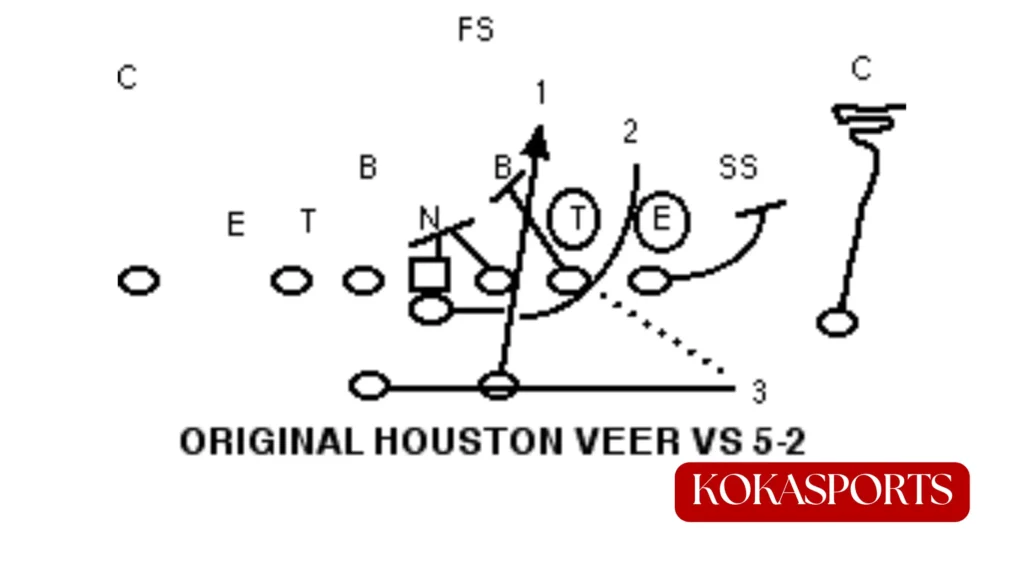
The veer is a football play built on simple logic: instead of blocking every defender, leave one or two unblocked and make them guess wrong.
Your quarterback reads these unblocked defenders at the point of attack. He decides whether to hand off, keep the ball, or pitch the ball to a trailing running back.
This option read happens in seconds, but it creates confusion that even the best linebacker cannot solve consistently.
The Core Principle
At its core, veer blocking focuses your offensive line on specific targets while ignoring others.
The playside guard and tackle might double-team the defensive tackle. The tight end seals the defensive end. Meanwhile, your QB watches the unblocked end or force player.
If that defender crashes inside toward your dive back, the quarterback pulls it back and attacks the edge.
Core Mechanics of Veer Offense and Inside Veer Triple Option
The inside veer operates with three possible outcomes on every snap the triple option everyone talks about.
The three reads work like this:
- Give to dive back: If the first defender sits or stays outside
- QB keeps: If the defender crashes inside on the dive
- Pitch to trailing back: If the force player commits to tackle the QB
Result: The offense blocks six defenders with six blockers while gaining numerical advantage with three ball carriers against two unblocked players.
Your fullback runs a direct path at the line of scrimmage, threatening the A or B gap. The quarterback extends the ball into his mesh point, reading the first unblocked defender typically the playside defensive tackle or defensive end, depending on the formation.
Split-Back vs Traditional Formations
The veer option differs from wishbone schemes because of backfield alignment.
In the split-back veer formation, two running backs line up beside or slightly behind the QB. This creates better angles for the pitch read.
The traditional I-formation places the fullback directly behind the quarterback. This works but creates tighter spacing.
The split back veer spreads defenders horizontally and creates better running lanes.
Evolution: Houston Veer to Modern Good Veer Offense
Yeoman created the veer to solve a problem: his teams couldn’t overpower bigger opponents.
By 1965, Yeoman had developed the outside veer concept. This later evolved into the inside veer that dominated football. Emory Bellard adapted these principles into the wishbone at Texas.
The veer evolved through several phases:
| Era | Innovation | Key Teams |
|---|---|---|
| 1965-1975 | Original Houston veer with split backs | Houston, Kansas |
| 1976-1990 | Inside veer becomes standard | Oklahoma, Nebraska |
| 1991-2005 | Flexbone adds slot receiver wrinkles | Navy, Georgia Tech |
| 2006-Present | Spread veer hybrids with zone read | Oregon, Auburn |
Modern youth football programs use simplified versions. The blocking scheme requires fewer complex adjustments than pro-style offenses.
Flag football leagues use no-contact veer principles where the quarterback simulates mesh points. At the collegiate level, programs like Navy and Air Force still build entire identities around option football. It controls the clock and limits turnovers.
Read More: Pin and Pull Football: The Run Game Explained
Veer Blocking Rules in Veer Football: Handling Double Teams for Offensive Line
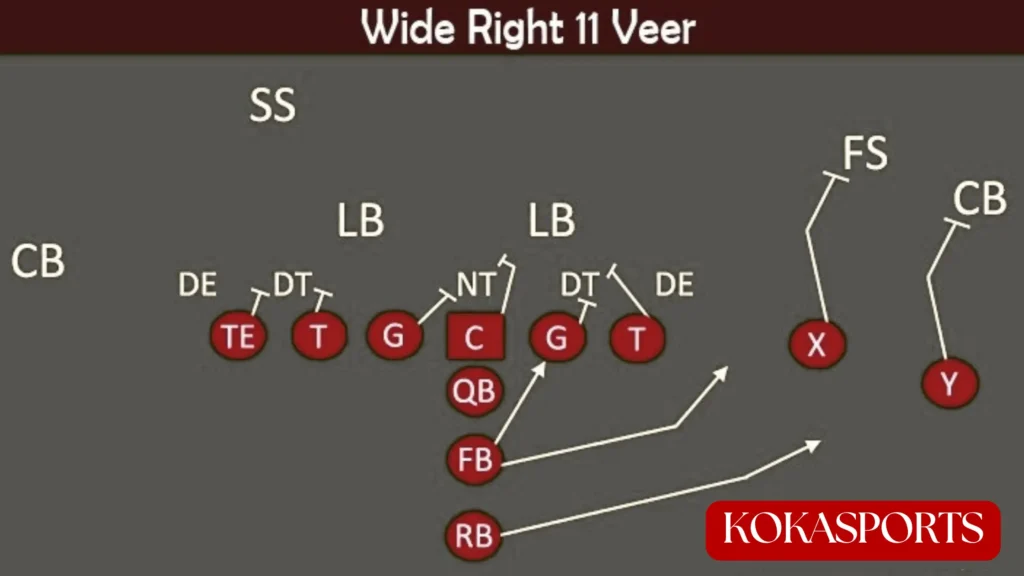
Blocking the veer differs fundamentally from man or zone schemes.
Your offensive line doesn’t worry about every defender. They focus on creating vertical push on specific targets while leaving designed threats unblocked.
Veer Blocking Rule #1: Block Down, Never Chase Outside
The core principle: block inside gaps first. Never chase an outside defender.
Your playside guard and tackle will often double-team the nose guard or defensive tackle. This drives him backward and up the field.
The double teams the most physical player on the defense while creating a natural running lane. Meanwhile, that defensive end goes completely unblocked he’s the QB’s read, not the line’s problem.
Inside Veer Blocking Assignments & Coach Cues
For a basic inside veer to the right side against a 4-3 defense:
Playside (Right):
- Right tackle: Blocks down on defensive tackle (first level threat)
- Right guard: Helps on double-team with tackle, then climbs to linebacker
- Tight end: Seals defensive end or releases to safety level
- Center: Blocks backside A-gap defender or helps double
Backside (Left):
- Left guard: Pulls around center to lead blocker on second level
- Left tackle: Reaches playside or cuts off backside pursuit
- Receivers and tight ends: Block cornerbacks depending on the formation
The quarterback’s mesh with the running back happens right as these blocks develop. Your dive back follows the double-team’s vertical push, hitting the hole fast.
Coach cues for young players:
- “Block the man inside you”
- “Step to the playside gap and climb”
- “Strike and stick together on doubles”
Veer Blocking Drills for Youth Football Coaches
Teaching veer concepts to younger players requires breaking complex actions into simple pieces.
1. Double-Team Progression Drill (5 minutes):
- Two linemen work against one defender on bags or sleds
- Focus on simultaneous contact and vertical movement
- Key point: Stay connected through the block
2. Mesh Point Repetition (10 minutes):
- Quarterback and fullback work on timing without defense
- Focus on soft hands and quick pull decisions
- Add read simulation: coach points which direction QB should pull
3. Read Key Recognition (12 minutes):
- Set up basic veer look with defenders
- Defenders alternate crashing or sitting based on coach signal
- QB executes proper read: give on sit, keep on crash
For flag football adaptations where contact isn’t allowed, linemen practice “showing numbers” to defenders. This is body positioning that influences movement.
The quarterback still reads and reacts. The running back’s ability to run lanes becomes crucial since blocks don’t physically move defenders.
Ultimate Veer Offense Playbook: Inside Veer, Veer Option & Flexbone Plays
A complete veer playbook balances simplicity with strategic variety.
You need core plays that your team can execute perfectly. Add constraint plays that punish specific defensive adjustments. Include complementary passes that prevent defenses from stacking the box.
Core Plays for Football Coaches – Houston Veer Series
Inside Veer (Base Triple Option):
This is your foundation. Run it to both sides until defenders respect every option.
The inside veer attacks between the tackles with the triple-option structure: dive, QB keep, pitch. Against a 5-2 defense, this play typically averages 5+ yards per carry because defenses can’t defend all three phases simultaneously.
Outside Veer:
A variation that targets the edge more aggressively. The QB’s first read happens on the outside linebacker or force player instead of the defensive tackle.
This version of the veer works beautifully against aggressive inside linebackers who over-pursue.
Midline Option:
This play attacks the center-guard gap with the fullback. It reads the nose guard or middle linebacker.
Midline works against spread defenses and teams trying to widen out to stop your edge game. The quick-hitting nature means less time for defensive tackles to penetrate.
Speed Option:
A constraint play that threatens the perimeter without the dive fake.
Your quarterback sprints toward the sideline immediately with a pitch relationship running back trailing. This option play forces the defense to defend the width of the field.
Counter Trey:
When defenses over-pursue your veer action to the playside, call counter trey the opposite direction.
Two pulling linemen lead the running back through the backside gap. This punishes aggressive flow.
Custom Playbook for Collegiate Veer Offense & Youth
Building your playbook requires matching plays to personnel and competition level.
Youth football programs need 4-5 base plays maximum. High school programs can handle 8-10. Collegiate programs might carry 12-15 variations.
| Formation | Primary Play | Secondary Option | Constraint |
|---|---|---|---|
| Split-back | Inside Veer | Outside Veer | Counter |
| I-formation | Inside Veer | Midline | Power sweep |
| Flexbone | Triple option | Midline | Rocket toss |
| Spread formation | Zone read | Speed option | Draw |
RPO (Run-Pass Option) packages add modern dimensions to traditional veer schemes.
Your quarterback executes the veer mesh while reading a linebacker. If that defender commits to the run, the QB pulls and throws a quick slant to your wide receiver or slot receiver.
This constraint forces defenses to play honest and prevents them from loading the box with eight defenders.
Coaching Veer Football: QB, Skills & Offensive Line Tips from Veer Coaches
Installing the veer requires teaching three distinct skill sets: quarterback decision-making, running back discipline, and offensive line physicality.
QB Mesh & Pitch Progression in Veer Offense
The quarterback position in veer schemes requires unique development.
Most QBs want to throw downfield and make highlight plays. Option football demands humility making the correct read matters infinitely more than athletic ability.
Mesh point technique separates good from great:
Your quarterback must extend the ball fully into the dive back’s stomach. He keeps his eyes on the read key. This soft handoff allows for smooth exchanges or quick pulls depending on the defender’s action.
Many young QBs pull too early, tipping the defense. Others commit to the give too firmly, making pull-backs awkward.
Pitch mechanics require different skills:
After pulling from the dive mesh, the quarterback sprints at the pitch read often the force player or cornerback.
His goal isn’t scoring. It’s threatening enough to freeze that defender. When the defender commits to the QBs keep, he executes a soft underhand pitch to the trailing back.
The progression: Mesh → Pull → Threaten → Pitch.
Spend 20 minutes daily on mesh reps with your fullback. Another 15 minutes on pitch accuracy to moving targets. Film study teaches read recognition show your QB what defensive ends look like when crashing versus sitting.
Offensive Line Coaching Against Double Teams
Veer blocking demands different mentalities than pass protection or power schemes.
Your linemen must embrace double teams as opportunities rather than signs of weakness.
Coach these principles for maximum effectiveness:
Stance adjustments: Veer linemen need slightly narrower stances for quicker lateral movement. Their weight distribution favors forward momentum since they’re firing upfield on most snaps.
First-step explosiveness: The initial step determines success. Both linemen in a double-team must fire simultaneously with violent hands into the defender.
Coaching cue: “Strike and stick together.”
Communication during blocks: Your center and guard must talk through combo blocks. “I’ve got him solo” or “Stay with me” signals whether one blocker climbs to the linebacker or both stay engaged.
The best veer offensive line coaches emphasize competitive drilling. Pit your linemen against each other in 2-on-1 situations. Keep score of who creates the most vertical movement.
Common Veer Football Mistakes Coaches Make
Even experienced coaches stumble when installing the veer. Avoid these errors:
Asking the QB to predetermine reads: The veer only works when your quarterback reacts to actual defensive movement, not guesses.
Letting linemen chase unblocked defenders: Your offensive tackle must ignore the read key. Blocking him ruins the entire play.
Over-installing before mastering inside veer: Run your base play 100 times before adding constraint options. Mastery beats variety.
Pitching too early instead of attacking the defender: The quarterback must threaten the force player before pitching. Early pitches telegraph the play.
Forgetting to drill mesh points daily: The QB-fullback exchange requires thousands of reps to become automatic under pressure.
Conclusion
The veer offense remains one of football’s most elegant systemssimple rules producing complex defensive problems.
From Yeoman’s original innovation to modern spread variations, these principles keep winning games. They respect mathematical realities: defenses cannot defend all options simultaneously.
Whether you coach flag football or work toward the collegiate level, veer explained here gives you the foundation. Master the fundamentals, drill them relentlessly, and watch your offense control the side of the field every Saturday.
The ability to run this offense with proper veer play execution creates success against any defense. Smart option read decisions by your QBs matter. Physical veer blocking from your offensive tackle and lineman positions matters.
Running a veer offense means playing smart, physical, and disciplined football. Every player from receivers to the tight end understands their role in this timeless option offense that veer teams have used to dominate for 60 years.
Veer Football FAQs – Every Question Answered
What is veer blocking?
Veer blocking focuses on double teams at the point of attack while leaving specific defenders unblocked for the quarterback to read. The blocking scheme creates vertical movement on first-level threats.
Best veer for flag football?
Simplified inside veer with one direction and speed option as constraint. No-contact modifications emphasize angles over physical blocks.
Inside veer vs. Houston veer?
Houston veer refers to the original system created by Bill Yeoman. Inside veer is the specific play that attacks between the tackles with triple-option reads.
How does the option play work?
The quarterback reads unblocked defenders. He distributes the ball to the dive back, keeps it himself, or pitches to the trailing running back based on defensive reactions.
Can the veer work against modern defenses?
Yes. The veer is an option running system that adapts to any era. Programs add RPO packages and spread formations to keep defenses honest.