
The midline option remains one of the most effective plays in option football for attacking defenses right up the gut. Despite the evolution of modern offenses, this classic option play continues to give defensive coordinators fits at every level of competition. When executed properly, the midline option creates numerical advantages without requiring dominant blockers, making it accessible for football coaches at high school, youth, and college programs alike.
What Is the Midline Option in Football?
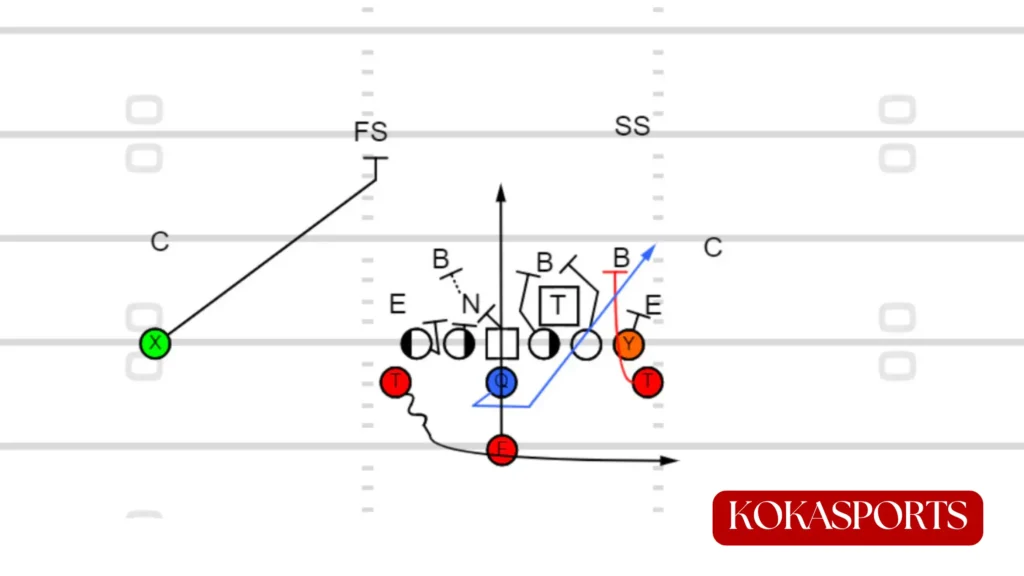
The midline option is an offensive play where the quarterback reads a defensive tackle or interior defensive lineman while deciding whether to hand the ball to the fullback or pull the ball and keep it himself. Unlike outside zone schemes or perimeter runs, this play attacks directly between the guards right up the gut of the defense.
The term “midline” refers to the play’s path, which splits the difference between traditional inside veer and outside option concepts. The running back receives the ball on a quick dive path through either the A-gap or B gap, depending on the defensive alignment. What makes this play special is that the offense helps create advantages by leaving a key defender unblocked and reading his reaction instead.
How the Midline Option Differs From Other Options
Many coaches confuse the midline option with similar concepts, but key differences exist:
- Midline vs Inside Veer: The inside veer reads the first defender outside the offensive tackle, while the midline option reads the three technique or 1 technique defender closer to the center
- Midline vs Zone Read: The zone read typically uses outside zone blocking and reads the edge defender, while the midline uses veer blocking principles and reads an interior lineman
- Midline vs Load Option: The load option brings a lead blocker to kick out the read defender, while the midline leaves him left unblocked
According to Jerry Campbell, a respected voice in option coaching circles, “The midline option gives you all the advantages of the triple option without needing your offensive line to reach defensive ends on the perimeter.”
lRead More:The Flexbone Offense: A Complete Guide for Coaches and Players
Why Football Coaches Use the Midline Option
The midline option solves several problems that coaches face against modern defenses:
Neutralizing Dominant Interior Players: When a nose tackle or defensive tackle dominates your center and guards, the midline option turns that player into the read defender. You don’t have to block him you just have to read him correctly.
Simplifying the Read: The give read happens quickly and at the mesh point, making it easier for the quarterback to read than perimeter options that require tracking faster defenders in space.
Creating Numerical Advantages: By leaving one defender unblocked, you create an extra blocker for someone else. This allows smaller or less experienced offensive linemen to find success.
Slowing Aggressive Penetration: Defenses that fire gaps and penetrate upfield become easier to option off, as their aggression makes the read clearer.
| Midline Option Advantage | How It Helps |
|---|---|
| Interior read | Easier for QB than edge reads |
| Quick mesh | Faster decision than perimeter options |
| No need for dominant blockers | Works with average offensive line |
| Attacks aggressive defenses | Punishes gap-shooting techniques |
Core Mechanics: How the Midline Option Works
The beauty of the midline option lies in its simplicity. Three players make the play work: the quarterback, the fullback (or dive back), and the read defender.
Quarterback Responsibilities in the Midline Option
The QB takes the snap and immediately establishes the mesh point with the fullback. His eyes lock onto the read defender typically the 3 technique defensive tackle to the playside or the nose tackle in odd front alignments.
The quarterback reads this defender for his first movement:
- If the defender closes down on the dive back, the quarterback will pull the ball and attack outside the read defender’s path
- If the defender stays wide or chases the quarterback running, the quarterback to read says “give” and the handoff goes to the fullback
Key coaching points for quarterbacks include keeping the ball extended at the mesh point, using the playside foot to step directly at the read defender, and maintaining a firm ride on the backfield runner to sell the fake. The backside foot should remain balanced, ready to redirect if the keep read appears.
Fullback Path and Responsibilities
The fullback aligns directly behind the quarterback in traditional sets or slides into position from two backs formations. His aiming point is the inside hip of the playside guard or playside tackle, depending on the blocking scheme.
The critical detail: the fullback must attack straight ahead with his eyes up and arms ready for the give to the fullback. He cannot hesitate or redirect based on the read defender that’s the QB decision alone. Running hard through the mesh point forces the read defender to commit, making the read easier.
Ball security becomes paramount. The fullback should cover the ball immediately after the handoff, anticipating contact from unblocked linebackers scraping to the ball.
Offensive Line Blocking for the Midline Option
The offensive line uses a combination of covered and uncovered rules similar to inside veer. The blocking scheme focuses on creating movement at the line of scrimmage while accounting for backside pursuit.
Covered linemen (those with a defender directly over them) block their man. Uncovered linemen take an inside release to the nearest linebacker at the second level. The backside guard often pulls to block the backside linebacker, though some systems prefer having him seal backside A-gap.
The offensive tackle on the playside has a crucial job: he must reach any 3 technique or defensive lineman who is NOT the read defender. If the read is on the 3 technique, the playside tackle works to the middle linebacker. The offensive guard to the playside blocks according to his covered or uncovered status.
Here’s a typical assignment chart:
| Position | Covered | Uncovered |
|---|---|---|
| Center | Block nose | Work to MLB |
| Playside Guard | Block defender | Release to LB |
| Playside Tackle | Block or bypass read | Release to LB |
| Backside Guard | Seal or pull | Pull to LB |
| Backside Tackle | Hinge or cut off | Hinge or cut off |
Running the Midline Option Against Different Defenses
The Midline Option vs Odd Front Defenses
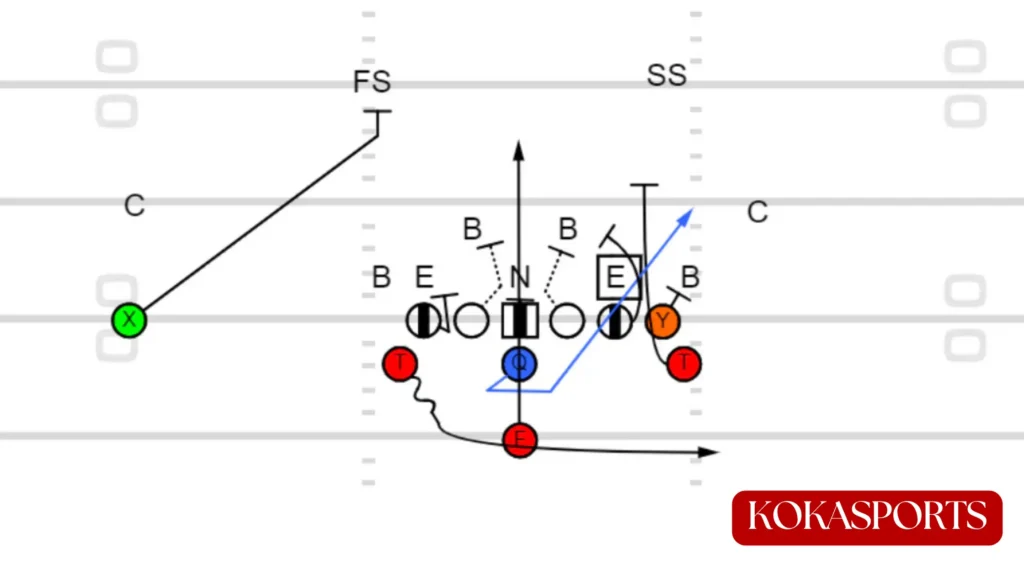
Against a 4-3 or 3-4 look with a nose guard, the midline option becomes particularly effective. The nose tackle often becomes the read defender, though some coaches prefer reading the 3 technique to the front side.
In odd front alignments, the center typically helps on the nose if he’s not the read, or releases to the middle linebacker if the nose is being optioned off. The guards work to secure their gaps and climb to linebackers as the scheme dictates.
The Midline Option vs 4-3 Defense

The 4-3 defense presents different challenges. Most coaches read the 3 technique defensive tackle on the playside, making him the unblocked defender. This forces the 1 technique to be blocked by the center, while the playside tackle climbs to the linebacker level.
Some offensive coordinator preferences dictate reading the 1 technique instead, especially if the 3 technique is their most dominant player. Both approaches work consistency in position coaches teaching and quarterback reads matters more than which specific technique you read.
Building an Effective Option System Around the Midline
The midline option rarely exists in isolation. Smart coaches pair it with complementary concepts:
Pairing with Triple Option: Adding a pitch man to the outside creates a true triple option look off midline action. Now the defense must defend three threats instead of two.
Midline Option RPO Concepts: Modern spread offense teams add quick screens or slants off midline action, forcing defenders to stay honest rather than flying to the ball.
Counter and Load Option Complements: When defenses start scraping hard to midline, counter plays and load options hit the void they create.
The genius of run the midline as your base play is simplicity. Master one play, then add variations as needed rather than installing fifteen different option schemes.
Common Coaching Mistakes to Avoid
Even experienced coaches make errors teaching the midline option:
Overcomplicating the Read: The read should be binary give or keep. Adding “maybe” or “gray area” reads confuses quarterbacks under pressure.
Poor Mesh Mechanics: Rushing the mesh point or failing to sell the ride creates uncertainty that allows defenders to play both runners.
Misidentifying the Read Defender: Pre-snap identification must be crystal clear. The quarterback is reading a specific number not making game-time decisions about which defender to option.
Neglecting Complementary Plays: Defenses adjust. Without companion plays like outside zone or run the veer off different reads, the midline becomes predictable.
The Midline Option in Modern Football
Today’s game features everything from spread offense attacks to traditional tight end heavy formations. The midline option adapts to both. Teams running one back sets from shotgun use midline principles just as effectively as two backs flexbone teams under center.
Even flag football leagues have adopted option principles, with modifications for the no-contact rules. The read concept forcing one defender to defend two players translates perfectly to flag environments where blocking limitations exist.
Conclusion
The midline option endures because it solves fundamental football problems. It creates numerical advantages, simplifies execution, and attacks where defenses feel safest between the tackles. For coaches seeking a reliable option play that doesn’t require elite athletes or complex blocking schemes, the midline play delivers consistent production.
Whether you coach youth football, high school varsity, or college programs, adding the running the midline option to your playbook provides both a foundational run concept and a building block for an entire option system. Master the basics the read, the mesh, the blocking and watch how this timeless play continues to force the defense into impossible choices every time you run the midline.
The key is commitment. Half-hearted installation produces mediocre results. But when coaches dedicate practice time to perfecting mesh point mechanics, drilling the give read, and coaching the quarterback to trust his read, the midline option becomes an unstoppable weapon that keeps defenses honest and offensive coordinators smiling on Saturday nights.
FAQs
What is the midline option?
The midline option is an option run play where the quarterback reads an interior defensive lineman and decides to give the ball or keep it.
What is the difference between midline and veer?
The midline reads an interior defensive lineman, while the veer reads a defender outside the offensive tackle.
What positions make up an O-line?
The offensive line has five positions: center, left guard, right guard, left tackle, and right tackle.
What are the 11 positions in football?
Quarterback, running back, fullback, wide receiver, tight end, left tackle, left guard, center, right guard, right tackle, and linebacker.