

A standard American football field is 160 feet wide (53⅓ yards). This width is the same in the NFL, college football, and high school football.
When you watch a thrilling game on Sunday afternoon, you probably focus on the action, the touchdowns, and the incredible plays. But have you ever stopped to think about how wide is a football field and how the actual measurements of the playing surface shape the game?
While most fans know a football field stretches 100 yards long, the width often gets overlooked. Yet this measurement plays a crucial role in every play, every formation, and every strategic decision coaches make during games.
How Wide Is a Football Field (Feet and Yards)
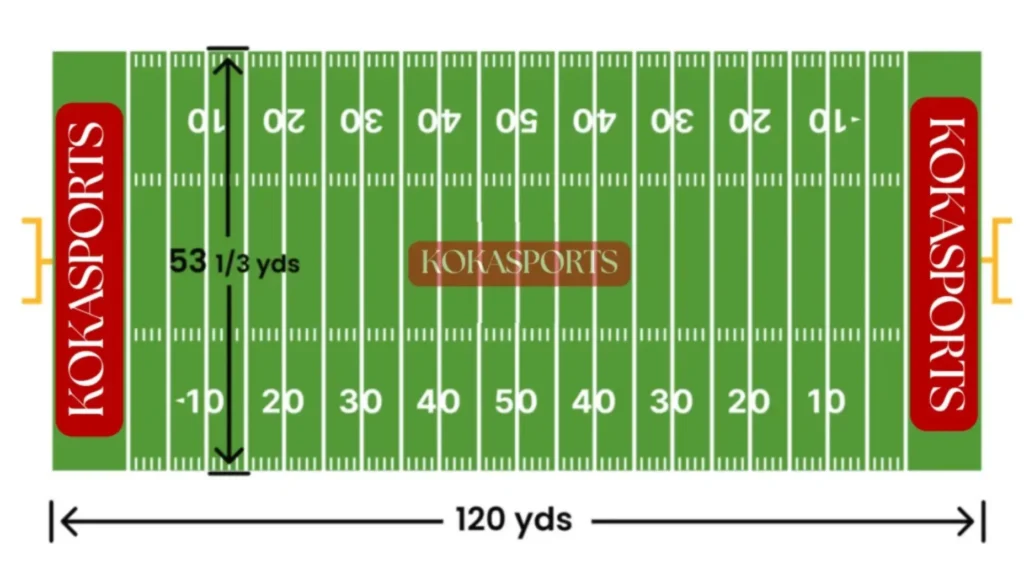
A football field measures exactly 160 feet across, which equals 53.3 yards. This measurement stays consistent whether you’re watching professional games, college matches, or high school competitions.
Here are the key measurements:
- Width: 160 feet (53.3 yards)
- Playing length: 100 yards (300 feet)
- Total length with end zones: 120 yards (360 feet)
- Total area: Approximately 1.32 acres
The width of the field determines how much space offensive players have to work with, how defenses can spread out, and where special teams must position themselves for successful kicks.
Read Also: How Big Is a Football Field? Official Football Field Dimensions Explained
Complete Football Field Dimensions
Let’s break down the exact measurements:
| Measurement | Feet | Yards |
|---|---|---|
| Field width | 160 feet | 53.3 yards |
| Playing length | 300 feet | 100 yards |
| Total with end zones | 360 feet | 120 yards |
| Each end zone | 30 feet | 10 yards |
The football field is 120 yards in total length when you include both scoring zones. Each end zone extends 10 yards beyond the goal line, creating the area where touchdowns happen.
The field dimensions follow strict standards set by the National Football League and college athletic associations. Every measurement from sideline to sideline and goal line to goal line must meet exact specifications.
The rectangular field measures:
- Width of the field: 53.3 yards
- Length between goal lines: 100 yards
- Distance end zone to end zone: 120 yards
- Each scoring zone depth: 10 yards deep
These standard dimensions create perfect proportion for football’s combination of running plays, passing plays, and special teams action.
Why Football Fields Are 160 Feet Wide
The width of a football field didn’t happen by accident. Early organizers established these measurements in the late 1800s when American football split from rugby.
The 160 feet wide measurement serves several purposes:
Safety and Spacing: The width provides enough room for 22 players to spread across the field of play without constant crowding. Players can run routes, defensive backs can cover receivers, and linemen can set up properly.
Strategic Balance: The measurement creates perfect balance between offense and defense. Too narrow, and defenses would dominate. Too wide, and offenses would have unfair advantages.
Practical Considerations: The field from sideline to sideline fits within reasonable land boundaries for stadiums and high schools. Building a regulation football field with these measurements works for communities of all sizes.
Historical Consistency: Once established, changing the width would require rebuilding thousands of fields nationwide. The measurement has proven ideal for over a century of play.
NFL vs College vs High School Field Width
One of the most interesting facts about football field sizes is that the width never changes. All fields measure exactly 160 feet from sideline to sideline, whether you’re watching the NFL, college games, or high school football.
However, the hash marks tell a different story:
| Level | Hash Mark Spacing | Distance from Sideline |
|---|---|---|
| NFL | 18 feet 6 inches apart | 70 yards 9 inches |
| College football | 40 feet apart | 60 feet |
| High school | 53 feet 4 inches apart | Minimal offset |
These differences significantly impact gameplay. In the NFL, narrow hash marks mean the ball is almost always near the middle of the field, giving quarterbacks equal throwing options to both sides.
College and high school level fields use wider hash marks, creating different angles, especially on one side of the field.
How Hash Marks Affect Field Width
While the width stays constant, hash mark positions dramatically affect play calling. The NFL places hash marks just 18 feet apart, essentially creating a narrow channel down the center.
College football spreads them 40 feet apart, creating what coaches call “field advantage” and “boundary advantage” depending on ball placement. When the ball sits on the right hash mark, the offense has more room to attack the left side.
High school level fields often place hash marks at the widest legal spacing. This creates the most dramatic sideline effects, where plays near one hash mark leave minimal room toward that boundary.
Inside the Football Field Layout
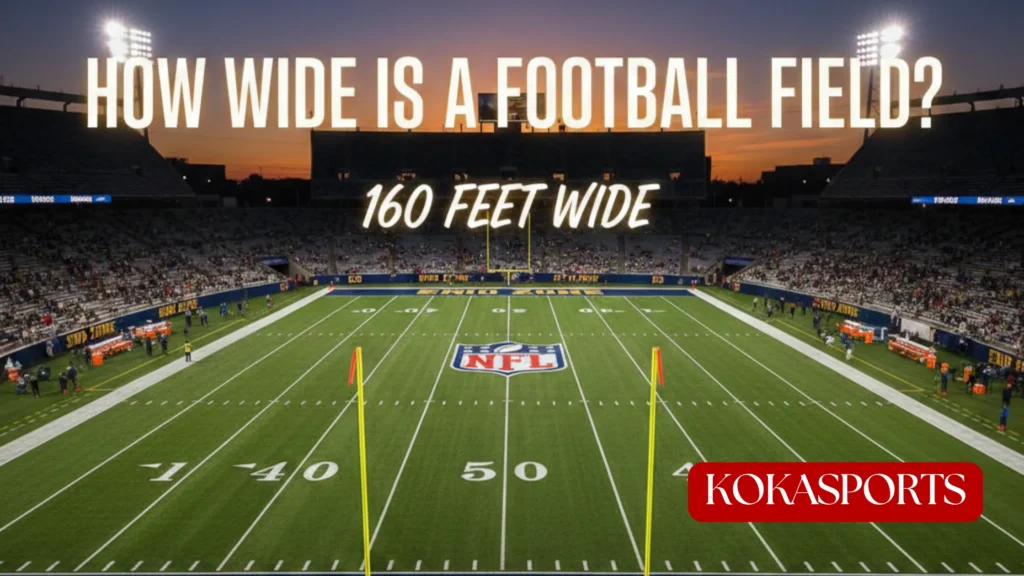
A football field features precise field markings that guide every play. The field is divided into sections that help officials, players, and fans track progress.
The Goal Lines: These lines mark where each end zone begins at each end of the field. Goal lines are located exactly 100 yards apart, creating the main playing area. They span the entire width of the surface.
Yard Lines: Starting from each goal line, yard line markings appear every 5 yards across the field. Every 10 yards, larger numbers help everyone track field position. These run parallel to the goal lines, extending from boundary to boundary.
The End Zones: Each end zone stretches 10 yards deep from the goal line to the end line. The back of the end zone features the goal post, positioned exactly on the boundary line.
Sidelines: The sideline boundaries mark the edges of legal play. When any part of a player’s body touches the sideline or beyond, they’re out of bounds. Coaches must stay within designated areas to avoid penalties.
Field Markings and Measurements
Beyond the basic length and width, markings provide essential reference points. White lines appear every 5 yards, with numbers marking every 10 yards to help track progress toward the goal line.
Small directional arrows point toward the nearest goal line, preventing confusion about which direction teams are moving. These arrows appear near the numbers, ensuring everyone knows which end represents the scoring objective.
Field numbers are painted large enough for fans in the upper decks to read clearly. At the 50-yard line marking the center, only the number 50 appears, while other locations show directional numbers counting down toward each goal line.
The boundary lines including the sideline and end line are typically 4 inches wide, creating clear visual markers for officials to judge whether plays stay in bounds.
Goal Posts and Scoring Zones
The goal post stands as one of football’s most recognizable features. Positioned at the back of the end zone, it measures 10 feet from ground to crossbar. The uprights extend upward and are spaced 18 feet 6 inches apart in professional games.
For a successful field goal, the ball must pass between these uprights and above the crossbar. Kickers must account for the width of the field when attempting kicks from different hash marks.
A kick from the left hash mark requires a different angle than one from the right, especially on college and high school level fields with wider spacing.
Full Football Field Dimensions Table
Here’s a complete breakdown of all measurements:
| Feature | Measurement | Details |
|---|---|---|
| Width | 53.3 yards | Sideline to sideline |
| Playing length | 100 yards | Between goal lines |
| Total length | 120 yards | Includes both end zones |
| Each end zone | 10 yards | Scoring area depth |
| Hash mark spacing (NFL) | 18 feet apart | Narrow channel |
| Hash mark spacing (college) | 40 feet apart | Wider angles |
| Goal post width | 18 feet 6 inches | Between uprights |
| Line thickness | 4 inches wide | All boundary lines |
| Total area | 1.32 acres | Complete surface |
Football Field vs Soccer Field
To appreciate the football field width, compare it to other sports:
- American football field: 53.3 yards wide
- Soccer fields: 70-80 yards wide (much wider)
- Lacrosse fields: 53-60 yards wide (similar)
- Rugby fields: 77 yards wide (significantly wider)
Football’s measurement creates tighter spacing than most field sports, emphasizing strategic use of limited horizontal space. This forces teams to be creative with formations and routes rather than simply spreading players out.
Why Field Width Matters for Strategy
The measurement influences countless strategic decisions:
Pass Routes: Receivers design routes based on available space from their position to the sideline. A receiver lined up near the hash mark has different options than one starting closer to the boundary.
Defensive Coverage: Cornerbacks must account for how many yards from the sideline they’re playing. Too close to the boundary limits the receiver’s escape routes. Too far away gives the offense more room to work.
Running Plays: The width of the field determines where running backs can find running lanes. Plays designed to go outside the tackle box depend on having sufficient room before reaching the sideline.
Special Teams: Punters and kickers must calculate angles based on field dimensions. A punt from the left hash mark requires a different trajectory than one from the right to achieve optimal placement.
Modern Field Technology and Precision
Today’s NFL field and major college facilities use advanced technology to ensure perfect measurements. Laser-guided painting systems create field markings with millimeter precision.
GPS tracking verifies that every line from goal line to goal line and sideline to sideline meets exact specifications.
Some facilities use 6 feet of reinforced material beneath the surface to prevent uneven settling that might distort measurements. Drainage systems ensure the playing field maintains its level surface regardless of weather.
Paint formulas now last longer and resist fading, keeping yard lines and numbers clearly visible throughout the season.
High School Football Fields
High school football fields follow the same basic measurements as professional and college fields. The regulation surface is 53.3 yards wide and features 100 yards of playing area between goal lines, plus 10 yards for each end zone.
However, some older high school football fields may have minor variations due to space constraints or older construction. While the official field measurements call for specific dimensions, schools with limited property might adjust slightly.
The hash marks on high school level fields are typically positioned wider than college or professional fields, creating more dramatic angles for plays near the sideline. This teaches young players to adapt their routes and blocking based on field position.
The Playing Surface
The football field measures 100 yards long by 53.3 yards in its playing area, but the surface type varies. NFL stadiums use either natural grass or modern synthetic turf designed to replicate grass performance.
Natural grass fields require extensive maintenance to keep the surface level and consistent from goal line to goal line. Grounds crews must ensure every part of the field provides uniform playing conditions.
Synthetic surfaces offer consistent performance regardless of weather. Both surface types must maintain exact measurements without variations that might affect ball placement or play outcomes.
Knowing the Dimensions: Why It Matters
Knowing the dimensions helps you appreciate the game at a deeper level. The precise measurements from end zone to end zone and sideline to sideline create the framework that makes strategic planning possible.
Every football games unfold on this perfectly measured stage. Whether it’s a quarterback scanning the open field, a running back looking for 5 yards, or a receiver trying to run the length of the field for a touchdown, these measurements shape every moment.
The field is a rectangle that’s roughly 2.25 times longer than it is wide. This ratio has proven ideal for the sport’s combination of running plays, passing plays, and special teams action.
Conclusion
A football field is exactly 160 feet wide a measurement that has remained constant across professional, college, and high school play for generations. This consistent width of the field creates the strategic framework that defines American football.
From the hash marks that vary by level to the goal lines that span the entire surface, every measurement serves a purpose. Whether you’re watching NFL football, college games, or youth competitions, you’re seeing action unfold on a precisely measured regulation football field.
The next time you watch a game, pay attention to how players use the space from sideline to sideline. You’ll gain new appreciation for the chess match happening within those 53.3 yards the fixed stage where every play, from a simple 5 yards gain to a dramatic 20 yards reception, unfolds within boundaries that have shaped the game for over a century.
FAQs
Is a football field wider than a soccer field?
No. A football field is 53.3 yards wide, while soccer fields are typically 70–80 yards wide, making soccer fields much wider.
Is the width the same in the NFL and college?
Yes. NFL, college, and high school fields are all 160 feet wide. Only hash mark placement differs by level.
Why is a football field 53⅓ yards wide?
The width comes from early football standardization. 160 feet provided balanced spacing and has remained unchanged for over a century.
Are all high school football fields the same size?
Most are. While older fields may vary slightly, nearly all follow the standard 160-foot width and 360-foot total length.
How do hash marks affect the width of play?
Hash marks don’t change field size but affect spacing. NFL hash marks are narrow, while college and high school marks are wider, creating different play angles.