


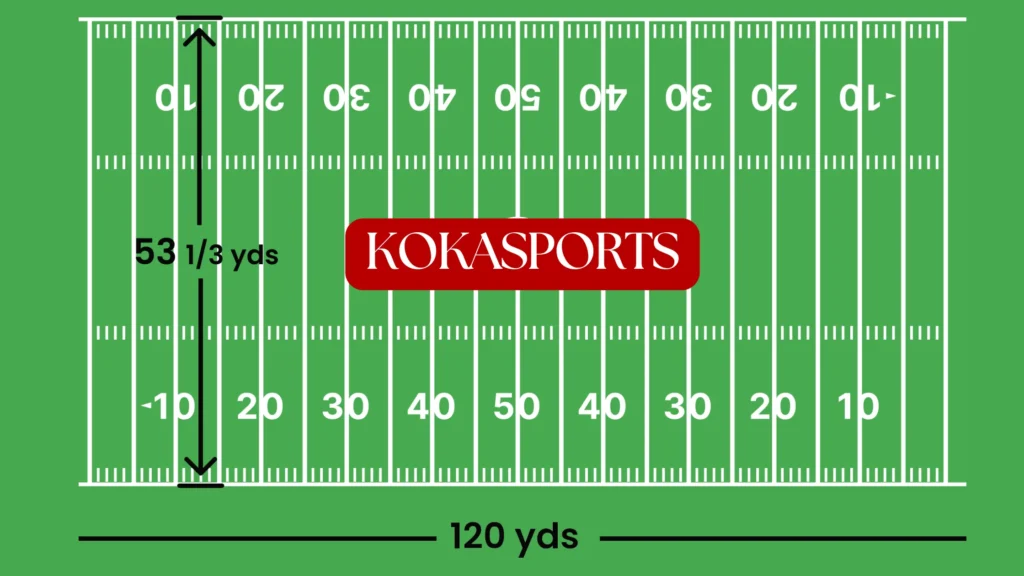
If you’ve ever wondered how long is a football field, you’re in the right place. A standard American football field is 120 yards long (including two 10-yard end zones) and 53.3 yards wide. The main playing area between the goal lines is 100 yards. Whether you’re watching the NFL, college games, or high school matches, these measurements stay the same across all levels of organized play.
Quick Answer: A football field measures 120 yards in total length (360 feet) and 53.3 yards in width (160 feet). The playing field between goal lines is 100 yards long.
American Football Field Size: The Complete Breakdown
The American football field size is carefully standardized to create fair, competitive gameplay. When people ask “long is a football field,” they need to know about two key measurements:
- Total field length: 120 yards long (includes both end zones)
- Playing field length: 100 yards (from goal line to goal line)
Each end zone adds 10 yards to both ends of the main playing area. This brings the total length to 120 yards or 360 feet. The football field length and width remain constant whether you’re playing professionally or in high school.
Read Also: How Wide Is a Football Field? Complete American Football Field Width Guide
Football Field Dimensions Table
| Measurement | Yards | Feet | Meters |
|---|---|---|---|
| Total Field Length | 120 yards | 360 feet | 109.7 m |
| Playing Field (goal line to goal line) | 100 yards | 300 feet | 91.4 m |
| Field Width | 53.3 yards | 160 feet | 48.8 m |
| Each End Zone | 10 yards | 30 feet | 9.1 m |
| Total Field Area | 6,400 sq yards | 57,600 sq feet | 5,351 sq m |
| Area in Acres | — | 1.32 acres | 0.53 hectares |
How Big is a Football Field? Real-World Comparisons
To truly appreciate the field size, let’s compare it to things you know:
Size Comparisons:
- 1.32 acres of total land
- About 1.5 basketball courts wide
- Nearly 4 tennis courts end-to-end
- Roughly 57,600 square feet of playing surface
- Similar to 1.3 city blocks in many urban areas
The entire field from sideline to sideline provides massive space for 22 players to compete. The playing surface creates the perfect balance between offensive strategy and defensive coverage.
End Zone Dimensions: Scoring Area Details
End zone dimensions are critical to the game. Each end zone serves as the primary scoring area in American football.
Key End Zone Facts:
- Length: Exactly 10 yards deep (or 30 feet)
- Width: Full field width (53.3 yards wide)
- Total per end zone: 533.3 square yards
- Location: Behind each goal line at both ends
The two end zones at each end combine for 20 yards of the field is 120 yards measurement. When a player crosses the goal line with the ball, their team scores a touchdown worth 6 points.
End Zone Features:
- Painted team colors and logos
- Goalposts positioned on the end line
- Out-of-bounds markers on sides and back
- Often features team names or mascots
Football Field Markings: Lines That Define the Game
The field markings on a football field help everyone track game progress. Let’s break down each type of line marking:
1. Yard Lines
The field is 100 yards from goal line to goal line, with white line markings every 5 yards running across the field:
- Major lines appear every 10 yards (10, 20, 30, 40, 50)
- The 50-yard line marks the middle of the field
- Numbers face both directions for easy reading
- Every five yards gets a smaller marking line
2. Hash Marks Explained
Hash mark indicators are small lines that run parallel to the goal lines:
NFL Hash Mark Specifications:
- Positioned 70 feet apart
- Located 18 feet from each sideline
- Marked every five yards down the field
- Help spot the ball after out-of-bounds plays
College Football Hash Marks:
- Wider spacing at 40 feet apart
- Closer to sideline than NFL
High School Football Fields:
- Hash marks are 53 feet, 4 inches apart
- Match the width of college goalposts
3. Goal Line and Boundary Lines
The goal line is the most important marker on the field:
- Marks where touchdowns are scored
- Separates playing field from end zone
- Distance from goal line to goal line: 100 yards
- The two goal lines are exactly 100 yards long apart
The end line marks the back boundary lines of each end zone, completing the field perimeter.
Goal Posts and Field Goal Measurements
The goal post structures are positioned on the end line at the back of each end zone:
NFL Goal Post Specifications:
- Crossbar height: 10 feet above ground
- Uprights width: 18 feet apart
- Upright height: At least 35 feet tall
- Yellow padding: Protects crossbar
Field Goal Distance Calculation:
When a team attempts a field goal, the total distance includes:
- Distance from line of scrimmage to goal line
- Plus 10 yards for the end zone depth
- Plus 9 yards for holder positioning (in NFL)
Example: A field goal from the 30-yard line = 30 + 10 + 7 = 47 yards
NFL vs High School vs College: Size Differences

Here’s a comparison table showing how field measurements vary:
| Feature | NFL | College | High School |
|---|---|---|---|
| Total Length | 120 yards | 120 yards | 120 yards |
| Field Width | 53.3 yards | 53.3 yards | 53.3 yards |
| Hash Marks | 70 feet apart | 40 feet apart | 53 ft 4 in apart |
| Goal Post Width | 18 feet | 18.5 feet | 23 feet 4 inches |
| Playing Surface | Grass or turf | Grass or turf | Mostly turf |
The standard American football field maintains the same 120 yards measurement across all levels. The field measures 120 yards whether you’re playing in a professional NFL field or a local high school stadium.
Width Measurements: Sideline to Sideline
The width of a football field is exactly 53.3 yards or 160 feet wide:
Why This Specific Width?
- Originally set at 160 feet for practical reasons
- Converts to 53.3 yards (160 ÷ 3 = 53.33…)
- Provides balance between offense and defense
- Fits well into existing athletic facilities
Sideline Specifications:
- Sideline markers run the full 360 feet long
- Side line boundaries are clearly marked with white line paint
- Team benches must stay 6 feet behind sideline
- Players must stay between boundary lines during play
The yards from the sideline to the nearest hash mark affects offensive play calling, as teams must adjust formations based on ball placement.
Playing Surface Options: Grass vs Artificial Turf
Modern football fields use either natural grass or artificial turf as the playing surface:
Natural Grass Benefits:
- ✅ Softer, more forgiving surface
- ✅ Cooler in hot weather (up to 50°F difference)
- ✅ Traditional feel preferred by many players
- ✅ Better for joint health long-term
Artificial Turf Advantages:
- ✅ Lower maintenance costs
- ✅ Consistent playing conditions year-round
- ✅ Can handle heavy use without damage
- ✅ Works in all weather conditions
- ✅ Lasts 8-10 years with proper care
The NFL allows teams to choose their preferred surface. Currently, about 30% of NFL teams use natural grass, while 70% use turf systems. The choice doesn’t affect football field dimensions – measurements stay identical regardless of surface type.
Field Measurements Around the Field
Several smaller measurements exist around the field that matter for gameplay:
Common Penalty Distances:
- 5 yards: False start, delay of game, offsides
- 10 yards: Holding, illegal block
- 15 yards: Personal foul, unnecessary roughness
Other Important Measurements:
- 6 yards: Team bench restricted area width
- 6 feet: Minimum distance coaches must stay from sideline
- 9 yards: Distance for extra point kicks (in NFL)
- 130 yards: Total field if you add 5-yard buffers at each end
These increments help officials mark penalties accurately and maintain proper field of play spacing.
The History Behind These Exact Measurements
The dimensions of a football field weren’t chosen randomly. The 100 yards between the two end zones comes from early football’s rugby origins when the game first developed in the 1800s.
Historical Facts:
- First standardized in 1912 by the football association (NCAA)
- The 160 feet width provided enough space for evolving offensive plays
- End zone concept added in 1912 (previously teams scored on the goal line)
- Measurements have remained mostly unchanged for over 100 years
The specific sizing creates perfect balance between offense and defense. The length of the field at 100 yards long gives teams enough space for strategic plays while keeping games exciting and manageable within time limits.
Practical Tips for Measuring Your Own Field
If you’re marking your own practice field, here are the key field measures you need:
Required Equipment:
- Field marking paint (water-based)
- Measuring wheel or 100-foot tape measure
- String line for straight lines
- Field stencils for numbers
Step-by-Step Marking:
- Mark the two goal lines 100 yards apart
- Add 10-yard end zones at each end (measures 120 yards total)
- Mark sideline boundaries 160 feet wide (53.3 yards)
- Add yard line markers every 5 yards
- Paint numbers every 10 yards
- Mark hash mark positions based on level of play
For a full-size standard American football field, you’ll need at least 1.32 acres of flat, well-drained land.
Conclusion: Everything You Need to Know
Now you know exactly how long is a football field – 120 yards from end to end, with 100 yards of main playing area between the two goal lines. The football field measures 360 feet long in total and 160 feet wide, creating 1.32 acres of playing surface.
These standardized measurements mean whether you’re watching college football, high school games, or professional NFL matchups, the field is 120 yards in total length and maintains consistent width. The playing field between goal line to goal line always spans exactly 100 yards, while each 10-yard end zone adds the extra distance.
Key Takeaways:
- ✓ Total length: 120 yards long (360 feet long)
- ✓ Playing field: 100 yards (goal line to goal line)
- ✓ Width: 53.3 yards (160 feet wide)
- ✓ Each end zone: 10 yards deep (30 feet)
- ✓ Total area: 1.32 acres
The next time you watch American football, you’ll have complete knowledge of the precise measurements that make this exciting sport possible. From the 50-yard line in the middle of the field to the goal area where touchdowns happen, every measurement serves a specific purpose in game strategy.
FAQs
How wide is a football field?
53.3 yards (160 feet) wide, same for NFL, college, and high school.
How long is an NFL end zone?
10 yards (30 feet) deep. Two end zones make the total field 120 yards.
How many football fields fit in an acre?
One football field covers 1.32 acres. About 0.76 fields fit in an acre.
NFL vs high school field sizes?
Both 120 yards long and 53.3 yards wide. Differences:
- NFL hash marks: 70 ft apart
- High school hash marks: 53 ft 4 in apart
- Goal posts: NFL 18 ft, high school 23 ft 4 in
How long to walk across a football field?
2–3 minutes for full 120 yards, ~2 minutes for 100 yards.
Are Canadian football fields the same size?
No. They are 150 yards long, 65 yards wide, with 20-yard end zones.