


A standard American football field measures 120 yards long (including two 10-yard end zones) and 53.3 yards wide (160 feet). The playing field itself is 100 yards from goal line to goal line. Each end zone adds 10 yards, creating a total area of 1.32 acres. This size is consistent across NFL, college, and high school football.
Whether you’re watching NFL games, college football, or high school football, the dimensions of a football field remain remarkably consistent. Let’s explore every aspect of these measurements and why they matter so much to players, coaches, and fans.
How Big Is a Football Field? Official Football Field Dimensions
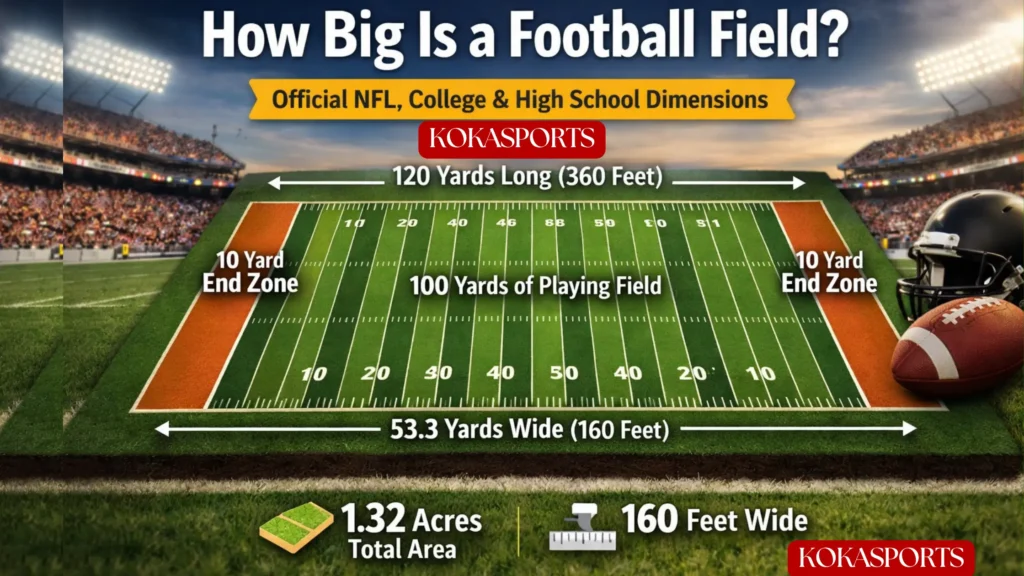
The American football field is a precisely measured space where every yard, foot, and marking serves a specific purpose.
The playing field itself measures 100 yards long between the two goal lines. Each end zone adds an additional 10 yards deep on either end. This brings the total to 120 yards when you include both scoring areas.
The width of the field is exactly 53.3 yards, which translates to 160 feet. This specific measurement balances offensive and defensive strategies while fitting within stadium designs.
When you multiply length and width, you get a field of play that covers 57,600 square feet, or about 1.32 acres of carefully maintained turf.
Read Also: What is the Pocket in Football?
Football Field Dimensions (Length, Width, and Total Area)
Here’s a complete breakdown of every measurement that makes up a regulation football field:
| Measurement | Yards | Feet |
|---|---|---|
| Total Length (including end zones) | 120 yards | 360 feet |
| Playing Field Length (goal line to goal line) | 100 yards | 300 feet |
| Field Width | 53.3 yards | 160 feet wide |
| Each End Zone Depth | 10 yards | 30 feet |
| Total Area | — | 57,600 sq ft (1.32 acres) |
How Long Is a Football Field in Yards and Feet?
A football field measures 100 yards long from goal line to goal line. This is the playing field where all offensive and defensive action takes place.
When you include both end zones, the total length extends to 120 yards. Each end zone adds 10 yards of depth behind the goal line.
In feet, these measurements translate to:
- Playing field: 300 feet (100 yards)
- Each end zone: 30 feet (10 yards)
- Total field: 360 feet long (120 yards)
The length of a football field is divided by white yard lines that appear every five yards, creating clear visual markers for players, coaches, and officials to track progress.
How Wide Is a Football Field? (53.3 Yards Wide Explained)
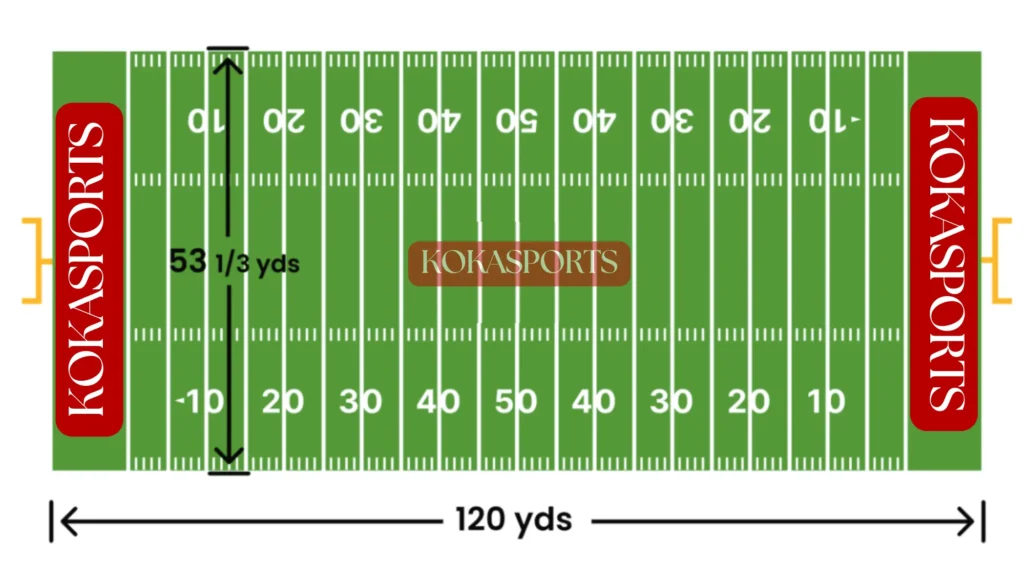
The width of a football field is exactly 53.3 yards, which equals 160 feet wide. This measurement is consistent across all levels of play, from youth leagues to the NFL.
Why the seemingly odd number? The 160 feet width is actually a round number that makes construction and measurement easier. When converted to yards (160 ÷ 3 = 53.333…), you get 53.3 yards wide.
This width measurement runs from sideline to sideline and remains constant for the entire length of the field, creating a perfect rectangular field. The field from sideline to sideline provides enough space for offensive formations while allowing defensive players to cover the full width.
Key facts about field width:
- 53.3 yards = 160 feet exactly
- Same width for NFL, college football, and high school football
- Provides balanced space for offensive and defensive strategies
- Creates the iconic football field is 53.3 yards measurement
How Big Is the Playing Field on a Football Field?
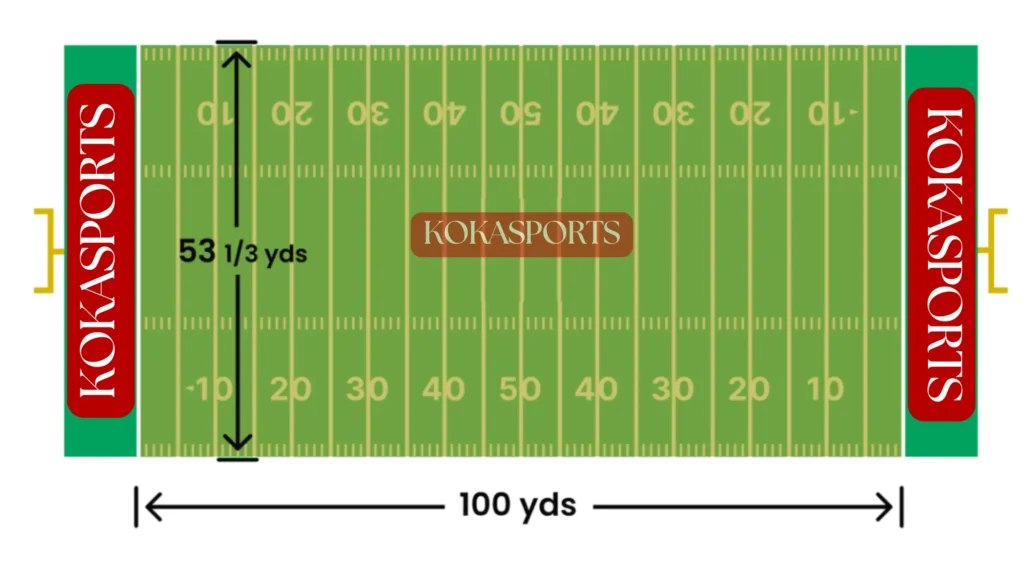
The playing field refers specifically to the 100 yards of space between the two goal lines. This is where teams line up for offensive and defensive plays during football games.
The field is divided into twenty sections, with yard lines every five yards clearly marked across the entire width. These white lines help everyone track progress down the field.
At the middle of the field, you’ll find the 50-yard line, which serves as the dividing point between the two halves. From there, the numbers count down toward each goal line:
- 40-yard line
- 30-yard line
- 20-yard line
- 10-yard line
Every single yard line is exactly 6 feet wide and stretches from sideline to sideline. This makes them easy to see from anywhere in the stadium.
The field of play covers exactly 48,000 square feet (not including end zones). When teams run the length of the playing field, they traverse 100 yards of carefully measured and maintained turf.
End Zones on a Football Field: Size, Purpose, and Strategy
Each end zone represents the ultimate destination for offensive players. These rectangular areas at either side of the field measure exactly 10 yards deep and span the full width of the field.
End Zone Dimensions
The end zones on a football field are painted in team colors and display the team name or logo, making them visually distinct from the rest of the playing field.
Key measurements:
- Depth: 10 yards deep (30 feet)
- Width: 53.3 yards (160 feet)
- Total area per end zone: 1,600 square yards
The goal line marks the boundary between the regular field of play and the end zone. When a player crosses this line with possession of the ball, a touchdown is scored. This is why you’ll often hear commentators say a team needs to get “goal line to goal line” for a scoring drive.
End Line Placement
Behind each end zone, you’ll find the end line, which marks the back boundary. If the ball crosses this line without being in a player’s possession, it results in a touchback or safety depending on which team caused it to go out of bounds.
The distance from goal line to end line is exactly 10 yards at all levels of play.
Strategic Use of End Zones
The zones on a football field aren’t just for show. A coach will design plays specifically to exploit different areas:
- The open field in the middle for crossing routes
- The corners where defensive coverage is weakest
- Quick slants to avoid sideline pressure
- Fade routes to the back corners
The 10 yards deep measurement gives receivers enough room to make catches and maintain possession before going out of bounds at the end of the field.
Hash Marks on a Football Field: Placement and Impact
One of the most misunderstood elements of field dimensions is the hash mark system. These short lines appear between each yard line and serve as reference points for ball placement.
Hash Mark Spacing by Level
The hash marks are positioned differently depending on the level of play:
NFL:
- 70 feet apart from each other
- 18.5 feet from each sideline
- Creates a tighter middle of the field
College Football:
- 40 feet apart
- 60 feet from each sideline
- Provides more wide-side space
High School Football:
- 53 feet 4 inches apart
- 60 feet from each sideline
- Widest spacing of all levels
Why Hash Mark Placement Matters
When a play ends near the sideline, officials move the ball to the nearest hash mark for the next play. In the NFL, this creates what’s called a “wide side” and a “short side” of the field.
Teams must adjust based on which hash mark the ball sits on:
- Wide side: More space for receivers to run routes
- Short side: Less room, favoring run plays or quick passes
- Middle hash: Balanced field on both sides
A coach might choose completely different plays depending on hash mark position. The set of hash marks appears every five yards down the entire length of the field, creating a grid pattern that helps everyone track position.
Field Markings Explained (Sideline, Yard Lines, Field of Play)
Every line and marking on a football field serves a specific purpose for gameplay and officiating.
Sideline Boundaries
The sideline marks the out-of-bounds area on each side of the field. Players who step on or beyond the sideline are considered out of bounds, which stops the clock in certain situations.
The sideline runs the entire length of a football field from one end line to the other – a distance of 120 yards total. Teams must be mindful of yards from the sideline when running plays, as receivers need space to complete catches while staying inbounds.
Yard Line Markings
Yard lines appear every five yards down the field, creating clear visual references. These white lines are painted 6 feet wide and run the full width from sideline to sideline.
The field numbers appear at every 10 yards, positioned on both sides of the field:
- 10-yard line
- 20-yard line
- 30-yard line
- 40-yard line
- 50-yard line (midfield)
These numbers help everyone quickly identify position on the field. When a team is at their own 20-yard line, they know they need to advance 80 yards to reach the opponent’s end zone.
Field of Play Definition
The field of play technically refers to the entire area between the sidelines and end lines, including both the 100 yards of playing field and the two end zones. This rectangular field measures 120 yards by 53.3 yards total.
All field markings must meet official standards to ensure the field qualifies as a regulation football field for competitive play.
How Big Is a Football Field Compared to Other Spaces?
To truly grasp how big is a football field, it helps to compare it to familiar things.
Real-World Size Comparisons
If you lined up 10 school buses end to end, they would roughly span the length of the field from goal line to goal line.
The 160 feet wide measurement is about the same as:
- 32 average cars parked side by side
- 2.5 standard bowling lanes
- Half a city block in most urban areas
Acreage and Square Footage
In terms of land coverage, a football field covers 1.32 acres when you include both end zones. This is:
- Larger than most residential house lots
- Smaller than a typical city block
- About 57,600 square feet total
If you wanted to run the length of a football field from one end of the field to the other, you’d cover 360 feet of distance.
Football Field vs Other Sports Venues
Here’s how a football field compares to other sports venues:
| Sport | Field Size | Comparison to Football |
|---|---|---|
| Soccer field | 100-130 yards long, 50-100 yards wide | Much less standardized |
| Baseball | 400 feet to center field | Slightly longer than football |
| Basketball court | 94 feet long | Almost 4 courts would fit |
| Tennis court | 78 feet long | Almost 5 courts would fit lengthwise |
The standard American football field is much more consistent in size compared to a soccer field, which can vary dramatically between venues.
Football Field Dimensions by Level (NFL, College, High School)
While the basic football field dimensions remain consistent across levels, some key differences exist that affect gameplay.
NFL Field Specifications
In NFL football, the hash marks are positioned closest together. This creates a more condensed middle of the field for offenses to attack.
NFL specifications:
- Hash marks: 18.5 feet from each sideline (70 feet between marks)
- Field length: 100 yards long plus 10 yards per end zone
- Field width: 53.3 yards wide (160 feet wide)
- Total: football field is 120 yards by 53.3 yards
The tight hash mark spacing in pro football favors defenses by limiting the amount of open field available on the wide side.
College Football Field Specifications
College football fields spread the hash marks wider at 40 feet apart. This gives offenses more room on the wide side of the field.
The wider hash mark placement means:
- More space for receivers on the wide side
- Different play-calling strategies
- Easier outside runs to the wide side
- More yards from the sideline to work with
Otherwise, college football maintains the same basic dimensions: 100 yards between goal lines and 53.3 yards in width.
High School Football Field Specifications
At the high school level, fields follow college football hash mark spacing in most states. High school football fields use the widest hash mark placement, giving young players more room to operate.
High school football specifications:
- Hash marks: 53 feet 4 inches apart (60 feet from sideline)
- Field length: 100 yards plus two 10 yards deep end zones
- Field width: 53.3 yards
- Total area: 1.32 acres
Some youth leagues may use slightly smaller fields for younger players, but official high school football maintains the same 100 yards yards in length and 53.3 yards yards in width as higher levels.
What Stays the Same Across All Levels
Regardless of level, these fundamental measurements remain constant:
- Field is 100 yards long between goal lines
- Field width: 53.3 yards wide (160 feet)
- Each end zone: 10 yards deep
- Total length: 120 yards (360 feet)
- Total area: 1.32 acres
- The field is a rectangle with precise dimensions
The dimensions of the football field create a consistent playing surface whether you’re watching high school level games or professional NFL matchups.
Football Stadiums and Official Field Requirements
Modern football stadiums are architectural marvels built precisely around the field dimensions. Designers must account not just for the football field itself but also for buffer zones, team benches, and safety areas.
Stadium Layout Requirements
Most professional stadiums place team benches about 6 feet from the sideline, with additional buffer space before reaching the stadium seating.
Additional space requirements in football stadiums:
- Camera wells behind end zones
- Player tunnels at field level
- Referee staging areas
- Equipment storage near sidelines
The paint and maintenance equipment used follows strict guidelines. Ground crews paint fresh lines before football games, ensuring the white yard lines and hash marks remain crisp and visible.
What Makes a Field Official?
An official field must meet strict requirements set by governing bodies. For the NFL, the league has specific standards. College football follows NCAA regulations. High school football typically follows state athletic association rules.
Every regulation football field must include:
- White yard lines every five yards across the field
- Numbered field numbers at every 10 yards
- Hash marks at the proper spacing for that level
- Two end zones each 10 yards deep
- Goal line markings at each end
- End line markings at the back of each end zone
- Sideline boundaries the full length of a football field
Indoor vs Outdoor Stadiums
Whether indoors or outdoors, every standard football field maintains identical measurements. Indoor facilities may use artificial turf instead of grass, but the dimensions stay exactly the same:
- 360 feet in yards in length
- 160 feet in yards in width
- Same hash mark placement
- Same end zone depth
This consistency is crucial for player safety and fair competition. The field is a rectangle with the exact same measurements regardless of stadium type.
Field Goal Posts
The field goal posts sit at the back of each end zone, mounted on the end line. These posts consist of two vertical poles 18 feet 6 inches apart with a crossbar 10 feet above the ground.
When a kicker attempts a field goal, the distance is measured from where the ball is snapped all the way through the end zone to the posts. This means a field goal attempt from the 50-yard line is actually about 67 yards total.
Conclusion
A football field is exactly 120 yards long and 53.3 yards wide. These official field dimensions create a perfectly balanced field of play used from high school to the NFL.
The playing field measures 100 yards long goal line to goal line, with each end zone adding 10 yards. This creates a rectangular field that covers 1.32 acres and measures 360 feet long by 160 feet wide.
Whether you’re watching football games at any level, these measurements remain constant, ensuring fair play and consistent strategy across the field.
FAQs
How many yards wide is a football field?
A football field is 53.3 yards wide from sideline to sideline at all levels of play.
How many feet wide is a football field?
A football field is 160 feet wide, which equals 53.3 yards.
How many acres is a football field?
A football field covers 1.32 acres including both end zones.
Are NFL and college football fields the same size?
Yes, both are 100 yards long, 53.3 yards wide, with 10-yard end zones, but hash marks are spaced differently.
How long is a football field including end zones?
A football field is 120 yards long (or 360 feet) including both end zones.
Why do coaches care about field dimensions?
Field dimensions affect play design, spacing, field position, and game strategy.