
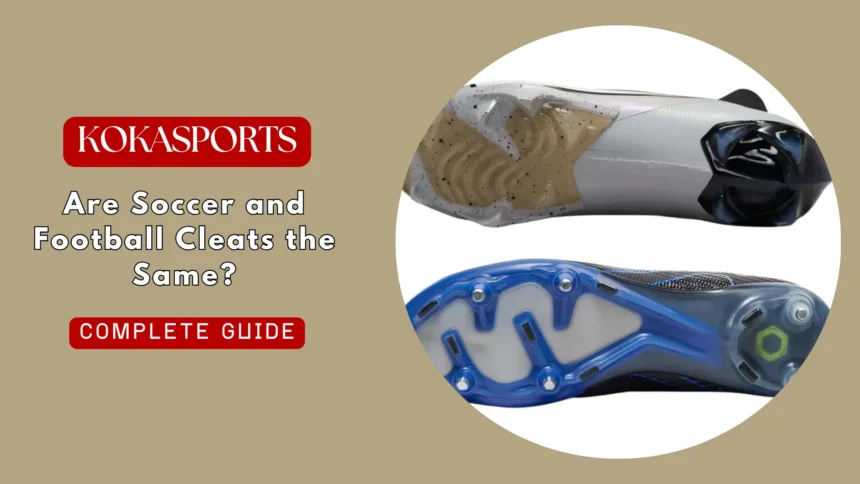
Are soccer and football cleats the same? The short answer is no and the difference between soccer and football cleat design goes much deeper than most people expect. At first glance, cleats may look similar across sports. They both have spikes on the bottom, they both lace up, and they both sit low on the foot.
But once you dig into the details, these two types of footwear are built for very different purposes. Wearing the wrong cleat for your sport can hurt your performance, increase your injury risk, and even get you kicked off the field by a referee. Whether you are a parent buying your child’s first pair of cleats, a multi-sport athlete trying to save money, or a coach advising your team, this guide breaks everything down for you in plain, simple terms.
What Is a Cleat and Why Does It Matter?
A cleat is a sports shoe with small protrusions called studs or spikes on the bottom of the outsole. These studs grip the ground and give athletes the traction they need to run, cut, and change direction quickly without slipping. On natural grass or turf, traction is everything. Without it, athletes slide, lose balance, and get injured.
Cleats are designed specifically for the movement patterns of each sport. A soccer player sprints constantly for 90 minutes, dribbles a ball with their feet, and makes sharp cuts across a large soccer field. A football player, on the other hand, makes short explosive bursts, hits and gets hit by other players, and needs a different kind of grip and protection. Because these sports demand completely different things from footwear, the cleat built for each one is shaped around those demands.
There are different types of cleats across many sports football, soccer, baseball, lacrosse, and rugby all use their own versions. Each type of cleat is tailored to that sport’s surface, movement style, and physical demands. Choosing the right cleats for your sport is one of the most important gear decisions you can make.
Read More: How to Throw a Football: Step-by-Step Guide to Throwing a Perfect Spiral
Key Differences Between Soccer and Football Cleats
Here is a quick comparison table before we dive into each difference:
| Feature | Soccer Cleat | Football Cleat |
|---|---|---|
| Toe cleat | No | Yes |
| Ankle cut | Low only | Low, mid, high |
| Weight | Very light | Heavier |
| Midsole padding | Minimal | More cushioning |
| Upper material | Thin for ball feel | Reinforced for contact |
| Stud pattern | Evenly spread | Varied by position |
| Outsole flexibility | Flexible | Stiffer |
Now let us go through each of these key differences between soccer cleats and football cleats one by one.
1. The Toe Cleat : The Biggest Giveaway
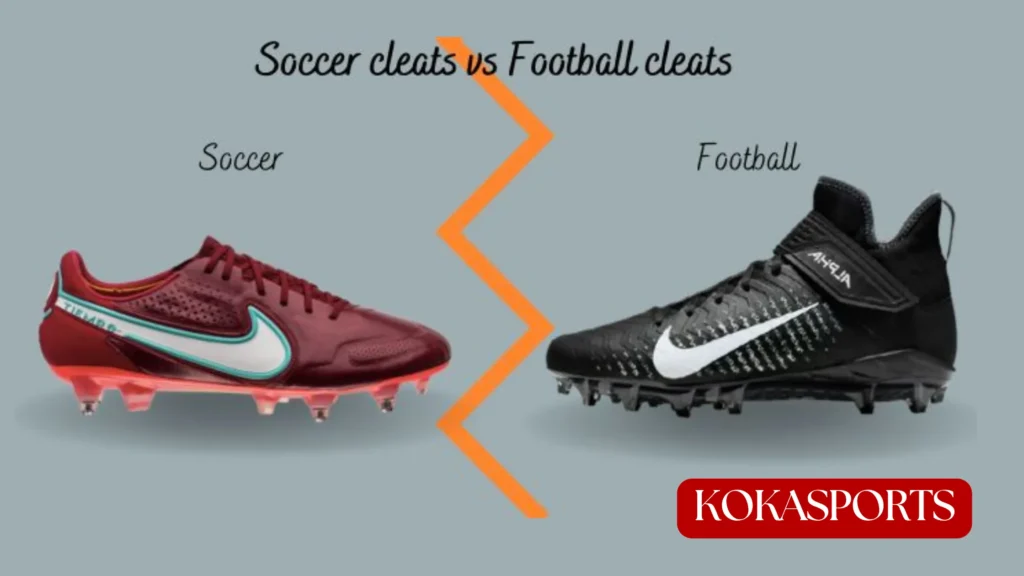
This is the single most important difference between soccer and football cleat design. Football cleats have a toe cleat an extra stud at the very front of the shoe near the big toe. This stud helps football players dig into the ground during explosive push-offs, like when a lineman fires off the line of scrimmage or a running back accelerates from a standstill.
Soccer cleats don’t have a toe cleat and that is completely intentional. In soccer, your foot is constantly in contact with the ball. A toe cleat would make ball control harder and could seriously injure another player during a tackle.
Most soccer leagues have rules that ban toe cleats. If a referee spots them during a pre-game cleat check, a player will not be allowed to compete. This single design feature is why football cleats for soccer use are generally not safe or legal in competitive play.
2. Stud Pattern and Configuration
The arrangement of studs on the bottom of a cleat affects how an athlete turns, grips, and moves. Soccer cleats feature a stud layout that is spread evenly across the entire outsole to support continuous, 360-degree movement on a large soccer pitch. Soccer cleats are designed for constant running, sharp turns, and quick lateral cuts across an open field.
Football cleats are designed with a stud pattern that supports short, explosive bursts rather than long, continuous sprints. Football demands quick stops, hard lateral cuts, and powerful push-offs. The stud configuration reflects that. Football cleats often have clustered studs near the heel and forefoot for maximum grip during those short movements. Football cleats may also vary in stud layout depending on the position linemen need different traction than wide receivers.
3. Weight Soccer Cleats Are Lighter
Soccer cleats are lighter than football cleats by a clear margin. Soccer cleats are lightweight by design because a soccer player can run anywhere from 7 to 9 miles in a single match. Every extra gram adds up over 90 minutes. Soccer cleats are usually built from thin synthetic materials or lightweight leather to keep the shoe as light as possible while still providing durability.
Football cleats are generally heavier because they include more padding, reinforced uppers, and structural support for high-impact contact. Football cleats are built for protection as much as performance. That extra weight is worth it in a contact sport but it would be a disadvantage in soccer, where speed and endurance are everything.
Fact: Elite soccer cleats can weigh as little as 5 to 7 ounces, while football cleats typically weigh 10 to 14 ounces or more.
4. Ankle Support
Football cleats come in three main cuts low, mid, and high-top each offering a different level of ankle support. High-cut football cleats wrap around the ankle to protect against the rolls and twists that happen during physical contact. Linemen and linebackers often prefer high-cut or mid-cut options. Skill position players like wide receivers sometimes prefer low-cut for speed.
Soccer cleats are usually low-cut across the board. A soccer player needs full ankle mobility to kick the ball, pass with precision, and move quickly in every direction. Restricting the ankle in soccer would limit performance. This is one reason why football cleats for soccer use feel bulky and awkward the extra ankle support works against the mobility that soccer requires.
5. Midsole Cushioning and Upper Construction
Football cleats offer more midsole cushioning to protect players from the physical pounding of a contact sport. Football players need that cushioning because they are absorbing hits from other players throughout the game. Soccer cleats prioritize a low-profile midsole so the player can feel the ground beneath them this is called “ground feel,” and it improves ball control and touch.
When it comes to the upper the part of the shoe that wraps around your foot the difference is just as clear. Soccer cleats feature a thin upper made from kangaroo leather, synthetic mesh, or knit material. The goal is to give the soccer player as much sensation and touch on the ball as possible. Football cleats are built with a thicker, reinforced upper to handle the wear and tear of a contact sport where players are blocking, tackling, and taking impact every play.
Are Soccer and Football Cleats the Same?
This question comes up a lot, especially at the youth level. The honest answer: it depends on the situation.
When it might be okay:
- Flag football leagues where contact is minimal
- Casual recreational games
- Speed positions like wide receivers who prioritize quickness over protection
When it is a problem:
- Tackle football at any competitive level
- Positions like linemen or linebackers that involve heavy contact
- Leagues that require specific football footwear
The main drawbacks when you wear soccer cleats in football are the lack of ankle support and the missing toe cleat, which reduces traction on explosive starts. Football players need a cleat that can handle contact and a soccer shoe is simply not built for that.
Can You Wear Football Cleats for Soccer?
You can, but you probably should not and in competitive play, you may not be allowed to. Here is why:
- The toe cleat is the biggest problem. Most youth and adult soccer leagues have rules that say cleats are not allowed if they include a toe spike. Referees check cleats before matches, and players caught with illegal footwear are sent off to change or sit out.
- Football cleats are heavier, which adds fatigue over a long soccer game.
- The thicker upper reduces ball feel, making passing and shooting less precise.
- The stud layout is not optimized for the constant movement patterns of a soccer match.
The only acceptable scenario for wearing football cleats in soccer is a completely casual, unorganized backyard game with no referee and no rules. Even then, the performance trade-offs make it a poor choice.
Soccer Cleats vs Football Cleats for Flag Football
Flag football sits between the two sports when it comes to cleat selection. Since there is no tackling, the need for heavy ankle support and padding drops significantly. Soccer cleats work well for flag football in most situations because the game focuses on running routes, quick cuts, and open-field speed all things soccer cleats handle well.
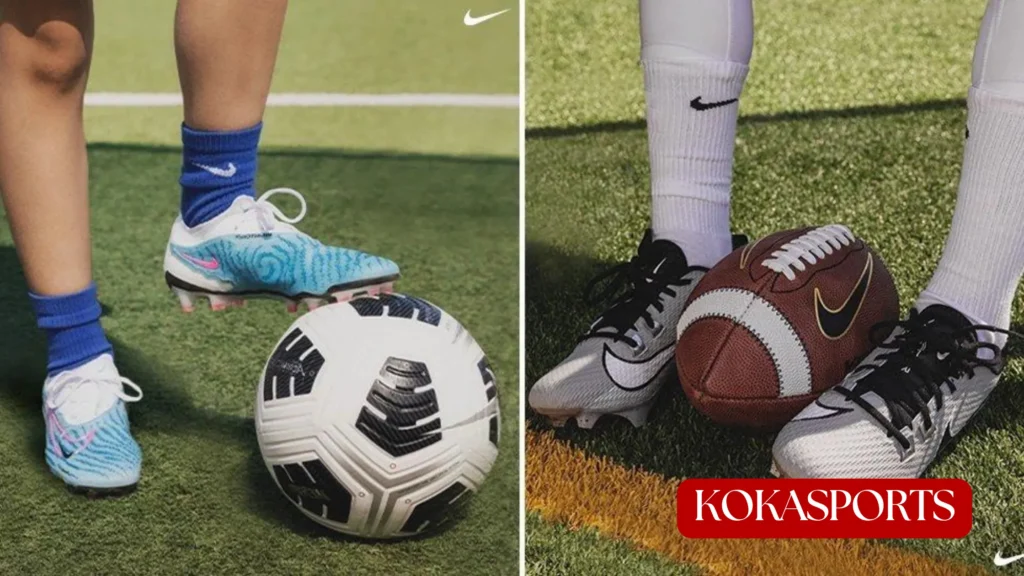
That said, football cleats offer better grip for linemen-style positions even in flag football, and some players simply prefer the feel of a low-cut football cleat. Either choice works just check your league rules before buying.
What About Lacrosse Cleats?
Lacrosse cleats are closer to football cleats in design. They often include a toe cleat, reinforced ankle support options, and a stiffer outsole. This means lacrosse cleats are not legal for competitive soccer in most cases, for the same reason football cleats aren’t. However, soccer cleats can often be used in recreational lacrosse leagues since they provide good traction without the toe cleat safety risk.
How to Choose the Right Cleat for Your Sport
Choosing the right cleats for your sport comes down to five simple steps:
- Identify your sport. Soccer players need lightweight, low-cut cleats without a toe spike. Football players need ankle support and position-specific stud patterns.
- Know your surface. Natural grass, artificial turf, and soft ground all require different stud types.
- Know your position. Understanding these differences by position helps you match features to your actual needs.
- Check your league rules. Always confirm which cleats your league allows before buying a right pair of cleats.
- Factor in fit and budget. A cleat that fits perfectly and costs $50 will serve you better than an expensive cleat that rubs and blisters.
Conclusion
The key differences between soccer and football cleat design come down to the toe cleat, ankle support, weight, stud pattern, and upper construction. Soccer vs football cleat design reflects two very different sports with very different demands. Soccer cleats are lightweight, low-cut, and built for continuous movement and ball touch. Football cleats are heavier, better padded, and built for explosive contact.
Learn the key differences before your next purchase. The right cleat keeps you safe, keeps you legal, and gives you every performance advantage your sport demands. Football and soccer cleats may look alike on a shelf but on the field, they are built for completely different games.
FAQs
Can you use the same cleats for football and soccer?
No soccer and football cleats have different stud patterns, weight, and ankle support, making them sport-specific.
Can soccer cleats be used for football youth?
Yes, most youth football leagues allow soccer cleats, but they lack ankle support and the toe cleat needed for full protection.
What is the difference between a football cleat and a soccer cleat?
The biggest difference is the toe cleat football cleats have one for traction, while soccer cleats don’t for safety and ball control.
What are soccer cleats called?
Soccer cleats are also called football boots in most countries outside the United States.