

High school football games are a beloved tradition, bringing together communities for an exciting evening of competition. Whether you’re a parent, a student, or a local fan, one of the most common questions is: How long is a high school football game?
In this guide, we’ll break down the exact length of a high school game, the NFHS rules that govern the clock, and how these games compare to the NFL and College levels.
The Short Answer: Average Game Duration
A typical high school football game lasts between 2 and 2.5 hours from kickoff to the final whistle. While the official game clock consists of four 12-minute quarters (48 minutes total), the actual duration is extended by halftime, timeouts, penalties, and other stoppages.+1
Official Timing Breakdown (NFHS Rules)
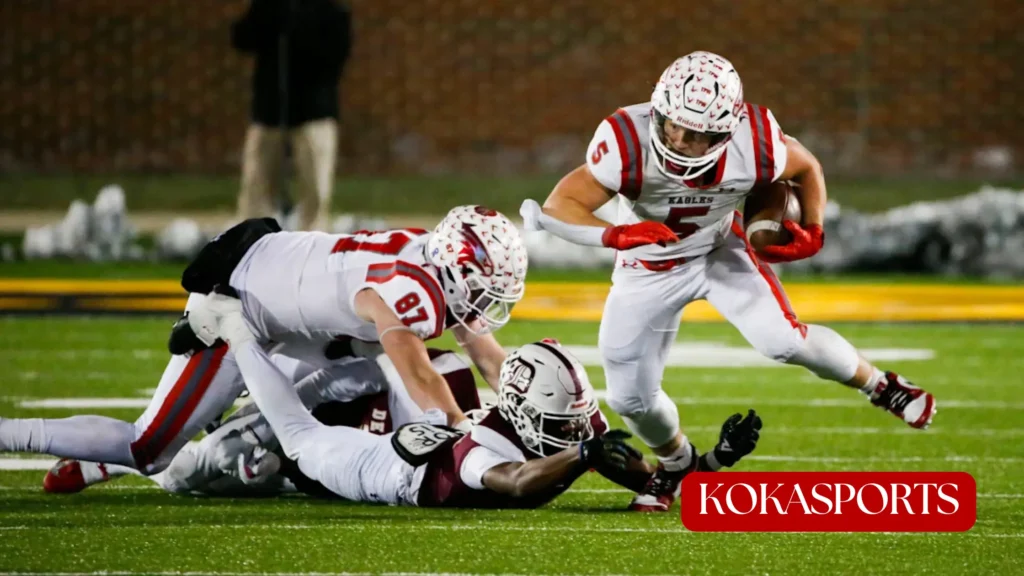
Most high schools in the U.S. follow the official NFHS Football Rules. For the 2026 season, these timing standards ensure a balanced pace of play:
1. The Four Quarters
High school games are divided into four quarters, each lasting 12 minutes. This is shorter than the 15-minute quarters used in college and the NFL.
2. Halftime Interval
Halftime typically lasts 12 to 15 minutes. This gives teams time to regroup in the locker room and allows for community traditions such as marching band performances, cheerleading routines, or homecoming ceremonies.
3. Clock Stoppages
The clock does not run continuously. It stops for:
- Timeouts: Each team is granted a specific number of timeouts per half.
- Incomplete Passes: The clock stops until the next snap.
- Out of Bounds: If a ball carrier steps out of play.
- Change of Possession: The clock pauses while the kicking and receiving units swap.
- Penalties & Injuries: Official stoppages to manage the field or tend to players.
What Happens in Overtime?
If the score is tied at the end of regulation, high school rules move away from a traditional game clock and into a possession-based system often called the “Kansas Plan.” In high school overtime, the game clock stops entirely, and the focus shifts to field position. Each team usually gets a possession starting from the opponent’s 10 or 20-yard line (depending on your state’s association). To visualize where this happens on the gridiron, check out our complete guide to football field dimensions and markings.
Teams alternate possessions until one outscores the other. Because there is no game clock in overtime, these periods can add 15 to 30 minutes to the total duration.
High School vs College vs NFL
If you are used to watching games on Sundays, you’ll find high school games move much faster.
| Feature | High School (NFHS) | College (NCAA) | NFL |
| Quarter Length | 12 Minutes | 15 Minutes | 15 Minutes |
| Total Play Time | 48 Minutes | 60 Minutes | 60 Minutes |
| Avg. Real Duration | 2 – 2.5 Hours | 3 – 3.5 Hours | 3 – 3.5 Hours |
| Halftime | 12–15 Minutes | 20 Minutes | 12–15 Minutes |
Factors That Make a Game Last Longer
Not every game fits the 2-hour mold. Several variables can push a game toward the 3-hour mark:
- Overtime: If the score is tied at the end of regulation, teams enter overtime. Most states use a system where each team gets a possession from the opponent’s 10 or 20-yard line.
- Penalty-Heavy Games: Frequent flags for holding or offsides result in constant clock resets.
- Weather Delays: Lightning or extreme rain can lead to mandatory 30-minute delays for player safety.
- Pass-Heavy Offenses: Since incomplete passes stop the clock, a game with two “Air Raid” offenses will naturally last longer than a game between two run-heavy teams.
Final Thoughts
When planning your Friday night, expect to spend about 2 hours and 15 minutes at the stadium. This gives you plenty of time to enjoy the concession stand, watch the halftime show, and cheer on your local team.
Frequently Asked Questions
How long is halftime in high school football?
Standard halftime is 12 minutes, though it can be extended to 15 or 20 minutes for special events like Homecoming.
Why is a high school game shorter than an NFL game?
High school games have 12-minute quarters (vs 15 in the NFL) and significantly fewer commercial breaks, which are a major factor in NFL game length.
Does the clock run after a first down?
Under NFHS rules, the clock usually continues to run after a first down is gained, unlike in college football (where it stops briefly to set the chains).