
The 4-3 defense stands as one of the most popular and effective defensive formations in football history. This proven system features four defensive linemen and three linebackers working together to stop the offense. Coaches at every level from youth leagues to the NFL trust this formation because it creates a balanced approach against both running and passing attacks.
What Is the 4-3 Defense in Football?
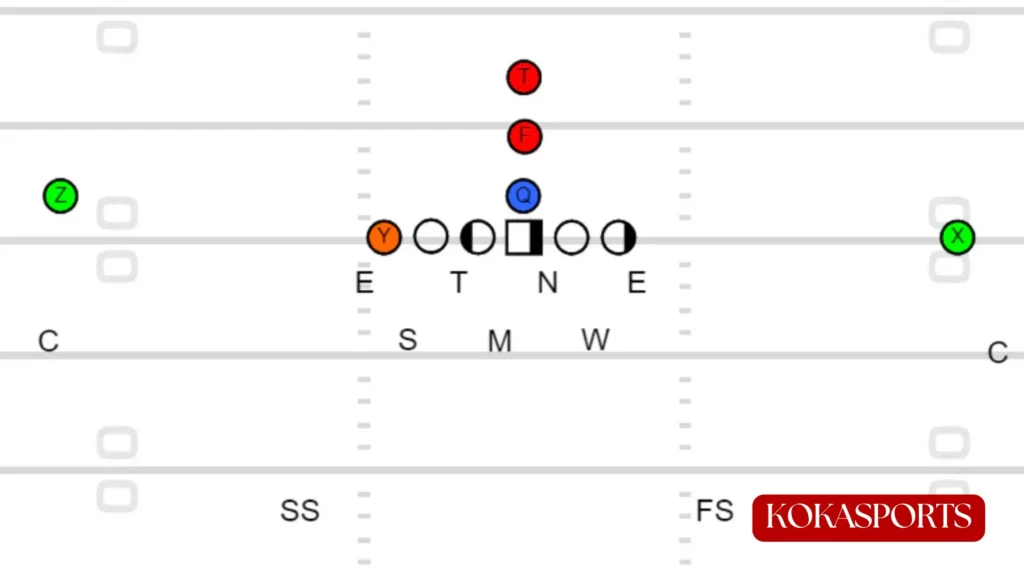
The 4-3 defense is a defensive formation that positions four players on the defensive line and three linebackers behind them. This seven-man front creates a powerful wall against offensive attacks while maintaining speed and flexibility in coverage. The remaining four players form the secondary, typically including two cornerbacks and two safeties.
The basic alignment looks like this:
Front Seven:
- Two defensive ends (positioned on the outside)
- Two defensive tackles (positioned in the middle)
- One middle linebacker (positioned in the center)
- Two outside linebackers (positioned on each side)
Secondary:
- Two cornerbacks (covering wide receivers)
- Two safeties (providing deep coverage help)
This defensive formation gives teams excellent balance. The four down linemen can rush the quarterback without bringing extra blitzers. Meanwhile, the three linebackers have freedom to read plays, fill gaps against the run, and drop into pass coverage. Teams running this scheme typically look for athletic defensive linemen who can win one-on-one battles against offensive linemen.
4-3 Defense History: Evolution of the Formation System
The 4-3 defense emerged in the 1950s when NFL teams began moving away from the old 5-2 defense. Coach Tom Landry, working with the New York Giants, helped pioneer this new approach. He recognized that offenses were becoming more sophisticated, so defenses needed more speed and versatility.
During the 1960s and 1970s, the Dallas Cowboys perfected the 4-3 defensive scheme under Landry’s guidance. His “Flex Defense” became famous for its gap discipline and assignment football. Other successful programs quickly adopted similar principles, and the formation spread throughout professional and college football.
Key moments in 4-3 defense history:
| Year | Development | Impact |
|---|---|---|
| 1954 | Tom Landry introduces early 4-3 concepts | Provides blueprint for modern defense |
| 1970s | “Steel Curtain” Steelers dominate with 4-3 | Proves system works at highest level |
| 1980s-1990s | Jimmy Johnson’s Miami 4-3 produces NFL talent | System becomes college standard |
| 2000s | Tampa 2 variation gains popularity | Shows scheme can evolve with game |
The formation proved adaptable through decades of offensive innovation. Whether facing wishbone running attacks in the 1970s or spread passing games in the 2000s, coaches found ways to adjust their 4-3 defensive formation to match the challenge.
4-3 Defense Formation: Basic Structure and Alignment
The 4-3 defense starts with a foundation built on gap control and assignment football. Each defender has specific responsibilities that work together like pieces of a puzzle. When everyone executes their job correctly, the defense becomes nearly impossible to run against and difficult to pass against.
The front four creates natural pressure on the quarterback while occupying offensive linemen. This allows the linebackers to flow freely to the football. The three linebackers serve as the defense’s quarterbacks, making calls and adjusting to offensive formations. They need to be smart, tough, and athletic enough to cover ground sideline to sideline.
Behind them, the secondary provides the last line of defense. These four players must prevent big plays while supporting against the run when needed. The two safeties particularly need range and instincts to cover large areas of the field.
The 4-3 Defensive Line Explained
The defensive line in this system carries enormous responsibility. Unlike three-man fronts where linemen mainly eat blocks, these four players must penetrate, create pressure, and make plays. Each position requires different skills and techniques.
Defensive End Responsibilities:
- Contain the edge on running plays
- Rush the quarterback on passing downs
- Set the edge to force runs inside
- Must have speed, strength, and technique
Defensive Tackle Roles:
- Control interior gaps (A and B gaps)
- Push pocket into quarterback’s face
- Shed blocks to make tackles
- Need power, quickness, and stamina
The techniques used by linemen vary based on alignment. A 3-technique defensive tackle aligns on the outside shoulder of the guard, while a 1-technique lines up on the center’s shoulder. These alignments create different gap responsibilities and blocking scenarios. Most 4-3 defensive formations use a 3-technique on the strong side and either a 1-technique or another 3-technique on the weak side.
The four-man rush creates natural advantages. Offensive lines must account for each rusher, leaving fewer bodies to help in protection. This allows talented pass rushers to win one-on-one matchups without bringing extra blitzers from the secondary level.
4-3 Defense Linebackers: Roles and Alignment
The three linebackers form the heart of the 4-3 defense. These players need intelligence, toughness, and versatility. They must diagnose plays quickly, shed blocks from bigger players, and have enough speed to run with tight ends and running backs in coverage.
Middle Linebacker (MIKE):
- Makes defensive calls and adjustments
- Keys the offense’s backfield action
- Fills inside gaps against runs
- Covers middle zones in pass coverage
- Needs to be tough, smart, and instinctive
Strong Side Outside Linebacker (SAM):
- Aligns toward the tight end side
- Has more run responsibility than WILL
- Often covers tight ends in man coverage
- Must be physical enough to take on blocks
- Requires strength and decent coverage skills
Weak Side Outside Linebacker (WILL):
- Plays on the side away from tight end
- Fastest linebacker in most schemes
- Often chases plays from backside
- Drops into coverage more frequently
- Needs elite speed and range
These three players must work as a coordinated unit. The middle linebacker serves as the quarterback of the defense, making pre-snap adjustments and directing traffic. The outside linebackers take their cues from the MIKE and adjust their positions based on offensive formations.
Good linebacker play separates average defenses from great ones. Teams that can find three athletic, intelligent players for these spots typically have success with the 4-3 defensive scheme. Without solid linebacker play, even the best defensive line will struggle.
Read More: Cover 4 Defense: Complete Guide to Cover 4 in Football
4-3 Defense Positions: Key Roles and Responsibilities
Success in the 4-3 defense requires the right players in the right positions. Each spot demands specific physical tools and mental attributes. Coaches must evaluate their roster carefully when installing this system.
Defensive Linemen Responsibilities
The four defensive linemen must create havoc in the backfield. Their primary jobs include stopping the run, rushing the passer, and occupying blockers to free up linebackers. Each position requires slightly different skill sets.
Strong Side Defensive End:
- Usually lines up over the tight end
- Sets the edge on strong side runs
- Must have power to fight through blocks
- Often faces double teams from tackle and tight end
Weak Side Defensive End:
- Primary pass rusher in most schemes
- Has more freedom to attack upfield
- Needs elite speed and bend around edge
- Often the defense’s best pass rusher
Defensive Tackles:
- Control interior running lanes
- Push pocket in quarterback’s face
- Must play with leverage and pad level
- Require combination of power and quickness
Teams need at least one dominant pass rusher on the edge. The defensive end position becomes crucial in today’s passing-heavy game. Without consistent pressure from the front four, the secondary faces difficult coverage situations.
Linebacker Roles and Reads
Linebackers in the 4-3 defense must read their keys quickly and react without hesitation. Each linebacker has specific pre-snap keys that tell them where the play is going.
Common Linebacker Keys:
| Linebacker | Primary Key | Secondary Key | Action |
|---|---|---|---|
| MIKE | Running Back | Offensive Line | Fill inside gaps |
| SAM | Tight End | Near Guard | Attack strong side |
| WILL | Offensive Tackle | Far Guard | Flow backside |
The middle linebacker typically reads the guards’ movement to diagnose run or pass. When guards pull or fire out, it signals run action in that direction. When they drop back in pass protection, the linebacker flows to his coverage responsibility.
Outside linebackers must recognize formations and adjust accordingly. Against multiple tight end sets, the SAM might move closer to the line. Against trips formations, the WILL might widen to match the offense’s spread look. This flexibility makes the 4-3 defensive formation effective against various offensive styles.
Coverage Concepts in the 4-3 Defensive Scheme
The 4-3 defense works effectively with multiple coverage schemes behind it. Coaches can mix coverages to keep offenses guessing while maintaining the same front seven alignment. This versatility gives defensive coordinators many options when calling plays.
Zone Coverage in a 4-3 Defensive Scheme
Zone coverage asks defenders to protect specific areas of the field rather than following individual receivers. This approach fits naturally with the 4-3 defensive scheme because the three linebackers provide excellent depth in underneath zones.
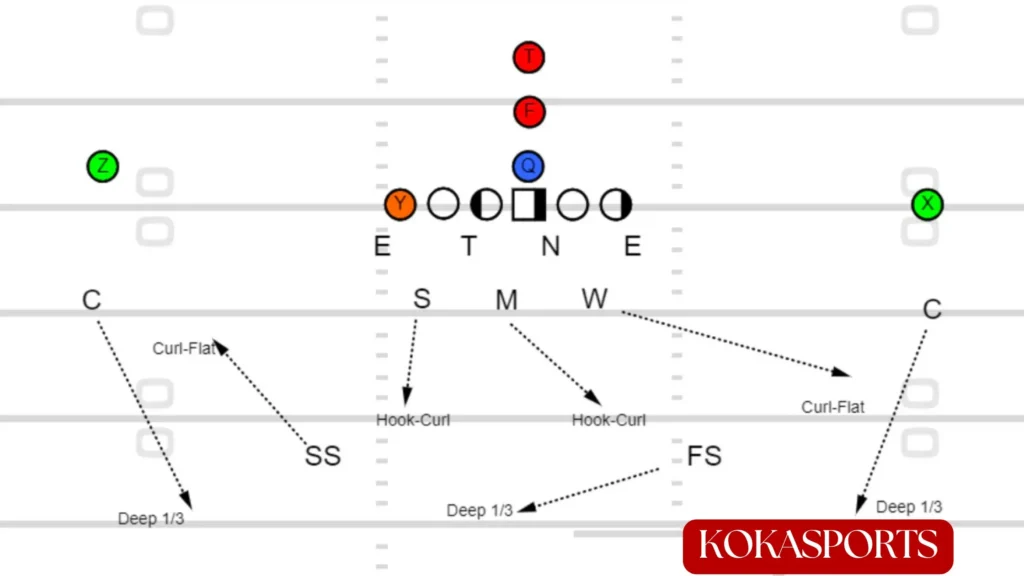
Cover 3 Principles:
- Three deep defenders (two corners, one safety)
- Four underneath defenders (three linebackers, one safety)
- Excellent against vertical passing attacks
- Vulnerable to crossing routes and floods
Cover 2 Principles:
- Two deep safeties splitting the field in half
- Five underneath defenders (three linebackers, two corners)
- Strong against deep passes
- Can struggle with routes in the seams
Cover 4 Principles:
- Four deep defenders (two corners, two safeties)
- Three underneath defenders (all three linebackers)
- Protects against big plays
- Leaves underneath routes more open
The beauty of zone coverage in the 4-3 defense comes from how quickly defenses can rotate into different looks. From the same pre-snap alignment, the defense might show Cover 2 but rotate to Cover 3 after the snap. This disguise creates confusion for quarterbacks trying to read the defense.
Many successful NFL defenses built their reputation on zone coverage behind a 4-3 front. The Tampa Bay Buccaneers of the early 2000s won a Super Bowl running “Cover 2” behind their four-man rush. Their speed at linebacker allowed them to cover lots of ground underneath while the safeties protected deep.
Man Coverage in the 4-3 Defense
Man coverage requires each defender to follow a specific offensive player anywhere they go. This approach works well when the defense has cornerbacks who can win one-on-one matchups against wide receivers. The 4-3 defense provides good man coverage options because the three linebackers can match up against tight ends and running backs.
Cover 1 Man Principles:
- One deep safety in center field
- Everyone else in man coverage
- Allows six-man pressure packages
- Requires athletic corners who can play alone
Cover 0 Blitz:
- No deep safety help (all defenders in man)
- Typically involves extra rushers
- High-risk, high-reward call
- Best used in obvious passing situations
Man coverage becomes particularly effective when the pass rush reaches the quarterback quickly. If the four defensive linemen can pressure the quarterback in under three seconds, even average cornerbacks can cover receivers. This synergy between pass rush and coverage defines successful defenses.
4-3 Defense Blitz Packages and Pressure Schemes

While the 4-3 defense generates natural pressure from four rushers, adding blitzers creates even more problems for offenses. Blitzing linebackers or defensive backs forces the offense to account for more potential rushers than they have blockers. Smart blitz design creates free runners who can hit the quarterback untouched.
Linebacker Blitz Concepts
The three linebackers in the 4-3 defensive formation provide excellent blitz options. They align closer to the line than in a three-man front, giving them shorter paths to the quarterback. Quick, decisive blitzers can arrive before the offensive line adjusts their protection.
Common Linebacker Blitzes:
- MIKE Blitz: Middle linebacker shoots through A or B gap
- SAM Blitz: Strong linebacker attacks from the tight end side
- WILL Blitz: Weak linebacker comes from the backside
- Double LB Blitz: Two linebackers rush while one drops into coverage
The key to successful linebacker blitzing lies in timing and disguise. Great defenses show one look pre-snap and change to something completely different at the snap. A linebacker who looks like he’s in coverage suddenly becomes a blitzer, creating confusion for the quarterback and offensive line.
Blitzing also requires the secondary to play tighter coverage. With fewer defenders dropping into zones, the remaining players must cover more ground. This trade-off between pressure and coverage becomes a chess match between offensive and defensive coordinators throughout the game.
Defensive Line Stunts and Pressure
Even without bringing extra rushers, the defensive line can create confusion with stunts and twists. These coordinated movements make offensive linemen choose who to block, often creating one-on-one situations for the defense’s best pass rushers.
Popular Stunt Packages:
- T-E Stunt: Tackle loops around end who penetrates first
- E-T Stunt: End loops inside while tackle crashes outside
- Cross Charge: Both tackles or both ends cross paths
- Games: All four linemen coordinate movements together
Stunts work best when the defense has quick, athletic linemen who can change direction smoothly. The first penetrator must occupy two blockers while his teammate loops to the created space. When executed properly, these movements leave an offensive lineman blocking air while a defender runs free to the quarterback.
4-3 Defense Variations: Under and Over Fronts
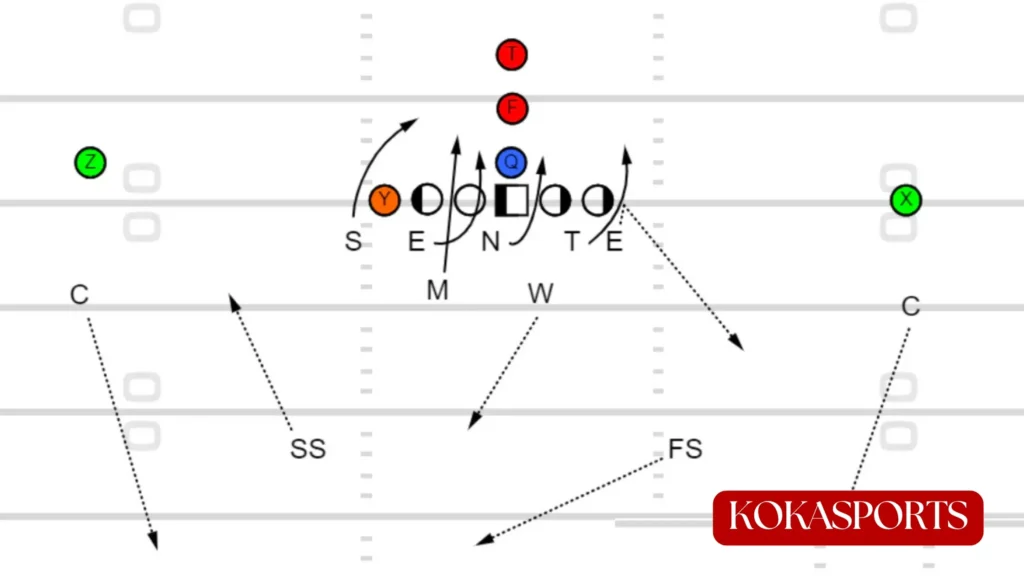
The basic 4-3 defense spawned several variations that shift strengths and create different looks. These adjustments allow defensive coordinators to match their scheme to available personnel and opponent tendencies.
The 4-3 Under Defense Explained
The 4-3 Under shifts the defensive line toward the weak side of the formation. This creates different gap responsibilities and forces the offense to adjust their blocking schemes. The “Under” front became popular because it creates natural opportunities for the weakside defensive end to rush one-on-one against the tackle.
Key Characteristics:
- Defensive tackle shades toward weak side A gap
- Three-technique tackle stays on strong side
- Weakside end in wide-nine technique (outside shoulder of tackle)
- Strong end plays more conservatively over tight end
This alignment creates interesting problems for offenses running zone blocking schemes. The weak side becomes loaded with defenders, forcing the offense to account for the shifted front. Meanwhile, the strong side has fewer defenders, but the ones present have more space to operate.
The Seattle Seahawks made the 4-3 Under famous during their Super Bowl run. Their scheme combined this front with aggressive Cover 3 coverage behind it, creating one of the most dominant defenses in recent NFL history.
The 4-3 Over Front
The 4-3 Over takes the opposite approach, shifting strength toward the tight end side. This creates a different set of matchups and gap responsibilities. Many teams prefer this alignment because it provides better support against strong-side running plays.
Key Characteristics:
- More defenders shifted toward tight end
- Creates opportunities for sam linebacker to blitz
- Strong-side end and tackle work together more
- Weak side has fewer defenders but more space
The “Over” front works particularly well against teams that run power and counter plays to the strong side. With the extra defender presence on that side, the offense faces more difficult blocking angles. The trade-off comes on the weak side, where the defense has fewer bodies to stop cutback runs.
4-3 Defense vs 3-4 Defense: Which Formation Works Best?
Coaches constantly debate whether the 4-3 defense or the 3-4 defense works better. Both systems have strengths and weaknesses, and the choice often depends on available personnel rather than philosophical preference.
Comparison Table:
| Feature | 4-3 Defense | 3-4 Defense |
|---|---|---|
| Defensive Linemen | Four | Three |
| Linebackers | Three | Four |
| Natural Pass Rush | Four rushers | Three or four rushers |
| Blitz Requirement | Less frequent | More frequent |
| Defensive End Size | 260-280 lbs | 280-300 lbs |
| Linebacker Size | 235-250 lbs | 240-260 lbs (inside) |
The 4-3 defense generates more natural pressure without blitzing. The four defensive linemen create one-on-one matchups in pass protection, allowing talented edge rushers to win their battles. This means the defense can play more zone coverage behind the rush because they don’t need to bring extra blitzers.
The 3-4 defense offers more disguise because the offense doesn’t know which linebackers will rush. However, this requires more blitzing to generate consistent pressure. Teams running the 3-4 need four quality linebackers, which can be difficult to find.
How to Run the 4-3 Defense: Installation and Execution
Installing the 4-3 defense requires careful planning and attention to detail. Coaches must teach techniques, assignments, and adjustments while building the physical and mental toughness needed to execute the system.
Installing the 4-3 Defensive Playbook
Start with basic alignment rules and gap responsibilities. Players must know where to line up against various offensive formations before learning complex adjustments. The 4-3 defensive playbook should progress from simple to complex, building confidence along the way.
Installation Steps:
- Week 1: Teach base alignment and individual techniques
- Week 2: Add basic run fits and gap responsibilities
- Week 3: Introduce simple coverage concepts (Cover 2, Cover 3)
- Week 4: Add stunts and basic blitz packages
- Week 5: Install motion adjustments and checks
- Week 6: Practice game-speed recognition and reaction
Communication becomes critical in the 4-3 defense. The middle linebacker must make calls that everyone hears and executes. Establish simple terminology that players can remember under pressure. Avoid overly complex names for plays and adjustments.
Practice should emphasize repetition of core concepts rather than installing countless plays. Teams that master ten plays run perfectly will beat teams that know fifty plays poorly. Focus on execution and assignment football above all else.
Common Mistakes When Running the 4-3 Defense
Even experienced coaches make errors when installing or adjusting their 4-3 defensive scheme. Recognizing these common pitfalls helps avoid them.
Frequent Coaching Mistakes:
- Playing Too Many Techniques: Stick to core defensive line techniques (3, 5, 9) rather than teaching everything
- Overcomplicating Coverage: Master two or three coverages before adding more options
- Neglecting Fundamentals: Proper tackling and gap discipline matter more than fancy stunts
- Mismatched Personnel: Don’t force smaller players to play defensive tackle or slower players to play linebacker
- Poor Communication: Players must hear and execute calls clearly under game pressure
The biggest mistake involves trying to do too much. The 4-3 defense works best when kept relatively simple. Teams that master basic techniques, communicate clearly, and play with effort will succeed more often than teams with complex playbooks and confused players.
4-3 Defense Strategy: Adjustments for Different Offenses
Modern offenses come in various styles, from run-heavy power attacks to spread passing games. The 4-3 defense must adjust to each approach while maintaining its core identity.
Defending Run-Heavy Offenses
Against teams that run the ball frequently, the 4-3 defense must establish gap discipline and tackle soundly. Every defender has a specific gap responsibility, and maintaining those assignments prevents big runs.
Keys to Stopping the Run:
- Defensive linemen must control their gaps and not get reached
- Linebackers flow to the ball and fill holes aggressively
- Safeties provide force support on the edges
- Everyone tackles with proper form and finishes blocks
The four-man front creates natural advantages against power running schemes. With four down linemen, the defense has enough bodies to match the offense’s tight end and two running backs. This allows linebackers to read and react without immediately facing double teams from offensive linemen.
Against zone running schemes, the defensive line must penetrate upfield and disrupt timing. Zone runs depend on horizontal and vertical stretching of the defense. Quick defensive linemen who shoot gaps force running backs to redirect and hit less desirable holes.
Defending Pass-Heavy Offenses
Spread offenses that throw frequently create different challenges for the 4-3 defense. These offenses try to force defenses into coverage conflicts by using four or five receivers. The defense must generate pressure while maintaining adequate coverage depth.
Adjustments Against Spread Offenses:
- Move to nickel or dime packages (replace linebackers with defensive backs)
- Bring more pressure to disrupt timing routes
- Play more zone coverage to avoid mismatches
- Use speed rushers on obvious passing downs
The key against passing teams involves getting pressure with four rushers. When the defensive line can collapse the pocket without blitzing, the defense can keep seven players in coverage. This makes completing passes much more difficult for the quarterback.
4-3 Defense in Youth Football: Teaching Methods
The 4-3 defense works excellently at the youth level because it provides clear, simple assignments for young players. Kids can learn their gaps and techniques without facing the complexity of multi-front defenses.
Benefits for Youth Teams:
- Simple to teach and remember
- Everyone has clear responsibilities
- Works against most youth offenses
- Builds proper technique early
- Players develop fundamental skills
Start with the absolute basics when teaching young players. Line them up correctly, teach proper stance and start, and emphasize getting to their gap. Don’t worry about sophisticated stunts or complex coverage schemes until players master basic execution.
Best Way to Teach Linebackers and Linemen
Young linebackers and linemen need patient, repetitive coaching. Break skills down into small components and drill each piece until it becomes automatic. The 4-3 defense allows coaches to focus on fundamental techniques that players will use throughout their careers.
Teaching Progression for Youth Players:
- Proper Stance: Three-point stance for linemen, two-point for linebackers
- First Step: Quick, explosive movement at the snap
- Hand Placement: Where to put hands on blocks
- Gap Responsibility: Which gap belongs to each player
- Pursuit Angles: How to chase ball carriers
- Tackling Form: Safe, effective tackling technique
Keep drills simple and repetitive. Young players learn through repetition more than explanation. Ten perfect reps of a drill beats fifty sloppy reps every time. Focus on quality over quantity in practice time.
4-3 Defense Strengths and Weaknesses: Complete Analysis
Every defensive system has advantages and disadvantages. Knowing the 4-3 defense strengths and weaknesses helps coaches maximize the scheme’s potential while minimizing its vulnerabilities.
Major Strengths:
- Natural four-man pass rush without blitzing
- Balanced approach against run and pass
- Simple assignments lead to fast play
- Works with most personnel types
- Easier to teach than complex schemes
Notable Weaknesses:
- Can struggle against heavy running formations
- Requires athletic defensive ends who can rush the passer
- Linebackers face more one-on-one situations with running backs
- Less flexibility than multiple-front defenses
- Edge players must be disciplined in containment
The 4-3 defensive formation excels when the team has four athletic down linemen who can win battles. Without quality players on the line, even perfect scheme execution struggles. This makes recruiting and developing linemen particularly important for teams running this system.
Is the 4-3 Defense Right for Your Team?
Choosing the 4-3 defense depends on your available talent and coaching philosophy. Some rosters naturally fit this scheme, while others might work better in a different system.
Questions to Ask:
- Do we have four quality defensive linemen?
- Can our ends rush the passer effectively?
- Do we have three athletic linebackers?
- Are we committed to teaching fundamental techniques?
- Does this fit our team’s overall identity?
If you answered yes to most questions, the 4-3 defense likely fits your program. However, if you have five good linebackers but only three solid linemen, a 3-4 scheme might work better. Always adjust your scheme to match available players rather than forcing players into positions where they cannot succeed.
Conclusion
The 4-3 defense remains one of football’s most reliable defensive systems. Its combination of simplicity, effectiveness, and adaptability explains why coaches continue choosing it at every level. Whether you’re installing this scheme for the first time or refining an existing system, the principles stay consistent: teach proper techniques, maintain gap discipline, communicate clearly, and play with effort on every snap.
Success in the 4-3 defensive formation comes from mastering fundamentals rather than seeking complex solutions. Teams that tackle well, maintain their assignments, and play with controlled aggression will find this scheme provides everything needed to field a championship-caliber defense. The formation’s 70-year history proves its value, and modern variations continue evolving to meet new offensive challenges.
FAQs
What is a 4-3 defense good for?
It balances stopping the run and defending the pass.
What is a 4-3 zone defense?
Four linemen and three linebackers cover specific zones rather than man-to-man.
Is 4-3 a 1-gap defense?
Yes, each defender usually controls one gap.
Which defense is better, 3-4 or 4-3?
It depends on your players; 4-3 favors speed, 3-4 favors versatility.