

What Is 21 Personnel Football?
21 personnel football is an offensive personnel grouping that puts 2 running backs, 1 tight end, and 2 wide receivers on the field alongside the quarterback and five offensive linemen. It is one of the most widely used groupings in the NFL because it creates a powerful balance between power running and versatile passing options. Defenses struggle against it because they cannot fully commit to stopping the run or the pass they have to prepare for both on every single snap.
How the Personnel Grouping System Works in Football
NFL coaches use a simple numbering system to label every offensive personnel package. This system is built on using a two-digit numerical code that identifies the type of offensive players on the field at any moment.
- The first digit = number of running backs on the field
- The second digit = number of tight ends on the field
- The remaining spots (after five offensive linemen + QB) = wide receivers
So 21 personnel = 2 RBs + 1 TE + 2 WRs. Simple, clean, and powerful.
Full NFL Personnel Grouping Chart
Here is a clean breakdown of every common offensive grouping used across American football:
| Personnel | RB | TE | WR | Best For |
|---|---|---|---|---|
| 10 personnel | 1 | 0 | 4 | Spread, fast tempo |
| 11 personnel | 1 | 1 | 3 | Balanced modern offense |
| 21 personnel | 2 | 1 | 2 | Power run + Play-action |
| 12 personnel | 1 | 2 | 2 | TE-heavy passing game |
| 22 personnel | 2 | 2 | 1 | Dominant power running |
| 13 personnel | 1 | 3 | 1 | Heavy run, goal line |
| 20 personnel | 2 | 0 | 3 | Two backs, spread look |
| 23 personnel | 2 | 3 | 0 | Goal line, short-yardage |
Every type of offensive personnel sends a message to the defense before the snap. The number of each type of skill position player on the field forces defensive coaches to decide how to line up, which defenders to play, and what coverage to run. The best NFL offenses use personnel groupings to deceive not just to tell the defense what is coming.
Read Also: What is 21 Personnel in Football? Complete Explanation
21 Personnel Football : A Full Breakdown
Who Is on the Field?
When a team lines up in a 21 personnel grouping, here is exactly who is on the field:
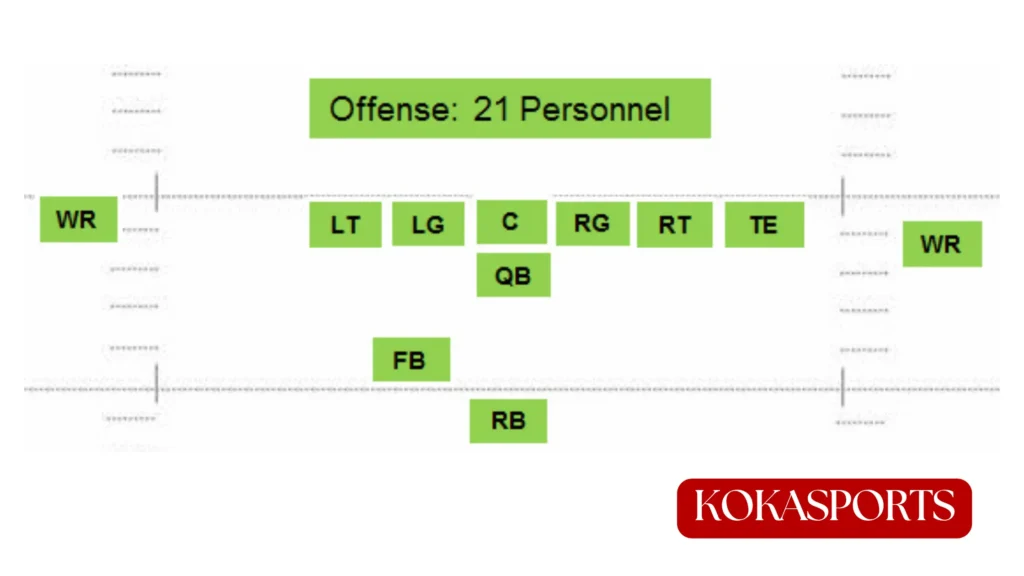
- 2 Running Backs Usually a halfback (the primary ball carrier) and a fullback (the lead blocker)
- 1 Tight End Can line up on the line of scrimmage or flex out as a receiver
- 2 Wide Receivers Split on either side of the formation
- 5 Offensive Linemen Center, two guards, two tackles
- 1 Quarterback Under center or in shotgun
This combination of running backs and tight ends alongside two wide receivers is what makes this personnel package so hard to defend. You have blockers AND receivers on the field at the same time, in the same grouping.
Why Football Coaches Love This Grouping
The reason football coaches at every level keep coming back to this grouping is simple it does not give the defense easy answers.
“The whole point of multiple personnel groupings is to make the defense wrong before the snap.” Common philosophy across NFL coaching staffs
With 2 RB in the backfield and 1 tight end on the field, the defense has to account for powerful blocking AND legitimate receiving threats. That conflict is exactly what a smart offensive coordinator wants to create on every single play.
Run Game Advantages of 21 Personnel
Why This Grouping Dominates the Run Game
When teams want to run the ball with power and consistency, this personnel package is one of the best tools available. The presence of two running backs especially when one of them is a fullback gives the offense an extra blocker at the point of attack that most other groupings simply do not have.
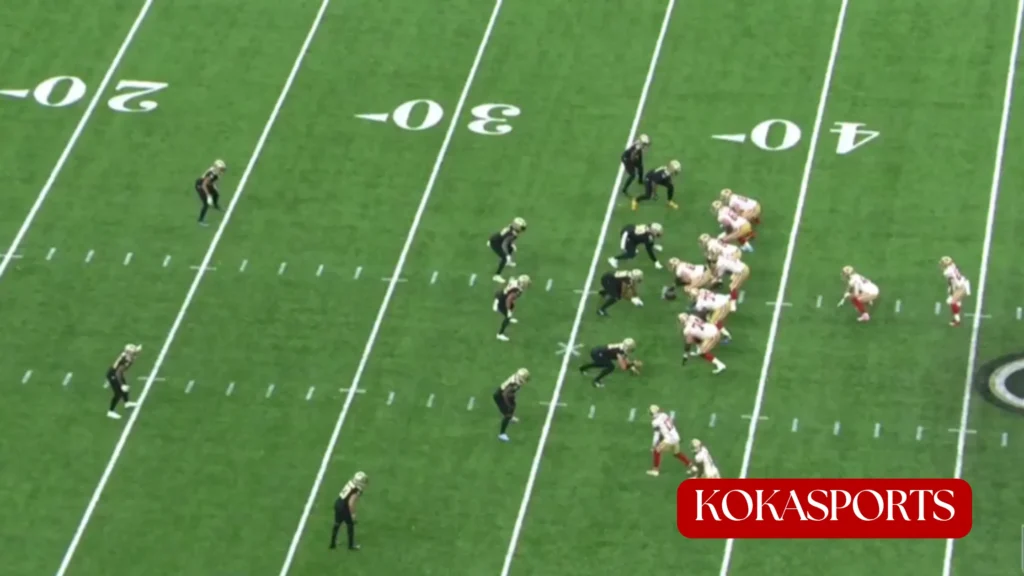
Top Run Concepts from 21 Personnel:
- Outside Zone The offensive line moves laterally, and the RB reads the blocks to find the right gap
- Power A lineman pulls, the fullback leads through the hole, and the RB follows downhill
- Counter Misdirection play where the RB steps one way before cutting the other direction
- Iso The fullback takes on the linebacker directly while the RB hits the hole hard
- Trap An interior lineman pulls to blindside a defensive tackle on an inside run
The Fullback’s Role in the Run Game
The fullback is the engine of the run play game in this grouping. He is the lead blocker on most power concepts, and his presence at the line of scrimmage forces the defense to respect the inside run on every snap. Teams that use fullbacks well like the San Francisco 49ers consistently rank among the top rushing teams in the NFL.
Short-Yardage and Goal Line
This grouping is also the go-to choice for short-yardage and goal line situations. With running backs on the field who can both block and carry the ball, and a tight end adding size at the point of attack, the offense has maximum physical presence without sacrificing all passing options.
Passing Game Advantages of 21 Personnel
Why the Pass Game Is Underrated in This Grouping
Most people assume this grouping is only for running. That assumption is exactly what makes the pass game out of 21 personnel so dangerous. Defenses load up to stop the run and then the quarterback throws over them.
Play-Action: The Biggest Weapon
Play-action passing is the most powerful tool in this offensive formation. After the offense runs the ball successfully a few times, the quarterback fakes a handoff and the defense freezes. That one moment of hesitation is all a wide receiver or tight end needs to get open.
Play action works so well here because the defense has real reason to believe it is a run. With 2 wide receivers running deep routes, the underneath and intermediate zones open up wide.
Other Key Passing Options
- Bootleg/Naked Play-Action The quarterback rolls out after a fake, with the tight end releasing into the flat as a safety valve
- Tight End Seam Routes With linebackers focused on the run, the tight end can run free up the seam
- RB Screen Passes One running back releases as a screen target while the other stays in to block
- WR Crossing Routes The two wide receivers cross underneath to stress zone coverage
The passing options available from this grouping are far more varied than most defenses are ready for. That mismatch is what makes offensive plays from 21 personnel so effective.
Why Defenses Struggle Against 21 Personnel
The Core Problem for Defensive Coordinators
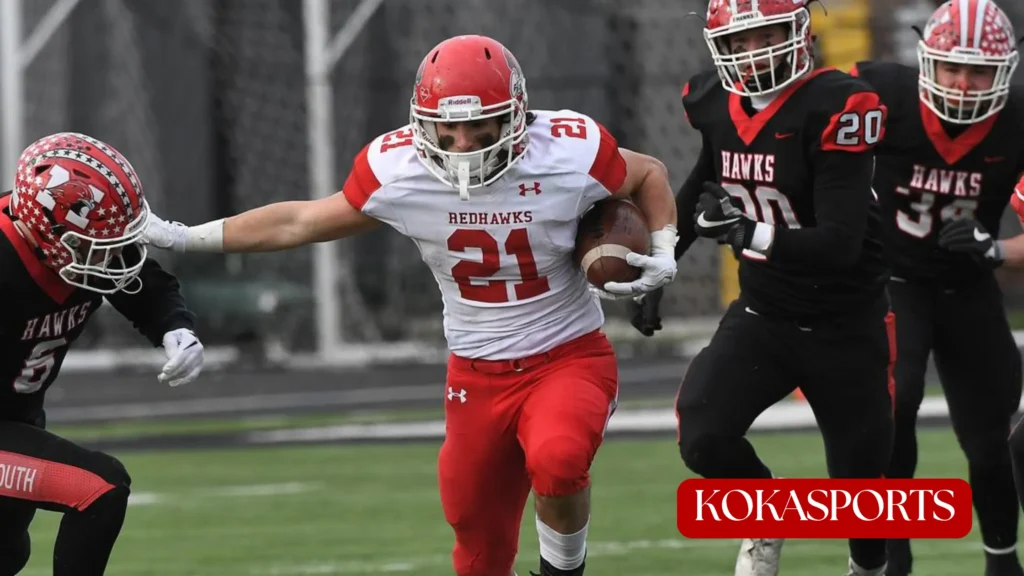
Defensive coaches face a fundamental conflict when they see this 21 personnel grouping on the field. They need enough players on the field to stop a powerful run game. But they also cannot leave receivers wide open in the pass game. They cannot fully commit either way.
The Box Count Dilemma
If the defense loads the box with extra run defenders, the quarterback can call a play-action pass and hit an open receiver over the top. If the defense spreads out to cover the WR and tight end, they give up run lanes that an extra blocker will exploit.
Linebacker Matchup Problems
One of the biggest issues for the base defense is linebacker coverage. A running back or fullback leaking out of the backfield often matches up against a linebacker in space a matchup the offense almost always wins. The tight end creates the same problem in the seam and middle of the field.
Why the Nickel Dilemma Matters
Most NFL defenses want to go to their nickel package (replacing a linebacker with a smaller defensive back) against passing formations. But against this grouping, going nickel means giving up your run stopper. That is a very uncomfortable trade-off for any defensive coordinator.
21 Personnel vs 11 Personnel
11 personnel is the most popular grouping in the modern NFL. It uses 1 RB, 1 TE, and three wide receivers on the field, which spreads the defense horizontally and creates space for the passing game. Here is how the two compare:
| Feature | 21 Personnel | 11 Personnel |
|---|---|---|
| Running backs on field | 2 | 1 |
| Wide receivers on field | 2 | 3 |
| Run strength | Very High | Moderate |
| Play-action threat | Very High | Moderate |
| Spread ability | Low-Moderate | Very High |
| Defense forced into | Base/Nickel conflict | Nickel |
| Best situation | Power run + PA pass | Passing downs |
The Key Difference: 11 personnel spreads the field with three wide receivers and is built for the modern passing game. 21 personnel compresses the formation, adds a blocker, and attacks defenses with physicality and misdirection. Both are valuable the best offenses use both.
21 Personnel vs 12 Personnel
12 personnel uses 1 RB, 2 TE, and 2 WRs. It is another power-based grouping, but it replaces the second running back with a second tight end. Here is the comparison:
| Feature | 21 Personnel | 12 Personnel |
|---|---|---|
| RBs on field | 2 | 1 |
| Tight ends on field | 1 | 2 (2 TE) |
| Lead blocker | Fullback | Second TE |
| Passing flexibility | High | High |
| Run power | Very High | High |
| Best for | Power run + play-action | TE-heavy passing + run |
The Key Difference: 21 personnel gives you a dedicated fullback as a blocker and runner. 12 personnel gives you an extra receiving tight end and more flexibility in the pass game. Teams like using 12 personnel when they want 2 TE on the field as dual receiving threats. Teams use 21 personnel when they want to physically dominate at the line of scrimmage first.
Kyle Shanahan and the 49ers Case Study
How San Francisco Built an Offense Around This Grouping
No team in recent NFL history has used this offensive personnel grouping better than the 49ers under Kyle Shanahan. His entire system is built around the outside zone run concept, and the two-back grouping is central to how it works.
What Makes Shanahan’s System Unique:
- Uses fullback Kyle Juszczyk as a multi-purpose weapon blocker, receiver, and runner all in one
- Runs the same offensive plays from multiple formations so defenders cannot read intent
- Mixes this grouping with spread formations from 11 personnel to keep defenses guessing
- Uses heavy pre-snap motion to force the defense to adjust and react before every snap
The San Francisco 49ers have proven that a 21 personnel offense can dominate in the modern NFL when the playbook is creative and the players fit the system. Their success has inspired a new generation of NFL coaches to bring the two-back grouping back into their own systems.
The Modern Revival of 21 Personnel
Why This Grouping Is Coming Back
For a while, it looked like this grouping might disappear. The rise of spread formations and the dominance of 11 personnel led many teams to abandon the fullback entirely. But the grouping is making a clear comeback.
Reasons for the Revival:
- Analytics show two-back sets produce higher yards-per-carry in specific down-and-distance situations
- Young coaches trained in the Shanahan system that identifies the type of defense to attack are spreading the philosophy
- Power running football wears defenses down physically over four quarters
- Using multiple offensive personnel packages makes an offense harder to prepare for
The best NFL teams today use a mix of personnel groupings not just one. And 21 personnel is back at the center of that conversation.
Conclusion
What does 21 personnel mean in football?
21 personnel means 2 running backs, 1 tight end, and 2 wide receivers are on the field at the same time.
Is 21 personnel a run or pass grouping?
It is both 21 personnel is designed to threaten the run and pass equally, forcing defenses into a conflict on every snap.
What is the difference between 21 and 12 personnel?
21 personnel uses 2 running backs and 1 tight end, while 12 personnel uses 1 running back and 2 tight ends.
What skill position players are most important in 21 personnel?
The fullback and tight end are the two most critical players the fullback powers the run game and the tight end unlocks the passing game.
Conclusion
21 personnel football is more than just a formation. It is a philosophy built on physical dominance, deception, and balance. It puts defenses in conflict before a single offensive player moves. It gives the quarterback real weapons in the pass game while also powering one of the most effective run games in football.
From youth leagues to the NFL, the football offensive teams that master this grouping give themselves a real competitive edge every single week. The best offenses in history have used it. And the smartest coaches in football today are bringing it back because when it is run correctly, there is simply no easy answer for the defense.